Category Archives: FDA

USA – Great American Deli Announces Product Recall Due to Possible Listeria Contamination

FDA

Great American Deli of Ooltewah, Tennessee is recalling GAD #114 Egg Salad Sandwich 4.8 oz. UPC: 7-41431-00114-2 due to possible contamination of Listeria monocytogenes, an organism which can cause serious and sometimes fatal infections in young children, frail or elderly people, and others with weakened immune systems. Although healthy individuals may suffer only short-term symptoms such as high fever, severe headache, stiffness, nausea, abdominal pain and diarrhea. Listeria infection can cause miscarriages and stillbirths among pregnant women. To date, we have not received any reports of illness related to the consumption of Egg Salad Sandwiches.

Almark Foods initiated a recall and is an ingredient supplier to one of Great American Deli’s suppliers, Knott’s Fine Foods that provides egg salad to the company.

Affected product could have been delivered in the following states through convenience stores, micro markets and vending machines: Wisconsin, Iowa, Illinois, Missouri, Kansas, Arkansas, Louisiana, Texas, Mississippi, Alabama, Florida, Tennessee, South Carolina, North Carolina, Kentucky, Virginia, West Virginia, Ohio, Indiana, Michigan and Pennsylvania.

Consumers who have purchased the affected sandwiches are urged to return them to the place of purchase for a full refund. Consumers with questions may contact the company at 1-800-343-1327 Monday – Friday 8:00 AM ET to 5:00 PM ET.

Great American Deli is taking this action out of caution for the safety of our consumers.

Affected lots: 19094, 19107, 19129, 19155, 19158, 19218, 19237, 19259, 19274, 19297, 19304, 19310, 19322, 19336.


Company Contact Information

Consumers:
 1-800-343-1327
Media:
Keith Sullivan
 423-238-5492

Product Photos

USA – Outbreak Investigation of Listeria monocytogenes Linked to Hard-Boiled Eggs, December 2019

FDA

Case Counts

Total Illnesses: 7
Illnesses in 2019: 4
Hospitalizations: 4
Deaths: 1
Last illness isolation date: November 12, 2019
States with Cases: FL (1), ME (1), PA (1), SC (2), TX (2)
States with Cases in 2019: TX (1), SC (2), FL (1)
Product Distribution*: Nationwide
*Distribution has been confirmed for states list, but at this time we believe the product was distributed nationwide. Updates will be provided as more information becomes available.

December 26, 2019

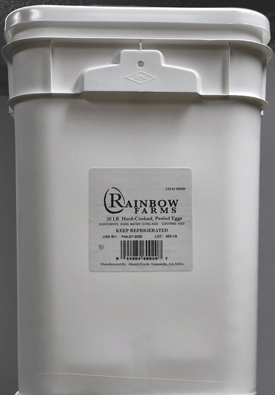
Rainbow Farms Select Hard Cooked Peeled Eggs 20 lbs container

On December 23, 2019 Almark Foods expanded its voluntary recall to include all hard-boiled eggs manufactured at its Gainesville, Georgia facility. The initial recall included bulk hard-boiled eggs in pails and now includes product packaged for sale at retail within shelf-life, which have “Best If Used By Dates” through March 2, 2020. At this time, Almark Foods is no longer producing products from this facility.

Companies who received recalled product from Almark Foods have initiated recalls of products containing these eggs. Additional companies and products may be added as the investigation continues.

Recommendation

Consumers should not eat any of the recalled products. A full list of products sold at retail is available below.

Food processors, restaurants, and retailers should not sell or serve any of the recalled hard-boiled and peeled eggs from Almark Foods. These products were sold in bulk pails to food processors, restaurants and retailers, and in retail packaging to retailers for direct-sale to consumers. The full list of products is below.

Additionally, FDA recommends that food processors, restaurants and retailers who have received  Almark Foods bulk, fresh hard-boiled eggs, use extra vigilance in cleaning and sanitizing any surfaces that may have come in contact with these products, to reduce the risk of cross-contamination.

Background

As of December 17, 2019, a total of seven people infected with the outbreak strain of Listeria monocytogenes have been reported from five states. In interviews, ill people answered questions about the foods they ate and other exposures in the month before they became ill. Of the five people for whom information was available, four reported eating products containing eggs. Three of these people reported eating hard-boiled eggs in deli salads purchased from grocery stores and in salads eaten at restaurants. Illnesses started on dates ranging from April 10, 2017 to November 12, 2019.

Additionally, based on whole-genome sequencing, the Listeria monocytogenes found in  environmental samples collected at the firm’s processing facility during FDA inspections conducted in February 2019 and December 2019 are a genetic match to the outbreak strain. Almark Foods has been cooperating with the ongoing investigation and announced an initial voluntary recall of hard-boiled and peeled eggs in pails on December 20, 2019. On December 23, 2019 Almark Foods expanded the initial recall to include all hard-boiled eggs produced at its Gainesville, Georgia facility.

This outbreak strain was found during environmental sampling in 2017 of one other food facility. That facility is not currently handling food and ceased operation in 2018.

The investigation is ongoing and additional information will be provided as it becomes available.

USA – Emesa Foods Recalls Premium Sesame Tahini Because of Possible Health Risk

FDA Photo 1, Product labeling

Emesa Foods, Taylor, MI is voluntarily recalling 23 cases and each case 6 containers of 800 gram of “Premium Sesame Tahini” because it has the potential to be contaminated with Salmonella, an organism which can cause serious and sometimes fatal infections in young children, frail or elderly people, and others with weakened immune systems. Healthy persons infected with Salmonella often experience fever, diarrhea, nausea, vomiting, and abdominal pain. In rare circumstances, infection with Salmonella can result in the organism getting into the bloodstream and producing more severe illnesses such as arterial infections (i.e., infected aneurysms), endocarditis, and arthritis.

The product was distributed in states of Michigan and Texas and is sold in 800 grams (28.2 Oz). Expiration dates (2/25/2021) are printed on the side of the container.

Product code, product description, UPC and expiration dates information:

Product Code

Product Description

UPC

Expiration Dates

29826 Premium Sesame Tahini 850005298267 02/25/2021

No illnesses have been reported to-date in connection with the Emesa Foods Tahini.

USA – Investigation of E. coli O157:H7 Outbreak Linked to Romaine from Salinas, California, November 2019

FDA

Update

December 19, 2019

FDA continues to actively investigate the cause of this outbreak. An investigation team consisting of staff from FDA, CDC, the California Department of Public Health and the California Department of Food and Agriculture are attempting to identify any factors that could have led to contamination at a common farm identified by traceback. This investigation involves assessing and sampling soil, animal droppings, compost, water, and other potential environmental sources at the ranches of this grower. The samples and information collected during the farm investigations will be analyzed.

The Wisconsin Department of Health Services recently reported that they identified the outbreak strain of E. coli O157:H7 in an unopened bag of Fresh Express brand Leafy Green Romaine collected from an ill person’s home. The source of the romaine identified in the bag was Salinas, California. It was determined that one of the growers of this product also supplied romaine linked to other E. coli outbreaks that FDA is investigating.

These outbreaks are each caused by strains that are different from each other and different from the larger outbreak. One of the additional outbreaks, in Washington state, is potentially linked to romaine lettuce. The other outbreak, with cases in the U.S. and Canada, is linked to Fresh Express Sunflower Crisp Chopped Salad Kits.

Case Counts

Total Illnesses: 138
Hospitalizations: 72
Deaths: 0
Last illness onset: December 1, 2019
States with Cases:  AZ (3), CA (4), CO (6), FL (2), IA (1), ID (3), IL (10), MD (5), MI (1), MN (5), MT (1), NE (2), NJ (9), NC (2), NM (2), OH (12), OR (1), PA (17), SC (1), SD (1), TN (1), TX (6), VA (6), WA (4), WI (33)

USA -Statement on new findings and current status of the romaine lettuce E. coli O157:H7 outbreak investigation

FDA

Today, the U.S. Food and Drug Administration is providing an update on our investigation of an outbreak of E. coli O157:H7 illnesses linked to romaine lettuce. The FDA takes our responsibility of protecting the public from unsafe food very seriously and is committed to providing the public with more information as it becomes available.

Outbreaks Reported

Early on, based on test results provided by the Maryland Department of Health, our investigation pointed to farms in Salinas, California, as potential sources of contaminated romaine lettuce based on the initial, limited number of reported illnesses. The FDA, in partnership with the California Department of Public Health and the California Department of Food and Agriculture, rapidly mobilized in November to concurrently deploy inspection teams to the farms identified through the initial traceback investigation. The on-site investigations at these farms included collecting a wide-variety of samples for lab testing, including water, soil, soil amendments, scat and swab samples. While the majority of these samples tested negative for the outbreak strain, final results are pending and the Wisconsin Department of Health Services recently reported that it had isolated E. coli O157:H7 from a particular bag of pre-washed, chopped romaine lettuce.

The FDA has also been tracking two additional and separate outbreaks of E. coli O157:H7.

Earlier this week, the FDA, U.S. Centers for Disease Control and Prevention (CDC), and the Canadian Food Inspection Agency announced an outbreak linked to Fresh Express Sunflower Crisp Chopped Salad Kits. To date, the CDC reported eight confirmed cases in the U.S. across three states associated with this cluster of illnesses.The Public Health Agency of CanadaExternal Link Disclaimer also reports 24 cases in six Canadian provinces.

Concurrently, the FDA has been working with health officials in Washington State regarding an outbreak of E. coli O157:H7 associated with romaine consumption at a local restaurant chain. Washington State officials reported 10 confirmed and three probable cases in this outbreak with all reports of exposure in early to mid-November.

It should be noted; these are currently being considered as three separate outbreaks caused by three different strains of E. coli O157:H7.

USA -Investigation of E. coli O157:H7 Outbreak Linked to Romaine from Salinas, California, November 2019

FDA

December 12, 2019

Case Counts

Total Illnesses: 102
Hospitalizations: 58
Deaths: 0
Last illness onset: November 18, 2019
States with Cases:  AZ (3), CA (4), CO (6), FL (1), IA (1), ID (3), IL (1), MD (4), MI (1), MN (3), MT (1), NE (1), NJ (7), NC (1), NM (2), OH (12), OR (1), PA (8), SD (1), TX (4), VA (4), WA (2), WI (31)

Recommendation

FDA, CDC, and state health authorities are investigating an outbreak of illnesses caused by E. coli O157:H7 in the United States. Epidemiologic, laboratory, and traceback evidence indicates that romaine lettuce from the Salinas, California growing region is a likely source of this outbreak. According to CDC, there have been 102 cases reported in 23 states.  The latest date that one of these patients reports becoming ill was on November 18, 2019.

Romaine from Salinas, California Label Enjoy By December 2, 2019


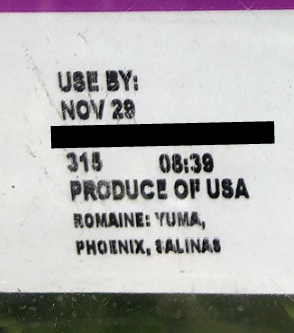
Romaine from Salinas, California Label Use By November 29, 2019

Consumers: Consumers should not eat romaine lettuce harvested from Salinas, California. Additionally, consumers should not eat products identified in the recall announced by the USDA on November 21, 2019.

Romaine lettuce may be voluntarily labeled with a harvest region. If this voluntary label indicates that the romaine lettuce was grown in “Salinas” (whether alone or with the name of another location) do not eat it. Throw it away or return it to the place of purchase.  If romaine lettuce does not have information about harvest region or does not indicate that it has been grown indoors (i.e., hydroponically- and greenhouse-grown), throw it away or return it to the place of purchase. Consumers ordering salad containing romaine at a restaurant or at a salad bar should ask the staff whether the romaine came from Salinas.  If it did, or they do not know, do not eat it.

At this time, romaine lettuce that was harvested outside of the Salinas region has not been implicated in this outbreak investigation. Hydroponically- and greenhouse-grown romaine, which is voluntarily labeled as “indoor grown,” from any region does not appear to be related to the current outbreak. There is no recommendation for consumers to avoid using romaine harvested from these other sources.

Restaurants and Retailers: Restaurants and retailers should not serve or sell romaine harvested from Salinas, California.  If you do not know the source of your romaine lettuce, and if you cannot obtain that information from your supplier, you should not serve, nor sell it.

Suppliers and Distributors: Suppliers, distributors and others in the supply chain should not ship or sell romaine harvested in Salinas, California. If the source of the romaine lettuce is unknown, you should not ship, nor sell the product.

For Restaurants, Retailers, Suppliers and Distributors: Currently, the FDA does not have enough traceback information to identify the specific source of the contamination that would allow us to request a targeted recall from specific growers.

FDA requested that industry voluntarily withdraw romaine grown in Salinas from the market and is requesting that industry withhold distribution of Salinas romaine for the remainder of the growing season in Salinas. Without more specific traceback information, this was the most efficient way to ensure that contaminated romaine was off the market.

At this time, romaine lettuce that was harvested outside of the Salinas region has not been implicated in this outbreak investigation. Hydroponically- and greenhouse-grown romaine, which is voluntarily labeled as “indoor grown,” from any region does not appear to be related to the current outbreak. There is no recommendation for consumers or retailers to avoid using romaine harvested from these other sources.

Update

Based on the information indicating that ill people in Maryland were exposed to romaine lettuce harvested in Salinas, California, FDA, with the assistance of staff from the California Department of Public Health and the California Department of Food and Agriculture, immediately deployed investigators to three farms in the Salinas area that were identified based on the traceback investigation.

FDA continues to actively investigate the cause of this outbreak. Additionally, FDA is investigating two other E. coli outbreaks, each caused by strains that are different from each other and different from the larger outbreak. One of the additional outbreaks, in Washington state, is linked to romaine lettuce, and the other outbreak, with cases in the U.S. and Canada, is linked to Fresh Express Sunflower Crisp Chopped Salad Kits. As part of these investigations, FDA and state partners are conducting traceback investigations to trace romaine exposures to the source.

Currently, the tracebacks on all three outbreaks have identified a common grower in Salinas. FDA, CDC, and California partners are deploying a team to conduct new investigations at several ranches used by this grower as we try to identify the source of the contamination.

USA – CATSMO LLC. Recalls Smoked Salmon Because of Possible Health Risk – Listeria monocytogenes

FDA listeria

CATSMO LLC. Of Wallkill, NY, out of an abundance of caution, is recalling Cold Smoked Salmon because it has the potential to be contaminated with Listeria monocytogenes, an organism, which can cause serious and sometimes fatal infections in young children, frail or elderly people, and others with weakened immune systems. Although healthy individuals may suffer only short-term symptoms such as high fever, severe headache, stiffness, nausea, abdominal pain and diarrhea, Listeria infection can cause miscarriages and stillbirths among pregnant women.

The recalled product was distributed in 11 states through retail stores and direct delivery as follows: NY, CT, NJ, MN, NC, FL, VA, MA, IL, PA and Washington D.C.

The product comes in a vacuum-sealed plastic package in whole fillets, specialty cuts, 4 oz., 8oz., or 1lb. sizes and are either plain or flavored.

Package markings of the recalled products are indicated in the table below:

Batch/Lot
(indicated on label)

Product Description (INDICATED ON LABEL)

Expiration Date (indicated on label)

7408 NOVA SLICED SMOKED SALMON 12/15/19 OR 12/16/19
7409 DANIEL BOULUD SLICED SMOKED SALMON 12/15/19 OR 12/16/19
7409 GOLD SLICED SMOKED SALMON 12/15/19 OR 12/16/19
7412 GOLD SLICED SMOKED SALMON 12/15/19 OR 12/16/19
7414 SCOTTISH SLICED SMOKED SALMON 12/15/19 OR 12/16/19
7414 LOIN SMOKED SALMON 12/15/19 OR 12/16/19
7415 SCOTTISH WHOLE NO SKIN SMOKED SALMON 12/15/19 OR 12/16/19
7415 GOLD WHOLE SMOKED SALMON 12/15/19 OR 12/16/19
7415 PASTRAMI WHOLE SMOKED SALMON 12/15/19 OR 12/16/19
7415 SCOTTISH WHOLE SMOKED SALMON 12/15/19 OR 12/16/19
7417 1lb SCOTTISH SMOKED SALMON 12/11/2019
7417 4oz SCOTTISH SMOKED SALMON 12/11/2019
7417 PASTRAMI SLICED SMOKED SALMON 12/15/19 OR 12/16/19
7420 4oz PASTRAMI SMOKED SALMON 12/11/2019
7420 4oz ORGANIC SMOKED SALMON 12/11/2019
7420 4oz DOUBLE SMOKED SALMON 12/11/2019
7420 4oz GOLD SMOKED SALMON 12/11/2019
7420 4oz GRAVELOX SMOKED SALMON 12/11/2019
7420 GOLD SLICED SMOKED SALMON 12/15/19 OR 12/16/19
7421 BOURBON PEPPER SLICED SMOKED SALMON 12/15/19 OR 12/16/19
7421 GOLD SLICED SMOKED SALMON 12/15/19 OR 12/16/19
7424 8oz DANIEL BOULUD BAJA SMOKED SALMON 12/11/2019
7424 8oz DANIEL BOULUD HIGHLAND SMOKED
SALMON
12/11/2019
7424 GOLD SLICED SMOKED SALMON 12/15/19 OR 12/16/19
7427 FIRST COURSE SLICED SMOKED SALMON 12/15/19 OR 12/16/19
7430 NOVA WHOLE SMOKED SALMON 12/15/19 OR 12/16/19
7430 SCOTTISH WHOLE SMOKED SALMON 12/15/19 OR 12/16/19
7432 8oz PASTRAMI SMOKED SALMON 12/11/2019
7432 4oz GOLD SMOKED SALMON 12/11/2019
7432 4oz RED BEET SMOKED SALMON 12/11/2019
7432 4oz BOURBON PEPPER SMOKED SALMON 12/11/2019
7432 4oz IRISH SMOKED SALMON 12/11/2019
7432 4oz GRAVELOX SMOKED SALMON 12/11/2019
7432 4oz ORGANIC SMOKED SALMON 12/11/2019

No illnesses have been reported to date in connection with this issue.

The potential for contamination is a result of a routine FDA environmental sampling and analysis. Out of an abundance of caution the company has decided to conduct an extensive corrective action plan and verification program so production can resume as soon as possible.

Consumers who have purchased the recalled product are urged to return it to the place of purchase for a full refund. Consumers with questions may contact the company at 845-895-2296 Monday through Friday 9am to 4pm EST.


USA -Outbreak Investigation of Hepatitis A Potentially Linked to Fresh Conventional Blackberries from Fresh Thyme Farmers Market and Woodman’s Market, Fall 2019

FDA

The U.S. Food and Drug Administration (FDA), along with the Centers for Disease Control and Prevention (CDC), and state and local partners, are investigating a multistate outbreak of hepatitis A illnesses in Indiana, Michigan, Minnesota, Missouri, Nebraska, and Wisconsin potentially linked to fresh, conventional (non-organic) blackberries from the grocery stores Fresh Thyme Farmers Market and Woodman’s Market.

On December 10, 2019, CDC updated their case counts to 18 illnesses, with the most recent illness onset date on November 15, 2019.

Based on the epidemiological information collected in the investigation thus far, ill patients reported consuming fresh, conventional blackberries bought in six states including Indiana, Michigan, Minnesota, Missouri, Nebraska, and Wisconsin. Case patients reported buying them from either Fresh Thyme Farmers Market or Woodman’s Market.

Currently, traceback information shows that the berries from Fresh Thyme Farmers Market came from a distribution center that ships fresh berries to Fresh Thyme Farmers Market stores in 11 states: IA, IL, IN, KY, MI, MO, MN, NE, OH, PA, and WI. As this investigation continues, the FDA will work with our federal and state partners to obtain additional information, including Woodman’s Market, during the traceback investigation and will update this advisory as more information becomes available.

Recommendation

The FDA is urging consumers to not eat any fresh, conventional blackberries if purchased between September 9 and September 30, 2019, from Fresh Thyme Farmers Market stores in the 11 states mentioned above or from Woodman’s Market located in Wisconsin and Illinois. People who purchased the fresh blackberries and then froze those berries for later consumption should not eat these berries. They should be thrown away.

If consumers purchased fresh, conventional blackberries from Fresh Thyme Farmers Market stores in the 11 states listed above or from Woodman’s Market located in Wisconsin and Illinois between September 9-30, ate those berries in the last two weeks, and have not been vaccinated for the hepatitis A virus (HAV), they should consult with their healthcare professional to determine whether post exposure prophylaxis (PEP) is indicated. PEP is recommended for unvaccinated people who have been exposed to HAV in the last two weeks. Those with evidence of previous hepatitis A vaccination or previous hepatitis A infection do not require PEP.

Contact your healthcare provider if you think you may have become ill from eating these blackberries, or if you believe that you have eaten these berries in the last two weeks.

Case Counts

Total Illnesses: 18
Hospitalizations: 10
Deaths: 0
Last illness onset: November 15, 2019
States with Cases: IN, MI, MN, MO, NE, WI

USA – White Castle Frozen Sandwiches Recalled For Possible Listeria monocytogenes

Food Poisoning Bulletin White Castle microwaveable 6 pack hamburgers

White Castle frozen sandwiches are being recalled for possible Listeria monocytogenes contamination. No illnesses have been reported to date in connection with this recall.

The recalled White Castle frozen sandwiches are all identified as sliders. They include frozen 6 pack cheeseburgers, frozen 6 pack hamburgers, frozen 6 pack jalapeño cheeseburgers, 16 pack hamburgers, and 16 pack cheeseburgers. The products are sold in rectangular cardboard packages. The code date is on a side panel. You can see the long list of recalled product lot codes and best by dates at the FDA web site, along with pictures of all of the product labels.

FDA

The recall affects product on shelves at “select retailers,” which weren’t mentioned in the recall notice, with best by dates ranging from 04 Aug 2020 to 17 Aug 2020. Any product that is currently on store shelves with these dates is being removed. Any product with a best by date before or after these specific dates is not included in the voluntary recall.

A recent sample conducted by a third party laboratory showed a presence of Listeria monocytogenes.

White Castle microwaveable 6 pack cheeseburgers

White Castle microwaveable 6 pack jalapeno cheeseburgers

USA -Outbreak Investigation of Salmonella Potentially Linked to Tailor Cut Produce Fruit Mix, Winter 2019

FDA

FDA and the Pennsylvania Department of Health (DOH) are investigating an outbreak of illnesses caused by Salmonella Javiana in Pennsylvania. Epidemiologic and traceback evidence indicate that fruit mix with cantaloupe, honeydew, pineapple, and grapes from Tailor Cut Produce of North Brunswick, New Jersey, are a potential source of this outbreak.

Total Illnesses: 31

Recommendation

Food service and institutional food operators should not sell or serve the fruit mix with cantaloupe, honeydew, pineapple, and grapes prepared by Tailor Cut Produce.

Tailor Cut Produce reports that their products may be found in restaurants, banquet facilities, hotels, schools and institutional food service establishments in New Jersey, New York, and Pennsylvania.

Because this fruit mix may have been distributed to nursing homes, schools, hospitals and other facilities that cater to vulnerable populations, it is important that these facilities do not sell or serve this fruit medley. Please consult with your distributor to confirm the source of the fruit mix used in your operation.

Background

The Pennsylvania Department of Health (DOH) reports that it is investigating 31 laboratory-confirmed illnesses of Salmonella at four healthcare facilities in southeast Pennsylvania. Salmonella Javiana has been identified among cases at three of four facilities. According to the Pennsylvania DOH the epidemiologic evidence collected thus far indicates that this fruit mix is a potential source of the illnesses. The state’s review of invoices shows that a common food eaten by many case patients was the fruit mix with cantaloupe, honeydew, pineapple, and grapes from Tailor Cut Produce.

FDA has activated a team to coordinate its outbreak investigation.  On December 6, 2019, the FDA and the Pennsylvania DOH shared the results of the investigation thus far with the firm, and the firm’s leadership stated that they would work with FDA to implement a recall of this product.

FDA will continue its investigation and provide updates as more information becomes available.