Category Archives: E.coli

RASFF Alert – E.coli – Chilled Minced Beef

RASFF-Logo

RASFF – Salmonella enterica ser. Typhimurium monophasic (1 ,4, [5], 12:i:-) (present /25g) and high count of Escherichia coli (550 CFU/g) in chilled minced beef produced in the Netherlands, with raw material from Germany, packaged in Denmark in Finland


Research – Season and Species: Two Possible Hurdles for Reducing the Food Safety Risk of Escherichia coli O157 Contamination of Leafy Vegetables

Food Protection Eurofins Food Testing UK

The food safety risk of Shiga toxin–producing Escherichia coli (STEC) infection per serving of leafy vegetables was investigated using a quantitative microbial risk assessment (QMRA) approach. The estimated level of E. coli O157 contamination was based on observed numbers of Enterobacteriaceae and E. coli on leafy vegetables grown and processed in southern Sweden from 2014 to 2016. Samples were collected before harvest, after washing, and at the end of shelf life. The observed counts were combined with data on the ratio of E. coli to E. coli O157 taken from earlier studies to estimate the probability of illness. The risks of STEC infection associated with species, either spinach (Spinacia oleracea) or rocket (Diplotaxis tenuifolia), growing season (spring or autumn), and washing (washed or not washed) were then evaluated. The results indicated that leafy vegetable species and growing season could be possible hurdles for reducing the food safety risk of STEC infection. At harvest, the probability of infection was 87% lower when consuming rocket compared with spinach and 90% lower when consuming leafy vegetables grown in spring compared with autumn. These relative risk reductions remained consistent even with other serving sizes and dose-response models. The lowest risk of STEC infection was associated with leafy vegetables early in the production chain, i.e., before harvest, while the risk increased during storage and processing. Consequently, the highest risk was observed when leafy vegetables were consumed at the end of shelf life. Washing had no effect on the food safety risk of STEC infection in this study. To improve the quality of QMRA, there is a need for additional data on the relationship between indicator organisms that can be easily enumerated (e.g., E. coli and Enterobacteriaceae) and E. coli strains that can cause STEC infection (e.g., E. coli O157) but are difficult to identify in food samples such as leafy vegetables.

UK – Scotland – Microbiological survey of minced beef on sale in Scotland

HPS

Scotland’s Rural College (SRUC) and partners, in collaboration with public analysis laboratories, will conduct a comprehensive survey of the microbiological pathogens STEC (Shiga toxin-producing E. coli), Campylobacter, Salmonella and hygiene indicator organisms (generic E. coli and aerobic colony counts) in minced beef across Scotland. All of the pathogens detected and a subset of 100 isolates of generic E. coli will be tested for antimicrobial resistance (AMR).

The primary objective of the survey is to generate baseline data on the prevalence of pathogens and hygiene indicator organisms in minced beef on retail sale. A secondary objective is to see if there are any patterns in variation, such as seasonal changes, in order to identify any risk factors associated with microbiological contamination.

The survey will be carried out between January and December 2019 and the results and analysis are due to be published by summer 2020.

Source: Food Standards Scotland, 23 January 2019

Vol: 53 No: 04 Year: 2019 Type: Current Note

Research – The effect of silver nanocomposite packaging based on melt mixing and sol–gel methods on shelf life extension of fresh chicken stored at 4 °C

Online Library

Abstract

In the present study, seven types of films were produced using different proportions of polyethylene containing silver, clay, and titanium dioxide nanoparticles. Following the determination of the minimum inhibitory concentration of the films in the eradication of Staphylococcus aureus and Escherichia coli, the film containing 5% silver nanoparticles and 5% titanium dioxide nanoparticles was found to have the highest antimicrobial property and was determined to be an ideal cover for food products. The antibacterial effect of the films on the shelf life extension and quality of the chicken stored at 4 °C in the Days 1, 3, and 5 of the experiment was checked. The structure and morphology of the nanoparticles and the selected films were evaluated using a field emission scanning electron microscope, scanning electron microscope, transmission electron microscope, Fourier‐transform infrared spectroscopy, and dynamic light scattering. The analysis of the results indicated that the most appropriate inhibition growth was observed with S. aureus and E. coli in nutrient agar and the largest diameter of the radial inhibition zone occurred with S. aureus. Moreover, the analysis of variance showed that the effect of different concentrations of silver and titanium dioxide nanoparticles was significant (p < .05). The results of this study showed that the produced nanocomposite was used to preserve chicken meat for 5 days at 4 °C inhibited the growth of both types of bacteria.

Practical applications

Nowadays production of active packaging is increasing worldwide as they were proved to have numerous effects on inhibiting of microbial growth and even bactericidal effects. Therefore, a wide variety of food producers in different sections namely agriculture, dairy, and meat industries have applied nanopackaging using different nanoparticles. Thus, more research on different physicochemical and antimicrobial effects are needed.

RASFF Alert- STEC E.coli – 026 – 0103 – Frozen Minced Beef

RASFF-Logo

RASFF – enteropathogenic Escherichia coli (O26:H11 O103:H2 eae+ stx- /25g) in frozen minced beef from the United Kingdom in France

RASFF Alerts – E.coli -Live Clams – Live Razor Clams

RASFF-Logo

RASFF – too high count of Escherichia coli (up to 330 MPN/100g) in live clams from Italy in Italy

RASFF – too high count of Escherichia coli (3500 CFU/100g) in live razor clams from the United Kingdom in the UK

USA – Recalls of hazardous meat and poultry up 83 percent since 2013, report finds

CBS

Recalls of hazardous meat and poultry have gone up by more than 80 percent in the last six years, according to a new report out Thursday morning. One in six Americans get sick every year from eating contaminated food leading to at least 3,000 deaths per year – 450 from salmonella alone.

“Something is rotten in our slaughterhouses and our fields, and so common sense protections from farm to fork can help prevent that,” said Adam Garber, a researcher for the U.S. Public Interest Research Group, the organization behind the report.

It found recalls of produce and processed food by the FDA increased about two percent from 2013 to 2018 and the most hazardous meat and poultry recalls by the USDA increased by 83 percent.

The report recommends the FDA require testing “water used for irrigation or watering of produce for hazardous pathogens” like E. coli and for meat and poultry products, declare when “antibiotic resistant strains of salmonella as an adulterant” are found.

UK- Scotland – Guidance for Scottish local authority officers on the production of cheese from unpasteurised milk

HPS

The Scottish Food Enforcement Liaison Committee (SFELC) has endorsed guidance produced by their Joint Specialist Cheese and Risky Foods Short-Life Working Group on the production of cheese from unpasteurised milk.

The guidance aims to control the microbiological risks in the production of artisan cheeses made from unpasteurised milk, specifically Shiga toxin-producing Escherichia coli(STEC). The guidance applies to all establishments producing cheese made from unpasteurised milk from cows, goats, sheep and buffalo.

Cheese made from unpasteurised milk has been linked to outbreaks of human illness and in particular, illness caused by STEC organisms including E. coli O157. The guidance has been developed in relation to the control of STEC and is intended for use during the inspection and enforcement of food safety controls applied by cheesemakers producing cheese made from unpasteurised milk.

The guidance reflects current scientific knowledge and understanding in relation to STEC and the production of cheese from unpasteurised milk. As scientific information and evidence on STEC evolves, the guidance will be reviewed. In addition, the guidance will complete a pilot implementation phase before a scheduled review.

The guidance is available to view at: https://www.foodstandards.gov.scot/downloads/SFELC_Document.pdf.

Details of a recent report on pathogen risks in unpasteurised cheese in Scotland can be viewed on the HPS weekly report, current note 52/5006: http://www.hps.scot.nhs.uk/ewr/redirect.aspx?id=78563.

Research – University of Cincinnati professor studies hamburger E. coli (O157) with NIAID grant

Eurekalert

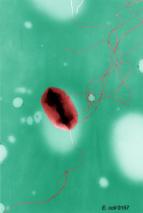
kswfoodworld E.coli O157

Image CDC


Alison Weiss, PhD, professor in the Department of Molecular Genetics, Biochemistry and Microbiology in UC College of Medicine, has been awarded a four-year grant of $1.6 million from the National Institute of Allergy and Infectious Diseases (NIAID) to study Shiga toxin producing Escherichia coli 0157:H7, also sometimes referred to as Hamburger E. coli.

Hamburger E. coli is the cause of foodborne illness and is an infection that often leads to bloody diarrhea and can result in kidney failure. It is mostly associated with eating undercooked, contaminated ground beef, and can be spread by person-to-person contact. In severe cases it can be fatal.

The infection was first discovered in hamburger meat, but it is carried asymptotically by many creatures so anything that has fecal matter from cattle can contaminate food, says Weiss. Vegetables and fruits can also carry E. coli if contaminated with animal fecal matter during field irrigation or as a result of harvesting or preparation of produce. Human hygiene practices can also spread E. coli.

Shiga toxin producing E. coli (STEC), including 0157:H7, are an important cause of diarrheal disease, causing about 265,000 illnesses in the United States annually.

USA – Marijuana failed E. coli, Salmonella and Chemical tests

Food Poison Journal

The Dept. of Licensing and Regulatory Affairs (LARA) issued a health and safety advisory due to the sale of marijuana which failed laboratory testing. The products were sold between 12/27/2018 and 12/30/2018 at HG Lansing. This recall affects the product batches listed in the link above of flower sold from HG Lansing – License PC-000159 located at 1116 E. Oakland Ave., Lansing MI 48906: