Category Archives: E.coli O157:H7

Research – Evaluation of Simultaneous Growth of Escherichia coli O157:H7, Salmonella spp., and Listeria monocytogenes in Ground Beef Samples in Different Growth Media

MDPI

Abstract

Several multiplex approaches for the simultaneous detection of pathogens in food have been developed in recent years, but the use of a single enrichment medium remains a problem. In this study, six enrichment broths (five non-selective media, tryptic soy broth (TSB), brain heart infusion broth (BHI), buffered peptone water (BPW), universal pre-enrichment broth (UPB), no. 17 broth, and a selective, Salmonella Escherichia Listeria broth (SEL)), were studied for the simultaneous detection of E. coli O157:H7, Salmonella spp., and L. monocytogenes, to validate the suitable enrichment broth to be used for the detection methods. Different ratios of E. coli O157:H7, Salmonella spp., and L. monocytogenes were used. Almost all non-selective broths evaluated in this study showed similar growth parameters and profiles among each other. The only selective enrichment broth under analysis (SEL) showed distinct growth features compared to the non-selective media, allowing for a slower but balanced growth of the three pathogens, which could be beneficial in preventing the overgrowth of fast-growing bacteria. In addition, when tested in ground beef samples, SEL broth seems to be the most distinctive medium with a balanced growth pattern observed for the three pathogens. Overall, this study is intended to provide the basis for the selection of suitable enrichment broths according to the technology detection to be used, the desired time of enrichment, and the expected balanced concentration of pathogens.
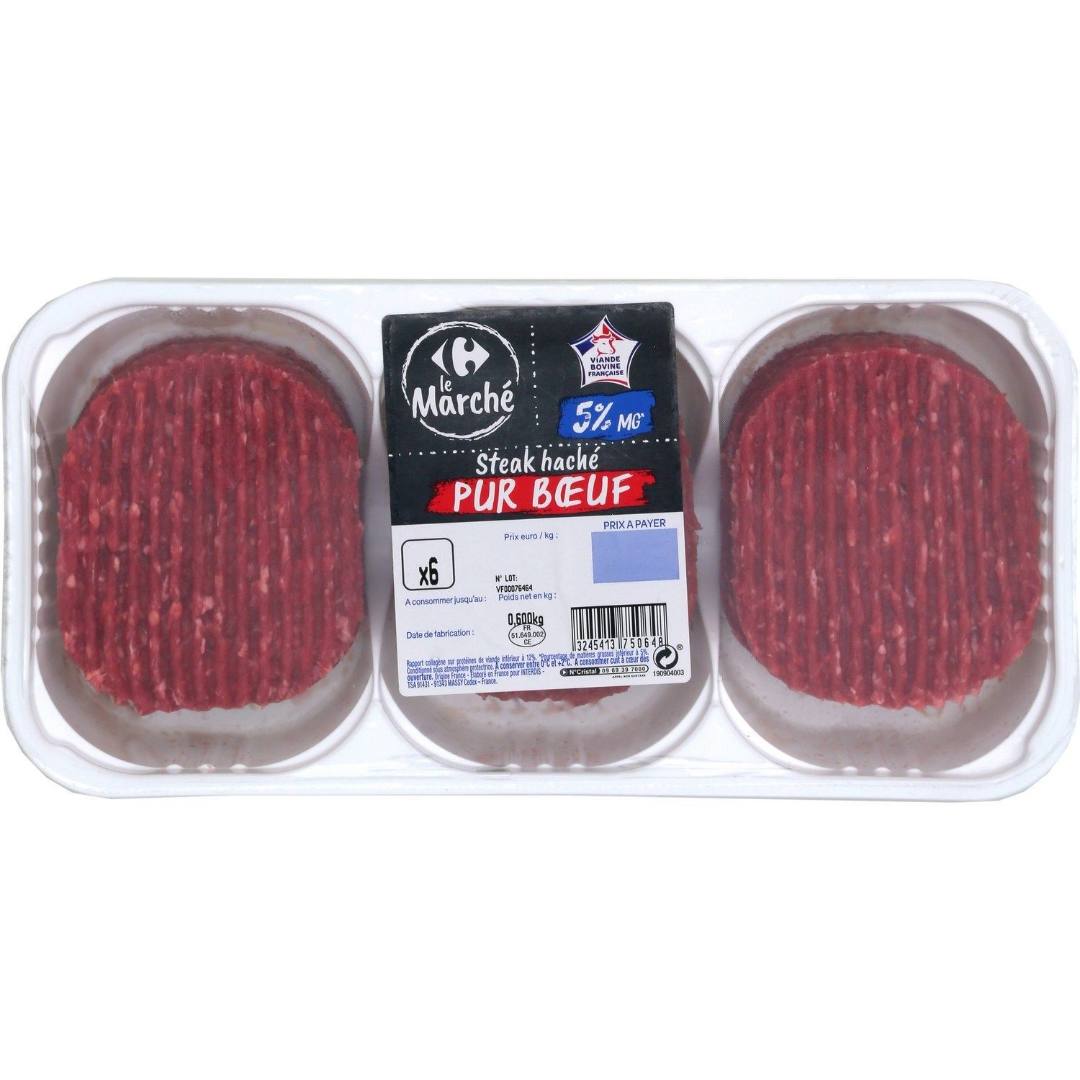
France – GROUND STEAK AND GROUND MEAT PURE BEEF 5% MG – STEC E.coli O157

Gov France

Product Category
Food
Product subcategory
Meats
Product brand name
CARREFOUR The Market
Model names or references
Minced steak 2X125g 3245415073998 Minced steak 6X100g 3245415074117 Minced steak 1X125g 3245415073875 Minced meat 350g: 3245415074179 Minced meat 500g 3245415074230 Minced meat 350g 3245413750785 SH 6X100g 3245413750648 SH 4X100g 3245415803748
Product identification
GTIN Batch Date
3245413750648 VF40138444 Use-by date 06/14/2024
3245415074117 VF40138444 Use-by date 06/14/2024
3245415803748 VF40138444 Expiry date 06/16/2024
3245415803748 VF40138444 Expiry date 06/17/2024
3245415073998 VF40138444 Use-by date 06/14/2024
3245415073875 VF40138444 Use-by date 06/14/2024
3245415073875 VF40138444 Expiry date 06/16/2024
3245415073875 VF40138444 Expiry date 06/17/2024
3245415074230 VF40138444 Expiry date 06/16/2024
3245413750785 VF40138444 Use-by date 06/14/2024
3245415074179 VF40138444 Expiry date 06/16/2024
Packaging
Ground steak 2X125g 3245415073998 Ground steak 6X100g 3245415074117 Ground steak 1X125g 3245415073875 Ground meat 350g: 3245415074179 Ground meat 500g 3245415074230 Viand chopped 350g 3245413750785 SH 6X100g 3245413750648 SH 4X100g 324541580374
Start/end date of marketing
From 06/08/2024 to 06/17/2024
Storage temperature
Product to be kept in the refrigerator
Health mark
FR 51.649.002 CE
Further information
Product in shared market, only products with the FR 51.649.002 CE stamp
Geographical sales area
Whole France
Distributors
Crossroads

USA- FDA Core Investigations of Foodborne Illness Outbreaks

FDA

What’s New

  • For the outbreak of Salmonella Typhimurium illnesses (ref #1234) linked to a not yet identified product, the case count has increased from 47 to 53. FDA has initiated traceback.
  • For the investigation of illnesses (ref #1233) linked to Diamond Shruumz-brand Chocolate Bars, Cones, and Gummies, the advisory has been updated to include additional illnesses and investigation updates. 
  • For the outbreak of Listeria monocytogenes illnesses (ref #1232) linked to a not yet identified product, FDA has initiated an inspection and sample collection.

Date
Posted

Ref

Pathogen
or
Cause of
Illness

Product(s)
Linked to
Illnesses

(if any)

Total
Case
Count


Status

6/19/

2024

1234

Salmonella
Typhimurium

Not Yet
Identified

53

Active

6/12/

2024

1233

Not Yet
Identified

Chocolate,
Gummies,
Cones 

See
Advisory

Active

6/5/

2024

1229

Salmonella
Braenderup

Not Yet
Identified

185

Active

5/22/

2024

1232

Listeria
monocytogenes

Not Yet
Identified

2

Active

5/22/

2024

1227

Salmonella
Africana

Not Yet
Identified

196

Active

4/17/

2024

1221

E. coli
O157:H7

Organic
Walnuts

See
Advisory

Active

USA – FDA – Investigations of Foodborne Illness Outbreaks

FDA

What’s New

  • An investigation of illnesses (ref #1233) linked to Diamond Shruumz-brand Chocolate Bars, Cones, and Gummies has been added to the table and FDA has issued an advisory. Consumers should not eat, sell, or serve any flavor of Diamond Shruumz-brand Chocolate Bars, Cones, and Gummies, and should discard them. FDA has initiated sample collection and analysis. The cause of illness has not yet been identified. FDA’s investigation is ongoing. Updates will be provided as they become available.
  • The FDA and CDC, in collaboration with state and local partners, are investigating a multistate outbreak of Salmonella Africana (ref #1227) illnesses that may be linked to cucumbers. The case count for this outbreak increased from 162 to 196. FDA and CDC are also investigating an outbreak of Salmonella Braenderup (ref #1229) illnesses that shares several similarities with the Salmonella Africana outbreak, including where and when illnesses occurred and the demographics of ill people. For the outbreak of Salmonella Braenderup illnesses, the case count has increased from 158 to 185. Investigators are working to determine whether the two outbreaks could be linked to the same food. On June 12, 2024, FDA updated the outbreak advisory.
  • Date
    Posted
    Ref Pathogen
    or
    Cause of
    Illness
    Product(s)
    Linked to
    Illnesses

    (if any)
    Total
    Case
    Count

    Status
    6/12/

    2024

    1233 Not Yet
    Identified
    Chocolate,
    Gummies,
    Cones
    See
    Advisory
    Active
    6/5/

    2024

    1229 Salmonella
    Braenderup
    Not Yet
    Identified
    185 Active
    5/22/

    2024

    1232 Listeria
    monocytogenes
    Not Yet
    Identified
    2 Active
    5/22/

    2024

    1227 Salmonella
    Africana
    Not Yet
    Identified
    196 Active
    4/17/

    2024

    1221 E. coli
    O157:H7
    Organic
    Walnuts
    See
    Advisory
    Active
    4/10/

    2024

    1218 Salmonella
    Typhimurium
    Organic
    Fresh
    Basil
    See
    Advisory
    Active

Research – Acid Adaptation Enhances Tolerance of Escherichia coli O157:H7 to High Voltage Atmospheric Cold Plasma in Raw Pineapple Juice

MDPI

Abstract

Pathogens that adapt to environmental stress can develop an increased tolerance to some physical or chemical antimicrobial treatments. The main objective of this study was to determine if acid adaptation increased the tolerance of Escherichia coli O157:H7 to high voltage atmospheric cold plasma (HVACP) in raw pineapple juice. Samples (10 mL) of juice were inoculated with non-acid-adapted (NAA) or acid-adapted (AA) E. coli to obtain a viable count of ~7.00 log10 CFU/mL. The samples were exposed to HVACP (70 kV) for 1–7 min, with inoculated non-HVACP-treated juice serving as a control. Juice samples were analyzed for survivors at 0.1 h and after 24 h of refrigeration (4 °C). Samples analyzed after 24 h exhibited significant decreases in viable NAA cells with sub-lethal injury detected in both NAA and AA survivors (p < 0.05). No NAA survivor in juice exposed to HVACP for 5 or 7 min was detected after 24 h. However, the number of AA survivors was 3.33 and 3.09 log10 CFU/mL in juice treated for 5 and 7 min, respectively (p < 0.05). These results indicate that acid adaptation increases the tolerance of E. coli to HVACP in pineapple juice. The potentially higher tolerance of AA E. coli O157:H7 to HVACP should be considered in developing safe juice processing parameters for this novel non-thermal technology.

USA – Cargill recalls ground beef from Walmart stores because of E. coli contamination

Food Safety News

Cargill Meat Solutions, a Hazleton, PA., establishment, is recalling more than 16,000 pounds of raw ground beef products that may be contaminated with E. coli O157:H7, the U.S. Department of Agriculture’s Food Safety and Inspection Service (FSIS) announced.

The ground beef was shipped to Walmart stores nationwide.

“FSIS is concerned that some product may be in consumers’ refrigerators or freezers. Consumers who have purchased these products are urged not to consume them. These products should be thrown away or returned to the place of purchase,” according to the recall notice.

Research – Use of dishwashers fails to inactivate foodborne pathogens in home-canned model foods

Science Direct

Unlabelled Image

Abstract

Risky home canning techniques are still performed for food preservation due to limited science-based recommendations. This study aimed to evaluate the inactivation of Shiga toxin-producing Escherichia coli O157:H7, Salmonella enterica (ser. Typhimurium, Enteritidis, and Infantis) and Listeria monocytogenes during home canning with a household dishwasher. The 450 mL of blended tomato (acidic liquid food) and potato puree (non-acidic solid food) were prepared with 1.5 % salt and 25 mL vinegar as model foods in glass jars (660 mL). The two model foods were sterilized, then inoculated with separate cocktails of each pathogen at 106–107 CFU/g. The prepared jars were placed in the bottom rack of a dishwasher and subjected to the following cycles: economic (50 °C, 122 min), express (60 °C, 54 min), and intensive (70 °C, 96 min). Temperature changes in jars were monitored by using thermocouples during heat treatment. Within the center of the jars, temperatures were measured as 45 to 53 °C in blended tomato and 44 to 52 °C in potato puree during all tested dishwasher cycles, respectively. The economic cycle treatment reduced S. entericaE. coli O157:H7, and L. monocytogenes populations by 3.1, 4.6, and 4.2 log CFU/g in blended tomato (P ≤ 0.05), where a <1.0 log reduction was observed in potato puree (P > 0.05). All pathogens showed similar heat resistance during the express cycle treatment with a log reduction ranging from 4.2 to 5.0 log CFU/g in blended tomato and 0.6 to 0.7 log CFU/g in potato puree. Reduction in L. monocytogenes population was limited (0.6 log CFU/g) compared to E. coli O157:H7 (2.0 log CFU/g) and S. enterica (2.7 log CFU/g) in blended tomato during the intensive cycle treatment (P ≤ 0.05). Dishwasher cycles at manufacturer defined settings failed to adequately inactivate foodborne pathogens in model foods. This study indicates that home-canned vegetables may cause foodborne illnesses when dishwashers in home kitchens are used for heat processing.

Research – Foodborne Illnesses from Leafy Greens in the United States: Attribution, Burden, and Cost

Science Direct

Abstract

Leafy green vegetables are a major source of foodborne illnesses. Nevertheless, few studies have attempted to estimate attribution and burden of illness estimates for leafy greens. This study combines results from three outbreak-based attribution models with illness incidence and economic cost models to develop comprehensive pathogen-specific burden estimates for leafy greens and their subcategories in the United States. We find that up to 9.18% (90% CI: 5.81%-15.18%) of foodborne illnesses linked to identified pathogens are attributed to leafy greens. Including ‘Unknown’ illnesses not linked to specific pathogens, leafy greens account for as many as 2,307,558 (90% CI: 1,077,815–4,075,642) illnesses annually in the United States. The economic cost of these illnesses is estimated to be up to $5.278 billion (90% CI: $3.230-$8.221 billion) annually. Excluding the pathogens with small outbreak sizes, Norovirus, Shiga toxin-producing Escherichia coli (both non-O157 and O157:H7), Campylobacter spp., and nontyphoidal Salmonella, are associated with the highest number of illnesses and greatest costs from leafy greens. While lettuce (romaine, iceberg, “other lettuce”) takes 60.8% of leafy green outbreaks, it accounts for up to 75.7% of leafy green foodborne illnesses and 70% of costs. Finally, we highlighted that 19.8% of Shiga toxin-producing Escherichia coli O157:H7 illnesses are associated with romaine among all food commodities, resulting in 12,496 estimated illnesses and $324.64 million annually in the United States.

USA – FDA – Investigations of Foodborne Illness Outbreaks

FDA

What’s New

  • An outbreak of Salmonella Africana illnesses (ref # 1227) linked to a not yet identified product has been added to the table. FDA has initiated traceback.
  • For the outbreak of E. coli O157:H7 (ref # 1221) linked to bulk organic walnuts, FDA has initiated an onsite inspection and sample collection and analysis.

Research -Shiga Toxin–Producing Escherichia coli O157:H7 Illness Outbreak Associated with Untreated, Pressurized, Municipal Irrigation Water — Utah, 2023

CDC

During July–September 2023, an outbreak of Shiga toxin–producing Escherichia coli O157:H7 illness among children in city A, Utah, caused 13 confirmed illnesses; seven patients were hospitalized, including two with hemolytic uremic syndrome. Local, state, and federal public health partners investigating the outbreak linked the illnesses to untreated, pressurized, municipal irrigation water (UPMIW) exposure in city A; 12 of 13 ill children reported playing in or drinking UPMIW. Clinical isolates were genetically highly related to one another and to environmental isolates from multiple locations within city A’s UPMIW system. Microbial source tracking, a method to indicate possible contamination sources, identified birds and ruminants as potential sources of fecal contamination of UPMIW. Public health and city A officials issued multiple press releases regarding the outbreak reminding residents that UPMIW is not intended for drinking or recreation. Public education and UPMIW management and operations interventions, including assessing and mitigating potential contamination sources, covering UPMIW sources and reservoirs, indicating UPMIW lines and spigots with a designated color, and providing conspicuous signage to communicate risk and intended use might help prevent future UPMIW-associated illnesses.