Category Archives: Decontamination Microbial

Research – Influence of commercial laying hen housing systems on the incidence and identification of Salmonella and Campylobacter

Science Direct

Foodborne Pathogen

Abstract

The housing of laying hens is important for social, industrial, and regulatory aspects. Many studies have compared hen housing systems on the research farm, but few have fully examined commercial housing systems and management strategies. The current study compared hens housed in commercial cage-free aviary, conventional cage, and enriched colony cage systems. Environmental and eggshell pool samples were collected from selected cages/segments of the housing systems throughout the production cycle and monitored for Salmonella and Campylobacter prevalence. At 77 wk of age, 120 hens per housing system were examined for Salmonella and Campylobacter colonization in the: adrenal glands, spleen, ceca, follicles, and upper reproductive tract. All isolates detected from environmental swabs, eggshell pools, and tissues were identified for serotype. Two predominant Salmonella were detected in all samples: S. Braenderup and S. Kentucky. Campylobacter coli and C. jejuni were the only Campylobacter detected in the flocks. Across all housing systems, approximately 7% of hens were colonized with Salmonella, whereas > 90% were colonized with CampylobacterSalmonella Braenderup was the isolate most frequently detected in environmental swabs (P < 0.0001) and housing system impacted Salmonella spp. shedding (P < 0.0001). Campylobacter jejuni was the isolate most frequently found in environmental swabs (P < 0.01), while housing system impacted the prevalence of C. coli and jejuni in ceca (P < 0.0001). The results of this study provide a greater understanding of the impact of hen housing systems on hen health and product safety. Additionally, producers and academia can utilize the findings to make informed decisions on hen housing and management strategies to enhance hen health and food safety.
Research – Propionate and Butyrate Inhibit Biofilm Formation of Salmonella Typhimurium Grown in Laboratory Media and Food Models

MDPI

Salmonella is among the most frequently isolated foodborne pathogens, and biofilm formed by Salmonella poses a potential threat to food safety. Short-chain fatty acids (SCFAs), especially propionate and butyrate, have been demonstrated to exhibit a beneficial effect on promoting intestinal health and regulating the host immune system, but their anti-biofilm property has not been well studied. This study aims to investigate the effects of propionate or butyrate on the biofilm formation and certain virulence traits of Salmonella. We investigated the effect of propionate or butyrate on the biofilm formation of Salmonella enterica serovar Typhimurium (S. Typhimurium) SL1344 grown in LB broth or food models (milk or chicken juice) by crystal violet staining methods. Biofilm formation was significantly reduced in LB broth and food models and the reduction was visualized using a scanning electron microscope (SEM). Biofilm metabolic activity was attenuated in the presence of propionate or butyrate. Meanwhile, both SCFAs decreased AI-2 quorum sensing based on reporter strain assay. Butyrate, not propionate, could effectively reduce bacterial motility. Bacterial adhesion to and invasion of Caco-2 cells were also significantly inhibited in the presence of both SCFAs. Finally, two SCFAs downregulated virulence genes related to biofilm formation and invasion through real-time polymerase chain reaction (RT-PCR). These findings demonstrate the potential application of SCFAs in the mitigation of Salmonella biofilm in food systems, but future research mimicking food environments encountered during the food chain is necessitated. View Full-Text

Research – Hepatitis A outbreak in Australia linked to imported Medjool dates, June–September 202

Gov Au

Abstract

Imported, minimally processed food products have been historically associated with several hepati-tis A outbreaks in Australia. Here, we report the first known hepatitis A outbreak in Australia linked to consumption of imported fresh Medjool dates. Between June and September 2021, six genetically identical hepatitis A cases were notified in New South Wales and the Australian Capital Territory. All cases reported date consumption during their exposure period. The implicated dates were positive for hepatitis A virus (HAV) by reverse transcription polymerase chain reaction. Rapid detection of this outbreak and the swift implementation of control measures was facilitated by two key factors. Firstly, Australian international border closures implemented in response to the COVID-19 pan-demic meant that a common locally-acquired, as opposed to travel-acquired, source for cases was strongly suspected. Secondly, prompt awareness of a hepatitis A outbreak in the United Kingdom (which was found to be associated with date consumption) allowed for early hypothesis generation and investigation. This paper details the epidemiological and microbiological factors involved in this outbreak investigation and the actions taken to mitigate public health risk.

Research – Asymptomatic Carriage of Listeria monocytogenes by Animals and Humans and Its Impact on the Food Chain

MDPI

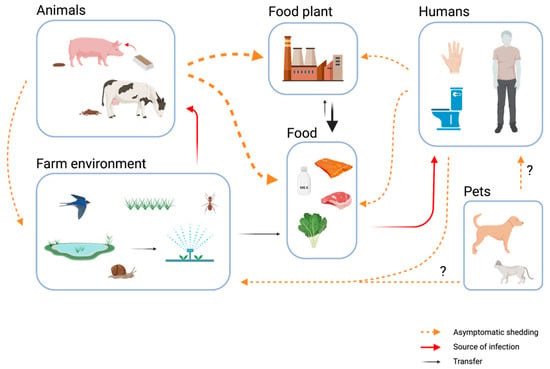
Humans and animals can become asymptomatic carriers of Listeria monocytogenes and introduce the pathogen into their environment with their feces. In turn, this environmental contamination can become the source of food- and feed-borne illnesses in humans and animals, with the food production chain representing a continuum between the farm environment and human populations that are susceptible to listeriosis. Here, we update a review from 2012 and summarize the current knowledge on the asymptomatic carrier statuses in humans and animals. The data on fecal shedding by species with an impact on the food chain are summarized, and the ways by which asymptomatic carriers contribute to the risk of listeriosis in humans and animals are reviewed. View Full-Text

Vietnam reports more food poisoning deaths in 10 months in 2022

English News

HANOI, Nov. 7 (Xinhua) — A total of 581 people in Vietnam suffered from food poisoning in the first 10 months of 2022, of whom 11 died, according to the country’s Preventive Health Department on Monday.

In the same period last year, as many as 1,519 people were affected by food poisoning, of whom five died.

ILSI releases comprehensive new book on food safety 

Food Safety News

International Life Sciences Institute (ILSI) has announced its release of a new book, “Present Knowledge in Food Safety: A Risk-Based Approach Through the Food Chain,” which presents approaches for exposure-led risk assessment and management of food contamination at key stages of production. 

“The ILSI Federation is excited to support everyone — from students to experts — in these important fields to enhance their work and research for the public benefit,” said Stéphane Vidry, Ph.D., ILSI’s global executive director. “Bolstering food safety and public health is one of ILSI’s key values, and it’s alive and well in the publication of this new book.” 

The book aims to improve the reliability, predictability, and relevance of food safety assessments, as well as their communication challenges, to protect public health.

The book includes 72 chapters contributed by more than 110 authors. Conceptually modeled after ILSI’s book, “Present Knowledge in Nutrition,” this book provides coverage of new and emerging science in the risk assessment paradigm as applied to chemical, physical and microbiological safety issues. 

Philippines – One student dies, several others hospitalized due to food poisoning in Iloilo

MB

ILOILO CITY – One student died while several others were hospitalized due to food poisoning in Ajuy town in Iloilo province on Friday, Nov. 4.

Mayor Jett Rojas confirmed to the Manila Bulletin in a phone interview on Sunday, Nov. 6, the news on the death of a student and several others who were hospitalized allegedly after drinking spoiled buko juice during a school party on Friday, Nov. 4.

“We can now confirm this is food poisoning,” said Mayor Rojas in an interview with the Manila Bulletin.


Research – Ciguatera in Europe project granted follow-up

Food Safety News

A project looking at the surveillance and control of ciguatera poisoning in Europe has been given a second edition.

A launch meeting for EuroCigua II was attended this past week by representatives of 11 organizations involved in food safety and public health from five European countries.

Partners include the Spanish Institute of Agrifood Research and Technology (IRTA), Canary Islands Health Service (SCS), the French Agency for Food, Environmental and Occupational Health and Safety (ANSES), German Federal Institute for Risk Assessment (BfR), Portuguese Economic and Food Safety Authority (ASAE), and Dutch National Institute for Public Health and the Environment (RIVM).

Also participating in the three-year effort are the European Food Safety Authority (EFSA), the European Center for Disease Prevention and Control (ECDC), European Environment Agency of the European Commission, the United Nations Food and Agriculture Organization (FAO) and experts from research groups in the United States and Japan.

Research – Virulence Potential and Antibiotic Susceptibility of S. aureus Strains Isolated from Food Handlers

MDPI

Staphylococcus spp. are common members of the normal human flora. However, some Staphylococcus species are recognised as human pathogens due to the production of several virulence factors and enterotoxins that are particularly worrisome in food poisoning. Since many of Staphylococcal food poisoning outbreaks are typically associated with cross-contamination, the detection of S. aureus on food handlers was performed. Hand swabs from 167 food handlers were analysed for the presence of S. aureus. More than 11% of the samples were positive for S. aureus. All S. aureus strains were isolated and analysed for the presence of virulence and enterotoxin genes, namely, seasebsecsedsegseitsst-1 and pvl. The same strains were phenotypically characterised in terms of antibiotic susceptibility using the disc diffusion method and antimicrobial agents from 12 different classes. A low prevalence of antibiotic-resistant strains was found, with 55.6% of the strains being sensitive to all of the antimicrobial agents tested. However, a high prevalence of resistance to macrolides was found, with 44.4% of the strains showing resistance to erythromycin. At least one of the virulence or toxin genes was detected in 61.1% of the strains, and seg was the most prevalent toxin gene, being detected in 44.4% of the strains.

Research – Occurrence of Listeria spp. in Soft Cheese and Ice Cream: Effect of Probiotic Bifidobacterium spp. on Survival of Listeria monocytogenes in Soft Cheese

MDPI

Listeria monocytogenes is one of the most important emerging foodborne pathogens. The objectives of this work were to investigate the incidence of Listeria spp. and L. monocytogenes in soft cheese and ice cream in Assiut city, Egypt, and to examine the effect of some probiotic Bifidobacterium spp. (Bifidobacterium breveBifidobacterium animalis, or a mixture of the two) on the viability of L. monocytogenes in soft cheese. The existence of Listeria spp. and L. monocytogenes was examined in 30 samples of soft cheese and 30 samples of ice cream. Bacteriological analyses and molecular identification (using 16S rRNA gene and hlyA gene for Listeria spp. and L. monocytogenes, respectively) were performed on those samples. Additionally, Bifidobacterium spp. were incorporated in the making of soft cheese to study their inhibitory impacts on L. monocytogenes. Out of 60 samples of soft cheese and ice cream, 25 samples showed Listeria spp., while L. monocytogenes was found in only 2 soft cheese samples. Approximately 37% of soft cheese samples (11 out of 30) had Listeria spp. with about 18.0% (2 out of 11) exhibiting L. monocytogenes. In ice cream samples, Listeria spp. was presented by 47% (14 out of 30), while L. monocytogenes was not exhibited. Moreover, the addition of B. animalis to soft cheese in a concentration of 5% or combined with B. breve with a concentration of 2.5% for each resulted in decreasing L. monocytogenes efficiently during the ripening of soft cheese for 28 d. Listeria spp. is widely found in milk products. Probiotic bacteria, such as Bifidobacterium spp., can be utilized as a natural antimicrobial to preserve food and dairy products. View Full-Text