For the Salmonella Mississippi outbreak (ref# 1097) in a not yet identified product, the case count has increased from 99 to 100 cases.
For the Salmonella Senftenberg outbreak (ref# 1087) in a not yet identified food, the case count has increased from 22 to 27 cases.
For the Salmonella Typhimurium outbreak (ref# 1095) in a not yet identified food, the case count has increased from 73 to 78 cases.
For the Cyclospora outbreak (ref# 1080) the case count has increased from 75 to 79 cases.
For the Salmonella Braenderup outbreak (ref# 1075) the FDA investigation has closed. A product linked to illnesses was not identified.
The investigation associated with Dry Cereal (ref # 1064) has ended and the FDA investigation has closed with no pathogen or cause of the self-reported illnesses identified, despite extensive testing for numerous potential microbial and chemical adulterants.
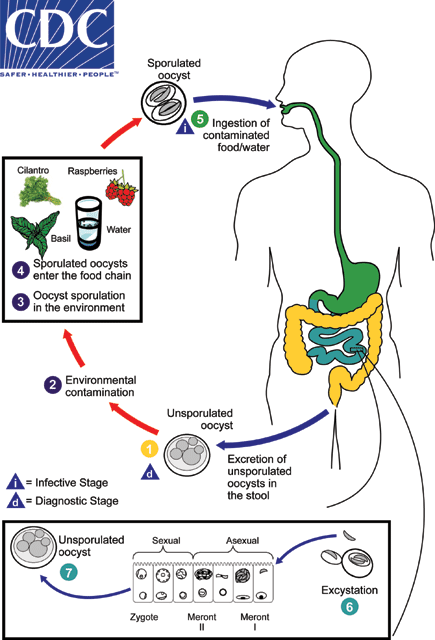
Cyclosporiasis illnesses are reported year-round in the United States. However, during the spring and summer months there is often an increase in cyclosporiasis acquired in the United States (i.e., “domestically acquired”). The exact timing and duration of these seasonal increases in domestically acquired cyclosporiasis can vary, but reports tend to increase starting in May. In previous years the reported number of cases peaked between June and July, although activity can last as late as September. The overall health impact (e.g., number of infections or hospitalizations) and the number of identified clusters of cases (i.e., cases that can be linked to a common exposure) also vary from season to season. Previous U.S. outbreaks of cyclosporiasis have been linked to various types of fresh produce, including basil, cilantro, mesclun lettuce, raspberries, and snow peas.
CDC, along with state and federal health and regulatory officials, monitor cases of cyclosporiasis in the United States in the spring and summer months to detect outbreaks linked to a common food source. However, many cases of cyclosporiasis cannot be directly linked to an outbreak, in part because of the lack of validated laboratory “fingerprinting” methods needed to link cases of Cyclospora infection. Officials use questionnaires to interview sick people to determine what they ate in the 14-day period before illness onset. If a commonality is found, CDC and partners work quickly to determine if a contaminated food product is still available in stores or in peoples’ homes and issue advisories.
Latest Information
The number of reported cases of domestically acquired cyclosporiasis illnesses has increased by 416 cases since the last update on July 28, 2022. Cases continue to be reported.
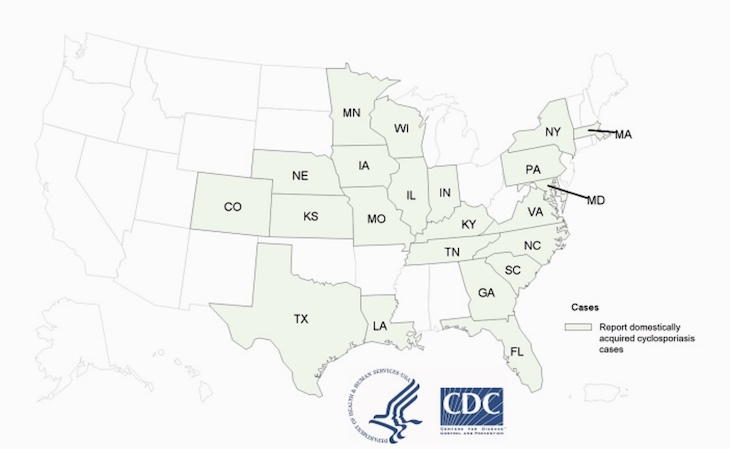
As of August 23, 2022, 800 laboratory-confirmed cases of cyclosporiasis in people who had no history of international travel during the 14-day period before illness onset have been reported to CDC by 31 jurisdictions, including 30 states and New York City, since May 1, 2022.
The median illness onset date is June 29, 2022 (range: May 3, 2022–August 12, 2022).
At least 52 people have been hospitalized; 0 deaths have been reported.
An outbreak of Salmonella Mississippi (ref# 1097) in a not yet identified product has been added to the table and FDA has initiated traceback.
For the E. coli O157:H7 outbreak (ref# 1081) in a not yet identified food, sample collection and analysis have been initiated.
For the Salmonella Senftenberg outbreak (ref# 1087) in a not yet identified food, the case count has increased from 22 to 25 cases.
For the Salmonella Typhimurium outbreak (ref# 1095) in a not yet identified food, the case count has increased from 62 to 73 cases, an on-site inspection and sample collection and analysis has been initiated.
For the Cyclospora outbreak (ref# 1080) the case count has increased from 70 to 75.
For the Cyclospora outbreak (ref# 1084), the case count has increased from 41 to 42.
For the Salmonella Braenderup outbreak (ref# 1075), the case count increased from 74 to 75.
For the outbreak of Listeria monocytogenes (ref# 1057) linked to ice cream, FDA initiated an on-site inspection.
An outbreak of E. coli O157:H7 (ref# 1081) in an unidentified product was added to the table and FDA has initiated a traceback investigation. CDC has issued an Investigation Notice.
An outbreak of Salmonella Senftenberg (ref# 1087) in an unidentified product was added to the table.
An outbreak of Salmonella Typhimurium (ref# 1095) in an unidentified product was added to the table and traceback has been initiated.
For the outbreak of Salmonella Braenderup (ref# 1075) in an unidentified product, the outbreak has ended.
For the outbreak of Cyclospora in an unidentified product (ref# 1084), the case count has increased from 77 to 98.
For the outbreak of hepatitis A illnesses linked to fresh strawberries (ref# 1066), the FDA investigation has closed and the outbreak is over.
For the Cyclospora outbreak in an unidentified vehicle (ref# 1084), the number of cases has increased from 51 to 60 and sample collection and analysis has been initiated.
A new outbreak has been added to the table: Cyclospora in a not yet identified food (ref #1080). Traceback has been initiated.
For the Salmonella Paratyphi B var. L(+) tartrate+ outbreak (ref# 1072) in a not identified food, FDA’s investigation status is now closed.
For the Listeria monocytogenes outbreak (ref# 1070) in a not identified food, the outbreak status has ended and FDA’s investigation status is now closed.
For the Salmonella Braenderup outbreak (ref #1075), the number of cases has increased from 70 to 74.
Cyclospora illnesses have spiked to 384 sick in 22 states and 30 hospitalized, according to the Centers for Disease Control and Prevention (CDC). There has been a cyclospora outbreak, in fact, usually several cyclospora outbreaks, in the United States during the spring and summer months every year since 2013. This is an increase of 323 cases since the last update was issued on June 30, 2022. Cases are still being reported.
For the Salmonella Senftenberg outbreak in Peanut Butter (ref# 1067), the outbreak status has ended and the investigation status is now closed.
A new outbreak has been added to the table: Cyclospora in a not yet identified food (ref #1084).
For the Salmonella Paratyphi B var. L(+) tartrate+ outbreak (ref# 1072) in a not yet identified food, the outbreak status has ended. FDA’s investigation status is still ongoing.
The U.S. Food and Drug Administration (FDA) recently updated its constituents about the agency’s ongoing Cyclospora cayetanensis prevention and research efforts. In 2021, FDA released its “Cyclospora Prevention, Response and Research Action Plan.” The action plan was developed by the agency’s Cyclospora Task Force and details FDA’s strategy for reducing the public health burden of foodborne cyclosporiasis in the U.S. It also defines the agency’s priorities for Cyclospora food safety research and supports ongoing efforts to combat foodborne illness in alignment with FDA’s New Era of Smarter Food Safety initiative.
Since releasing the Cyclospora action plan, FDA has made progress on several goals. The agency’s activities related to the Cyclospora action plan include:
Collaboration with the National Advisory Committee on Microbiological Criteria for Foods to develop a charge document that will inform FDA’s prioritization of Cyclospora research and propose novel food safety research projects in collaboration with stakeholders
Implementation of a genotyping approach for Cyclospora in environmental and food samples based on the same method published by the U.S. Centers for Disease Control and Prevention (CDC)
Implementation of a distance learning plan and a series of Cyclospora methodology training webinars on the “Bacteriological Analytical Manual (BAM) Chapter 19b – Detection of C. cayetanensis in Fresh Produce” using a real-time PCR-analytical method in Spanish for regulatory lab personnel at food safety authorities in Mexico through the FDA-SENASICA-Cofepris Food Safety Partnership
Collaborated with the U.S. Centers for Disease Control and Prevention (CDC) to publish an article in Food Safety Magazine summarizing the data on all cyclosporiasis outbreaks from 2013 to 2020
Delivered eight webinars directed to the fresh produce industry, regulators, and other stakeholders for Cyclospora outreach and educational purposes
Completed a microbial survey of fresh herbs that included over 800 samples tested for C. cayetanensis.
Public Heath Canada is working with its public health and food safety partners to identify possible ways non-travel related Cyclospora infections are occurring in Canada.
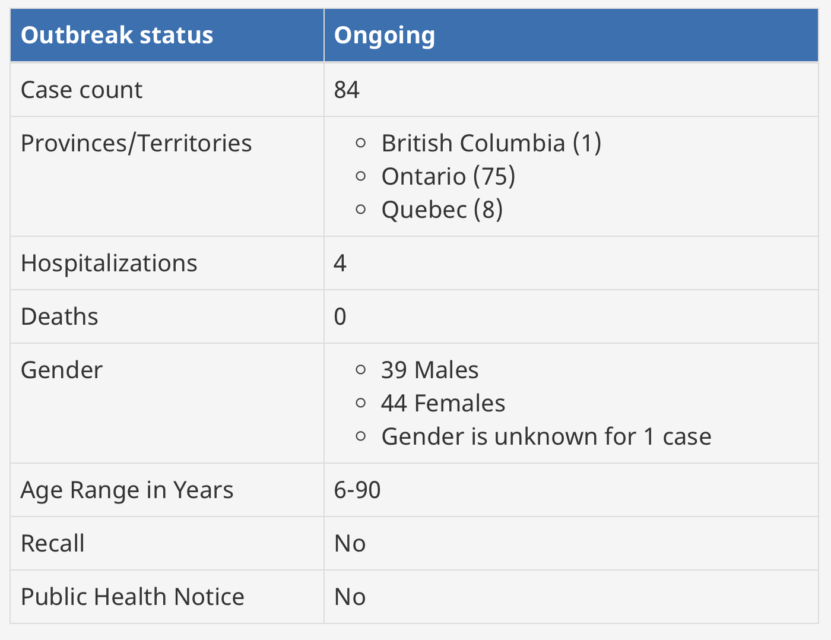
As of June 30, a total of 84 cases of Cyclospora infections were reported in the following provinces: British Columbia (1), Ontario (75), and Quebec (8). 4 individuals have been hospitalized and no deaths have been reported. To date, there is no recall or Public Health Notice, the investigation is ongoing.
In case you are experiencing Cyclosporiasis symptoms such as watery diarrhea (most common), cramping, bloating, increased gas, nausea, fatigue, and possibly vomiting and low-grade fever, it is important to report it. It can help to detect & resolve outbreaks early and prevent others from being harmed, and it enables better surveillance. If symptoms persist, seek medical care.



 FoodWorld