Category Archives: Bacteriophage

Research – Simple lab-free test to detect bacteria in fluids from water to urine

Science Daily

A novel new test for bacteria in fluids makes it as easy as observing a colour change to confirm the presence of disease-causing pathogens, promising much easier diagnostic tests and greater food safety.

Engineers and biochemists at McMaster university have brought their skills together to make it possible for untrained users to confirm contamination in fluids using a biogel test that changes colour in the presence of such bacteria as E. coli, listeria and other frequent testing targets.

The test uses harmless bacteriophages embedded in the gel to locate target bacteria in a sample of fluid such as lake water, urine or a container of milk, even in low concentrations.

Bacteriophages are the most common form of life on Earth. Each form of bacteriophage is specialized to destroy one form of bacteria.
Research – Lysin and Lytic Phages Reduce Vibrio Counts in Live Feed and Fish Larvae

MDPI

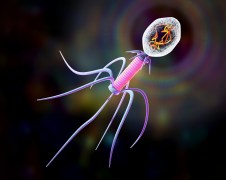
Bacteriophage on colorful background

Abstract

Vibrio species are naturally found in estuarine and marine ecosystems, but are also recognized as significant human enteropathogens, often linked to seafood-related illnesses. In aquaculture settings, Vibrio poses a substantial risk of infectious diseases, resulting in considerable stock losses and prompting the use of antimicrobials. However, this practice contributes to the proliferation of antimicrobial-resistant (AMR) bacteria and resistance genes. Our investigation aimed to explore the potential of biological agents such as bacteriophage CH20 and endolysin LysVPp1 in reducing Vibrio bacterial loads in both rotifer and fish larvae. LysVPp1’s lytic activity was assessed by measuring absorbance reduction against various pathogenic Vibrio strains. Phage CH20 exhibited a limited host range, affecting only Vibrio alginolyticus GV09, a highly pathogenic strain. Both CH20 and LysVPp1 were evaluated for their effectiveness in reducing Vibrio load in rotifers or fish larvae through short-setting bioassays. Our results demonstrated the significant lytic effect of endolysin LysVPp1 on strains of Vibrio alginolyticusVibrio parahaemolyticus, and Vibrio splendidus. Furthermore, we have showcased the feasibility of reducing the load of pathogenic Vibrio in live feed and fish larvae by using a non-antibiotic-based approach, such as lytic phage and endolysin LysVPp1, thus contributing to the progress of a sustainable aquaculture from a One Health perspective

Research – Effect of Bacteriophages against Biofilms of Escherichia coli on Food Processing Surfaces

MDPI

Abstract

The bacterial adhesion to food processing surfaces is a threat to human health, as these surfaces can serve as reservoirs of pathogenic bacteria. Escherichia coli is an easily biofilm-forming bacterium involved in surface contamination that can lead to the cross-contamination of food. Despite the application of disinfection protocols, contamination through food processing surfaces continues to occur. Hence, new, effective, and sustainable alternative approaches are needed. Bacteriophages (or simply phages), viruses that only infect bacteria, have proven to be effective in reducing biofilms. Here, phage phT4A was applied to prevent and reduce E. coli biofilm on plastic and stainless steel surfaces at 25 °C. The biofilm formation capacity of phage-resistant and sensitive bacteria, after treatment, was also evaluated. The inactivation effectiveness of phage phT4A was surface-dependent, showing higher inactivation on plastic surfaces. Maximum reductions in E. coli biofilm of 5.5 and 4.0 log colony-forming units (CFU)/cm2 after 6 h of incubation on plastic and stainless steel, respectively, were observed. In the prevention assays, phage prevented biofilm formation in 3.2 log CFU/cm2 after 12 h. Although the emergence of phage-resistant bacteria has been observed during phage treatment, phage-resistant bacteria had a lower biofilm formation capacity compared to phage-sensitive bacteria. Overall, the results suggest that phages may have applicability as surface disinfectants against pathogenic bacteria, but further studies are needed to validate these findings using phT4A under different environmental conditions and on different materials.

Research – Investigating bacteriophages as a novel multiple-hurdle measure against Campylobacter: field trials in commercial broiler plants

Nature

Abstract

Campylobacter mitigation along the food production chain is considered effective for minimizing the public health burden of human campylobacteriosis. This study is the first combining different measures in a multiple-hurdle approach, using drinking water additives and feed additives in single and combined application schemes in commercial broiler plants. Broiler chickens in the study groups were naturally contaminated with Campylobacter. Application of an organic acid blend via drinking water, consisting of sodium propionate, potassium sorbate, and sodium diacetate, resulted in significant reductions of up to 4.9 log10 CFU/mL in fecal samples and in cecal samples at slaughter. The application of a phage mixture, consisting of Fletchervirus phage NCTC 12673 and Firehammervirus phage vB_CcM-LmqsCPL1/1, resulted in reductions of up to 1.1 log10 CFU/mL in fecal samples 1 day after dosing. The sole administration of curcumin via feed resulted in small and inconsistent reductions. In the group receiving a combination of all tested measures, reductions of up to 1.1 log10 CFU/mL were observed. Based on the results of our field trials, it was shown that both the sole application and the combined application of mitigation measures in primary production can reduce the Campylobacter load in broiler chickens, while no synergism could be observed.

Research – A new Rogue-like Escherichia phage UDF157lw to control Escherichia coli O157:H7

Frontiers In.org

Introduction: Shiga toxin-producing Escherichia coli (STEC) O157:H7 is one of the notorious foodborne pathogens causing high mortality through the consumption of contaminated food items. The food safety risk from STEC pathogens could escalate when a group of bacterial cells aggregates to form a biofilm. Bacterial biofilm can diminish the effects of various antimicrobial interventions and enhance the pathogenicity of the pathogens. Therefore, there is an urgent need to have effective control measurements. Bacteriophages can kill the target bacterial cells through lytic infection, and some enzymes produced during the infection have the capability to penetrate the biofilm for mitigation compared to traditional interventions. This study aimed to characterize a new Escherichia phage vB_EcoS-UDF157lw (or UDF157lw) and determine its antimicrobial efficacy against E. coli O157:H7.

RASFF Alert -Streptomyces soil-based spores and bacteriophage blend

RASFF

Unauthorised novel food ingredients Streptomyces soil-based spores and bacteriophage blend in a food supplement from the United States in Slovenia

Research – Positive and negative aspects of bacteriophages and their immense role in the food chain

Nature

Abstract

Bacteriophages infect and replicate inside a bacterial host as well as serve as natural bio-control agents. Phages were once viewed as nuisances that caused fermentation failures with cheese-making and other industrial processes, which lead to economic losses, but phages are now increasingly being observed as being promising antimicrobials that can fight against spoilage and pathogenic bacteria. Pathogen-free meals that fulfil industry requirements without synthetic additives are always in demand in the food sector. This study introduces the readers to the history, sources, and biology of bacteriophages, which include their host ranges, absorption mechanisms, lytic profiles, lysogenic profiles, and the influence of external factors on the growth of phages. Phages and their derivatives have emerged as antimicrobial agents, biodetectors, and biofilm controllers, which have been comprehensively discussed in addition to their potential applications in the food and gastrointestinal tract, and they are a feasible and safe option for preventing, treating, and/or eradicating contaminants in various foods and food processing environments. Furthermore, phages and phage-derived lytic proteins can be considered potential antimicrobials in the traditional farm-to-fork context, which include phage-based mixtures and commercially available phage products. This paper concludes with some potential safety concerns that need to be addressed to enable bacteriophage use efficiently.

Research – ‘UK should break licensing impasse and maximise the potential of phages’

The Microbiologist

In a major new report the UK’s Science, Innovation & Technology Committee has called for steps to develop the potential of bacteria-killing viruses – called bacteriophages or phages for short – that can provide an alternative to antibiotics that are attracting growing resistance.

Research – Reduction and Growth Inhibition of Listeria monocytogenes by Use of Anti-Listerial Nisin, P100 Phages and Buffered Dry Vinegar Fermentates in Standard and Sodium-Reduced Cold-Smoked Salmon

MDPI

Abstract

Cold-smoked salmon are ready-to-eat products that may support the growth of pathogenic Listeria monocytogenes during their long shelf-life. Consumption of such contaminated products can cause fatal listeriosis infections. Another challenge and potential risk associated with CS salmon is their high levels of sodium salt. Excess dietary intake is associated with serious health complications. In the present study, anti-listerial bacteriocin (nisin), P100 bacteriophages (Phageguard L, PGL) and fermentates (Verdad N6, P-NDV) were evaluated as commercial bio-preservation strategies for increased control of L. monocytogenes in standard (with NaCl) and sodium-reduced (NaCl partially replaced with KCl) CS salmon. Treatments of CS salmon with nisin (1 ppm) and PGL (5 × 10⁷ pfu/cm2) separately yielded significant initial reductions in L. monocytogenes (up to 0.7 log) compared to untreated samples. Enhanced additive reductions were achieved through the combined treatments of nisin and PGL. Fermentates in the CS salmon inhibited the growth of Listeria but did not lead to its eradication. The lowest levels of L. monocytogenes during storage were observed in nisin- and PGL-treated CS salmon containing preservative fermentates and stored at 4 °C, while enhanced growth was observed during storage at an abusive temperature of 8 °C. Evaluation of industry-processed standard and sodium-replaced CS salmon confirmed significant effects with up to 1.7 log reductions in L. monocytogenes levels after 34 days of storage of PGL- and nisin-treated CS salmon-containing fermentates. No differences in total aerobic plate counts were observed between treated (PGL and nisin) or non-treated standard and sodium-reduced CS salmon at the end of storage. The microbiota was dominated by Photobacterium, but with a shift showing dominance of Lactococcus spp. and Vagococcus spp. in fermentate-containing samples. Similar and robust reductions in L. monocytogenes can be achieved in both standard and sodium-replaced CS salmon using the bio-preservation strategies of nisin, PGL and fermentates under various and relevant processing and storage conditions.

Research – Validation of a Bacteriophage Hide Application to Reduce STEC in the Lairage Area of Commercial Beef Cattle Operations

MDPI

Abstract

Finalyse, a T4 bacteriophage, is a pre-harvest intervention that utilizes a combination of bacteriophages to reduce incoming Escherichia coli O157:H7 prevalence by destroying the bacteria on the hides of harvest-ready cattle entering commercial abattoirs. The objective of this study was to evaluate the efficacy of Finalyse, as a pre-harvest intervention, on the reduction in pathogens, specifically E. coli O157:H7, on the cattle hides and lairage environment to overall reduce incoming pathogen loads. Over 5 sampling events, a total of 300 composite hide samples were taken using 25 mL pre-hydrated Buffered Peptone Water (BPW) swabs, collected before and after the hide wash intervention, throughout the beginning, middle, and end of the production day (n = 10 swabs/sampling point/timepoint). A total of 171 boot swab samples were also simultaneously taken at the end of the production day by walking from the front to the back of the pen in a pre-determined ‘Z’ pattern to monitor the pen floor environment from 3 different locations in the lairage area. The prevalence of pathogens was analyzed using the BAX® System Real-Time PCR Assay. There were no significant reductions observed for Salmonella and/or any Shiga toxin-producing E. coli (STEC) on the hides after the bacteriophage application (p > 0.05). Escherichia coli O157:H7 and O111 hide prevalence was very low throughout the study; therefore, no further analysis was conducted. However, boot swab monitoring showed a significant reduction in E. coli O157:H7, O26, and O45 in the pen floor environment (p < 0.05). While using Finalyse as a pre-harvest intervention in the lairage areas of commercial beef processing facilities, this bacteriophage failed to reduce E. coli O157:H7 on the hides of beef cattle, as prevalence was low; however, some STECs were reduced in the lairage environment, where the bacteriophage was applied. Overall, an absolute conclusion was not formed on the effectiveness of Finalyse and its ability to reduce E. coli O157:H7 on the hides of beef cattle, as prevalence on the hides was low.