Category Archives: Bacillus

Research – Insight into Bacillus cereus Associated with Infant Foods in Beijing

MDPI

This study was undertaken to investigate the prevalence, antimicrobial resistance, and virulence gene profiles of Bacillus cereus in different brands of infant formula in Beijing supermarkets. Eighty-eight Bacillus cereus isolates were recovered in sixty-eight infant formulas of five domestic brands and fourteen imported brands. The prevalence rate in domestic and imported samples were 70.6% and 52.9%, respectively. Lower mean prevalence level was found in domestic samples (1.17 MPN/g) compared with the imported samples (3.52 MPN/g). Twenty-four virulence gene profiles were found, and most strains carried at least one virulence gene. The prevalence of nheAnheBnheCcytKbceT, and entFM in domestic and imported brand samples was similar. The occurrence of enterotoxin genes hblAhblC, and hblD in domestic samples were 22.2%, 27.8%, and 22.2%, respectively, which was significantly higher than imported samples. Antimicrobial drugs-susceptibility analysis showed that all isolates were susceptible to gentamincin, amikacin, and ciprofloxacin; 38%, 7%, and 2.3% were resistant to rifampin, tetracycline, and chloramphenicol, respectively; and only one isolate was resistant to trimethoprim-sulfamethoxazole. Moreover, the cell numbers of Bacillus cereus in prepared infant formula increased rapidly at room temperature. Thus, monitoring guidelines are needed for accepted levels of Bacillus cereus in infant formula.
Research – Aflatoxin Reduction and Retardation of Aflatoxin Production by Microorganisms in Doenjang during a One-Year Fermentation

MDPI

Meju, a raw material for doenjang preparation, is highly vulnerable to aflatoxin-producing fungi. The aim of this study was to evaluate the effect of a one-year fermentation on aflatoxins and aflatoxin-producing fungi in doenjang spiked with aflatoxins B1, G1, B2, and G2 and inoculated with toxigenic Aspergillus flavus. A significant reduction in aflatoxins was observed after a year of fermentation, measuring 92.58%, 100%, 98.69%, and 100% of B1, G1, B2, and G2, respectively. After a year of fermentation, 6.95 ± 3.64 µg/kg of total aflatoxin was detected, which represents a 97.88% reduction in the total aflatoxin compared with the initial value (328.83 ± 36.60 µg/kg). Several aflatoxin-degrading fungi (Aspergillus versicolorCladosporium subcinereumAspergillus ochraceus) and bacteria (Bacillus albusBacillus velezensis) isolated from doenjang were identified as the major contributors to the reduction of aflatoxin. Furthermore, it was observed that most of the aflatoxin contamination in doenjang occurred during the meju stage, and this stage was found to be most susceptible to A. flavus contamination and growth. These findings reveal that native microorganisms mediate aflatoxin clean-up in doenjang during fermentation and support the use of such microorganisms as a starter culture for the preparation of aflatoxin-free doenjang.

Research – Effect of hydrophobic/hydrophilic characteristics of B. cereus spores on their resistance to detergents

Journal of Food Protection

Bacillus cereus spores have the ability to adhere to solid surfaces, including stainless steel, a material widely used in food industries. Adhesion of spores allows for recontamination during food processing, and the cleaning and disinfection are largely used by industries to control them. Hence, this study aims to assess the detachment capacity (or removing activity) of sodium hydroxide, nitric acid, phosphoric acid-based detergent, chlorine-based detergent; against two adhered Bacillus cereus spores (hydrophobic strain and hydrophilic strain) to stainless steel surfaces. Microorganism adhesion on the surfaces reached 5.5 log CFU/cm² the two strain studied. Two protocols composed of combinations of chemical compounds concentration, temperature, and contact time were tested. The inactivation kinetics shapes were convex and were modelled by the Weibull model. The effect of temperature and biocide concentration were quantified using a Bigelow like model. The temperature applied during of treatment of the cleaning in place is an important factor acting on the speed of inactivation or detachment of Bacillus cereus spores. However, this efficiency depends on the hydrophobic characteristics of Bacillus cereus spores. The concentration of detergent and acid also affects the inactivation rate. The inactivation rate, whereas the character of hydrophobic does not intervene for the chlorine alkaline treatments.

USA – Pepperoni recalled due to Bacillus cereus

FSIS USDA

WASHINGTON, Dec. 14, 2021 – Smithfield Packaged Meats Corp., doing business as Margherita Meats, Inc., an Omaha, Neb. establishment, is recalling approximately 10,990 pounds of ready-to-eat (RTE) pepperoni products that may be adulterated with Bacillus cereus (B. cereus), the U.S. Department of Agriculture’s Food Safety and Inspection Service (FSIS) announced today.

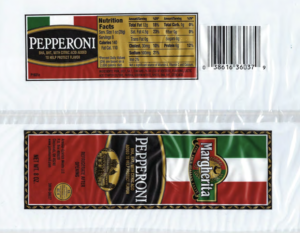
The RTE unsliced pepperoni product was produced and packaged on June 17, 2021.  The following products are subject to recall [view label]:

  • 8-oz. plastic shrink-wrapped packages containing unsliced pepperoni “Margherita PEPPERONI” with lot code P1931C and a “use by date” of 12-14-21 represented on the label.

The products subject to recall bear establishment number “EST. 19” inside the USDA mark of inspection. These items were shipped to retail locations nationwide.

The problem was discovered when the Department of Defense notified FSIS that they found B. cereus during routine product testing.

B. cereus is a toxin-producing microorganism that causes diarrhea and vomiting in people. Those with compromised immune systems are at risk for more severe illness. Vigorous rehydration and other supportive care including antibiotics are the usual treatment.

There have been no confirmed reports of adverse reactions due to consumption of these products. Anyone concerned about an injury or illness should contact a healthcare provider.

FSIS is concerned that some product may be in consumers’ pantries or refrigerators. Consumers who have purchased these products are urged not to consume them. These products should be thrown away or returned to the place of purchase.

FSIS routinely conducts recall effectiveness checks to verify recalling firms notify their customers of the recall and that steps are taken to make certain that the product is no longer available to consumers. When available, the retail distribution list(s) will be posted on the FSIS website at www.fsis.usda.gov/recalls.

Media with questions regarding the recall can contact Jim Monroe, Corporate Affairs, Margherita Meats Corp., at (703) 559-1875. Consumers should call the Margherita Consumer Affairs Hotline at (844) 342-2596.

Consumers with food safety questions can call the toll-free USDA Meat and Poultry Hotline at 1-888-MPHotline (1-888-674-6854) or live chat via Ask USDA from 10 a.m. to 6 p.m. (Eastern Time) Monday through Friday. Consumers can also browse food safety messages at Ask USDA or send a question via email to MPHotline@usda.gov. For consumers that need to report a problem with a meat, poultry, or egg product, the online Electronic Consumer Complaint Monitoring System can be accessed 24 hours a day at https://foodcomplaint.fsis.usda.gov/eCCF/.

RASFF Alert- Bacillus cereus – Millet Flour

RASFF

Aflatoxins and Bacillus cereus in organic sesame seeds from Togo in Germany, Netherlands and Switzerland

Research – Control of Bacillus weihenstephanensis in Pasteurized Liquid Whole Eggs Formulated with Nisin

Journal of Food Protection

Bacillus weihenstephanensis can grow at refrigeration temperature and cause food poisoning. It has been isolated from liquid whole egg products. The moderate heat used for pasteurization of liquid egg products is ineffective for killing spore-forming bacteria including Bacillus. Available predictive models and a pretrial study in broth suggested the potential for growth of Bacillus spp. under the tested conditions. Hence, hurdles such as storage of product below 4°C or use of preservatives would be needed to ensure the food safety of pasteurized egg products. This study evaluated the growth inhibition of B. weihenstephanensis in pasteurized liquid whole egg product formulated with 6.25 ppm nisin during storage at refrigerated and abuse refrigerated temperatures for a total 13 weeks, in three replicate trials. At day 0, the product had a pH of 7.52±0.29, while background microflora such as aerobic plate counts, presumptive B. cereus, and yeast and molds were <10 CFU/g. Product inoculated with target 2.5 log10 CFU/g of B. weihenstephanensis, stored at 4°C for 4 weeks and subsequently at 7 or 10°C for 9 weeks exhibited no growth in all three replicate trials.  Average counts reduced (p<0.05) by at least one-log10 in six weeks in all samples stored at either 7 or 10°C. Similarly, growth of total plate counts, presumptive Bacillus spp., yeast and mold counts was not observed in uninoculated controls stored at 4°C for 4 weeks and subsequently at 7 or 10°C for 9 weeks. Visual and odor evaluation performed at each sampling time point showed no abnormalities. This study assessed the efficacy of maximum allowed level of nisin for use in pasteurized liquid whole eggs and validated the inhibition of B. weihenstephanensis in the product for an extended shelf life of up to 13 weeks.

USA – FDA Enforcement Report – Ripple Dairy-Free. As It Should Be 8g Plant Based Protein – Bacillus cereus

FDA

Product Description:

Ripple Dairy-Free. As It Should Be8g Plant Based Protein;Half the Sugar of Dairy MilkPET bottle with twist cap50% More Calcium that Dairy Milk.Keep refrigerated. Fresh for 7-10 days after opening.48 fl oz. (1.5 qt) ((1.42L) – 6 x 48 ox. bottles per caseIngredients:Water, Pea Protein blend, (water, pea protein) cane more…

Reason for Recall:

Complaint led investigation found the presence of Bacillus Cereus in one lot of product.

Product Quantity:

YF 21250: 8,636,YF 21251: 8,864

Recall Number:

F-0284-2022

Code Information:

Lot numbers: YF21250, Best by: 3/6/2022 Lot number: YF21251, Best by: 3/7/2022

Classification:

Class II

Research – The Application of Bacillus subtilis for Adhesion Inhibition of Pseudomonas and Preservation of Fresh Fish

MDPI

Inhibiting the growth of spoilage bacteria, such as Pseudomonas spp., is key to reducing spoilage in fish. The mucus adhesion test in vitro showed that the adhesion ability of Bacillus subtilis was positively correlated with its inhibition ability to Pseudomonas spp. In vivo experiments of tilapia showed that dietary supplementation with B. subtilis could reduce the adhesion and colonization of Pseudomonas spp. in fish intestines and flesh, as well as reduce total volatile basic nitrogen (TVB-N) production. High throughput and metabolomic analysis showed treatment with B. subtilis, especially C6, reduced the growth of Pseudomonas spp., Aeromonas spp., Fusobacterium spp., and Enterobacterium spp., as well as aromatic spoilage compounds associated with these bacteria, such as indole, 2,4-bis(1,1-dimethylethyl)-phenol, 3-methyl-1-butanol, phenol, and 1-octen-3-ol. Our work showed that B. subtilis could improve the flavor of fish by changing the intestinal flora of fish, and it shows great promise as a microecological preservative. View Full-Text

USA – Smithfield Packaged Meats Corp. Dba Margherita Meats Inc. Recalls Pepperoni Products Due To Possible Bacillus Cereus Contamination

FSIS USDA

WASHINGTON, Dec. 14, 2021 – Smithfield Packaged Meats Corp., doing business as Margherita Meats, Inc., an Omaha, Neb. establishment, is recalling approximately 10,990 pounds of ready-to-eat (RTE) pepperoni products that may be adulterated with Bacillus cereus (B. cereus), the U.S. Department of Agriculture’s Food Safety and Inspection Service (FSIS) announced today.

The RTE unsliced pepperoni product was produced and packaged on June 17, 2021.  The following products are subject to recall [view label]:

  • 8-oz. plastic shrink-wrapped packages containing unsliced pepperoni “Margherita PEPPERONI” with lot code P1931C and a “use by date” of 12-14-21 represented on the label.

The products subject to recall bear establishment number “EST. 19” inside the USDA mark of inspection. These items were shipped to retail locations nationwide.

The problem was discovered when the Department of Defense notified FSIS that they found B. cereus during routine product testing.

B. cereus is a toxin-producing microorganism that causes diarrhea and vomiting in people. Those with compromised immune systems are at risk for more severe illness. Vigorous rehydration and other supportive care including antibiotics are the usual treatment.

There have been no confirmed reports of adverse reactions due to consumption of these products. Anyone concerned about an injury or illness should contact a healthcare provider.

FSIS is concerned that some product may be in consumers’ pantries or refrigerators. Consumers who have purchased these products are urged not to consume them. These products should be thrown away or returned to the place of purchase.

FSIS routinely conducts recall effectiveness checks to verify recalling firms notify their customers of the recall and that steps are taken to make certain that the product is no longer available to consumers. When available, the retail distribution list(s) will be posted on the FSIS website at www.fsis.usda.gov/recalls.

Media with questions regarding the recall can contact Jim Monroe, Corporate Affairs, Margherita Meats Corp., at (703) 559-1875. Consumers should call the Margherita Consumer Affairs Hotline at (844) 342-2596.

Consumers with food safety questions can call the toll-free USDA Meat and Poultry Hotline at 1-888-MPHotline (1-888-674-6854) or live chat via Ask USDA from 10 a.m. to 6 p.m. (Eastern Time) Monday through Friday. Consumers can also browse food safety messages at Ask USDA or send a question via email to MPHotline@usda.gov. For consumers that need to report a problem with a meat, poultry, or egg product, the online Electronic Consumer Complaint Monitoring System can be accessed 24 hours a day at https://foodcomplaint.fsis.usda.gov/eCCF/.

Click to access 047-2021-labels.pdf

Research – Bacillus amyloliquefaciens ALB65 Inhibits the Growth of Listeria monocytogenes on Cantaloupe Melons

ABSTRACT

Listeria monocytogenes is a foodborne pathogen that causes high rates of hospitalization and mortality in people infected. Contamination of fresh, ready to eat produce by this pathogen is especially troubling because of the ability of this bacterium to grow on produce under refrigeration temperatures. In this study, we created a library of over 8,000 plant phyllosphere-associated bacteria and screened them for the ability to inhibit the growth of L. monocytogenes in an in vitro fluorescence-based assay. One isolate, later identified as Bacillus amyloliquefaciens ALB65, was able to inhibit the fluorescence of L. monocytogenes by >30-fold in vitro. B. amyloliquefaciens ALB65 was also able to grow, persist, and reduce the growth of L. monocytogenes by >1.5 log CFU on cantaloupe melon rinds inoculated with 5 × 103 CFU at 30°C and was able to completely inhibit its growth at temperatures below 8°C. DNA sequence analysis of the B. amyloliquefaciens ALB65 genome revealed six gene clusters that are predicted to encode genes for antibiotic production; however, no plant or human virulence factors were identified. These data suggest that B. amyloliquefaciens ALB65 is an effective and safe biological control agent for the reduction of L. monocytogenes growth on intact cantaloupe melons and possibly other types of produce.
IMPORTANCE Listeria monocytogenes is estimated by the Centers for Disease Control and Prevention and the U.S. Food and Drug Administration to cause disease in approximately 1,600 to 2,500 people in the United States every year. The largest known outbreak of listeriosis in the United States was associated with intact cantaloupe melons in 2011, resulting in 147 hospitalizations and 33 deaths. In this study, we demonstrated that Bacillus amyloliquefaciens ALB65 is an effective biological control agent for the reduction of L. monocytogenes growth on intact cantaloupe melons under both pre- and postharvest conditions. Furthermore, we demonstrated that B. amyloliquefaciens ALB65 can completely inhibit the growth of L. monocytogenes during cold storage (<8°C).