Monthly Archives: January 2020

Research – Thermal and Chemical Treatments To Reduce Salmonella on Alfalfa (Medicago sativa) and Broccoli (Brassica oleracea var. italica) Seeds before and during the Sprouting Process: A Hurdle Approach

Journal of Food Protection

ABSTRACT

Sprouts are vehicles of foodborne diseases caused by pathogens such as Salmonella. The aim of this study was to evaluate thermal and chemical treatments applied as a hurdle approach to reduce Salmonella in alfalfa (Medicago sativa) and broccoli (Brassica oleracea var. italica) seeds before and during their germination. Seeds, inoculated and then dried at 55°C for 48 h, were subjected to a chemical treatment and a thermal shock with (i) 75 mM caprylic acid at 70°C for 5 s, (ii) 0.04% CaO at 70°C for 5 s, or (iii) 1% H2O2 at 70°C for 5 s. After each treatment, seeds were immersed in water at 3°C for 5 s. Next, the imbibition process was carried out with 0.016% H2O2 at pH 3.0. Finally, the seeds were transferred to a rotary drum-type germinator and were sprayed with the same chemical solution that was applied before the imbibition process, for 20 s at intervals of 5 min for 40 min at 3 rpm. All chemical treatments reduced Salmonella at least 5 log CFU/g on both seeds. Germination rates between 90 and 93% were obtained after application of thermal and chemical treatments. Salmonella was not detected after the imbibition stage when caprylic acid and H2O2 treatments were applied. However, during the germination process of both seeds, Salmonella counts of >6 log CFU/g were obtained despite all treatments being applied at different stages of the sprouting process. These results demonstrated that thermal and chemical treatments used as a hurdle approach to control Salmonella on alfalfa and broccoli seeds significantly reduced the pathogen concentration on seeds >5 log but were ineffective to eliminate Salmonella and to control its growth during the sprouting process. The production of safe sprouts continues to be a major challenge for industry.
HIGHLIGHTS
  • A hurdle approach reduces Salmonella concentration >5 log on alfalfa and broccoli seeds.

  • Germination rates over 90% were reached on alfalfa and broccoli seeds after sequential treatments.

  • Salmonella counts increase during germination, despite the efficacy of previous treatments on seeds.

  • Production of safe sprouts continues to be a major challenge for industry.

USA – Pig ears still a Salmonella risk despite interventions

AVMA

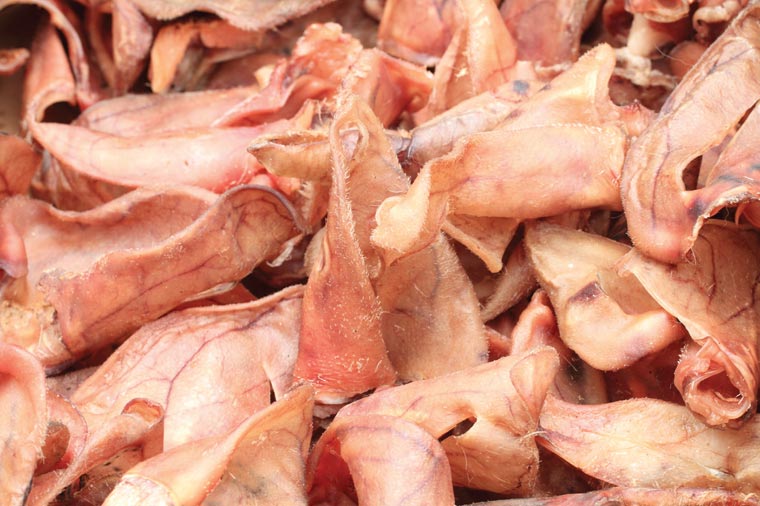
Pig ear treats remain a source of Salmonella after decades of illnesses.

The most recent outbreaks linked with pig ears ended in October 2019 after at least 154 illnesses with 35 people hospitalized. Companies recalled treats imported from Argentina, Brazil, and Columbia.

Pig ear treats have been linked with illness outbreaks since at least 1999, when epidemiologists said the products likely sickened at least 30 people in Canada. U.S. authorities blocked entry of the implicated products.

Pig ear treats

Image AVMA

Mexico – Children suffer food poisoning at IMSS health service daycare

Mexico News Daily

As many as 70 young children suffered food poisoning at an IMSS daycare in Guadalajara, Jalisco, on Tuesday.

They are believed to have taken ill after eating tainted panela cheese they were served at lunch at the daycare, operated by the Mexican health service.

Showing severe symptoms of vomiting and diarrhea, the children ranging in age from a few months to 4 years old were taken to several IMSS clinics in the city but were later reported to be in stable condition.

Tainted panela cheese blamed for the outbreak.

Thailand – More than 100 Chiang Mai students hospitalised with food poisoning

The Thiager

There was chaos at Chiang Mai hospitals yesterday when around 130 students were hospitalised with food poisoning. The grade 8 students from Montfort College in Chiang Mai had eaten lunch at the San Sai scout camp when they began showing symptoms of food poisoning, including diarrhea, vomiting and stomach cramps.

There were an estimated 400 students at the camp: about 89 were taken to the local San Sai Hospital and another 50 taken to other Chiang Mai area hospitals. 30 doctors and nurses were dispatched to the camp in Mae Faek subdistrict of Chiang Mai’s San Sai to treat other students who did not require hospitalisation.

Details of the food poisoning remain unclear other than a boiled chicken dish with dipping sauce was served for the children’s lunch.

RASFF Alerts – Salmonella – Breaded Alaskan Pollock Fillets – Chicken Quarters – Chilled Turkey Breast Fillets – Processed Fish Maws

RASFF-Logo

RASFF – Salmonella (present /25g) in chilled breaded Alaska pollock fillets (Theragra chalcogramma) from the Netherlands in Germany

RASFF – Salmonella enterica ser. Enteritidis (4 out of 5 samples /25g) in back chicken quarters from Poland in Poland

RASFF – Salmonella enterica ser. Typhimurium monophasic (1 ,4, [5], 12:i:-) (presence /25g) in chilled turkey breast fillet from Poland, via Denmark in Finland

RASFF – Salmonella enterica ser. Kentucky (presence /25g) and Salmonella enterica ser. Senftenberg (presence /25g) in processed fish maws from the Gambia in the UK

RASFF Alerts – Aflatoxin – Groundnut Kernels – Roasted Peanuts – Dried Figs – Ground Hazlenuts

RASFF-Logo

RASFF – aflatoxins (Tot. = 63 µg/kg – ppb) in groundnut kernels from Argentina in Italy

RASFF – aflatoxins (B1 = 12.2; Tot. = 14 µg/kg – ppb) in roasted peanuts from Italy, with raw material from China in Belgium

RASFF – aflatoxins (B1 = 5.7; Tot. = 14.7 µg/kg – ppb) in dried figs from Turkey in France

RASFF – aflatoxins (Tot. = 11.64 µg/kg – ppb) in ground hazelnuts from Turkey in Germany

RASFF Alerts – Listeria monocytogenes – Frozen Potato Slices – Chilled Cooked Sausages with Parsley

RASFF-Logo

RASFF – Listeria monocytogenes (presence /100g) in frozen potato slices from Belgium in the UK

RASFF – Listeria monocytogenes (<10 CFU/g) in chilled cooked sausage with parsley from Belgium in Belgium

RASFF Alert – Food Poisoning – Cheese

RASFF-Logo

RASFF – food poisoning suspected to be caused by cheese from the Netherlands in the Netherlands

RASFF Alerts – Norovirus – Oysters

RASFF-Logo

RASFF – foodborne outbreak suspected to be caused by live oysters from France in Italy

RASFF – foodborne outbreak caused by and norovirus in live oysters from France in Sweden

RASFF – norovirus (presence) in oysters (Crasosstrea gigas) from France in the Netherlands

RASFF – withdrawal of live bivalve molluscs harvested in France because of possible contamination with norovirus in France

RASFF – withdrawal of live bivalve molluscs harvested in France because of possible contamination with norovirus in Denmark

RASFF – withdrawal of live bivalve molluscs harvested in France because of possible contamination with norovirus in France

RASFF – withdrawal of cupped oysters (huitres creuses) harvested in France because of possible contamination with norovirus in the Netherlands

RASFF – norovirus in frozen oysters (Crassostrea gigas) from South Korea, via the Netherlands and via Sweden in Finland

RASFF Alert – Animal Feed -Salmonella – Toasted Soya Beans

RASFF-Logo

RASFF – Salmonella enterica ser. Agona (present /25g) in toasted soy beans from Belgium in Belgium