Monthly Archives: January 2020

Research – Acidic environment could boost power of harmful pathogens

Science Daily

When food we’ve swallowed reaches our stomachs, it finds an acidic environment. The low pH in the stomach helps to begin digestion — and has been thought to kill the bacteria that hides in food that otherwise could harm our bodies.

However, recent work from the Ackley and Chandler labs in the Department of Molecular Biosciences at the University of Kansas runs counter to this idea, instead suggesting lower pH in the digestive tract may make some bacterial pathogens even more harmful.

Their findings, published in the peer-reviewed journal PLOS Pathogens, could have implications for addressing the crisis of antibiotic resistance in bacterial infections around the world.

The investigation was performed using small, bacteria-eating organisms called Caenorhabditis elegans.

Research – Treatment of fresh produce with a Salmonella‐targeted bacteriophage cocktail is compatible with chlorine or peracetic acid and more consistently preserves the microbial community on produce

Wiley Online

Diets rich in minimally processed foods are associated with numerous health benefits, in part, due to their diverse, natural microbiota. However, antimicrobials, such as chlorine and peracetic acid (PAA), that are used to address food safety concerns may damage the natural microflora of fresh produce. One promising approach for targeting pathogenic bacteria in foods without impacting the normal food microbiota are bacteriophages. In this study, we observed that combinational treatment of conventional antimicrobials (PAA and chlorine) and bacteriophages, specifically the Salmonella‐targeted preparation SalmoFresh, retained the bactericidal effectiveness of individual interventions, and in some cases, achieved substantially increased efficacy. Additionally, the bacterial microbiomes of farm fresh and organic produce were less affected after phage treatment compared to PAA and chlorine. Finally, our study revealed that resistance rates against SalmoFresh were relatively minor and unaffected by the stresses introduced after chemical washes and/or bacteriophage treatment.

Information -10 of the germiest places in hotel rooms

WFMZ

It’s the busiest travel time of the year. But before you pack up your suitcase and head to Grandma’s for the holidays, there’s something you should know about that hotel room you may be staying in: it’s dirtier than you think!

It looks clean, but just how clean is it?

Before you kick back your feet and turn on the TV, you might want to wipe down that remote with some Lysol wipes. These apparently house guests such as E. Coli, MRSA and Staph.

Be wary of the drinking glasses, especially if the hotel does not have a restaurant or a kitchen to wash the glasses. The habit of some cleaners is to rinse them under the bathroom tap without using soap and dry them with a hotel towel.

Some other tips: skip making your own coffee. Coffee makers can harbor mold and respiratory viruses if not cleaned properly.

And speaking of not being cleaned properly, one investigation of hotel ice buckets found many of them tested positive for E. coli.

Canada -Scarpone’s Italian Store brand frozen Ground Veal recalled due to E. coli O157:H7

CFIA

Recall details

Ottawa, January 13, 2020 – The Italian Store is recalling Scarpone’s Italian Store brand frozen Ground Veal from the marketplace due to possible E. coli O157:H7 contamination. Consumers should not consume the recalled product described below.

Recalled products

Brand Product Size UPC Codes Additional Information
Scarpone’s Italian Store Ground Veal (frozen) Variable Starting with:
0 200904
All units sold between December 23, 2019 and January 13, 2020, inclusive. Sold at The Italian Store, 5140 Skyline Way NE, Calgary, AB.

What you should do

If you think you became sick from consuming a recalled product, call your doctor.

Check to see if you have the recalled product in your home. Recalled products should be thrown out or returned to the store where they were purchased.

Food contaminated with E. coli O157:H7 may not look or smell spoiled but can still make you sick. Symptoms can include nausea, vomiting, mild to severe abdominal cramps and watery to bloody diarrhea. In severe cases of illness, some people may have seizures or strokes, need blood transfusions and kidney dialysis or live with permanent kidney damage. In severe cases of illness, people may die.

Background

This recall was triggered by Canadian Food Inspection Agency (CFIA) test results. The CFIA is conducting a food safety investigation, which may lead to the recall of other products. If other high-risk products are recalled, the CFIA will notify the public through updated Food Recall Warnings.

The CFIA is verifying that industry is removing the recalled product from the marketplace.

Illnesses

There have been no reported illnesses associated with the consumption of this product.

Product photos

Printer ready version of photos

  • Scarpone's Italian Store - Ground Veal (frozen)
  • Universal Product Code - Scarpone's Italian Store - Ground Veal (frozen)

Hong Kong – Import and sale of shellfishes harvested in production areas 35.11 and 35.06 in France suspended

CFS

Issue Date 10.1.2020
Source of Information Centre for Food Safety
Food Product Shellfishes
Product Name and Description Shellfishes harvested in production areas 35.11 and 35.06 in France
Reason For Issuing Alert
  • The CFS received a notification from the Rapid Alert System for Food and Feed (RASFF) of the European Commission that shellfishes harvested in the abovementioned areas which were suspected to be contaminated with norovirus were under recall.
  • The CFS immediately followed up with major local importers and retailers. Preliminary investigation found that a local importer had imported not ready-to-eat mussels from the abovementioned areas into Hong Kong which were on sale in its supermarkets.
Action Taken by the Centre for Food Safety
  • For the sake of prudence, the CFS has immediately suspended the import into and sale within Hong Kong of all shellfishes harvested in the two areas concerned.
  • The importer concerned had already voluntarily stopped sale and removed from shelves of the affected product for the sake of prudence.
  • The CFS is tracing the distribution of the affected product.
  • The CFS has informed the French authorities of the import suspension and will also notify the local trade.
  • The CFS will continue to follow up on the incident and take appropriate action to safeguard food safety and public health.
Advice to the Trade Stop using or selling the affected product harvested in the abovementioned areas concerned immediately.
Advice to Consumers
  • One may be infected by norovirus or other pathogenic microorganism if consuming undercooked shellfish which is contaminated. So, shellfish should be thoroughly cooked before consumption.
  • Young children, elderly people, pregnant women and others with weakened immune systems should pay special attention when consuming shellfish.
Further Information The CFS press release

France -Collective food-borne infections suspected of being linked to the consumption of raw shellfish, epidemiological report as of January 8, 2020

Sante Publique France

Cases of TIAC suspected of being linked to the consumption of raw shellfish in mainland France have been reported since December 2019.

A collective food poisoning (TIAC) ​​is defined by the appearance of at least 2 cases of illness with a similar symptomatology, generally gastrointestinal, the cause of which can be related to the same food or meal. Any person (doctor, manager of collective catering establishments, consumer, etc.) who is aware of an episode that may be a TIAC, must declare this suspicion of TIAC to the administration (Regional Health Agency (ARS) and / or the Departmental Directorate (for social cohesion) and for the protection of populations (DD (CS) PP). This declaration involves local information from the other structure (ARS or DD (CS) PP).

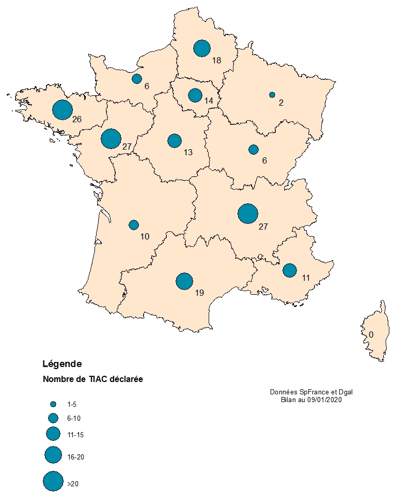
Since the beginning of December 2019, 179 compulsory declarations (DO) of collective food poisoning (TIAC) ​​suspected of being linked to the consumption of raw shellfish, mainly oysters, have been sent to Santé publique France. The reports come from the majority of regions in mainland France (see Figure 1).

Figure 1 – Number of TIAC suspected of being linked to the consumption of raw shellfish, by reporting region. Metropolitan France, December 1, 2019 – January 8, 2020.
Figure 1 - Number of TIAC suspected of being linked to the consumption of raw shellfish, by reporting region.  Metropolitan France, December 1, 2019 - January 8, 2020.

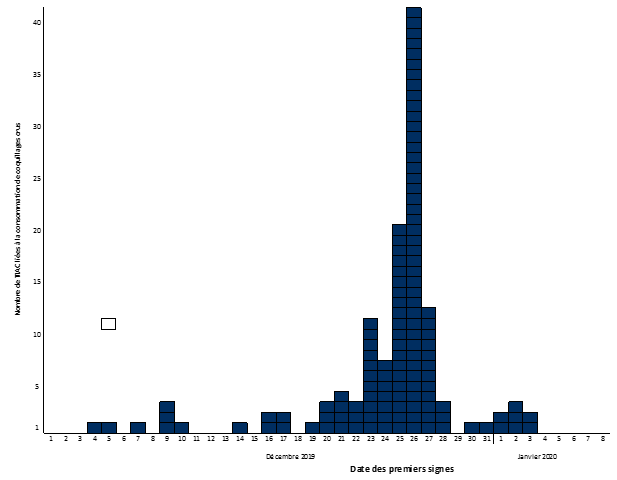
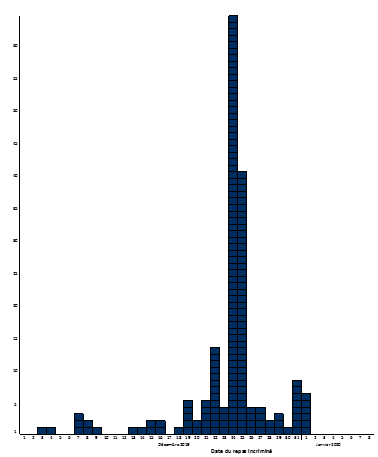
The vast majority (138/179, 77%) of these TIAC occurred from December 23 (Figures 2 and 3). A peak of patients is observed around December 25-27 (Figure 2). The offending meals are grouped around December 24-25 (Figure 3).

A total of 1,033 people were sick, of whom 21 (2%) were hospitalized. Most of them are people over the age of 15. Of the 595 patients with age information, 19 (3.1%) were children under the age of 15. The symptoms, mainly diarrhea and vomiting, as well as the incubation times, are compatible with infections with norovirus or other enteric viruses. Stool tests performed to date by the National Reference Center for Gastroenteritis Viruses have confirmed the presence of norovirus and other enteric viruses.

Figure 2 – Number of TIAC suspected of being linked to the consumption of raw shellfish by date of first signs of patients (information available for 125/179 TIAC). December 1, 2019 – January 8, 2020.
Figure 2 - Number of TIAC suspected of being linked to the consumption of raw shellfish by date of first signs of patients (information available for 125/179 TIAC).  December 1, 2019 - January 8, 2020.
Figure 3 – Number of TIAC suspected of being linked to the consumption of raw shellfish by date of the offending meal (information available for 176/179 TIAC). December 1, 2019 – January 8, 2020.
Figure 3 - Number of TIAC suspected of being linked to the consumption of raw shellfish by date of the offending meal (information available for 176/179 TIAC).  December 1, 2019 - January 8, 2020.

The number of TIAC suspected of being linked to the consumption of raw shellfish is significantly higher than in previous years. Each year between 25 and 120 TIAC suspected of being linked to the consumption of shellfish are reported to Public Health France, of which between 4 and 30 occurred during the December-January periods.

Following reports from TIAC suspected of being linked to the consumption of raw shellfish, the Directorate General for Food (DGAL) in conjunction with the Departmental Directorates in charge of protecting populations (DD (CS) PP) is carrying out an investigation traceability in order to trace back to the production area for suspected shellfish and confirmation analyzes are carried out on the areas concerned. To date, several areas have been closed due to contamination by noroviruses. Zone closings can be viewed on this site:
http://www.atlas-sanitaire-coquillages.fr/ (“Statutes” section)

USA – Seven Seattle Evergreen Restaurants Associated with E. coli Outbreak

Food Poisoning Bulletin 

There are now seven Seattle Evergreen Restaurants associated with an E. coli O157:H7 outbreak that has sickened 15 people, an increase of two more patients since the last update posted in December 2019. The outbreak appears to be over, according to the Seattle King County Health Department, but the investigation is ongoing. Three people were hospitalized because they were so sick.

The seven Seattle Evergreen restaurants named by the health department include Evergreen locations at:

  • Pioneer Square (106 1st Avenue S, Seattle)
  • University District (4609 Village Ter NE, Seattle)
  • Downtown (823 3rd Avenue, Seattle)
  • Chinatown-International District (504 5th Ave South, Seattle)
  • Sammamish Highlands (600 228th Avenue NE, Sammamish)
  • Seattle-Tacoma International Airport (17801 International Blvd, Seattle)
  • 2nd and Pike Street (1430 2nd Ave, Seattle)

Cruise Ship – Norovirus – What you need to know.

Cruise Critic

With cruise ship “outbreaks” regularly appearing in the news, awareness of Norovirus — an extremely common and highly contagious virus that causes gastroenteritis — has been significantly raised.
But before you reconsider that long-awaited cruise vacation because of gloom-and-doom reports on television and in your daily paper, know these facts:

  • Norovirus is not a “cruise ship” virus, nor does it limit itself to sea-going vessels.
  • Norovirus spreads swiftly wherever there are many people in a small area, including nursing homes, restaurants, hotels, dormitories … and cruise ships.
  • The common cold is the only illness more common, and the Centers for Disease Control and Prevention in Atlanta estimates that there are more than 20 million cases of Norovirus annually.
  • Norovirus is associated with cruise travel simply because health officials are required to track illnesses on ships (and are not at hotels and resorts); therefore, outbreaks are found and reported more quickly at sea than on land.

Here’s everything you need to know about Norovirus — and how to avoid getting sick on your next cruise vacation. See the link above.

Singapore -SFA recalls live mussels from France due to presence of Norovirus

CNA


SINGAPORE: The Singapore Food Agency (SFA) said on Saturday (Jan 11) that it has directed food specialist Classic Fine Foods to recall the Bouchot live mussels from France.

In a media release, SFA said that the European Commission Rapid Alert System for Food and Feed has issued a recall for the live mussels from Baie Du Mont-Saint-Michel Aop in France “due to the presence of a norovirus”.

Research-Nisin-Based Organic Acid Inactivation of Salmonella on Grape Tomatoes: Efficacy of Treatment with Bioluminescence ATP Assay

Journal of Food Protection

ABSTRACT

The antimicrobial activity of a new nisin-based organic acid sanitizer (NOAS), developed in our laboratory, was tested against viable aerobic mesophilic bacteria and Salmonella populations inoculated on produce surfaces. The activity of NOAS was compared with 200 ppm of chlorinated wash water and a bioluminescence ATP technique to determine the efficacy of treatments compared with plate count methods. The activity of the 10% final concentration of NOAS against viable populations of 109 CFU/mL Salmonella in phosphate-buffered saline (PBS), sterile deionized distilled water, and buffered peptone water was tested in vitro and on grape tomatoes inoculated with Salmonella at 2.5 log CFU/g. A similar batch of inoculated tomatoes were treated with 200 ppm of total available chlorinated water. All treatments for inactivation of viable Salmonella in vitro was tested up to 30 min and 5 min for the attached populations on tomatoes. Inactivation of viable Salmonella at 109 log CFU/mL by 10% the NOAS solution averaged >107 log CFU/mL in PBS, sterile deionized distilled water, and buffered peptone water. Similarly, Salmonella bacteria inactivated on tomato surfaces by the NOAS solution was significantly (P < 0.05) greater than numbers on chlorinated washed tomatoes, and surviving bacterial populations on NOAS and chlorine-treated tomatoes were <1 and 4 CFU/g, respectively. A significant linear correlation coefficient (r2 = 0.99) between the bioluminescence ATP assay and aerobic plate counts of inoculated and untreated grape tomatoes were recorded but not with NOAS and chlorine-treated tomatoes, as bacterial populations were less than the minimum baseline for determination. Also, the results indicated that the NOAS solution is a better alternative antimicrobial wash solution than 200 ppm of chlorinated water.

HIGHLIGHTS
  • The antimicrobial activity of NOAS was compared with chlorinated water.

  • Salmonella bacteria were more susceptible to NOAS than chlorinated water.

  • Assay correlated with aerobic plate count of inoculated and untreated tomatoes, not treated ones.

  • NOAS is an excellent alternative antimicrobial wash solution compared with chlorinated wash water.