Research – Yersiniosis – Annual Epidemiological Report for 2021

ECDC

For 2021, 6 876 confirmed cases of yersiniosis (caused by Yersinia enterocolitica and Y. pseudotuberculosis) were reported by 28 EU/EEA countries with an overall rate of 1.9 cases per 100 000 population. This represented an increase of 11.8% on 2020 and the pre-pandemic period (2017−2019). As in previous years, Germany accounted for the highest number of cases, followed by France. These two countries accounted for 49% of all confirmed yersiniosis cases in the EU/EEA. Denmark had the highest notification rate of 7.8 cases per 100 000 population, followed by Finland, Lithuania and Czechia (Table 1, Figure 1).
Thirty-three percent of 1 649 yersiniosis cases with known information were hospitalised. No deaths were reported among the 3 659 cases with known outcome.
Click to access AER%20yersiniosis%20-%202021.pdf

Research – Strategies for Controlling the Sporulation in Fusarium spp

MDPI

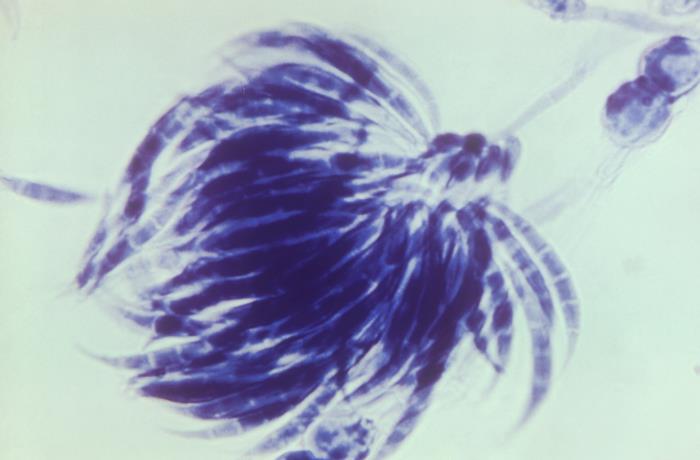
Fusarium species are the most destructive phytopathogenic and toxin-producing fungi, causing serious diseases in almost all economically important plants. Sporulation is an essential part of the life cycle of Fusarium. Fusarium most frequently produces three different types of asexual spores, i.e., macroconidia, chlamydospores, and microconidia. It also produces meiotic spores, but fewer than 20% of Fusaria have a known sexual cycle. Therefore, the asexual spores of the Fusarium species play an important role in their propagation and infection. This review places special emphasis on current developments in artificial anti-sporulation techniques as well as features of Fusarium’s asexual sporulation regulation, such as temperature, light, pH, host tissue, and nutrients. This description of sporulation regulation aspects and artificial anti-sporulation strategies will help to shed light on the ways to effectively control Fusarium diseases by inhibiting the production of spores, which eventually improves the production of food plants.

Research – Control measures for Shiga toxin-producing Escherichia coli (‎STEC)‎ associated with meat and dairy products: meeting report

WHO

Overview

Although Shiga toxin-producing Escherichia coli (STEC) have been isolated from a variety of food production animals, they are most commonly associated with ruminants from which we derive meat and milk. Because of the widespread and diverse nature of ruminant-derived food production, coupled with the near ubiquity of STEC worldwide, there is no single definitive solution for controlling STEC that will work alone or in all situations. Instead, the introduction of multiple interventions applied in sequence, as a “multiple-hurdle scheme” at several points throughout the food chain (including processing, transport and handling) will be most effective.

This report summarizes the review and evaluation of interventions applied for the control of STEC in cattle, raw beef and raw milk and raw milk cheese manufactured from cows’ milk, and also evaluates available evidence for other small ruminants, swine and other animals. The information is presented from primary production, to the end of processing, providing the reader with information on the currently available interventions based on the latest scientific evidence.

This work was undertaken to support the development of guidelines for the control of STEC in beef, raw milk and cheese produced from raw milk by the Codex Committee on Food Hygiene (CCFH).

Report


Denmark – Listeria in salmon salad with oatmeal

DVFA

Coop Danmark A/S is recalling salmon salad with oat rice, as Listeria monocytogenes has been detected in hot-smoked salmon, which is included as an ingredient in the meal salad.
Recalled Foods , Published: December 21, 2022
 
​Which food:
Salmon salad with oatmeal
Net weight: 350g
EAN number: 5700384594915
Last dates of use: All dates from 20.12.2022 to and including 26.12.2022
​
Sold in:
Kvickly, SuperBrugsen, Dagli’Brugsen, Fakta, Coop365 and Irma throughout the country as well as Coop.dk/Food.
 
Company that revokes:
Coop Danmark A/S, Roskildevej 65, 2620 Albertslund.
 
Cause:
The bacterium Listeria monocytogenes has been detected in hot-smoked salmon, which is included in the meal salad.
 
Risk:
Infection with Listeria bacteria, where the symptoms can include flu-like symptoms, fever and headache and, in rare cases, gastrointestinal problems. 
 
Advice for consumers:
The Danish Veterinary and Food Administration advises consumers to return the product to the store where it was purchased or to discard it. If you have questions about symptoms or illness, you should contact your own doctor or the doctor on duty.

Germany – Qurt vanilla 200 g (quark preparation) – Salmonella

LMW

Alert type: groceries
Date of first publication: 12/20/2022
Product name:

Qurt vanilla 200 g (quark preparation)

Product images:
221219 product recall Qurt vanilla 03012023.jpg


Manufacturer (distributor):

Lobetal organic dairy, Sydower Feld 1, DE 16359 Biesenthal

Reason for warning:

Detection of Salmonella

Packaging Unit: 200 g
Durability: 01/03/2023
Manufacturer’s website:


Australia – The Yoghurt Shop Caramel Crumble Yoghurt 190g – E.coli

FSANZ

Product information

Purely Natural Yoghurt is conducting a recall of the below product. The product has been available for sale at Coles in SA and NT; IGA in SA and NT; and OTR (On The Run) locations in SA.

Date markings

Best Before date – BB: 23/01/23

The Yoghurt Shop Caramel Crumble Yoghurt 190g

Problem

The recall is due to microbial (E.coli) contamination.

Food safety hazard

Food products contaminated with E.coli may cause illness if consumed.

Country of origin

Australia

What to do​

Consumers should not eat this product and should return the product to the place of purchase for a full refund. Any consumers concerned about their health should seek medical advice.

For further information please contact:

Purely Natural Yoghurt
(08) 7081 0711
​

Related links:

Research – Salmonellosis – Annual Epidemiological Report for 2021

ECDC

In 2021, 30 EU/EEA countries reported data on salmonellosis. Twenty-six countries reported data using either the 2008, 2012 or 2018 EU case definitions for salmonellosis. Compared with the 2008 and 2012 EU case definitions, the 2018 EU case definition allows nucleic acid determination for laboratory confirmation, and includes a requirement for antimicrobial susceptibility testing and reporting of results. Four countries used another case definition, which was not specified.

Click to access SALM_AER_2021.pdf

Research – Hepatitis A – Annual Epidemiological Report for 2021

ECDC

In 2021, 30 EU/EEA countries reported 3 864 cases of hepatitis A (Table 1). The EU/EEA notification rate was 0.9 cases per 100 000 population. In 2021, both the lowest number of reported cases and the lowest notification rate were reported since the beginning of EU-level hepatitis A surveillance in 2007. The total number of hepatitis A cases reported in EU/EEA countries in 2021 represented a decrease of 65.7% and 12.3% compared to 2019 and 2020, respectively.

Click to access HEPA_AER_2021.pdf

Research – STEC infection – Annual Epidemiological Report for 2021

ECDC

For 2021, 6 534 confirmed cases of STEC infection were reported by 30 EU/EEA countries (Table 1). Twenty-seven countries reported at least two confirmed cases, and three countries reported no cases. The EU/EEA notification rate was 2.2 cases per 100 000 population, representing a 37.5% increase compared with the previous year.

Click to access AER%20STEC%20-%202021.pdf

Listeriosis – Annual Epidemiological Report for 2021

ECDC

In 2021, 2 268 confirmed cases of listeriosis were reported by 30 EU/EEA Member States. The EU/EEA notification rate was 0.51 per 100 000 population. Germany, France, and Italy had the highest numbers of reported cases (560, 435 and 241, respectively), corresponding to 54.5% of all cases reported in the EU/EEA. The highest incidence rates were observed in Iceland, Finland, and Denmark. Figure 1 illustrates the country-specific age-standardised rates per 100 000 population.

Click to access AER%20listeriosis%20-%202021.pdf