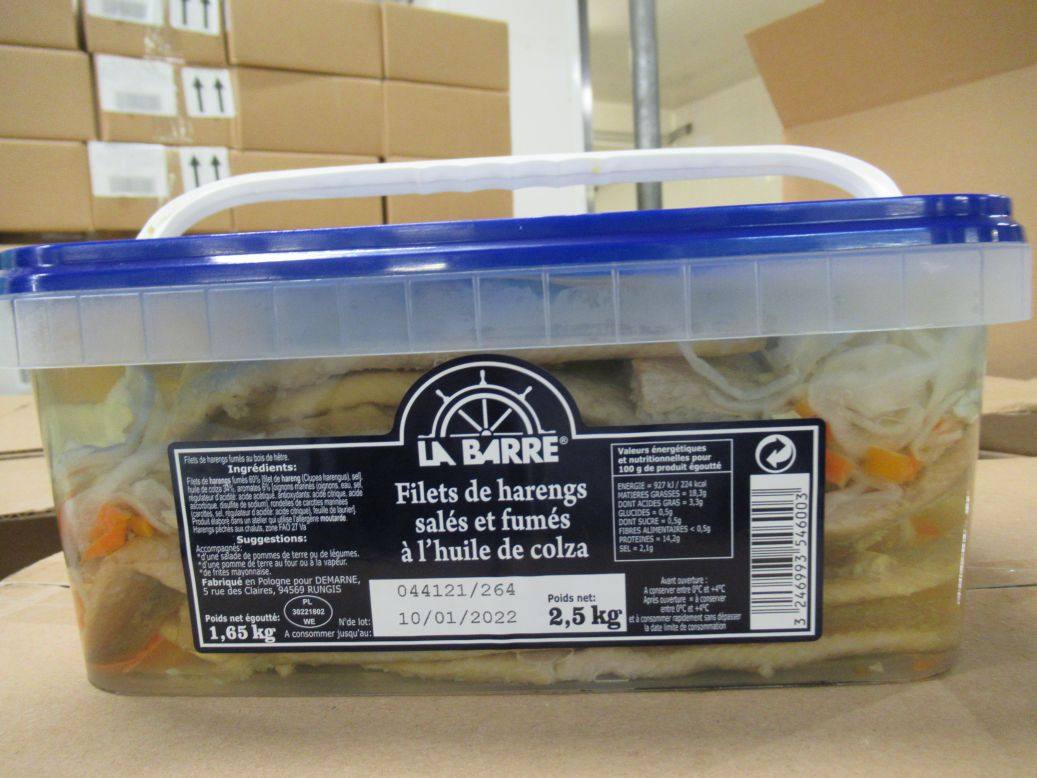
France – SALTED AND SMOKED HERRING FILLETS IN COLZA OIL – Listeria monocytogenes

Gov france

Identifying information for the recalled product

  • Product category Food
  • Product sub-category Fishery and aquaculture products
  • Product brand name BAR
  • Names of models or references SALTED AND SMOKED HERRING FILLETS IN COLZA OIL 2.5 kg
  • Product identification
    GTIN Lot Dated
    3246993546003 044121/243 Use-by date 12/12/2021
  • Packaging2.5 KG BUCKET
  • Start date / End of marketing From 11/03/2021 to 11/30/2021
  • Storage temperature Product to be stored in the refrigerator
  • Health mark PL 30221802
  • Geographical sales area Whole France
  • Distributors POmona
  • List of points of saleHareng_LB_2.5kg_30.11.21.pdf

Practical information regarding the recall

  • Reason for recall Unsatisfactory analysis, presence of Listeria <10 / g
  • Risks incurred by the consumer Listeria monocytogenes (causative agent of listeriosis)

India – 4 more norovirus cases in Thrissur

The Hindu

Norovirus Food Safety kswfoodworld

Four more cases of norovirus were reported from a college in Thrissur on Tuesday. The infection was reported in four day scholars of the college.

Though 57 cases have been reported from the college earlier, they were in college hostels. The Health Department has asked the college authorities to make the classes online.

According to preliminary investigation, the infection spread from the drinking water distributed in the hostel.

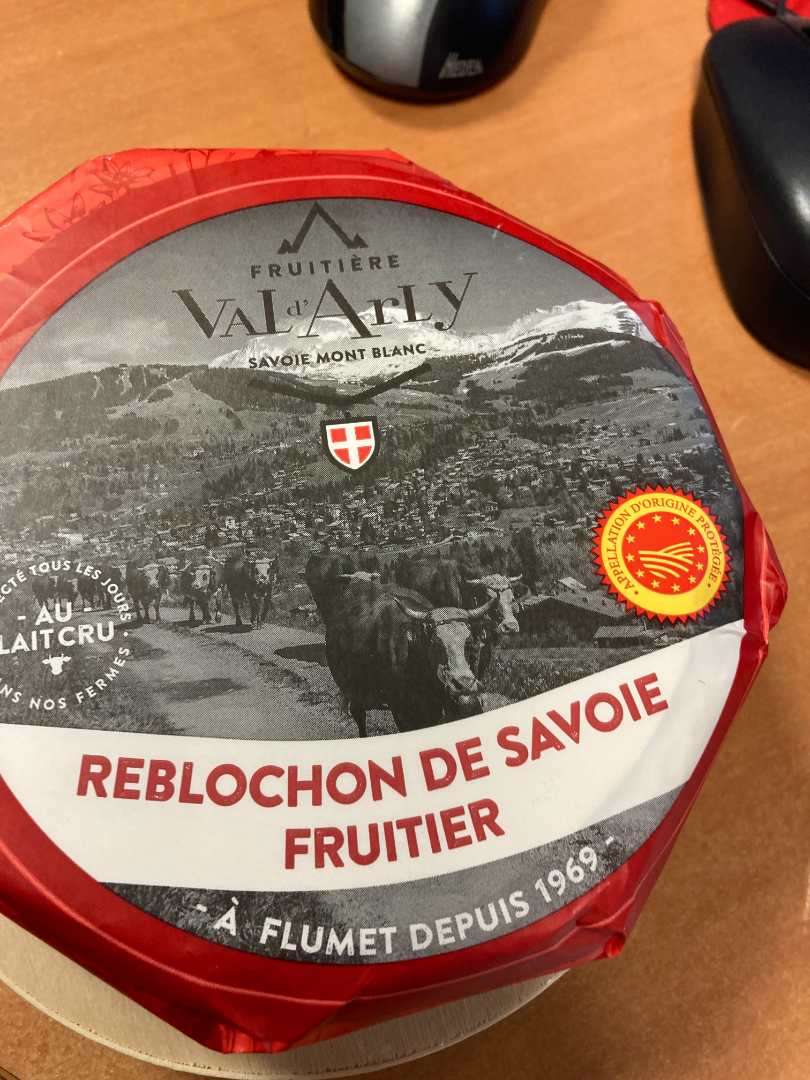
France – Reblochon Savoie Fruitier PDO – Brucella spp

Gov france

Identifying information for the recalled product

  • Product category Food
  • Product sub-category Milk and dairy products
  • Product brand name COOP VAL D’ARLY
  • Names of models or references REBLOCHON DE SAVOIEE FRUITIER AOP
  • Product identification
    GTIN Lot Dated
    3489450003200 Lots 312013 and 311932 Use-by date 12/07/2021
  • Packaging450grs
  • Start date / End of marketing From 10/21/2021 to 11/18/2021
  • Storage temperature Product to be stored in the refrigerator
  • Geographical sales area Whole France
  • Distributors promocash

Practical information regarding the recall

  • Reason for recall SUSPICION OF CONTAMINATION OF PRODUCTS BY BRUCELLA MELITENSIS
  • Risks incurred by the consumer Brucella spp (causative agent of brucellosis)

Germany – E. coli in lamb and flour prompts warning in Germany

Food Safety News

Findings of E. coli in lamb and flour has triggered a warning from German authorities.

Basic rules of kitchen hygiene, such as using different cutting boards for raw meat and vegetables, should be followed. Proper cooking is one of the best ways to avoid food poisoning from E. coli.

As part of zoonosis monitoring in Germany in 2020, Shiga toxin-producing E. coli (STEC) were detected in 50 of 380 samples of fresh lamb.

Lamb from Germany was significantly more often STEC-positive than that from other countries with 36 of 190 samples positive compared to 12 of 177.

Consumers, especially small children, the elderly, the immunocompromised and pregnant women, should only consume lamb that has been well cooked, advised the Federal Office for Consumer Protection and Food Safety (BVL).

“An infection with STEC should not be underestimated. In children in particular, it can lead to the development of hemolytic uremic syndrome (HUS), which is often associated with acute kidney failure,” said Friedel Cramer, BVL president.

STEC was detected in 22 of 242 samples of wheat flour from milling operations. Consumers can minimize this risk by not eating raw dough, cake batter or other foods containing raw flour. E. coli was also found in six of 318 samples of raw milk soft cheese sold at retail, from wholesale and at import points.

In total, 94 isolates belonged to 28 different O serogroups with O146 as the most common while O157 was not detected.

France – Butter, Faisselle – Salmonella

Gov france

Identifying information for the recalled product

  • Product category Food
  • Product sub-category Milk and dairy products
  • Product brand name No Brand
  • Names of models or references Thursday 11/18: faisselles DLC 11/25 Friday 11/19: soft butters, salted butters DLC 10/12
  • Product identification
    Lot Dated
    Soft butters, salted butters made on Friday 11/19: DLC 10/12 Use-by date 12/10/2021
    Faisselles manufactured on 25/11: DLC 10/12 Use-by date 25/11/2021
  • Start date / End of marketing From 11/19/2021 to 11/26/2021
  • Storage temperature Product to be stored in the refrigerator
  • Geographical sales area30 km radius
  • Distributors Villeneuve farm – rue de la plaine-41000 Saint Denis sur Loire

Practical information regarding the recall

  • Reason for recall GAEC Daudin Fils is now withdrawing from the sale of the following products following the suspicion of the presence of salmonella.
  • Risks incurred by the consumer Salmonella spp (causative agent of salmonellosis)

UK – Morrisons Tackling Campylobacter

Morrisons

Since 2013 we have been working hard to reduce Campylobacter levels in fresh chicken. We have introduced a Campylobacter reduction plan which has shown significant improvements year on year.

Our results for the 2nd Quarter of 2021 (April to June) are as follows:

  • 0.8% of our chickens have the higher levels of contamination compared to the FSA retail target of 7% from a sample of 120 chickens tested.

Our results now for the last 26 consecutive quarters have been below the 7% FSA retail target.

The facts:

• Campylobacter is a common bacteria which causes food poisoning which can be found on fresh chicken.
• Campylobacter is destroyed if chicken is cooked thoroughly.
• As a bacteria, campylobacter can be transferred on to any surface that raw chicken contacts.
• Food Standards Agency (FSA) advice is Do Not Wash raw chicken.

Click here for a quick guide from the FSA about Campylobacter

How you can prevent it:

We understand that campylobacter can be a concern when it comes to handling fresh chicken.

However there are 4 simple steps you can take at home to minimise the risk of food poisoning:

  • Step 1 – Cover and chill raw poultry at the bottom of the fridge
  • Step 2 – Do not wash poultry
  • Step 3 – Wash hands and utensils after handling raw poultry
  • Step 4 – Ensure poultry is thoroughly cooked

What Morrisons have achieved:

  • A long term reduction of campylobacter levels from 2014 to 2021.
  • We have worked with our suppliers and implemented a Campylobacter Action Plan, which has successfully reduced campylobacter levels on fresh chicken.
  • We have established our own monitoring program; our test results show levels of campylobacter are now consistnently below the FSA 7% target (for the last 26 quarters).

image4mr2e.png

What’s next?

While the results of our reduction programme are extremely encouraging, we are not complacent and we will continue to work closely with all areas of the industry to continually find areas to improve.

UK – Co-op Tackling Campylobacter

COOP

Food safety is an absolute priority for Co-op and we are determined to tackle Campylobacter. How will we do this? By working together with our farmers and suppliers to reduce the incidence of Campylobacter. We have been keen supporters of the initiatives the FSA (Food Standards Agency) have driven to combat Campylobacter.

Industry Campaign

Co-op were one of the first retailers to sign up to be part of the Foods Standards Agency’s ‘Acting on Campylobacter Together’ (ACT) campaign. The joint aim was to rapidly introduce and share the best workable and available technologies and techniques in food production and across the supply chain.

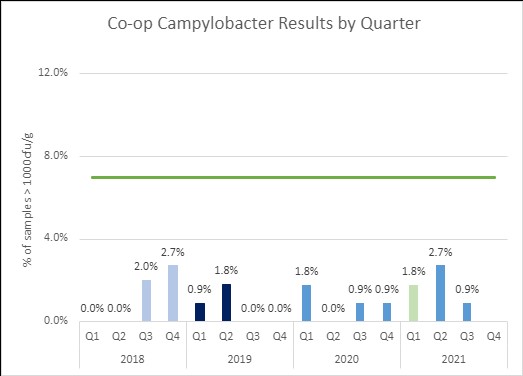
The FSA started the Campylobacter retail survey in 2014 sampling from nine retailers and publishing results showing % of chickens with incidence of Campylobacter at highest contamination levels (>1000cfu/g) . By the beginning of 2017 the overall results were showing a significant reduction in the percentage of chickens with high levels of Campylobacter from 20.3% (July 2014 – February 2015) to 7% with highest contamination levels (August – December 2016).

Heather Hancock, Chairman of the Food Standards Agency, said:

“The challenge we set of reducing the number of people who get ill from campylobacter has been achieved. In the absence of any other clear indicators, we can reasonably say that the work that we and the food industry have done from farm to fork has given us this really positive result for public health.

“This has been achieved by working with the industry to tackle this difficult problem and raising consumer awareness. We commend the efforts of the larger retailers and the major processing plants who supply them, all of which have shown significant improvement and many have achieved the target we set to reduce the highest levels of campylobacter. They have invested a lot of effort and money into interventions to tackle the problem.

Extract taken from the Campylobacter News Story 13.03.17

Our Results

From January 2017, food retailers have published our own Campylobacter test results for fresh chicken, in collaboration with the open data scheme on Campylobacter with the Food Standards Agency.

Campylobacter results Q3 2021

UK – J Sainsbury Tackling Campylobacter

Sainsburys

12 January 2021

Our customers’ health and safety is of paramount importance to us. Working closely with our suppliers and farmers, we are committed to ensuring that levels of Campylobacter on our fresh chicken are kept as low as possible

Campylobacter is commonly found on chicken and can cause food poisoning if chicken isn’t prepared and cooked properly. It’s not yet possible to eliminate it from raw chicken, but we have been working hard to reduce levels.

From farm to fork

Smiley face

With our suppliers, we’ve been busy finding ways to tackle Campylobacter at every step of the food chain. This starts on the farm by trying to stop Campylobacter from colonising flocks, introducing novel thermal treatments in the factory as well as new convenient roast in the bag packaging.

Like other raw meats, chicken still needs to be handled with care, but lower levels of Campylobacter means improved safety for our customers when they are preparing chicken at home. We were the first retailer to include food safety advice on our products.

How are we doing?

We test nearly a thousand chickens a year to check on how we are doing, and we continue to make progress. We’ve achieved a target that was set by the UK Food Standards Agency (FSA), but are committed to continue making further improvements wherever we can. To do this, we need to find new solutions through further research and trials, working closely with our suppliers.

UK – M&S Campylobacter Results Q2 – 2021

Click to access campylobacter-q2-2021.pdf

Research – Reduction of Escherichia coli O157:H7, Listeria monocytogenes, and Salmonella on Whole Yellow Onions (Allium cepa) Exposed to Hot Water

Journal of Food Protection

In-home or food service antimicrobial treatment options for fresh produce are limited. Hot water treatments for whole (unpeeled) produce have been proposed, but data to support this practice for onions are not available. Separate cocktails of rifampin-resistant Escherichia coli O157:H7, Listeria monocytogenes, and Salmonella were cultured on agar and suspended in sterile water. The outer papery skin at the equator or root or stem ends of the whole yellow onions was spot inoculated at 6 log CFU per onion. After drying for 30 min and, in some cases, storage at 4°C for 6 days, onions were immersed in water at ca. 100°C for 5 s or 85°C for 10 to 180 s. No significant difference (P > 0.05) in the mean decline of Salmonella was found on onions that were exposed to hot water after drying the inoculum for 30 min or after storage at 4°C for 6 days. Exposure of whole onions at 100°C for 5 s reduced E. coli O157:H7 and L. monocytogenes populations by >5 log CFU per onion at all inoculum sites and Salmonella populations by >5 log CFU per onion at the stem end and equator but not consistently at the root end. Mean root-end reductions of ≥5 log CFU per onion of E. coli O157:H7, L. monocytogenes, and Salmonella were achieved consistently when the root end was fully immersed in 85°C hot water for 45 or 60 s except in a small number of cases (4 of 57; 7%) when the root end was oriented upward and above the water line during treatment. When onions were held at 85°C for 180 s with the root end above the water line in an uncovered water bath, no significant declines in Salmonella populations were observed; significant mean declines in Salmonella were achieved (mean, 5 log CFU per onion; range, 3.49 to 6.25 log CFU per onion) when the water bath was covered. Short exposure to hot water can significantly reduce pathogens on the surface of whole onions. Reductions are more consistent when the root end is submerged and when the water bath is covered.

HIGHLIGHTS
  • Short hot-water exposure significantly reduces pathogen populations on whole onions.
  • Salmonella reductions were greater at the stem and equator than at the root end.
  • Pathogen reduction was greater for fully submerged root ends in covered water baths.