We understand that we have a role to play to reduce the level of Campylobacter in the supply chain and to help raise awareness with our customers as to how they can handle fresh poultry in a safe manner.
The Food Standards Agency (FSA) has identified Campylobacter as a key priority and is working with those directly in the industry to tackle it. Aldi is dedicated to supporting the FSA in this goal, which is why we are a signatory of the Acting on Campylobacter Together (ACT) campaign.
As well as working with the FSA (and other industry bodies), we understand that we need to take a lead with our suppliers to deliver against the FSA target.
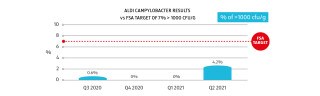
Aldi monitors the levels of Campylobacter carefully by compiling regular sets of independently verified data which is shared with the FSA via the BRC for the purposes of industry reporting. The results for Q2 2021 (April to June) show that 4.2% of birds were in the >1,000 cfu/g category. Our results are below the FSA target of less than 7% of birds in the >1,000 cfu/g category.
Campylobacter is a naturally occurring bacterium found in raw poultry that has the ability to cause food poisoning if the product is not cooked or handled correctly. Customers can keep safe by following the handling and cooking instructions provided on all Tesco raw poultry.
Providing high quality, safe food is always our absolute priority. It has long been our commitment to reduce levels of Campylobacter in our poultry and we are now seeing real progress at all stages of the supply chain, in tackling the issue through the work we have done with our suppliers.
Our Plan
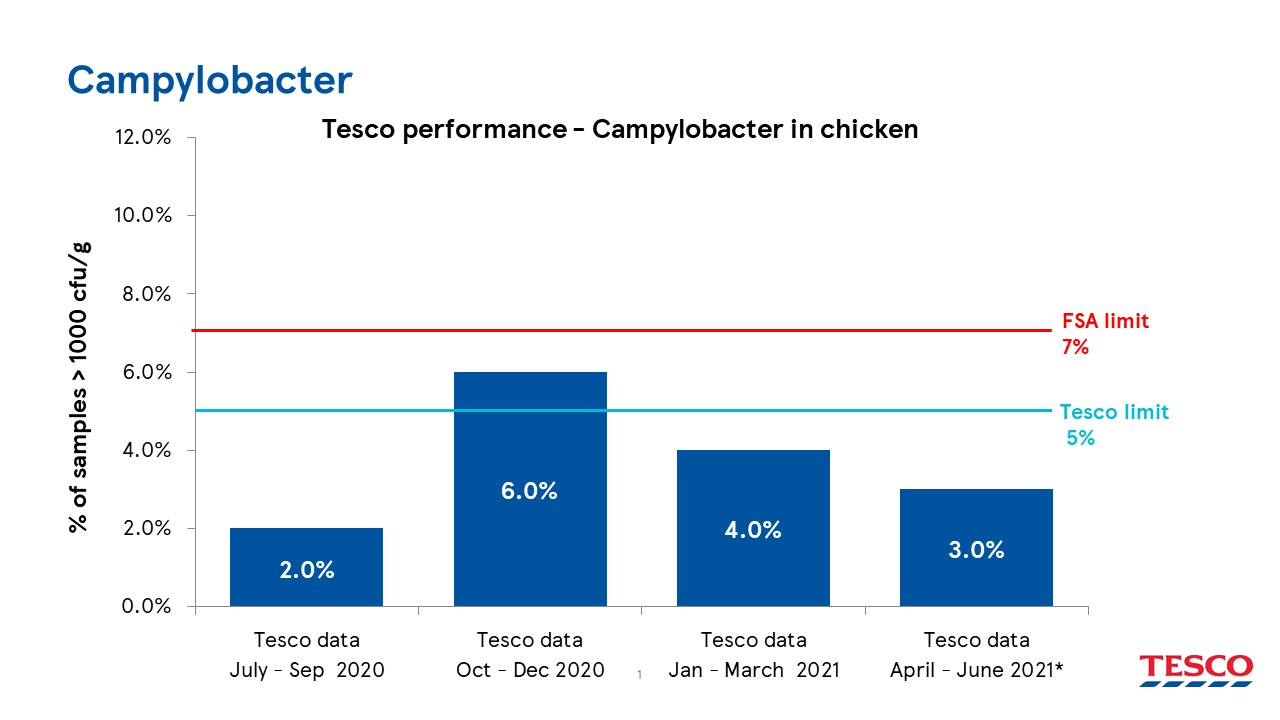
We aim to remain at the forefront of progress on Campylobacter reduction and to ensure we deliver this we have introduced our own industry leading target- that at least 95% of chickens supplied to Tesco will have minimal levels of Campylobacter (less than 1000 cfu/g). This will enable us to help our customers be a safe as possible, whilst handling and cooking poultry.
All of our raw poultry contains safe handling information on packaging and cooking instructions are checked to ensure thorough cooking. For further information please visit our Real Food website: Food Safety in the Home
Safety and satisfaction are close to our hearts, which is why our quality assurance team accepts nothing short of perfection. Food safety is at the heart of what we do and underpins our purchasing policy across food and non-food items.
We work hard to ensure our suppliers meet national, European and Global safety standards and implement a strict internal Quality Management System comprising of rigorous product testing and supplier auditing.
Campylobacter
Food safety is the highest priority at Lidl UK, and together with our suppliers and the Food Standards Agency (FSA) we are committed to tackling Campylobacter in chicken. This is being achieved through several initiatives throughout the process, from the farm and processing stages to supply chain and in-store, too. These initiatives are demonstrated in our plan below.
What is Campylobacter?
Campylobacter is the most common cause of food poisoning in humans. Campylobacter is naturally occurring in the environment and lives inside many animals including chickens.
The most common ways Campylobacter is spread is through cross-contamination and undercooked chicken.
Customer advice
Lidl strongly advises all our customers to follow the FSA’s advice when handling and cooking raw chicken:
Cover and chill raw chicken, store it at the bottom of the fridge so juices cannot drip on to other foods.
Don’t wash raw chicken.
Thoroughly wash and clean all utensils, chopping boards and surfaces used to prepare raw chicken. Wash hands thoroughly with soap and warm water after handling raw chicken.
Cook chicken thoroughly, making sure it is steaming hot throughout, with no pink meat and all the juices running clear.
Lidl UK’s actions on Campylobacter
Lidl joined the new Acting on Campylobacter Together (ACT) board in 2015 as a joint way of tackling Campylobacter between retailers, processors and the FSA.
Our poultry suppliers are working hard on increased bio-security on-farm to reduce Campylobacter in poultry flocks.
Our poultry suppliers have implemented innovative factory interventions to reduce Campylobacter through the process of slaughtering and production.
All of our flavoured birds are sold as roast-in-bag, reducing the need for customers to touch raw chicken.
All of our raw poultry contains hygiene information on the packaging advising customers of good practice.
The percentage of chicken sold at smaller retailers that is contaminated with high levels of Campylobacter remains above a Food Standards Agency target.
A UK-wide survey sampled 1,008 chickens from August 2019 to October 2020. It looked at levels of Campylobacter on whole fresh retail chickens from independent shops, butchers and smaller chains such as Iceland, McColl’s, Budgens, Nisa, Costcutter and One Stop.
Campylobacter was detected in 59.6 percent of the chicken skin samples from non-major retailers, and 12.8 percent of them were above 1,000 colony forming units per gram (CFU/g) of chicken skin. This continues to be higher than levels found in samples from the nine major retailers.
The highest single count was 89,000 CFU of Campylobacter per gram of skin. The proportion of highly contaminated chickens was the most for butchers compared to the stores that are part of smaller retail chains.
Rise from last survey
The Food Standards Agency (FSA) has a maximum acceptable level of no more than 7 percent of birds with more than 1,000 CFU/g of Campylobacter. In 2019, the UK reported 58,718 cases of campylobacteriosis with raw chicken meat identified as a key vehicle of infection.
The ubiquity of Listeria monocytogenes in the environment affects the food industry and presents concerns for frozen food facilities. This study determined the prevalence and numbers of Listeria species and L. monocytogenes on raw produce arriving at frozen food facilities. Raw produce was collected using multilevel blinding protocols to ensure anonymity of participants and avoid traceback. Five raw vegetables were selected: corn, carrots, green beans, peas, and spinach. Raw products were collected after arrival at the facilities but before cleaning or other preprocessing steps that are typically performed inside the facility. The U.S. Food and Drug Administration’s Bacteriological Analytical Manual method for detection of Listeria spp. and L. monocytogenes was followed, with PCR screening followed by selective plating methods. Listeria numbers were estimated from positive samples using the most-probable-number (MPN) methodology. A total of 290 samples were collected, with 96 and 17 samples positive for Listeria spp. (33.1%) and L. monocytogenes (5.9%), respectively. Enumeration data for the 96 Listeria spp. samples indicated 82 samples had greater than 100 MPN of Listeria spp. per g and 14 samples had less than 100 MPN Listeria spp. per g. The prevalence of Listeria spp. varied by commodity: spinach (66.7%), peas (50%), corn (32.2%), green beans (22.2%), and carrots (13%). L. monocytogenes prevalence was determined in corn (13.6%), peas (6.3%), and green beans (4.2%) arriving at processing facilities. Such data were previously unavailable to frozen vegetable processors and are valuable in implementing process control standards. The prevalence and pathogen concentration data from raw commodities found in this study can provide the industry with information to conduct more accurate quantitative risk assessments and a baseline to model and target appropriate pathogen reduction steps during processing.
HIGHLIGHTS
Prevalence of Listeria spp. and L. monocytogenes in raw produce was determined.
96 Listeria spp. and 17 L. monocytogenes samples were found from 290 produce samples.
82 produce samples had >100 MPN/g and 14 samples had <100 MPN/g for Listeria spp.
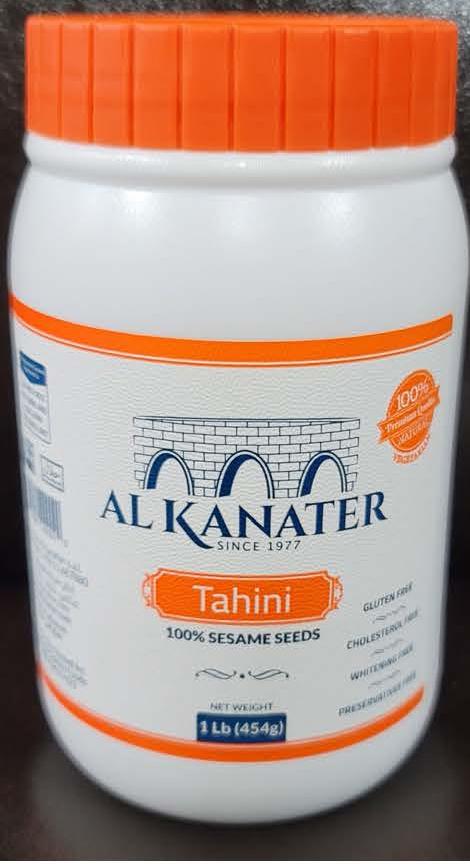
International Golden Foods, Inc (IGF) of Bensenville, IL is voluntarily recalling certain lot codes of the Al kanater brand tahini because it has the potential to be contaminated with Salmonella, an organism which can cause serious and sometimes fatal infections in young children, frail or elderly people and others with weakened immune system. Healthy persons infected with Salmonella often experience fever, diarrhea (which may be bloody), nausea, vomiting and abdominal pain. In rare circumstances, infection with Salmonella can result in the organism getting into the bloodstream and producing more severe illnesses such as arterial infections (i.e., infected aneurysms), endocarditis and arthritis.
The product was distributed nationwide and is sold in 16 Oz. jars. The jars are labelled “Al kanater Tahini.” Lot codes are printed on the jar. Product code, description, lot code, and UPC information are noted below.
Product Code
Product Description & Size
Lot #
UPC
AT1LB
Al kanater Tahini Sesame Paste 1 lb. (454 gr)
TT4N‐201127
6‐92551‐00002‐0
No illnesses have been reported to-date in connection with the Al Kanater Brand Tahini.
This problem was revealed as a result of a random sampling by the Michigan Department of Agriculture. Although we have not received the final laboratory reports, IGF is recalling product with the lot codes listed above. Consumers who have purchased Al kanater Tahini with these lot codes should discontinue use and return it to the store of purchase for a full refund. Retailers that may have further distributed the recalled lot codes should share this notice with their customers. Retailers or consumers with questions may contact IGF at 630-860-5552. Please see attached a sample product picture. Company Contact Information: ‐630‐860‐5552, 800‐343‐7423.,info@goldenfood.com,
Please return all product back to us.
Mansour Amiran 11/29/21 International Golden Foods, Inc. 819 Industrial Dr. Bensenville, IL 60106.
Lidl is recalling the above batch of Deluxe Stuffed Dates due to the presence of Salmonella. Point-of-sale recall notices will be displayed in Lidl stores supplied with the implicated batch.
Nature Of Danger:
People infected with Salmonella typically develop symptoms between 12 and 36 hours after infection, but this can range between 6 and 72 hours. The most common symptom is diarrhoea, which can sometimes be bloody. Other symptoms may include fever, headache and abdominal cramps. The illness usually lasts 4 to 7 days. Diarrhoea can occasionally be severe enough to require hospital admission. The elderly, infants, and those with impaired immune systems are more likely to have a severe illness.
Action Required:
Consumers:
Consumers are advised not to eat the implicated batch.
Herb & Garlic Goat Cheese, Aged Cheddar Goat Cheese
Issue
Food » Microbial Contamination » Listeria
What to do
Do not consume the recalled products
Affected products
Brand
Product
Size
UPC
Codes
Great Lakes Goat Dairy
Herb & Garlic Goat Cheese
175 g
6 28055 40020 2
Best Before
2022 JL12
210411
Great Lakes Goat Dairy
Aged Cheddar Goat Cheese
175 g
6 28055 40017 2
Best Before
2022 JL26
12059
Issue
Great Lakes Goat Dairy is recalling Great Lakes Goat Dairy brand Herb & Garlic Goat Cheese and Aged Cheddar Goat Cheese from the marketplace due to possible Listeria monocytogenes contamination.
The recalled products have been sold in Ontario.
What you should do
If you think you became sick from consuming a recalled product, call your doctor
Check to see if you have the recalled products in your home
Do not consume the recalled products
Recalled products should be thrown out or returned to the location where they were purchased
Food contaminated with Listeria monocytogenes may not look or smell spoiled but can still make you sick. Symptoms can include vomiting, nausea, persistent fever, muscle aches, severe headache and neck stiffness. Pregnant women, the elderly and people with weakened immune systems are particularly at risk. Although infected pregnant women may experience only mild, flu-like symptoms, the infection can lead to premature delivery, infection of the newborn or even stillbirth. In severe cases of illness, people may die.
Lidl is recalling Deluxe Stuffed Dates because salmonella has been found in the product.
Product details
Deluxe Stuffed Dates
Pack size
240g
Batch code
21301/196
Best before
21 January 2022
Risk statement
The presence of salmonella in the product listed above.
Symptoms caused by salmonella typically include fever, diarrhoea, and abdominal cramps.
Action taken by the company
Lidl is recalling the above product. Point of sale notices will be displayed in all retail stores that are selling this product. These notices explain to customers why the product is being recalled and tell them what to do if they have bought the product. Please see the point of sale notices attached.
If you have bought the above product do not eat it. Instead, return it to the store from where it was bought for a full refund. Any customers with queries or concerns can contact Customer Services on 0370 444 1234.
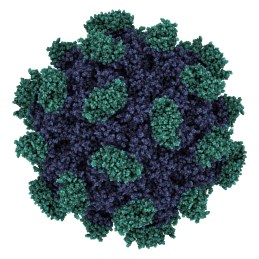
Hepatitis E virus capsid structure. HEV infection causes viral hepatitis. Atomic-level structure.
A Hepatitis E outbreak had been declared by Chadian health authorities in mid-November 2021 in Sategui health area, Lai health district in the Tandjile region.
As of November 20, there have been 377 suspected cases and 2 deaths (CFR 0.5%) reported. Among those affected, the majority have been men with 216 cases (57%) and the most affected age group has been less than 10 years of age with 90 cases (23.8%).
Hepatitis E is endemic in Chad, particularly in the Tangile region, which previously experienced large-scale outbreaks in 2017 and 2018. Poor hygiene and sanitation conditions coupled with limited access to safe water are risk factors for outbreaks in this region.