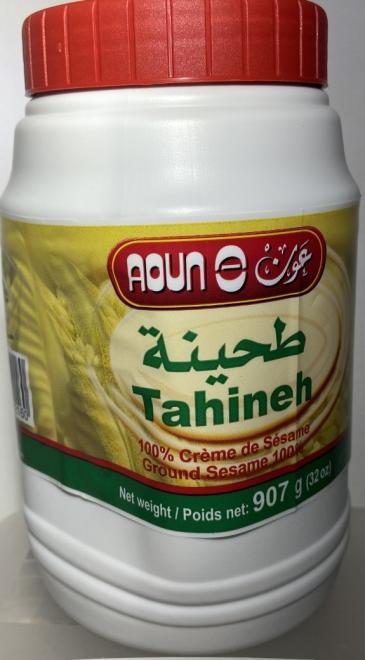
Canada – Aoun brand Tahineh recalled due to Salmonella

CFIA

Aoun Tahineh, 907 g - Front

Product
Tahineh – Ground Sesame 100%
Issue
Food » Microbial Contamination » Salmonella
What to do

Do not consume the recalled product

Issue

Phoenicia Group Inc. is recalling Aoun brand Tahineh from the marketplace due to possible Salmonella contamination.

The recalled product has been sold in Alberta, Ontario, and Quebec and may have been distributed in other provinces and territories.

What you should do

  • If you think you became sick from consuming a recalled product, call your doctor
  • Check to see if you have the recalled product in your home
  • Do not consume the recalled product
  • Recalled products should be thrown out or returned to the location where they were purchased

Food contaminated with Salmonella may not look or smell spoiled but can still make you sick. Young children, pregnant women, the elderly and people with weakened immune systems may contract serious and sometimes deadly infections. Healthy people may experience short-term symptoms such as fever, headache, vomiting, nausea, abdominal cramps and diarrhea. Long-term complications may include severe arthritis.

Canada – Fraser Valley Meats brand Whole Kernel Corn (frozen) recalled due to Salmonella

CFIA

Fraser Valley Meats Whole Kernel Corn - Label

Product
Whole Kernel Corn (frozen)
Issue
Food » Microbial Contamination » Salmonella
What to do

Do not consume, use, sell, serve, or distribute the recalled product

Affected products

Brand Product Size UPC Codes
Fraser Valley Meats Whole Kernel Corn (frozen) ~2 kg 2 000921 000002 Sold between December 3 and December 15, 2021

Issue

Fraser Valley Meats is recalling Fraser Valley Meats brand Whole Kernel Corn (frozen) from the marketplace due to possible Salmonella contamination.

The recalled product has been sold in British Columbia.

Research – Food Handling Concerns and Practices at-Home during the COVID-19 Pandemic by Food Security Status

Journal of Food Protection

There is limited examination about COVID-19-related food handling concerns and practices that cause chemical or microbial contamination and illness, particularly among those with food insecurity. We investigated consumer food handling concerns and practices during the COVID-19 pandemic, and whether they differed by food insecurity status. An online survey was distributed among Chicago, Illinois residents between July 15-August 21, 2020 (N=437). Independent t-tests and Fisher’s Exact tests were used to identify differences in food handling concerns and practices between those with and without food insecurity (alpha=0.05). Survey items included questions about food handling practices that were considered safe or neutral (i.e., washing hands and produce with water, sanitizing food packaging) and unsafe (i.e., using cleaning agents to wash foods, leaving perishable foods outside) using 5-point Likert-style scales or categorical responses (i.e., yes, no). Participant responses fell between “slightly” and “somewhat” concerned about contracting COVID-19 from food and food packaging (mean ± SE: 2.7±0.1). While participants reported washing their hands before eating and preparing foods at least “most of the time” (mean ± SE: 4.4 ± 0.0 and 4.5 ± 0.0, respectively), only one-third engaged in unsafe practices. The majority of participants (68%) indicated that they altered food handling practices due to the COVID-19 pandemic and received information about food safety from social media (61%).  When investigating differences in concerns and practices by food insecurity status, food insecure participants were more concerned about COVID-19 foodborne transmission for all food items (ps<0.0001) and more frequently performed unsafe based food handling practices than those with food security (ps<0.0001). Results from this study suggest more investigation is needed to understand barriers to safe food handling knowledge and practices, particularly among those with food insecurity.

Research – The Application of Bacillus subtilis for Adhesion Inhibition of Pseudomonas and Preservation of Fresh Fish

MDPI

Inhibiting the growth of spoilage bacteria, such as Pseudomonas spp., is key to reducing spoilage in fish. The mucus adhesion test in vitro showed that the adhesion ability of Bacillus subtilis was positively correlated with its inhibition ability to Pseudomonas spp. In vivo experiments of tilapia showed that dietary supplementation with B. subtilis could reduce the adhesion and colonization of Pseudomonas spp. in fish intestines and flesh, as well as reduce total volatile basic nitrogen (TVB-N) production. High throughput and metabolomic analysis showed treatment with B. subtilis, especially C6, reduced the growth of Pseudomonas spp., Aeromonas spp., Fusobacterium spp., and Enterobacterium spp., as well as aromatic spoilage compounds associated with these bacteria, such as indole, 2,4-bis(1,1-dimethylethyl)-phenol, 3-methyl-1-butanol, phenol, and 1-octen-3-ol. Our work showed that B. subtilis could improve the flavor of fish by changing the intestinal flora of fish, and it shows great promise as a microecological preservative. View Full-Text

Research – Recent Advances in the Mechanisms and Regulation of QS in Dairy Spoilage by Pseudomonas spp.

MDPI

Food spoilage is a serious issue dramatically impacting the worldwide need to counteract food insecurity. Despite the very expensive application of low temperatures, the proper conservation of fresh dairy products is continuously threatened at different stages of production and commercialization by psychrotrophic populations mainly belonging to the Pseudomonas genus. These bacteria cause discolouration, loss of structure, and off-flavours, with fatal implications on the quality and shelf-life of products. While the effects of pseudomonad decay have been widely reported, the mechanisms responsible for the activation and regulation of spoilage pathways are still poorly explored. Recently, molecule signals and regulators involved in quorum sensing (QS), such as homoserine lactones, the luxR/luxI system, hdtS, and psoR, have been detected in spoiled products and bacterial spoiler species; this evidence suggests the role of bacterial cross talk in dairy spoilage and paves the way towards the search for novel preservation strategies based on QS inhibition. The aim of this review was to investigate the advancements achieved by the application of omic approaches in deciphering the molecular mechanisms controlled by QS systems in pseudomonads, by focusing on the regulators and metabolic pathways responsible for spoilage of fresh dairy products. In addition, due the ability of pseudomonads to quickly spread in the environment as biofilm communities, which may also include pathogenic and multidrug-resistant (MDR) species, the risk derived from the gaps in clearly defined and regulated sanitization actions is underlined. View Full-Text

Research – Role of blue light in bactericidal effect against meat-borne pathogens and freshness maintaining of beef 

Journal of Food Protection

Beef is rich in various nutrients while easily spoils due to contamination by pathogens, thus it is of great significance to develop a bactericidal method to inactivate meat-borne pathogens and meanwhile maintain the freshness of beef. For the first time, the present study investigated the bactericidal effect of blue light (BL) at 415 nm against four meat-borne pathogens (methicillin-resistant Staphylococcus aureus , Escherichia coli , Salmonella Typhimurium and Listeria monocytogenes ) in vitro and inoculated on the surface of fresh beef, respectively. When the non-illuminated beef was used as control, the population of the four pathogens did not change significantly ( P > 0.05), while BL-illuminated beef showed dose-dependent inactivation effect in both in vitro and in vivo studies. The experiments on beef cuts showed that 109.44 J/cm 2 of BL inactivated 90% of inoculated cells for the tested strains ( P < 0.05), and the impact of BL inactivation could be sustained in 7 days of cold storage. Notably, changes of lipid oxidation rate, water holding capacity and cooking loss value between the control and beef illuminated by 109.44 J/cm 2 at the same time were scarcely detected during the storage. BL had a minor but insignificant influence on surface color and free amino acid content. Moreover, the pH of illuminated beef increased slower ( P < 0.05) than that of non-illuminated beef. The present work demonstrated that BL could be a novel bactericidal and freshness-maintaining method for fresh beef.

France – PORK FILET MIGNON STUFFED WITH FIGS AND SPICE BREAD – Salmonella

Gov france

Identifying information for the recalled product

  • Product category Food
  • Product sub-category Meats
  • Product brand name CLERMONT MEATS
  • Names of models or references PORK FILET MIGNON STUFFED WITH FIGS AND SPICE BREAD – CLERMONT MEAT
  • Product identification
    Lot Dated
    LOT n ° 3420111339 Use-by date 12/21/2021
  • Packaging Sold on demand in the traditional department of the store
  • Start date / End of marketing From 12/10/2021 to 12/13/2021
  • Storage temperature Product to be stored in the refrigerator
  • Health mark FR 35.152.002 CE
  • Further information Product sold at the store’s traditional stand
  • Geographical sales area E. Leclerc Douai
  • Distributors E. Leclerc

Practical information regarding the recall

  • Reason for recall Detection of Salmonella / 10g following samples from the usual analytical monitoring plan
  • Risks incurred by the consumer Salmonella spp (causative agent of salmonellosis)

USA – CDC – Food Safety Page

4 Steps to Food Safety - Clean, Separate, Cook and Chill

CDC

France – BLUE OF VERCORS SASSENAGE Cheese – Listeria monocytogenes

Gov france

Identifying information for the recalled product

  • Product category Food
  • Product sub-category Milk and dairy products
  • Product brand name BLUE OF VERCORS SASSENAGE
  • Names of models or references BLUE OF VERCORS SASSENAGE
  • Product identification
    Lot Dated
    10/27/2021 Date of minimum durability 01/10/2022
    11/17/2021 Date of minimum durability 01/31/2022
  • Start date / End of marketing From 11/18/2021 to 12/13/2021
  • Storage temperature Product to be stored in the refrigerator
  • Health markFR26.163.081CE
  • Geographical sales area Departments: ARDECHE (07), DROME (26), ISERE (38), RHONE (69)
  • Distributors Leclerc Chatte Intermarche st sauveur; Romans cheese and terroirs, Fromagerie Lambert; Limouches charcuterie; Eat organic; College Daniel Faucher; Valentin High School, Debussy College, Horticultural High School, Perron Residence, Janier Fromagerie, Savoureine
  • List of points of sale LIST_ETAB_POUR_RAPPEL.pdf

Practical information regarding the recall

  • Reason for recall Presence of Listeria
  • Risks incurred by the consumer Listeria monocytogenes (causative agent of listeriosis)

USA – Clostridium Botulinum Outbreak May Be Associated With Canned Soup

Food Poisoning Bulletin

A new Clostridium botulinum outbreak on the USDA’s Core Investigation Table may be associated with canned soup. That pathogen is a risk with low acid canned foods such as canned soup or home canned vegetables.

There is no more information on the table about this outbreak. We do not know the patient case counts, if traceback or sampling is being conducted, or if any facilities are being inspected.