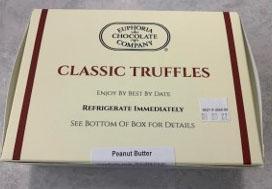
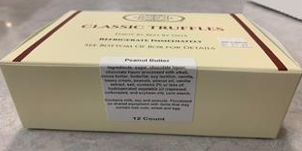
USA – Euphoria Chocolate Company Issues Voluntary Recall of Peanut Butter Classic Truffles, Dark Chocolate Peanut Butter Meltaways and Milk Chocolate Peanut Butter Meltaways Because of Possible Health Risk -Salmonella

FDA

Summary

Company Announcement Date:
FDA Publish Date:
Product Type:
Food & Beverages
Peanut Butter
Foodborne Illness
Reason for Announcement:
Salmonella
Company Name:
Euphoria Chocolate Company
Brand Name:
Euphoria Chocolate
Product Description:
Chocolate candy

Company Announcement

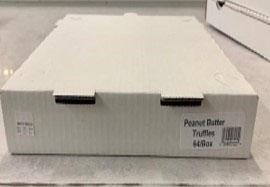
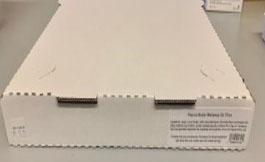
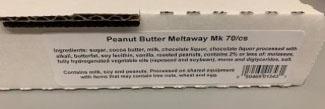
05/26/2022 – Euphoria Chocolate Company of Eugene,OR is initiating a voluntary recall of Peanut Butter Classic Truffles, Dark Chocolate Peanut Butter Meltaways, and Milk Chocolate Peanut Butter Meltaways due to a potential Salmonella contamination.

Salmonella is an organism which can cause serious and sometimes fatal infections in young children, frail or elderly people, and others with weakened immune systems. Healthy people infected with Salmonella often experience fever, diarrhea (which may be bloody), nausea, vomiting and abdominal pain. In rare circumstances, infection with Salmonella can result in the organism getting into the bloodstream and producing more severe illnesses such as arterial infections (i.e., infected aneurysms), endocarditis and arthritis.

The recalled products have one month shelf life for the Peanut Butter Classic Truffles and eight months shelf life for both the Dark Chocolate Peanut Butter Meltaways, and Milk Chocolate Peanut Butter Meltaways.  They were sold from Euphoria Chocolate store’s display case and distributed in Oregon to retailers and supermarkets from 02/17/2022 to 05/20/2022. A list of recalled products and affected Best By Dates range is listed in the table below.

Brand

Product

Pack
Size

UPC

Best By Dates Range

Distributed in State

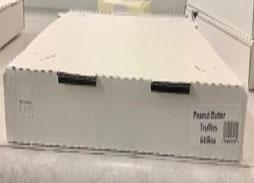
Euphoria Chocolate Peanut Butter Classic Truffles 12pk 12 5046907226 03/15/2022 –
06/20/2022
OR
Euphoria Chocolate Peanut Butter Classic Truffles 64pk 64 5046907225 03/15/2022 –
06/20/2022
OR
Euphoria Chocolate Dark Chocolate
Peanut Butter
Meltaways
70 5046901342 10/16/2022 –
01/10/2023
OR
Euphoria Chocolate Milk Chocolate Peanut Butter Meltaways 70 5046901343 10/16/2022 –
01/10/2023
OR

Euphoria Chocolate Company initiated this recall because it contains the Jif 96 Ounce Crunchy Peanut Butter Twin Pack that is recalled by JM Smucker Co.

In addition, if you may have further distributed this product, please identify your customers and notify them at once of this product recall and inform them to not consume the products and destroy or discard it.

This recall is being made with the knowledge of the Oregon Department of Agriculture and the Food and Drug Administration.

Anyone who has the recalled Euphoria Chocolate products in their possession should not consume and should discard of the affected products.  Consumers with questions may contact the company at 541-344-4914, Monday-Friday, 8am – 4pm PST.


Company Contact Information

Consumers:
 541-344-4914

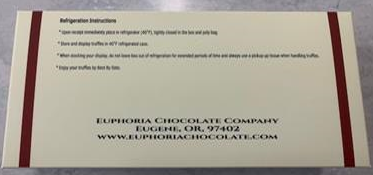
Product Photos

USA – A G Specialty Foods Inc. Issues Voluntary Recall of Food Products Containing Jif and Smuckers Peanut Butter Due to the Potential Salmonella Contamination

FDA

Summary

Company Announcement Date:
FDA Publish Date:
Product Type:
Food & Beverages
Peanut Butter
Foodborne Illness
Reason for Announcement:
Salmonella
Company Name:
A G Specialty Foods
Brand Name:
Multiple brand names
Product Description:
Snack Packs and Sandwiches

Company Announcement

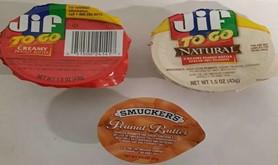
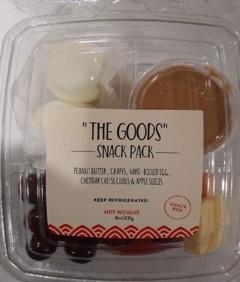
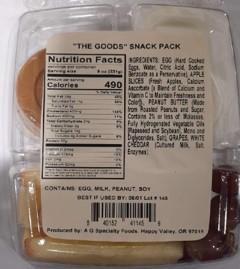
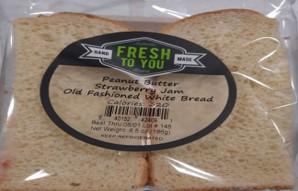
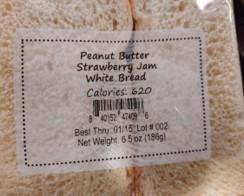
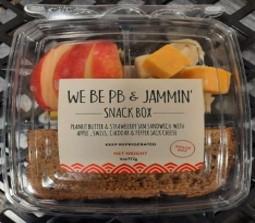
5/26/2022 –  A G Specialty Foods Inc of Happy Valley, Oregon is initiating a voluntary recall of perishable products “The Goods” Snack Pack, We Be PB & Jammin’ Snack Box, Peanut Butter Strawberry Jam Old Fashioned White Bread, and Peanut Butter Strawberry Jam White Bread containing the Jif Creamy Peanut Butter, Jif Creamy Peanut Butter To Go 1.5oz cups, Jif Natural Creamy Peanut Butter To Go 1.5oz cups, and Smuckers Peanut Butter 3/4oz cups due to a potential Salmonella contamination.

Salmonella is an organism which can cause serious and sometimes fatal infections in young children, frail or elderly people, and others with weakened immune systems. Healthy people infected with Salmonella often experience fever, diarrhea (which may be bloody), nausea, vomiting and abdominal pain. In rare circumstances, infection with Salmonella can result in the organism getting into the bloodstream and producing more severe illnesses such as arterial infections (i.e., infected aneurysms), endocarditis and arthritis.

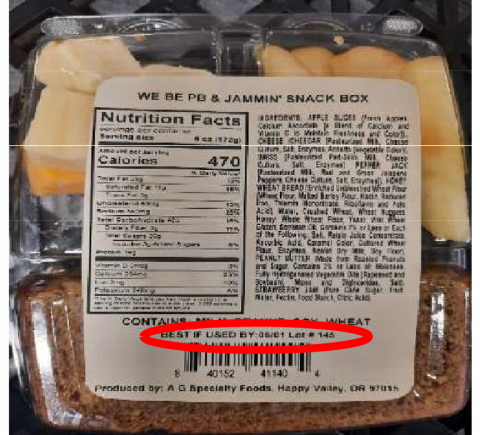
The recalled products have 7-14 days shelf life and were distributed in Oregon and Washington to distributors, retailers and foodservice companies from 05/11/2022 through 05/23/2022 with Lot Codes from 129 to 141.

A list of recalled products and affected Use By Dates range is listed in the table below.

Produced By

Product

Pack
Size

UPC

Use By Dates Range

Included States

A G Specialty Foods ”The Goods” Snack Pack 8oz 8 40152 41145 9 05/16/2022
06/03/2022
OR, WA
A G Specialty Foods Peanut Butter Strawberry Jam Old Fashioned White Bread 6.5oz 8 40152 42409 1 05/06/2022 –
06/03/2022
OR, WA
A G Specialty Foods Peanut Butter Strawberry Jam White Bread 6.5oz 8 40152 47409 6 05/16/2022-
06/03/2022
OR, WA
A G Specialty Foods We BE PB & Jammin’ Snack Box 6oz 8 40152 41140 4 05/16/2022-
06/03/2022
OR, WA

No illnesses or deaths have been reported in consumption with A G Specialty Foods’ products to date.

In addition, if you may have further distributed this product, please identify your customers and notify them at once of this product recall and inform them to not consume the products and destroy or discard them.

A G Specialty Foods, Inc. initiated this recall because it contains the Jif Creamy Peanut Butter and Jif Creamy Peanut Butter To Go 1.5oz cups, Jif Natural To Go 1.5oz cups, and Smuckers Peanut Butter 3/4oz cups that are recalled by J.M. Smucker Co. because of an outbreak of infections from Salmonella.

This recall is being made with the knowledge of the Oregon Department of Agriculture, and the Food and Drug Administration.

Anyone who has the recalled products produced by A G Specialty Foods in their possession should not consume and should discard the affected products including the Jif Creamy Peanut Butter To Go 1.5oz cups, Jif Natural Creamy Peanut Butter To Go 1.5oz cups, and Smuckers Peanut Butter 3/4oz cups.

Consumers with questions may contact the company at 503-305-6100, Monday-Friday, 8:00 am – 4:30 pm PST.

Thank you for your understanding and cooperation in this regard. Please feel free to contact us should you require additional information or assistance.


Company Contact Information

Consumers:
 503-305-6100

Product Photos

USA – FSIS – Public Health Alert for Ready-to-Eat Salad Products Containing Peanut Butter that May be Contaminated with Salmonella

FSIS USDA

The U.S. Department of Agriculture’s Food Safety and Inspection Service (FSIS) is issuing a public health alert for ready-to-eat (RTE) salad products containing Food and Drug Administration (FDA) regulated peanut butter that has been recalled by J.M. Smucker Company due to potential Salmonella contamination. FSIS is issuing this public health alert to ensure that consumers are aware that this product should not be consumed.

The salad products were produced between 5/11/2022 and 5/23/2022. The following products subject to the public health alert are [view labels]:

  • 14.5-oz. plastic clamshell containers labeled “Super Asian Chicken Salad” with a “Best Thru” date of 05/16 through 06/03.

The product bears establishment number “P-214” inside the USDA mark of inspection. These items were distributed to an Amazon Go retail location in Washington.

The problem was discovered when FSIS was notified by the establishment that the salad dressing component of the RTE salad product was formulated with peanut butter that has been recalled.

There have been no confirmed reports of illness or adverse reactions due to consumption of these products. Anyone concerned about an illness should contact a health care provider.

Consumption of food contaminated with Salmonella can cause salmonellosis, one of the most common bacterial foodborne illnesses. The most common symptoms of salmonellosis are diarrhea, abdominal cramps, and fever within 6 hours to 6 days after eating the contaminated product. The illness usually lasts 4 to 7 days. Most people recover without treatment. In some persons, however, the diarrhea may be so severe that the patient needs to be hospitalized. Older adults, infants, and persons with weakened immune systems are more likely to develop a severe illness. Individuals concerned about an illness should contact their health care provider.

FSIS is concerned that some product may be in consumers’ refrigerators. Consumers who have purchased these products are urged not to consume them. These products should be thrown away or returned to the place of purchase.

Media and consumers with questions regarding the public health alert can contact Brian Schkeryantz, A G Specialty Foods, at 949-293-3963 or brian@agspecialtyfoodsinc.com.

Consumers with food safety questions can call the toll-free USDA Meat and Poultry Hotline at 888-MPHotline (888-674-6854) or live chat via Ask USDA from 10 a.m. to 6 p.m. (Eastern Time) Monday through Friday. Consumers can also browse food safety messages at Ask USDA or send a question via email to MPHotline@usda.gov. For consumers that need to report a problem with a meat, poultry, or egg product, the online Electronic Consumer Complaint Monitoring System can be accessed 24 hours a day at https://foodcomplaint.fsis.usda.gov/eCCF/.

he U.S. Department of Agriculture’s Food Safety and Inspection Service (FSIS) is issuing a public health alert for ready-to-eat (RTE) salad products containing Food and Drug Administration (FDA) regulated peanut butter that has been recalled by J.M. Smucker Company due to potential Salmonella contamination. FSIS is issuing this public health alert to ensure that consumers are aware that this product should not be consumed.

The salad products were produced between 5/11/2022 and 5/23/2022. The following products subject to the public health alert are [view labels]:

  • 14.5-oz. plastic clamshell containers labeled “Super Asian Chicken Salad” with a “Best Thru” date of 05/16 through 06/03.

The product bears establishment number “P-214” inside the USDA mark of inspection. These items were distributed to an Amazon Go retail location in Washington.

The problem was discovered when FSIS was notified by the establishment that the salad dressing component of the RTE salad product was formulated with peanut butter that has been recalled.

There have been no confirmed reports of illness or adverse reactions due to consumption of these products. Anyone concerned about an illness should contact a health care provider.

Consumption of food contaminated with Salmonella can cause salmonellosis, one of the most common bacterial foodborne illnesses. The most common symptoms of salmonellosis are diarrhea, abdominal cramps, and fever within 6 hours to 6 days after eating the contaminated product. The illness usually lasts 4 to 7 days. Most people recover without treatment. In some persons, however, the diarrhea may be so severe that the patient needs to be hospitalized. Older adults, infants, and persons with weakened immune systems are more likely to develop a severe illness. Individuals concerned about an illness should contact their health care provider.

FSIS is concerned that some product may be in consumers’ refrigerators. Consumers who have purchased these products are urged not to consume them. These products should be thrown away or returned to the place of purchase.

Media and consumers with questions regarding the public health alert can contact Brian Schkeryantz, A G Specialty Foods, at 949-293-3963 or brian@agspecialtyfoodsinc.com.

Consumers with food safety questions can call the toll-free USDA Meat and Poultry Hotline at 888-MPHotline (888-674-6854) or live chat via Ask USDA from 10 a.m. to 6 p.m. (Eastern Time) Monday through Friday. Consumers can also browse food safety messages at Ask USDA or send a question via email to MPHotline@usda.gov. For consumers that need to report a problem with a meat, poultry, or egg product, the online Electronic Consumer Complaint Monitoring System can be accessed 24 hours a day at https://foodcomplaint.fsis.usda.gov/eCCF/.

Canada – Cebu’s Dried Fish brand Dried Silver Fish (Bol S Dilis) recalled due to histamine

CFIA

Summary

Product
Dried Silver Fish (Bol S Dilis)
Issue
Food – Chemical
What to do

Do not use, sell, serve or distribute the affected product.

Audience
Retail

Affected products

Issue

Cebu’s Dried Fish brand Dried Silver Fish (Bol S Dilis) recalled due to histamine.

The recalled product has been sold in Alberta and online.

Nigeria – Public Alert No.030/2022 – Ferrero Voluntarily Recalls Kinder® Surprise 20g and 20gx3 chocolate products manufactured by Italian based company Ferrero – Salmonella

NAFDAC

The National Agency for Food and Drug Administration and Control is notifying the public that Italian based company Ferrero is recalling Kinder Surprise 20g and Kinder Surprise 20g x3 with best before dates between 11th July 2022 and 7th October 2022 due to the possible presence of Salmonella.  The products are being recalled because they were manufactured in a facility where Salmonella Typhimurium was detected.

Salmonella is an organism which can cause serious and sometimes fatal infections in young children, frail or elderly people, and others with weakened immune systems.

People infected with Salmonella typically develop symptoms between 12 and 36 hours after infection, but this can range between 6 and 72 hours. The most common symptom is diarrhoea, which can sometimes be bloody.  Other symptoms may include fever, headache, and abdominal cramps. Diarrhoea can occasionally be severe enough to require hospital admission. The elderly, infants, and those with impaired immune systems are more likely to have more severe ill.

Details.

PRODUCT PACK SIZE BEST BEFORE DATES
Kinder Mini Eggs 75g All best before dates between 20th April 2022 and 21st August 2022
Kinder Egg Hunt Kit 150g All best before dates between 20th April and 21st August 2022
Kinder Surprise 100g All best before dates between 20th April and 21st August 2022
Kinder Schokobons 200g All best before dates between 20th April and 21st August 2022
BATCHES PREVIOUSLY RECALLED IN FSAI FOOD ALERT 2022.23
Kinder Surprise 20g All best before dates between 11th July and 7th October 2022
Kinder Surprise 20g x 3 All best before dates between 11th July and 7th October 2022

Recommendation

Members of the public already in possession of the above stated product batch are implored not to consume the product and handover stock to the nearest NAFDAC office. If you think you became sick from consuming a recalled product, contact your doctor.

Consumers are encouraged to report consumer complaints, any Adverse/allergic  reaction related to the use of any regulated product to the nearest NAFDAC office, NAFDAC PRASCOR (20543 TOLL FREE from all networks), via pharmacovigilance@nafdac.gov.ng or via the NAFDAC ADR e-Reporting platform available at www.nafdac.gov.ng

References

www.fsai.ie/news_centre/food_alerts/kinder_surprise_recall.htm

Germany – Sour milk cheese Bliestaler-Art Wilma Edelharzer Wilma farmer’s hand cheese The real farmer’s hand cheese – Listeria monocytogenes

LMW

Alert type: Food
Date of first publication: 05/27/2022
Product name:

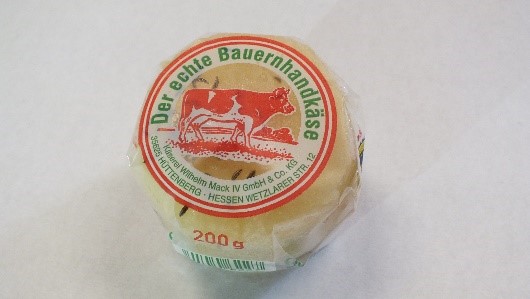
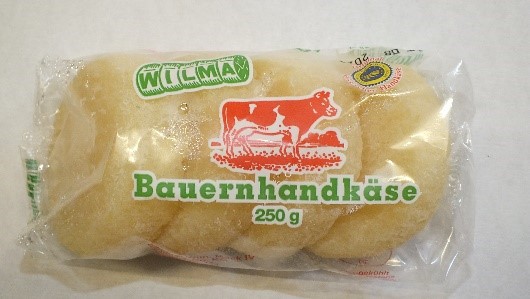
Sour milk cheese Bliestaler-Art Wilma Edelharzer Wilma farmer’s hand cheese The real farmer’s hand cheese

Product images:

1.jpg

Käserei Wilhelm Mack GmbH & Co. KG

2.jpg

Käserei Wilhelm Mack GmbH & Co. KG

3.jpg

Käserei Wilhelm Mack GmbH & Co. KG

4.jpg

Käserei Wilhelm Mack GmbH & Co. KG

Manufacturer (distributor):

Käserei Wilhelm Mack GmbH & Co. KG Elbestrasse 15 35625 Hüttenberg

Reason for warning:

Possible contamination with Listeria

Durability:

06/20/2022, 06/23/2022 and 06/27/2022

Further information:

Listeria disease usually manifests itself within 14 days after infection with diarrhea and fever. Pregnant women, the elderly and people with a weakened immune system in particular can develop more severe illnesses with blood poisoning and meningitis. In pregnant women, even without symptoms, the unborn child can be harmed.

Anyone who has eaten this food and develops severe or persistent symptoms should seek medical attention and report possible Listeria infection.

Pregnant women who have eaten this food should seek medical treatment and advice even if they have no symptoms. For other people without symptoms, this is not useful.

For more information, please refer to the manufacturer’s press release attached.

Click to access Pressemitteilung+R%FCckruf+K%E4serei+Wilhelm+Mack+GmbH+&+Co+KG.pdf

Research – Seafood safety and food‐borne zoonoses from fish

EFSA

Parasitic nematodes of the genus Anisakis are the causative agent of anisakiosis, an important fish‐borne zoonosis. Humans are infected through consumption of raw or undercooked fish, contaminated with the parasite. Infection can result in both gastrointestinal and allergic symptoms. There are few reports of anisakiosis in Portugal, but evidence of Anisakis allergy exists, indicating that exposure is occurring in the population. The European Food Risk Assessment Fellowship Programme (EU‐FORA) work programme, entitled: ‘Food safety of fish and zoonoses: fish consumption and microbiological risk assessment and perception, from fisherman to final consumers in Portugal’ was hosted by the Interdisciplinary Centre of Marine and Environmental Research (CIIMAR), in Porto, Portugal. It aimed to gather information on risk perception and attitudes in the Portuguese population to contamination of fish with Anisakis spp. and on their knowledge of methods to prevent infection. In addition, it aimed to examine the risk of anisakiosis in the Portuguese population.

Research – Evaluation of Potential for Butyl and Heptyl Para-Hydroxybenzoate Enhancement of Thermal Inactivation of Cronobacter sakazakii during Rehydration of Powdered Infant Powdered Infant Formula and Non-Fat Dry Milk.

Journal of Food Protection

Prior studies have demonstrated that parabens enhanced the thermal inactivation of foodborne pathogens including Cronobacter sakazakii , Salmonella enterica serotype Typhimurium, Escherichia coli O157:H7 and Listeria monocytogenes in model systems. However, there have been few studies looking at this phenomenon in actual food systems. The current study evaluated the potential enhancement of thermal inactivation of C. sakazakii by butyl para-hydroxybenzoate (BPB) in powdered infant formula (PIF) and non-fat dry milk (NFDM) before and after rehydration. When PIF was rehydrated with water at designated temperatures (65 – 80 ºC) in baby bottles, BPB did not enhance thermal inactivation. Rehydrated NFDM and lactose solutions with BPB were inoculated and heated at 58 ºC, BPB enhancement of thermal inactivation was negatively associated with NFDM levels in a dose-dependent manner, whereas presence of lactose retained thermal enhancement regardless of its concentration, suggesting an interaction between proteins and BPB. Fluorescence tests further indicated an interaction between BPB and the proteins in PIF and NFDM. Inoculated dry NFDM with and without BPB stored at 24 ºC and 55 ºC for 14 days did not substantially enhance inactivation in the dry state. This study suggests that BPB is not likely to enhance mild thermal inactivation treatments in foods that have appreciable amounts of protein.

Research – Comparison of Selected Phenotypic Features of Persistent and Sporadic Strains of Listeria monocytogenes Sampled from Fish Processing Plants

MDPI

(1) Background: The main source of transmission of Listeria monocytogenes is contaminated food, e.g., fish and meat products and raw fruit and vegetables. The bacteria can remain for 13 years on machines in food processing plants, including fish plants.

(2) Methods: A total of 720 swabs were collected from a salmon filleting line. The research material consisted of 62 (8.6%) L. monocytogenes isolates. Pulsed Field Gel Electrophoresis (PFGE) allowed detecting a pool of persistent strains. All persistent strains (n = 6) and a parallel group of strains collected sporadically (n = 6) were characterized by their ability to invade HT-29 cells, biofilm formation ability, and minimum bactericidal concentrations (MBC) of selected disinfectants.

(3) Results: Among the obtained isolates, 38 genetically different strains were found, including 6 (15.8%) persistent strains. The serogroup 1/2a-3a represented 28 strains (73.7%), including the persistent ones. There were no significant differences in invasiveness between the persistent and sporadic strains. The persistent strains tolerated higher concentrations of the tested disinfectants, except for iodine-based compounds. The persistent strains initiated the biofilm formation process faster and formed it more intensively.

(4) Conclusions: The presence of persistent strains in the food processing environment is a great challenge for producers to ensure consumer safety. This study attempts to elucidate the phenotypic characteristics of persistent L. monocytogenes strains. View Full-Text

Research – A risk assessment model for Salmonella spp. in swine carcasses

EFSA

Salmonellosis is one of the most important food‐borne outbreaks that occurs in the EU/EEA. From the first production stages at slaughter, meat is susceptible to spoilage and can be a substrate for the pathogenic microorganisms growth. Among the pathogens, the presence of Salmonella is mainly due to mishandling during the evisceration stage. For the year 2019, according to the collected data from MSs, on the 17.9% of all food‐borne outbursts, the presence Salmonella was confirmed. Pork meat is considered as one of the four most commonly reported foods in cases of salmonellosis. For the training purposes of this project, Salmonella isolation and identification along with RA for carcass contamination, was performed. Pig carcasses were sampled using the non‐destructive technique. The sampling took place post dressing and before the stage of chilling. For the Salmonella detection, a three phases process was performed (pre‐enrichment, enrichment, isolation). A total of 757 samples were collected, 19 were found to be positive for Salmonella. The most common was found to be Salmonella Derby, which was identified eight times. The main objective of the project was to determine the prevalence of Salmonella spp. in swine carcasses. Moreover, certain parameters were evaluated in terms of their influence on the prevalence of Salmonella. A stochastic simulation model was developed in Microsoft Office Excel 2019 by using the add‐in @Risk v.8.1. The prevalence was estimated to be 2.6%. For the pigs sampled, the average value of the distance from farm to slaughterhouse was 200.92 km. Additionally, the average weight of the carcasses was 127.97 kg. The prevalence of Salmonella between the samples that came from farms with a distance above the average, was higher by 1.7 units, while the prevalence for the samples with weight above the average was higher by 0.2 units. According to the stochastic model, it is specified that the prevalence is higher with greater distance, and there is an 8.1% probability the prevalence will exceed the legislation’s – hygiene criteria. In addition, the prevalence of Salmonella was shown to increase, as well in the case of samples from weightier animals, but to a lesser extent.