Category Archives: Uncategorized

Research – Assessment of mycotoxins co‐occurrence in Italian dried figs and in dried figs‐based products

Wiley Online

Abstract

The possible contamination by aflatoxins (AFs), ochratoxin A (OTA), fumonisin B1 (FB1), fusaric acid (FA), and beauvericin (BEA), was investigated in 55 samples of dried figs and dried figs‐based products purchased from the South Italy (Calabria) market. A total of 41 samples showed contamination by at least one of the mycotoxins investigated. Aflatoxin B1 was found in six samples (0.19 — 8.41 μg/kg) total aflatoxins were found in 13 samples (0.5–17.12 μg/kg), OTA was found in 21 samples (<LOQ—158.58 μg/kg), FB1 was found in eight samples (153.81–5,412.96 μg/kg), BEA was found in 12 samples (<LOQ—5,708.49 μg/kg), and FA was found in 28 samples (<LOQ—74,520.20 μg/kg). The analyzed samples were contaminated with one (41.8%), two (7.3%), three (5.5%), four (10.9%), and five (5.5%) mycotoxins. To the best of our knowledge, the incidence of contamination by FA and BEA has been shown for the first time in dried figs.

Practical applications

The present work was focused on mycotoxin mixtures contamination levels of dried figs and dried figs‐based products. It is known that the co‐occurrence of mycotoxins leads to additive or synergistic effects. For some analyzed samples the AFB1, aflatoxins, and ochratoxin A (OTA) levels exceed the European Union countries legal limit. In addition, the simultaneous presence of FB1, FA, and BEA can be a potential threat to the health of consumers. Although different studies examined AFs, OTA, and Fusarium toxins as single mycotoxins in dried figs, to our knowledge, the co‐occurrence of AFs, OTA, FB1, FA, and BEA in dried figs and in dried figs‐based products samples has not been reported previously. Therefore, to prevent mycotoxins contamination, the employment of good practices in all the processing steps is necessary. Furthermore, the quality control of the ingredients used in figs preparations (spices, other dried fruits, cocoa, etc.), usually not adequately, is essential. Finally, it is of importance to establish more stringent rules to ensure food safety, even if no legal limit was still set for Fusarium toxins in dried fruit.
Research – Consumers’ Return Intentions towards a Restaurant with Foodborne Illness Outbreaks: Differences across Restaurant Type and Consumers’ Dining Frequency

Science Direct

This study reports an investigation of the determinants of the likelihood consumers will revisit a restaurant that has had a foodborne illness outbreak, including the moderating effects of restaurant type and consumer dining frequency. A scenario-based survey was distributed via Amazon’s Mechanical Turk to collect data from 1,034 respondents; the tally of valid responses was 1,025. Partial least squares-based structural equation modeling (PLS-SEM) showed perceived vulnerability and perceived severity to be statistically significant; both also negatively affected customer intentions to patronize restaurants cited for serving foods that caused foodborne illness outbreaks. Results suggest that type of restaurant is a significant moderator between perceived severity and customer intentions. The type of diner, however, based on frequency, does not moderate the relationships between perceived severity and perceived vulnerability and customer intentions to patronize restaurants that served food causing a foodborne illness outbreak (FBI). Using protection motivation theory (PMT) (Rogers, 1975), this study’s findings contribute to understanding determinants and moderators of customer intentions to revisit restaurants after a foodborne illness outbreak.

Research – Genetic Diversity of Salmonella and Listeria Isolates from Food Facilities

Journal of Food Protection

Food production–related facilities (farms, packing houses, etc.) are monitored for foodborne pathogens, and data from these facilities can provide a rich source of information about the population structure and genetic diversity of Salmonella and Listeria. This information is of both academic interest for understanding the evolutionary forces acting on these organisms and of practical interest to those responsible for controlling pathogens in facilities and to those analyzing data from facilities in the context of public health decision making. We have collected information about all positive isolates from facility inspections performed by the U.S. Food and Drug Administration for which whole genome sequencing data are available. The within- and between-facilities observed genetic diversity of isolates was computed and related to the common origin of isolates (as the common collected facility). This relationship provides quantification for assessing the relationship between isolates based on their genetic similarity quantified by single-nucleotide polymorphisms (SNPs). Our results show that if the genetic distance (D) between two isolates is low, then more likely than not they are from the same facility or have some overlap in their supply chain. For example, if the genetic distance is no more than 20 SNPs, the probability (P) that two isolates come from the same facility = 0.66 for Salmonella and 0.70 for Listeria. However, if two isolates come from different facilities, their genetic distance is likely large (for Salmonella, P(D > 20 SNPs) = 0.99982; for Listeria, P(D > 20 SNPs) = 0.99949); even if two isolates come from the same facility, their genetic distance is also very likely large (for Salmonella, P(D > 20 SNPs) = 0.794; for Listeria, P(D > 20 SNPs) = 0.692). These results provide insight into what SNP thresholds might be appropriate when determining whether two isolates are from the same facility and thus would be of interest to those investigating foodborne outbreaks and conducting traceback investigations.

Research – Advancing Retail Food Policy Debates: Estimating the Risk of Contaminated Servings of Food Attributed to Employee Food Handling Practices in Retail Food Establishments

Journal of Food Protection

Food employee contamination of ready-to-eat foods through improper food handling practices is an important contributing factor for foodborne illness in retail and food service establishments. Decreasing the incidence of improper food handling practices is a frequent topic of retail food policy deliberations that often involves estimating the degree to which a proposed policy might affect a specific food handling practice. However, the potential reduction in contaminated servings of food, and therefore foodborne illnesses avoided, associated with a given proposed policy change, is all too often uncertain. This article discusses the components, assumptions, and applications of the food handling practices model, a quantitative model that estimates the impact of food handling practices on servings of food moving along three consecutive stages: the contamination stage, the pathogen control stage, and the foodborne illness stage. To our knowledge, this article is the first time the model has been presented in an academic platform, and we also explore unique and interesting aspects of the model not addressed in publicly available documents. Risk-based estimates for contaminated servings of food attributed to changes in one or multiple food handling practices are derived that provide an important link between increased compliance with proper food handling practices and public health. Model estimates show that decreases in the incidence of inappropriate food handling practices lead to varying levels of contaminated food servings avoided, depending on the food handling practice. The ability to derive such estimates provides stakeholders and the general public with a means of understanding the relative impact of proposals to reduce improper food handling and to help inform regulatory food safety policy discussions and decision making.

Information – The International Outbreak Museum – Portland – Orgegon

Outbreak Museum

The International Outbreak Museum began in the office of Dr. Bill Keene in his early years investigating infectious disease outbreaks at the Oregon state health department. Bill realized early on that outbreak investigations are very public opportunities to teach large audiences about the kinds of foods and products that can become contaminated and cause widespread dissemination of disease. From one of the very first (and still the oldest) exhibits, an actual box of “Rely Tampons” that associated with Toxic Shock Syndrome and Staphylococcus aureus in 1978, to painstakingly reproduced products (like Sally Jackson artisanal raw milk cheese), the physical museum includes some pretty cool stuff. We’ve got bunches of restaurant menus, cans of contaminated leather spray, bottles of MRSA-contaminated tattoo ink and equipment, and packaging from many products that were recalled from the market because they caused outbreaks and made citizens sick.

The museum is part of The Northwest Center for Foodborne Outbreak Management, Epidemiology, and Surveillance (FOMES), a program that fosters the public health practice of foodborne and diarrheal disease surveillance and outbreak investigation. FOMES will be working to bring all of the physical IOM exhibits to digital life and feature them in their proper place on the web. Our hope is that Dr. Keene’s museum can be used to share the fascinating stories behind outbreak investigations. Please consider submitting information about your latest investigation (even if you didn’t find a smoking gun).

Research -Microbacteria can build up in your reusable water bottle

The Jakarta Post

Both oral and environmental bacteria and viruses could be building up on reusable water bottles that are not cleaned on a regular basis, according to a scientist from the Center for Ecology and Hydrology.

Senior scientist Andrew Singer was recently interviewed by the Huffington Post UK, where he explained that even E. coli could find its way into an unclean reusable water bottle.

“When you flush the toilet, the toilet water will get aerosolized and a fraction of the water droplets can land on and in your water bottle,” Singer explained.

Singer said that poor personal hygiene habits, such as rarely or not washing your hands after using the toilet, or taking your water bottle to the toilet with you, could increase the chances of getting serious infections.


Research – Soil bacteria provide a promising E. coli treatment

Medical Express

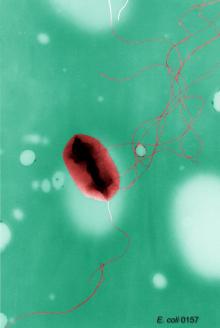
kswfoodworld E.coli O157

Image CDC


While thoroughly cooking meat and washing vegetables and hands after can prevent E. coli , treatment for the severe stomach bug can be difficult, as antibiotics are known to make the disease worse by releasing a potent toxin into the infected person’s gut.

Now, scientists from the University of Glasgow have found a product made by natural soil-living bacteria that can successfully treat E. coli O157 – [one of] the most serious types of the bug – without producing any serious side effects.

The new study, published in Infection and Immunity, found that Aurodox, a compound first discovered in 1973 but found to be poorly active as a true antibiotic, was able to successfully block E. coli O157 infections.

Scotland has one of the highest incidences of E. coli O157 in the world, and almost half of O157 cases in Scotland are in children under 16 years of age.

The Aurodox compound was able to reduce the ability of E. coli O157 to bind to human cells and, unlike traditional antibiotics, did not cause the release of potent toxins. The researchers believe that this compound could be used as a promising future treatment of E. coli O157 infections.

USA – Notes from the Field: Multiple Modes of Transmission During a Thanksgiving Day Norovirus Outbreak — Tennessee, 2017

CDC

On November 28, 2017, the manager of restaurant A in Tennessee reported receiving 18 complaints from patrons with gastrointestinal illness who had dined there on Thanksgiving Day, November 23, 2017. Tennessee Department of Health officials conducted an investigation to confirm the outbreak, assess exposures, and recommend measures to prevent continued spread.

On November 23, one patron vomited in a private dining room, and an employee immediately used disinfectant spray labeled as effective against norovirus* to clean the vomitus. After handwashing, the employee served family-style platters of food and cut pecan pie. For the November 23 Thanksgiving Day, restaurant A served 676 patrons a limited menu from 11 a.m. to 8 p.m. The manager provided contact information, seating times, and seating locations for 114 patrons with reservations. All patrons with contact information were telephoned, and a questionnaire was used to assess illness and exposures for anyone living in the household who ate at restaurant A on November 23. Stool specimens were requested from ill patrons. Among the 676 patrons, 137 (20%) were enrolled in a case-control study.

A probable case was defined as diarrhea (three or more loose stools in 24 hours) or vomiting within 72 hours of eating at restaurant A on November 23; probable cases with norovirus RNA detected in a stool specimen by real-time reverse transcription–polymerase-chain reaction (RT-PCR) were considered confirmed. On November 30, environmental swabs for norovirus testing were collected in the restaurant. Patient and environmental samples were tested by real-time RT-PCR and sequenced at the Tennessee State Public Health Laboratory.

Thirty-six (26%) case-patients (two confirmed and 34 probable) and 101 (74%) controls were enrolled in the case-control study. Illness onsets occurred during November 23–25, with 17 of 35 (49%) cases occurring on November 24 (Figure). The mean incubation period was 31 hours (range = 2.5–54.5 hours), and the mean illness duration was 3 days (range = 0–6 days). Only one case-patient sought medical care. Diarrhea was reported by 33 (94%) case-patients, fatigue by 29 (83%), nausea and abdominal cramps by 28 (80%), vomiting by 24 (69%), and fever by six (17%).

Among menu items, only pecan pie was significantly associated with illness (odds ratio [OR] = 2.6; 95% confidence interval [CI] = 1.1–5.8); however, it was eaten by only 16 (47%) of 34 case-patients. The vomiting event occurred around noon; patrons seated during 11 a.m.–1 p.m. were significantly more likely to become ill than were patrons seated during other times (OR = 6.0; 95% CI = 2.6–15.3). No significant differences between dining locations (i.e., private dining room versus general seating) were identified (OR = 1.4; 95% CI = 0.4–4.3). Logistic regression was used to evaluate the effects of eating pecan pie, seating time, and seating location; only seating time during 11 a.m.–1 p.m. remained statistically significant (OR = 6.0; 95% CI = 2.2–16.5).

Stool specimens from two case-patients identified Norovirus GII.P16-GII.4 Sydney. Norovirus GII was identified in one environmental swab collected from the underside of a table leg adjacent to the vomitus.

UK – Avoid the unwanted gift of food poisoning this Christmas

FSA

With an estimated one million cases a year, food poisoning doesn’t stop over the festive season.

To save you and your loved ones from a nasty bout of food poisoning over the holidays, follow our advice:

  1. When Christmas food shopping, take enough bags with you so that you can separate out raw and ready-to-eat foods to avoid cross-contamination.
  2. Check the guidance on your turkey to ensure you have enough time to fully defrost it – it could take as many as 4 days.
  3. Don’t wash raw turkey – it just spreads germs further by splashing them onto your hands, clothes, utensils and worktops.
  4. To work out the cooking time for your bird, read the instructions on the packaging. Check that: the meat is steaming hot throughout, there is no pink meat visible when you cut into the thickest part and meat juices run clear.
  5. Whether you cooked your turkey from frozen or fresh, your turkey leftovers can be used to make a new meal (such as a turkey curry). This new meal can then be frozen, but make sure you only reheat it once.

Research – Innate antimicrobial immunity in the skin: A protective barrier against bacteria, viruses, and fungi

PLOS One

Innate immunity is an essential defense against pathogens

The epidermis, the outermost layer of the skin, is a physical barrier against pathogens. However, breach of the skin barrier through wounding introduces a myriad of microbes to the site of injury. Upon disturbance of the epidermal barrier, the innate immune system and its effectors play a key role in protecting humans against cutaneous and systemic infection [1]. Major constituents of the innate immune system include phagocytic cells, such as macrophages, neutrophils, and dendritic cells, as well as innate leukocytes, such as natural killer (NK) cells, mast cells, basophils, and eosinophils. In addition, epidermal keratinocytes act as active innate immune cells. In response to sensing pathogen-associated molecular patterns (PAMPs) expressed by microbes and host danger molecules, innate immune receptors present on keratinocytes become activated, causing release of inflammatory cytokines and host antimicrobial molecules [2, 3].