Category Archives: Uncategorized

Information -Don’t be too chill about frozen berries, illness

The Columbian

When North Carolina State University microbiologist Benjamin Chapman makes a smoothie, he like many of us uses frozen berries. But first, Chapman microwaves his frozen berries to boiling and then refreezes them again before tossing them into the blender.

Why the extra steps? Chapman wants to be sure that there are no pathogens in the frozen berries that could cause a foodborne illness for him or his family.

“What I am doing may be overkill, but it makes me feel good,” says Chapman, who has been making smoothies this way for the past eight to 10 years, since his children were infants and toddlers. “I don’t have any thoughts that the berries are super high-risk to making us sick. But to me, it is something that is quick and easy to do. It’s my own risk management.”

Nor is he alone in taking extra precautions with frozen berries. In May, the Food and Drug Administration announced that it began sampling frozen berries last fall to look for hepatitis A and norovirus, two of the most common foodborne illnesses. The federal agency said that it plans to test 2,000 samples over the next 18 months from both domestic and imported sources, including food processors, distribution centers, warehouses and retailers, such as grocery stores.

USA- Legionnaires’ disease confirmed in Batavia, Illinois Retirement Community

Outbreak News Today Legionella_Plate_01

Officials with the Kane County (IL) health department received reports of four cases of Legionnaires’ disease. Four residents at Covenant Living at the Holmstad in Batavia have been confirmed to have Legionnaires’ disease.

“Public health officials are testing for Legionella bacteria and continue to investigate to identify potential sources and additional individuals who may have been exposed during this period,” said Kane County Health Department Executive Director Barbara Jeffers. “Covenant Living is working closely with public health officials.”

USA – All ‘Berkley & Jensen’ pig ear treats sold at BJ’s Wholesale Clubs recalled

Food Safety News

Dog Goods has expanded an existing recall to include all 30-packs of “Berkley & Jensen” brand pig ears sold at BJ’s Wholesale Club stores.

Dog Goods purchased the pig ears from a single supplier in Brazil from September 2018 through August 2019. The U.S. Food and Drug Administration, together with the Centers for Disease Control and Prevention and state partners, is investigating a link between pig ear pet treats and human cases of salmonellosis.

This recall is being expanded after Rhode Island Department of Health testing found Salmonella in “Berkley & Jensen” brand pig ear pet treats.

Spain – Four ill in Spain with botulism linked to tuna – Clostridium botulinum

Food Safety News

Four people are part of a foodborne botulism outbreak in Spain after eating DIA brand tuna.

A batch of canned tuna in sunflower oil of the brand DIA has been removed from sale. The Spanish Agency for Food Safety and Nutrition (AESAN) said those who became ill ate a homemade salad that included the tuna. Spanish media reported one of the patients was still in hospital.

The foodborne outbreak was suspected to be caused by the tuna or grated carrots from Spain with distribution including Andorra, according to a Rapid Alert System for Food and Feed (RASFF) notice.

AESAN became aware on Aug. 9, through the Spanish rapid information exchange system (SCIRI), of a notification from health authorities in Castilla y León of a food poisoning outbreak caused by botulinum toxin linked to consumption of canned tuna in a homemade “Russian” salad.

Bosnia and Herzegovina -71 People sought Medical Help after Food Poisoning

Sarajevo Times

A total of 71 people have sought medical help after eating kebabs and sandwiches at a fast food facility in Srebrenik and 22 people coming from the Tuzla, Gradacac and Srebrenik area reported to the Infectious Diseases Clinic of the University Clinical Center in Tuzla.

“We are in contact with the hygienic-epidemiological services in the Tuzla Canton and we are working on the remediation of the epidemic,” said Dr. Blasko Topalovic from the Public Health Institute of Tuzla Canton.


India – 2 toddlers dead, 10 hospitalised after eating contaminated food in orphanage in Mathura

News Room Post

District Magistrate, Sarvagya Ram Mishra, on Thursday said: “It is very very unfortunate that 12 kids took ill due to food poisoning out of which two lost their lives. The children who died were between six months to two years old.

Mathura (Uttar Pradesh): Two toddlers died and 10 children were hospitalised after they allegedly consumed contaminated food, earlier this week, at an orphanage here, a senior district official said.

District Magistrate, Sarvagya Ram Mishra, on Thursday said: “It is very very unfortunate that 12 kids took ill due to food poisoning out of which two lost their lives. The children who died were between six months to two years old.

Norway – Norway norovirus outbreaks linked to seaweed salad from China

Food Safety News

More than 100 people have fallen ill in Norway from norovirus likely in a frozen seaweed salad from China.

The first outbreak of norovirus suspected to be linked to the seaweed salad occurred in mid-June and the most recent was at the beginning of August. The implicated product was also shipped to Denmark.

“It is suspected that seaweed from China was the cause of more than 100 cases of gastroenteritis from at least 11 eateries in different areas of Norway. Most of the outbreaks were in June and July this year. Investigations are still ongoing. Norovirus was detected in patients from at least two of these eateries,” Guri Aanderud, senior adviser in the seafood section at the Norwegian Food Safety Authority (Mattilsynet) told Food Safety News.

CDC – Food Safety Education Month

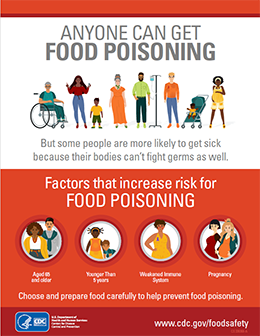
CDC people at risk poster

September is National Food Safety Education Month. Learn how to be a food safety superhero! Take steps to help prevent food poisoning, and show others how to keep food safe.

Every year, an estimated 1 in 6 Americans (or 48 million people) get sick, 128,000 are hospitalized, and 3,000 die from eating contaminated food. Anyone can get sick from a foodborne illness (also called food poisoning). But some groups of people are more likely to get sick and to have a more serious illness. These groups are:

  • Children younger than 5
  • Adults aged 65 and older
  • People with health problems or who take medicines that lower the body’s ability to fight germs and sickness
  • Pregnant women

There are things you can do to protect yourself and your family. As you prepare and handle food, follow these four steps:

  • Clean: Wash your hands, utensils, and surfaces often when you cook.
  • Separate: Raw meat, poultry, seafood, and eggs can spread germs. Separate them from cooked food and fresh produce.
  • Cook: Use a food thermometer to make sure foods are cooked to an internal temperature that kills germs.
  • Chill: Refrigerate perishable foodsexternal icon and leftovers within two hours. Chill within one hour if it’s above 90°F.

Join us in sharing information about the four steps to food safety. Let’s make sure everyone knows how to protect themselves and their loved ones from food poisoning.

Food Safety Education Month Materials

New and Updated Resources

Information on Food Safety

USA – Hepatitis A in Food Worker at Cracker Barrel in Bridgeport, MI

Food Poisoning Bulletin

A food worker at the Cracker Barrel Restaurant and Old County Store at 6450 Dixie Highway in Bridgeport, Michigan has been diagnosed with hepatitis A, according to the Saginaw County Health Department. That person worked there from August 25 through August 28, 2019. Anyone who visited that facility during that time frame may have been exposed to the virus.

Research – Inactivation of Staphylococcus aureus Biofilms on Food Contact Surfaces by Superheated Steam Treatment

Journal of Food Protection Staph

ABSTRACT

The objective of this study was to compare the inactivation efficacy of saturated steam (SS) and superheated steam (SHS) on Staphylococcus aureus biofilms on food contact surfaces, including type 304 stainless steel coupons with No. 4 finish (STS No. 4), type 304 stainless steel coupons with 2B finish (STS 2B), high-density polyethylene (HDPE), and polypropylene (PP). In addition, the effects of the surface characteristics on the inactivation efficacy were evaluated. Biofilms were formed on each food contact coupon surface using a three-strain cocktail of S. aureus. Five-day-old biofilms on STS No. 4, STS 2B, HDPE, and PP coupons were treated with SS at 100°C and SHS at 125 and 150°C for 2, 4, 7, 10, 15, and 20 s. Among all coupon types, SHS was more effective than SS in inactivating the S. aureus biofilms. S. aureus biofilms on steel coupons were more susceptible to most SS and SHS treatments than the biofilms on plastic coupons. S. aureus biofilms on HDPE and PP coupons were reduced by 4.00 and 5.22 log CFU per coupon, respectively, after SS treatment (100°C) for 20 s. SS treatment for 20 s reduced the amount of S. aureus biofilm on STS No. 4 and STS 2B coupons to below the detection limit. With SHS treatment (150°C), S. aureus biofilms on HDPE and PP needed 15 s to be inactivated to below the detection limit, while steel coupons only needed 10 s. The results of this study suggest that SHS treatment has potential as a biofilm control intervention for the food industry.

HIGHLIGHTS
  • SHS was more effective than SS for inactivating biofilm cells of S. aureus.

  • Biofilms on steel coupons were more susceptible than those on plastic coupons.

  • The thermal conductivity of the coupon was an important factor in SHS treatment.

  • Biofilm; Saturated steam; Staphylococcus aureus; Superheated steam