Category Archives: Uncategorized

USA -Salmonella Outbreak Doug Saul’s Bar-B-Que in Nashville, NC Sickens 14

Food Poisoning Bulletin

A Salmonella outbreak Doug Saul’s Bar-B-Que & Seafood restaurant located in Nashville, North Carolina has sickened at least 14 people, according to the Nash County Health Department. Ten of those people named the restaurant as a source of some of the food they ate before they got sick. That facility is located at 813 Western Avenue in Nashville.

Research -The nature of salmonella is changing — and it’s meaner

Science Daily

Salmonella is acting up in Michigan, and it could be a model for what’s happening in other states, according to a new Michigan State University study.

The study, appearing in Frontiers in Medicine, documents a substantial uptick in antibiotic resistant strains, and consequently, longer hospital stays as doctors work to treat the increasing virulent pathogens.

“If you get a salmonella infection that is resistant to antibiotics today, you are more likely to be hospitalized longer, and it will take you longer to recover,” said Shannon Manning, MSU Foundation professor in the Department of Microbiology and Molecular Genetics and senior author of the study. “We need better detection methods at the clinical level to identify resistant pathogens earlier so we can treat them with the right drugs the first time.”

Losing a day or more to misdiagnosis or improper treatment allows symptoms to get worse. Doctors might kill off a subpopulation of bacteria that are susceptible, but the ones that are resistant grow stronger, she added.

Salmonella is a diverse group of bacterial pathogens that causes foodborne infections. Infected patients often develop diarrhea, nausea, vomiting and abdominal pain, though some infections are more severe and can be life threatening.

When it comes to treatments, each strain reacts differently to the range of antibiotics available for prescription by doctors. So getting it right the first time is crucial.

Specifically in Michigan, doctors are seeing more strains that are resistant to ampicillin, a common antibiotic prescribed to treat salmonella. Multidrug resistance, or resistance to more than three classes of antibiotics, has also increased in Michigan and could further complicate patient treatment plans.

“We’re still uncertain as to why this is happening; it could be that these antibiotics have been overprescribed in human and veterinary medicine and that possessing genes for resistance has allowed these bacteria to grow and thrive in the presence of antibiotics,” Manning said. “Each state has its own antibiotic-resistance issues. It’s important that the medical profession remains vigilant to ever-changing patterns of resistance in salmonella and other foodborne pathogens, rather than look for a blanket national solution.”

Historically, salmonella has affected young children and the elderly, but now there’s been a rise in adult cases, suggesting that the epidemiology of the infections has changed in Michigan.

Diving into individual strains of salmonella, the team of scientists found that patients with Typhimurium were more likely to have resistant infections as were patients infected during the fall, winter or spring months.

Another distinction was revealed between the strains affecting people living in rural and urban areas. Enteritis infections tend to be higher in rural areas. This may be attributed to rural residents’ exposure to farm animals or untreated sources of water.

Each state’s salmonella population has its own personality; so every state’s approach to identifying disease drivers and effective treatments should be modified to reflect these traits.

“Our results show the importance of surveillance, monitoring resistance frequencies and identifying risk factors specific to each state and region,” Manning said. “The trends that are revealed can lead to new prevention strategies.”

USA -Investigation of E. coli O157:H7 Outbreak Linked to Romaine from Salinas, California, November 2019

FDA

November 26, 2019

Recommendation

FDA, CDC, and state health authorities are investigating an outbreak of illnesses caused by E. coli O157:H7 in the United States. Epidemiologic, laboratory, and traceback evidence indicates that romaine lettuce from the Salinas, California growing region is a likely source of this outbreak. The CDC is reporting an increase in the case count to 67 and that the most recent illness onset date is November 14, 2019.

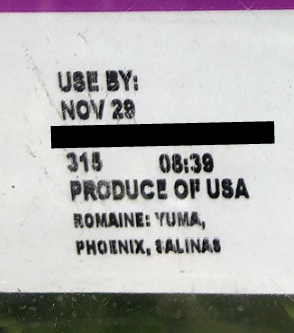
Romaine from Salinas, California Label Enjoy By December 2, 2019


Romaine from Salinas, California Label Use By November 29, 2019

Consumers: Consumers should not eat romaine lettuce harvested from Salinas, California. Additionally, consumers should not eat products identified in the recall announced by the USDA on November 21, 2019.

Romaine lettuce may be voluntarily labeled with a harvest region. If this voluntary label indicates that the romaine lettuce was grown in “Salinas” (whether alone or with the name of another location) do not eat it. Throw it away or return it to the place of purchase.  If romaine lettuce does not have information about harvest region or does not indicate that it has been grown indoors (i.e., hydroponically- and greenhouse-grown), throw it away or return it to the place of purchase. Consumers ordering salad containing romaine at a restaurant or at a salad bar should ask the staff whether the romaine came from Salinas.  If it did, or they do not know, do not eat it.

At this time, romaine lettuce that was harvested outside of the Salinas region has not been implicated in this outbreak investigation. Hydroponically- and greenhouse-grown romaine, which is voluntarily labeled as “indoor grown,” from any region does not appear to be related to the current outbreak. There is no recommendation for consumers to avoid using romaine harvested from these other sources.

Restaurants and Retailers: Restaurants and retailers should not serve or sell romaine harvested from Salinas, California.  If you do not know the source of your romaine lettuce, and if you cannot obtain that information from your supplier, you should not serve, nor sell it.

Suppliers and Distributors: Suppliers, distributors and others in the supply chain should not ship or sell romaine harvested in Salinas, California. If the source of the romaine lettuce is unknown, you should not ship, nor sell the product.

For Restaurants, Retailers, Suppliers and Distributors: Currently, the FDA does not have enough traceback information to identify the specific source of the contamination that would allow us to request a targeted recall from specific growers. At this stage in the investigation, the most efficient way to ensure that contaminated romaine is off the market would be for industry to voluntarily withdraw product grown in Salinas, and to withhold distribution of Salinas romaine for the remainder of the growing season in Salinas. FDA has made this request of industry.

At this time, romaine lettuce that was harvested outside of the Salinas region has not been implicated in this outbreak investigation. Hydroponically- and greenhouse-grown romaine, which is voluntarily labeled as “indoor grown,” from any region does not appear to be related to the current outbreak. There is no recommendation for consumers or retailers to avoid using romaine harvested from these other sources.

Background

According to the CDC, as of November 25, 2019, 67 people infected with the outbreak strain of E. coli O157:H7 have been reported from 19 states. The case patients report that illnesses started on dates ranging from September 24, 2019 to November 14, 2019.

The Maryland Department of Health identified E. coli O157:H7 in an unopened package of Ready Pac Bistro® Chicken Caesar Salad collected from an ill person’s home in Maryland. Analysis of this salad, through Whole Genome Sequencing (WGS), has linked strain E. coli O157:H7 to three Maryland cases and the multi-state outbreak.

The FDA and state partners are conducting a traceback investigation to trace romaine exposures to the source. Preliminary information indicates that ill people in Maryland were exposed to romaine lettuce harvested in Salinas, California.

FDA has deployed investigators to the farms in question to try to determine the source and extent of the contamination. More information will be forthcoming as the investigation proceeds.

Additionally, state partners are conducting laboratory analyses of romaine lettuce samples from case patients potentially linked to the outbreak.

The Salinas region as defined by the United Fresh Produce Association and the Produce Marketing Association Romaine Taskforce ReportExternal Link Disclaimer includes: Santa Cruz, Santa Clara, San Benito, and Monterey counties in California.

Genetic analysis of the E. coli O157:H7 strains from patients in this current outbreak are similar to strains of E. coli O157:H7 associated with a previous outbreak from the Fall of 2017 and the Fall of 2018 that affected consumers in both Canada and the U.S. The 2017 outbreak of E. coli O157:H7 was associated with leafy greens in the U.S. and romaine in Canada. The 2018 outbreak of E. coli O157:H7 was associated with romaine in both countries.

Hong Kong -Not to consume batch of prepackaged Spanish chorizo suspected to be contaminated with Listeria monocytogenes

CFS

Issue Date 25.11.2019
Source of Information Rapid Alert System for Food and Feed (RASFF) of the European Commission
Food Product Prepackaged chorizo imported from Spain
Product Name and Description Product name: Chorizo Picante
Brand: la alegria
Place of origin: Spain
Net weight: 200 grams per pack
Lot No.: 37, 38 and 39
Best-before date: April 30, 2020
Reason For Issuing Alert
  • The Centre for Food Safety (CFS) received a notification from the RASFF of the European Commission that the above-mentioned batch of the product might have been contaminated with Listeria monocytogenes and was being recalled.
  • According to the information provided by the RASFF, a local importer, Gourmet Cuisine Hong Kong Limited, had imported some of the affected batch of the product into Hong Kong,” a spokesman for the CFS said.
Action Taken by the Centre for Food Safety
  • The CFS immediately contacted the importer concerned for follow-up.  Preliminary investigation found that the importer had imported 450 packs of the affected batch of the product, of which 26 packs had been sold while the others were disposed of. The importer has initiated a recall according to the CFS’ instructions.
  • The CFS will alert the trade to the incident, and will continue to follow up and take appropriate action. Investigation is ongoing.
Advice to the Trade
  • Stop using or selling the batch of the product concerned immediately if they possess it.
Advice to Consumers
  • Not to consume the affected batch of the product if they have bought any.
Further Information The CFS press release

Enquiries about the recall can be made to the importer’s hotline at 2439 1977 during office hours.

USA-Northern Fisheries LTD. Voluntary Expanded Tuna Recall Press Release

FDA

Northern Fisheries LTD of Little Compton, RI, has expanded their voluntary recall of frozen, wild-caught yellowfin Tuna Medallions (product of Vietnam) to include product sold directly to consumers. This recall is due to potentially elevated levels of histamine. Elevated levels of histamines can produce an allergic reaction called scombroid fish poisoning that may result in symptoms that can generally appear within minutes to several hours after eating the affected fish.

The most common symptoms of histamine or scombroid fish poisoning are tingling or burning sensation in the mouth, facial swelling, rash, hives and itchy skin, nausea, vomiting or diarrhea; these symptoms usually resolve within several hours without medical intervention. However, each individual may experience symptoms differently. If symptoms are severe an individual should seek immediate medical attention for treatment.

These tuna products were sold to customers in: CT, MI, MN, RI and WI.

ALL LOTS WITH PRODUCTION DATE: 06/13/2019 UPC Code: 815838020638

Production date and UPC Code can be found on back of the Tuna King Brand rider card.

BRAND DESCRIPTION PRODUCTION DATE: NORTHERN
LOT #
UPC CODE
Tuna King Tuna Medallions 2-3oz 10x1lb 06/13/2019 0058797 815838020638

Customers who received products with the listed Production Date of: 06/13/2019 should not consume them and should discard them immediately.

Customers with questions or concerns may contact Northern Fisheries LTD by calling (401) 592-0600, Monday through Friday, 9 a.m. to 5 p.m., Eastern Time or email.

northfish@northfishltd.com

Canada -Food Recall Warning – Lafleur brand Original Wieners recalled due to Listeria monocytogenes

CFIA

Recall details

Ottawa, November 25, 2019 – Olymel S.E.C. / L.P. is recalling Lafleur brand Original Wieners from the marketplace due to possible Listeria monocytogenes contamination. Consumers should not consume the recalled product described below.

The following product has been sold in Quebec, Ontario and the Northwest Territories.

Recalled product

Brand Product Size UPC Codes
Lafleur Original Wieners 450 g 0 65305 02201 0 Best Before
2020 JA 15

Background

This recall was triggered by the company. The Canadian Food Inspection Agency (CFIA) is conducting a food safety investigation, which may lead to the recall of other products. If other high-risk products are recalled, the CFIA will notify the public through updated Food Recall Warnings.

The CFIA is verifying that industry is removing the recalled products from the marketplace.

Illnesses

There have been no reported illnesses associated with the consumption of this product.

Product photos

Printer ready version of photos

  • Lafleur - Original Wieners

India -High Aflatoxin level in milk

All About Feed

After a Food Safety and Standards Authority of India’s (FSSAI) report revealed a cancer-causing substance Aflatoxin M1 in milk samples, the government in the southern Indian state of Tamil Nadu decided to form a high-level committee that will look into this.

The committee comprising officials from the state food safety, health, and animal husbandry departments, Tamil Nadu Co-operative Milk Producers’ Federation Limited, Tamil Nadu Veterinary, and Animal Sciences University (TANUVAS) and some research agencies will study the report and will also take samples to find out the reasons and how the toxin managed to enter in the animal food chain.

Canada – Canada reports US Romaine Lettuce may have sickened at least one Citizen – E.coli O157

Food Poison Journal Eurofins Food Testing UK

Although an outbreak is not occurring in Canada, the Public Health Agency of Canada (PHAC) has identified one Canadian illness with a similar genetic fingerprint to illnesses reported in the U.S. investigation.

The Canadian Food Inspection Agency (CFIA) has confirmed that romaine lettuce from the affected areas reported in the U.S. investigation is imported to Canada at this time of year. The CFIA has taken measures to protect consumers and is implementing new actions at the border to ensure that any affected romaine lettuce products are no longer being imported into Canada.

As a result of the U.S. outbreak investigation and its link to product on the Canadian market, the Public Health Agency of Canada is advising Canadians to follow the U.S. CDC’s public health advice, which advises consumers to not eat, and retailers and food service establishments to not sell or serve, any romaine lettuce harvested from the Salinas, California growing region in the U.S. Romaine lettuce harvested in Canada is not affected by this advice.

Hong Kong -Not to consume romaine lettuce produced in Salinas, California, US – E.coli O157

CFS

Issue Date 23.11.2019
Source of Information US authorities
Food Product Romaine lettuce produced in the US
Product Name and Description Product name: baby spring mix
Brand: organicgirl
Place of origin: Salinas, California, US
Net weight: 5 ounces /142 grams
Reason For Issuing Alert
  • The CFS, through its Food Incident Surveillance System, noted a notice from the US Food and Drug Administration about the investigation of an outbreak of E. coli infections that was likely linked to the consumption of romaine lettuce produced in Salinas, California, which was suspected to be contaminated with E. coli O157:H7.
  • For the sake of prudence, the CFS has immediately suspended the import into and sale within Hong Kong of romaine lettuce produced in the area concerned.
Action Taken by the Centre for Food Safety
  • CFS has informed the US authorities concerned of the import suspension and alerted the trade to the incident.
  • The Centre will continue to follow up on the incident and take appropriate action.
Advice to the Trade
  • Stop using or selling the affected batches of the products immediately if they possess them.
Advice to Consumers
  • Not to consume the affected batches of the products if they have purchased any.
Further Information The CFS press release

Members of the public may call the hotline of the importer at 2299 1133 during office hours for enquiries about the recall.

USA – E. coli O103 illnesses in Tennessee prompt Ground Beef Recall

Food Poison Journal

K2D Foods, doing business as (DBA) Colorado Premium Foods, a Carrolton, Ga. establishment, is recalling approximately 113,424 pounds of raw ground beef products that may be contaminated with E. coli O103, the U.S. Department of Agriculture’s Food Safety and Inspection Service (FSIS) announced today.

The raw ground beef items were produced on March 26, March 29, April 2, April 5, April 10, and April 12, 2019.  The following products are subject to recall:

  • Two 24-lb. vacuum-packed packages in cardboard boxes containing raw “GROUND BEEF PUCK” with “Use Thru” dates of 4/14/19, 4/17/19, 4/20/19, 4/23/19, 4/28/19, and 4/30/19.

The products subject to recall bear establishment number “EST. 51308” inside the USDA mark of inspection on the boxes. These items were shipped to distributors in Port Orange, Fla. and Norcross, Ga. for further distribution to restaurants.