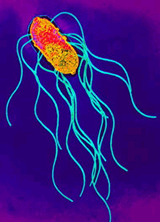
Category Archives: Salmonella

RASFF Alerts – Salmonella – Sesame Seeds – Prawns in a Mango Sauce

RASFF-Logo

RASFF-Salmonella (presence /25g) in sesame seeds from Sudan in Greece

RASFF-Salmonella (presence /25g) in sesame seeds from India in Germany

RASFF-Salmonella (in 1 out of 5 samples /25g) in sesame seeds from Sudan in Greece

RASFF-Salmonella (presence /25g) in unpeeled sesame seeds from Nigeria in Sesame Seeds

RASFF-Salmonella enterica ser. Neuland (presence /25g) in sesame seeds from Nigeria in Germany

RASFF -Salmonella enterica ser. Onderstepoort (presence /25g) in prawns in mango sauce from Germany in Austria

RASFF-Salmonella enterica ser. Kentucky, Salmonella enterica ser. Ruiru and Salmonella enterica ser. Senftenberg (presence /25g) in sesame seeds from Sudan in Greece


RASFF Alert – Animal Feed – Salmonella – Enterobacteriaceae – Cows Ears – Fish Meal

RASFF-Logo

RASFF-too high count of Enterobacteriaceae (3700, 8800 CFU/g) in cow ears from Mexico in Germany

RASFF-Salmonella enterica ser. Istanbul (in 1 out of 5 samples <10 CFU/g) in fish meal from Mauritania in Greece

USA – Notable Outbreaks and Recalls of 2018 – A Busy Year!

Food Safety Tech


As stated by CDC’s John Besser, Ph.D. last month at the Food Safety Consortium, “It’s been quite a year for outbreaks.” Here’s a not-so-fond look back at some of the noteworthy outbreaks and recalls of 2018.

Romaine Lettuce –E.coli O157:H7

Raw Beef Products – Salmonella

Shell Eggs – Salmonella

Pre-cut Melon – Salmonella

Vegetable Trays – Cyclospora

Salad Mix – Cyclospora

Raw Turkey – Salmonella

Honey Smacks Cereal – Salmonella

Duncan Hines Cake Mix – Salmonella

Johnston County Hams – Listeria monocytogenes

Norway – Norway investigates Listeria infections; Sweden, Denmark report on Campylobacter and Salmonella

Food Safety News

Norwegian authorities are investigating a potential outbreak of Listeria monocytogenes that has affected six people.

The Norwegian Institute of Public Health (Folkehelseinstituttet) reported an increase in cases of people infected with Listeria in December. Of the six cases, four are from Oppland and Hedmark. Usually, one to two patients with listeriosis are reported monthly.


UK – Scots dog owners urged to check food now over Salmonella outbreak fears after traces of bacteria found in Just Natural products

The Scottish Sun Salmonella kswfoodworld

SCOTS dog owners have been urged to check their pooches’ food after a number of products were recalled when traces of salmonella were found.

Avondale Pet Foods Ltd recalled Just Natural Chicken & Tripe as shoppers could unwittingly have bought the contaminated grub.

Research – A Quantitative Risk Assessment of Human Salmonellosis from Consumption of Walnuts in the United States

Journal of Food Protection

We assessed the risk of human salmonellosis from consumption of shelled walnuts in the United States and the impact of 0- to 5-log reduction treatments for Salmonella during processing. We established a baseline model with Salmonella contamination data from 2010 to 2013 surveys of walnuts from California operations to estimate baseline prevalence and levels of Salmonella during preshelling storage and typical walnut processing stages, considered U.S. consumption data, and applied an adapted dose-response model from the Food and Agriculture Organization and the World Health Organization to evaluate risk of illness per serving and per year. Our baseline model predicted 1 case of salmonellosis per 100 million servings (95% confidence interval [CI], 1 case per 3 million to 1 case per 2 billion servings) of walnuts untreated during processing and uncooked by consumers, resulting in an estimated 6 cases of salmonellosis per year (95% CI, <1 to 278 cases) in the United States. A minimum 3-log reduction treatment for Salmonella during processing of walnuts eaten alone or as an uncooked ingredient resulted in a mean risk of <1 case per year. We modeled the impact on risk per serving of three atypical situations in which the Salmonella levels were increased by 0.5 to 1.5 log CFU per unit pretreatment during processing at the float tank or during preshelling storage or posttreatment during partitioning into consumer packages. No change in risk was associated with the small increase in levels of Salmonella at the float tank, whereas an increase in risk was estimated for each of the other two atypical events. In a fourth scenario, we estimated the risk per serving associated with consumption of walnuts with Salmonella prevalence and levels from a 2014 to 2015 U.S. retail survey. Risk per serving estimates were two orders of magnitude larger than those of the baseline model without treatment. Further research is needed to determine whether this finding reflects variability in Salmonella contamination across the supply or a rare event affecting a portion of the supply.

RASFF Alerts – Salmonella – Sesame Seeds – Ground Black Pepper – Chicken Breast Fillets

RASFF-Logo

RASFF -Salmonella (presence /25g) in sesame seeds hulled from Nigeria, via Turkey in Poland

RASFF-Salmonella (present /25g) in sesame seeds from Nigeria in Poland

RASFF-Salmonella (present /25g) in ground black pepper from Vietnam in Spain

RASFF-Salmonella enterica ser. Typhimurium in frozen chicken breast filletts from the Netherlands in the Netherlands

RASFF Alerts – Animal Feed – Salmonella – Fish Meal – Soybean Meal

RASFF-Logo

RASFF-Salmonella (presence /25g) in fish meal from the United States in Greece

RASFF-Salmonella enterica ser. Mbandaka (presence /25g) in soybean meal from Brazil in Belgium

Research – Genetic Diversity of Salmonella and Listeria Isolates from Food Facilities

Journal of Food Protection

Food production–related facilities (farms, packing houses, etc.) are monitored for foodborne pathogens, and data from these facilities can provide a rich source of information about the population structure and genetic diversity of Salmonella and Listeria. This information is of both academic interest for understanding the evolutionary forces acting on these organisms and of practical interest to those responsible for controlling pathogens in facilities and to those analyzing data from facilities in the context of public health decision making. We have collected information about all positive isolates from facility inspections performed by the U.S. Food and Drug Administration for which whole genome sequencing data are available. The within- and between-facilities observed genetic diversity of isolates was computed and related to the common origin of isolates (as the common collected facility). This relationship provides quantification for assessing the relationship between isolates based on their genetic similarity quantified by single-nucleotide polymorphisms (SNPs). Our results show that if the genetic distance (D) between two isolates is low, then more likely than not they are from the same facility or have some overlap in their supply chain. For example, if the genetic distance is no more than 20 SNPs, the probability (P) that two isolates come from the same facility = 0.66 for Salmonella and 0.70 for Listeria. However, if two isolates come from different facilities, their genetic distance is likely large (for Salmonella, P(D > 20 SNPs) = 0.99982; for Listeria, P(D > 20 SNPs) = 0.99949); even if two isolates come from the same facility, their genetic distance is also very likely large (for Salmonella, P(D > 20 SNPs) = 0.794; for Listeria, P(D > 20 SNPs) = 0.692). These results provide insight into what SNP thresholds might be appropriate when determining whether two isolates are from the same facility and thus would be of interest to those investigating foodborne outbreaks and conducting traceback investigations.


USA – Raw Turkey Salmonella Reading Outbreak Grows to 216 Sick

Food Poisoning Bulletin

The raw turkey Salmonella Reading outbreak has grown to 216 sick, according to the Centers for Disease Control and Prevention (CDC). Eighty-four people are hospitalized and one person who lived in California has died. This outbreak has also sickened people in Canada.