Category Archives: Salmonella

USA – Columbia River Cow Pie Frozen Pet Foods Recall Expands – Listeria – Salmonella

Food Poisoning Bulletin

The recall of Columbia River frozen pet foods, including Cow Pie Pet Foods, has expanded to include more products. Those foods are being recalled for possible Listeria monocytogenes and Salmonella contamination. No illnesses have been reported in this recall. The Washington State Department of Agriculture found the pathogens in one package of each product.

The recall. now includes 261 packages of Cow Pie Lot #72618 and 82 packages of Chicken & Vegetables Lot #111518 fresh frozen meats for dogs and cats, that were produced in July 2018 and November 2018. These are fresh frozen meat products that are fed raw to dogs and cats. The products were distribute din Alaska, Oregon, and Washington state through direct delivery and retail stores.

The Cow Pie product is in frozen 2 pound purple and white plastic bags with the lot number, 72618, on an orange sticker. The Chicken & Vegetables product comes in frozen 2 pound turquoise and white plastic bags with lot number 111518 found on an orange sticker.

Pets can be sickened with Salmonella and Listeria monocytogenes bacteria. They can then pass the bacteria onto people. Pets infected with those pathogens may be lethargy and have bloody diarrhea, fever and vomiting. If your pet has been ill with these symptoms, see your vet.

USA -Outbreak of Multidrug-Resistant Salmonella Infections Linked to Raw Turkey Products – Investigation Notice

CDC

  • Since the last update on November 8, 2018, 52 ill people from 26 states and the District of Columbia have been added to this investigation.
  • As of December 18, 2018, 216 people infected with the outbreak strain of Salmonella Reading have been reported from 38 states and the District of Columbia.
    • 84 people have been hospitalized, and one death has been reported from California.
  • Epidemiologic and laboratory evidence(https://www.cdc.gov/foodsafety/outbreaks/investigating-outbreaks/index.html) indicates that raw turkey products from a variety of sources are contaminated with Salmonella Reading and are making people sick.
  • In interviews, ill people report eating different types and brands of turkey products purchased from many different locations. Three ill people lived in households where raw turkey pet food was fed to pets.
  • The outbreak strain has been identified in samples taken from raw turkey pet food, raw turkey products, and live turkeys.
    • On November 15, 2018, Jennie-O Turkey Store Sales in Barron, Wisconsin recalled approximately 91,388 pounds of raw ground turkey products.
    • On December 21, 2018, Jennie-O Turkey Store Sales, LLC, in Faribault, Minnesota recalled approximately 164,210 pounds of raw ground turkey products.
    • A single, common supplier of raw turkey products or of live turkeys has not been identified that could account for the whole outbreak.
  • The Public Health Agency of Canada has identified ill people infected with the same DNA fingerprint of Salmonella Reading bacteria in Canada.
  • The outbreak strain of Salmonella Reading is present in live turkeys and in many types of raw turkey products, indicating it might be widespread in the turkey industry. CDC and USDA-FSIS have shared this information with representatives from the turkey industry and asked about steps that they may be taking to reduce Salmonella contamination.


USA -Jennie-O – 216 with Salmonella, 175 Hospitalized with 1 Death from Ground Turkey

Food Poisoning Journal 

Since the last update on November 8, 2018, 52 ill people from 26 states and the District of Columbia have been added to this investigation. As of December 18, 2018, 216 people infected with the outbreak strain of Salmonella Reading have been reported from 38 states and the District of Columbia. A list of the states and the number of cases in each can be found on the Map of Reported Cases page.

Illnesses started on dates from November 20, 2017, to December 6, 2018. Ill people range in age from less than 1 year to 99, with a median age of 40. Fifty-five percent of ill people are female. Of 175 people with information available, 84 (48%) have been hospitalized. One death has been reported from California.

USA – Final Update – Burien Fresh Smoothies Salmonella Outbreak

Food Poison Journal

SummaryPublic Health investigated an outbreak of salmonellosis (caused by Salmonella bacteria) associated with Burien Fresh Smoothies in Burien. The exact food or drink item that caused the illnesses has not been identified.

Since August 15, 2018, eleven people from six separate meal parties reported becoming ill after consuming food and beverage from Burien Fresh Smoothies from August 6–8, 2018. Two of the ill people were hospitalized and have since recovered. There is no indication that any employees of the restaurant have had any symptoms consistent with salmonellosis.

Eight of the eleven people who got sick tested positive for Salmonella Braenderup with the same genetic fingerprint, suggesting that they have a common source of infection.

Food samples collected from the establishment tested negative for salmonella. We were not able to confirm which food or beverage caused these illnesses.

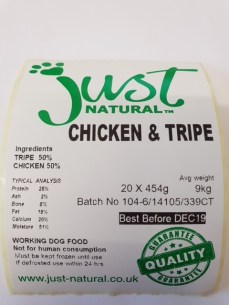
UK – Avondale Pet Foods Ltd recalls Just Natural Chicken & Tripe because Salmonella has been found in the product

FSA  Just_Chicken__Tripe

Avondale Pet Foods Ltd recalls Just Natural Chicken & Tripe because salmonella has been found in the product. This product has been sold in Scotland and England only.

Product details

Just Natural Chicken & Tripe

Pack size 20 x 454g and 8 x 1kg
Batch code 104-6/14105/339CT
Best before December 2019

No other Avondale Pet Foods Ltd products are known to be affected.


Food Standards Scotland

Risk: The presence of salmonella in the product listed above. Salmonella is a bacteria that can cause illness in humans and animals. The product could therefore carry a potential risk, because of the presence of salmonella, either through direct handling of the pet food, or indirectly, for example from pet feeding bowls, utensils or contact with the faeces of animals. In humans, symptoms caused by salmonella usually include fever, diarrhoea and abdominal cramps. Infected animals may not necessarily display signs of illness, but symptoms can include diarrhoea.

Our advice to consumers (pet owners):

When handling and serving raw pet food it is always advised to clean utensils and feeding bowls thoroughly after use. Consumers should wash hands thoroughly after handling raw pet food, bowls, utensils or after contact with the faeces of infected animals. Raw pet food should be stored separately from any food (especially ready to eat foods). Care should be taken when defrosting to avoid cross contamination of foods and surfaces. If you have bought any of the above product, return it to the store from where it was bought for a full refund.

Action taken by the company:  

Avondale Pet Foods Ltd is recalling the above product. Point of sale notices will be displayed in all retail stores that are selling this product. These notices explain to customers why the product is being recalled and tell them what to do if they have bought the product.

UK – 9 sick: Salmonella linked to Dr Zak’s Barn Farmed Liquid Egg White

Barf Blog

Dr Zak’s Barn Farmed Liquid Egg White sounds like 19th century hucksterism or medicine man.

According to Tony Gussin of the North Devon Gazette, nine people in the UK including one in North Devon are thought to have caught the disease after consuming Dr Zak’s Barn Farmed Liquid Egg White bottles.

RASFF Alerts – Salmonella – Forzen Poultry Meat – Salted Chicken Breasts – MRM – Sesame Seeds – Sausages – Tahini Halva – Duck – Chicken

RASFF-Logo

RASFF-Salmonella enterica ser. Bovismorbificans (presence /25g) in frozen poultry meat preparation from Thailand in Belgium

RASFF-Salmonella enterica ser. Agona (presence in 1 out of 5 samples) in frozen poultry meat preparation from Thailand in Belgium

RASFF-Salmonella (1 out of 5 samples /25g) in frozen salted chicken half breasts from Brazil in the UK

RASFF-Salmonella in frozen chicken breast caps from Belgium in the Netherlands

RASFF -Salmonella enterica ser. Typhimurium (presence) in frozen mechanically separated meat from Belgium in Belgium

RASFF-Salmonella (presence in 1 out of 5 samples) in sesame seeds from Nigeria in Poland

RASFF-Salmonella (presence /25g) in frozen seasoned chicken from Poland in France

RASFF-Salmonella (presence /25g) in sausages from Spain in Belgium

RASFF-Salmonella (present /25g) in hulled sesame seeds from India in Spain

RASFF-Salmonella (present /25g) in tahini halva from the Czech Republic in Germany

RASFF-Salmonella enterica ser. Newport (presence /25g) and Salmonella enterica ser. Typhimurium monophasic (1 ,4, [5], 12:i:-) (presence /25g) in frozen eviscerated ducks from Hungary in Italy

RASFF-Salmonella enterica ser. Enteritidis in frozen and chilled chicken fillets from Poland in Italy

RASFF-Salmonella (presence /25g) in fresh boiled chicken fillet (A class) from Poland in Lithuania

RASFF-Salmonella enterica ser. Enteritidis (presence /25g) in chicken legs from Poland in Lithuania

RASFF-Salmonella (presence /25g) in fresh boiled chicken legs from Poland in Lithuania

RASFF Alerts – Animal Feed – Salmonella – Dog Chews – Turkey Meat Meal

RASFF-Logo

RASFF-Salmonella enterica ser. Infantis (presence /25g) in dog chews from France, with raw material from Denmark, packaged in Germany in Germany

RASFF-Salmonella (presence /25g) and Salmonella enterica ser. Mbandaka (presence /25g) in turkey meat meal from Poland in Belgium

Research – How to kill pathogens on seafood

Food Processing

Controlled release antimicrobial film makes seafood safer.

Seafood may be contaminated with bacterial pathogens, such as Vibrio and Salmonella, which can survive long-term freezing conditions. Vibrio naturally occur in marine environments and Salmonella can contaminate seafood during production or processing and both are concerns for the seafood industry.

However, a solution may be at hand. A biodegradable, edible film made with plant starch and antimicrobial compounds may control the growth of foodborne pathogens on seafood, according to a group of international researchers.

Catherine Cutter, professor of food science, Penn State, explained, “We have the ability to develop a film with antimicrobial activity that can kill foodborne pathogens on food surfaces. Given the recent outbreaks that we have seen with a number of food products, coming up with something that can be used by the industry to kill microorganisms on the surfaces of food is a noble area of research to investigate.

“Vibrio and Salmonella are somewhat susceptible to freezing,” Cutter said. “So, if you treat bacterial cells with antimicrobials and then freeze them, the approach can be more lethal.”

Freezing does not kill bacteria. However, when freezing food, ice crystals can form from the water in food. The ice crystals, Cutter said, can act like “daggers” and pierce the bacterial cell wall, causing damage to the cell.

Researchers used a blend of thermoplastic starch, a biodegradable polymer made from tapioca powder and a gelatin coating containing antimicrobials known as Nisin Z and lauric arginate (LAE).


Research – Control of pathogens in cheeses made from unpasteurised milk

HPS Scotland

A new report, prepared for Food Standards Scotland (FSS), outlines the scientific evidence on food safety controls, which can be used to reduce the risks of food poisoning bacteria in the production of raw milk cheeses.

The report, by Dr Catherine Donnelly, was prepared to supply evidence for Scottish artisan cheesemakers and enforcement officials in managing the microbiological safety of artisan cheeses, particularly those produced from unpasteurised milk. The main pathogens of concern posing a risk to the safety of cheeses made from unpasteurised milk are Listeria monocytogenes, Shiga toxin-producing Escherichia coli, Salmonella and Staphylococcus aureus.

The report, which is in three parts:

  • examines categorisation of commonly produced cheese types in Scotland and provides an overview of potential critical control points (CCPs) at each stage of the cheesemaking process, in order to control bacterial pathogens of primary concern;
  • analyses currently available predictive models, challenge testing methods and results of challenge testing, providing evidence of the safety, or lack thereof, attained during cheesemaking;
  • provides an analysis of microbiological and physicochemical results obtained from cheesemakers, as well as from the scientific literature and recommendations on testing targets and frequencies to assure process control and production of microbiologically safe products.

‘Review of controls for pathogen risks in Scottish artisan cheeses made from unpasteurised milk’ can be accessed at: https://www.foodstandards.gov.scot/downloads/FSS_2017_015_-_Control_of_path….

[Source: FSA, 12 December 2018. https://www.foodstandards.gov.scot/publications-and-research/publications/c…]