Category Archives: Salmonella in Chicken

UK – Almost half the adults (46%) who cook coated frozen chicken products do not always check cooking instructions on packaging before cooking

FSA

The Food Standards Agency (FSA), Food Standards Scotland (FSS) with Ipsos MORI have published a survey of consumer practices relating to coated frozen chicken products.

This survey identifies behaviours which could increase people’s risk to foodborne disease. It was commissioned as a result of a Salmonella incident linked to frozen chicken products such as nuggets, goujons, dippers, poppers and kievs. While these products may appear cooked on the outside, they often contain raw chicken and so they must be cooked thoroughly to help kill Salmonella bacteria.

Findings show that two thirds of adults aged 16-75 (67%) say they have recently cooked or eaten coated frozen chicken products at home. These products are particularly popular with younger adults, with 88% of those aged 16-24 having recently consumed them or cooked them at home. Participants were also more likely to have cooked or eaten these products if they have children aged 15 or under in their household (86%).

The survey also included questions on the storage and handling of these products pre and post-cooking:

  • Almost two thirds of those who cook these products (62%) say uncooked coated frozen chicken products at least sometimes come into contact with other surfaces such as worktops and plates
  • Over half of those who cook these products (58%) say they always wash their hands after handling coated frozen chicken products
  • Almost a quarter of consumers who personally cook products say they defrost them before cooking (23%), 62% say they do not. Among those who defrost products, half say they leave them at room temperature (53%)

Most participants who use an oven to cook coated frozen chicken products say they sometimes cook them together with other products, such as chips or vegetables (84%). Cooking these chicken products at a lower temperature or for a shorter time than advised may mean they are not thoroughly cooked before serving.

Narriman Looch, Head of Animal Feed and Foodborne Disease Control Branch said: ‘It’s important to understand that frozen chicken products often contain raw chicken, even though they may look pre-cooked on the outside. While additional measures have been put in place by food businesses to improve the safety of these products, consumers need to handle these products as they should other raw meat products. Cooking food at the right temperature and for the right amount of time will kill any Salmonella bacteria that may be in food. Therefore, we are urging consumers to follow cooking instructions for these products to protect themselves and their families.’

Food safety tips for frozen breaded chicken products:

  • Treat these products as raw chicken, ensuring they are steaming hot after cooking and surfaces they have touched are cleaned to avoid the spread of bacteria
  • Make sure the oven is up to temperature before cooking
  • Check the instructions on packaging and cook at the correct temperature and for the time stated
  • Wash your hands, utensils and clean surfaces after handling these products
  • If products require defrosting, follow the storage instructions on packaging and always defrost in the fridge

About this poll

The FSA and FSS commissioned an online survey via three waves of Ipsos MORI’s online omnibus of 5,599 adults (aged 16-75) living in the UK. Of these 3,740 had cooked or eaten coated frozen chicken products recently and went on to complete the full survey. The data was weighted to be representative of the UK adult population aged 16 – 75.

The full report is available in the research section of our website.

About the outbreak

FSA and FSS are continuing to work with Public Health England (PHE) and devolved public health authorities as well as our international food safety partners, via the United Nations’ World Health Organization, (WHO) and the Food and Agriculture Organization’s (FAO’s) International Food Safety Network (INFOSAN), to address the causes of the outbreak at source to prevent further cases of Salmonella Enteritidis.

Between January 2020 and May 2021 there have been 511 cases of Salmonellosis in the UK caused by two strains of Salmonella Enteritidis and linked to consumption of frozen, raw, breaded chicken products.

Authorities in Poland and UK retailers have taken action to reduce the risk from these products. Where non-compliant or unsafe food has been identified by the UK, action has been taken to protect consumers.
RASFF Alerts – Salmonella – Polish Chicken – Curry Black Pepper – Fish Gourami – Minced Beef – Dried Oregano – Chicken Soup Mix

RASFF

Salmonella Enteritidis in official samples of chicken neck skins from Poland in Spain and France

RASFF

Salmonella Infantis in frozen fish (Gourami) from Vietnam in Norway

RASFF

Salmonella Enteritidis in chicken neck skins from Poland in Poland and France

RASFF

Salmonella Enteritidis and Salmonella group C (O:8) in official samples of chicken neck skins from Poland in France

RASFF

Salmonella in minced beef from Germany in the Netherlands

RASFF

Salmonella infantis incarne di pollame proveniente dalla Polonia//Salmonella infantis in frozen poultry meat from Poland in Italy

RASFF

Salmonella enteritidis in frozen chicken soup mix from Slovakia in Slovakia and Estonia

RASFF

Poultry meat skin from chicken necks salmonella -salmonella Salmonella Enteritidis from Poland in Poland and Lithuania

RASFF

Fresh poultry meat Salmonella enteritidis from Poland in Poland and Slovakia

RASFF

S. Javiana, S. Newport, S. Infantis in black pepper from Brazil in Germany

RASFF

Salmonella Rubislaw in black pepper from Brazil in Germany

RASFF

Salmonella Sandiego in black pepper from Brazil in Germany

RASFF

Salmonella enterica sér. Enteritidis in chilled chicken quarters from Poland in the Czech Republic

RASFF

Salmonella Infantis in fresh chicken broiler quarters from Poland in Lithuania

RASFF

Salmonella enterica ser. Infantis (in 1 out of 5 samples /25g) in chilled chicken breasts from Poland in the Czech Republic

RASFF

Salmonella Mbandaka in dried oregano from Chile in Germany and Sweden

RASFF

Salmonella in Curry from Turkey in Austria and Hungary

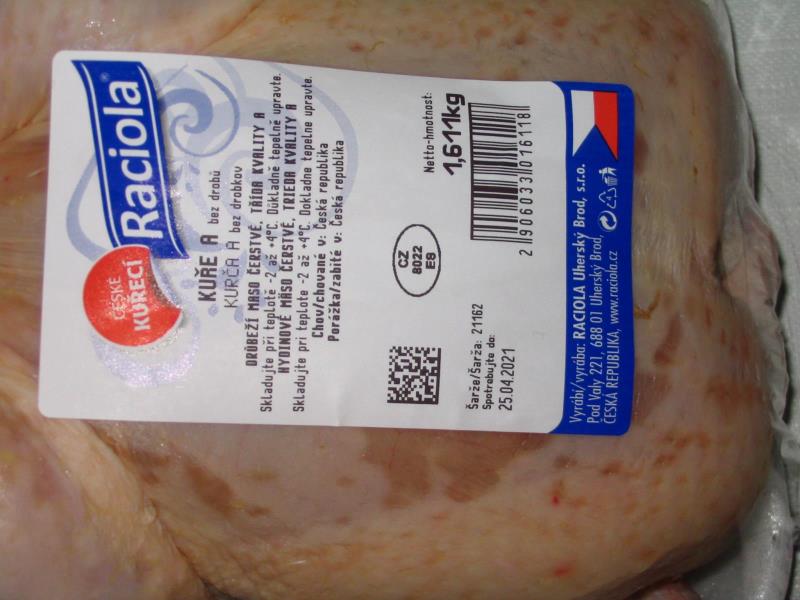
Czech Republic- Chilled chicken without offal B – Salmonella

Potravinynapranyri

Food group: Meat and meat products Packaged meat

Chilled chicken without offal B
Category: Dangerous food
Unsatisfactory parameter:

Salmonella enterica serum. Enteritidis

The pathogenic bacterium Salmonella enterica serum was detected in chilled chickens without offal Enteritidis , which can cause a condition called salmonellosis.

Expiration date: 4/25/2021
Packaging: Plastic foil
Producer: RACIOLA Uhersky Brod, sro
Country of origin:  Czechia
Date of sampling: 20. 4. 2021
Reference number: 21-000018-SVS-CZ
The sample was found by official inspection of the State Veterinary Administration.

Research- Monte Carlo Simulation Model for Predicting Salmonella Contamination of Chicken Liver as a Function of Serving Size for Use in Quantitative Microbial Risk Assessment

Journal of Food Protection

Salmonella kswfoodworld

The first step in quantitative microbial risk assessment (QMRA) is to determine distribution of pathogen contamination among servings of the food at some point in the farm-to-table chain. In the present study, distribution of Salmonella contamination among servings of chicken liver for use in QMRA was determined at meal preparation. A combination of five methods: 1) whole sample enrichment; 2) quantitative polymerase chain reaction; 3) cultural isolation; 4) serotyping; and 5) Monte Carlo simulation were used to determine Salmonella prevalence (P), number (N), and serotype for different serving sizes. In addition, epidemiological data were used to convert serotype data to virulence (V) values for use in QMRA. A Monte Carlo simulation model based in Excel and simulated with @Risk predicted Salmonella P, N, serotype, and V as a function of serving size from one (58 g) to eight (464 g) chicken livers. Salmonella P of chicken livers was 72.5% (58/80) per 58 g. Four serotypes were isolated from chicken livers: 1) Infantis (P = 28%, V = 4.5); 2) Enteritidis (P = 15%, V = 5); 3) Typhimirium (P = 15%, V = 4.8); and 4) Kentucky (P = 15%, V = 0.8). Median Salmonella N was 1.76 log per 58 g (range: 0 to 4.67 log/58 g) and was not affected ( P > 0.05) by serotype. The model predicted a non-linear increase ( P ≤ 0.05) of Salmonella P from 72.5% per 58 g to 100% per 464 g, minimum N from 0 log per 58 g to 1.28 log per 464 g, and median N from 1.76 log per 58 g to 3.22 log per 464 g. Regardless of serving size, predicted maximum N was 4.74 log, mean V was 3.9, and total N was 6.65 log per lot (10,000 chicken livers). The data acquired and model developed in this study fill an important data and modeling gap in QMRA for Salmonella and chicken liver.

Research – Application of peroxyacetic acid for decontamination of raw poultry products and comparison to other commonly used chemical antimicrobial interventions – A Review

Journal of Food Protection

Poultry remains one of the top food commodities responsible for foodborne illness in the U.S., despite poultry industry efforts since the inception of HACCP to reduce the burden of foodborne illness implicating poultry products. The appropriate use of antimicrobial compounds during processing of raw poultry can help minimize this risk. Currently, peroxyacetic acid (PAA) is the most popular antimicrobial in the poultry industry, displacing chlorine compounds and others. The aim of this review was to compare the effectiveness of PAA to that of other antimicrobials for the decontamination of raw poultry carcasses and parts. Twenty-six articles were found that compared PAA to over 20 different antimicrobials, applied as spray or immersion treatments for different exposure times and concentrations. The most common comparisons were to chlorine compounds (17 articles), to lactic acid (LA) compounds (5 articles) and to cetylpyridinium chloride (CPC, 6 articles). Studies measured effectiveness by reductions in native flora or inoculated bacteria, usually Salmonella or Campylobacter . PAA was found to be more effective than chlorine under most conditions studied. Effectiveness of PAA was higher or comparable to that of LA and CPC depending on product and treatment conditions. Overall, the results of primary literature studies support the popularity of PAA as an effective intervention against pathogenic bacteria during poultry processing.

USA- Salmonella Outbreaks Linked to Backyard Poultry

CDC

Fast Facts
  • Illnesses: 163
  • Hospitalizations: 34
  • Deaths: 0
  • States: 43
  • Recall: No
  • Investigation status: Active
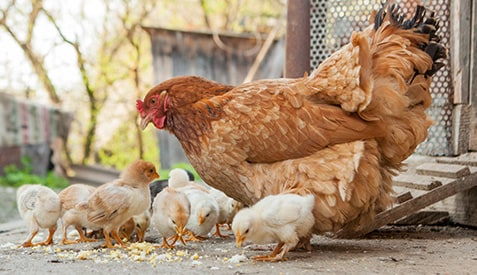
Backyard poultry with chickens eating
Backyard Poultry and Salmonella

Backyard poultry, like chicken and ducks, can carry Salmonella germs even if they look healthy and clean. These germs can easily spread to anything in the areas where they live and roam.

You can get sick from touching your backyard poultry or anything in their environment and then touching your mouth or food, and swallowing Salmonella germs.

RASFF Alerts – Salmonella – Polish Chicken – Polish Turkey – Chicken Meat – Mussels –

RASFF

Salmonella group B (O:4) in chilled turkey meat from Poland in Belgium, Germany and Netherlands

RASFF

Salmonella enterica ser. Enteritidis in chilled chicken meat from the Netherlands in the Netherlands and Belgium

RASFF

Fishing mussels – salmonella spp from Denmark in France

RASFF

Frozen chicken legs – Salmonella Enteritidis from Poland in France

RASFF

Salmonella in chicken meat preparations from Poland in the Netherlands, Luxembourg and Belgium

RASFF

Salmonella Enteritidis in official samples of chicken neck skins from Poland in the UK, Lithuania, Belgium, 

RASFF

Salmonella Typhimurium in turkey meat from Poland in Belgium, Czech Republic, Germany, Ireland and Latvia

RASFF

Salmonella infantis in chicken meat from Spain in France

RASFF

Salmonella infantis in chicken breast from Poland in the Czech Republic


Czech Republic – Class A chicken without offal from Poland- Salmonella

Potraviny na Pranyri

Place of inspection:
Vedryne ( Vedryne 131, 73994 Vedryne )
Company ID: 07329695
Food group: Meat and meat products Unpacked: meat, minced meat, meat preparations
Class A chicken without offal
Category: Dangerous food
Unsatisfactory parameter:
Salmonella enterica serum. Infantis

The pathogenic bacterium Salmonella enterica serum was detected in chicken meat Infantis , which can cause a condition called salmonellosis.

Lots: 109921138
Expiration date: 4/15/2021
Producer: SuperDrob SA, PL 06630501 WE, Zimna 2, Lublin, 20-952 Poland
Country of origin:  Poland
Date of sampling: 9. 4. 2021
Reference number: 21-000016-SVS-CZ
 
The sample was found by official inspection of the State Veterinary Administration.
 

USA – Breaded Chicken Products and Salmonella

Food Safety News

This week the CDC, public health and regulatory officials in several states, and the U.S. Department of Agriculture’s Food Safety and Inspection Service (USDA-FSIS) announced a multistate outbreak of Salmonella Enteritidis infections linked to raw frozen breaded stuffed chicken products. As of June 2, 2021, a total of 17 people infected with the outbreak strain of Salmonella Enteritidis have been reported from six states. Illnesses started on dates ranging from Feb. 21, 2021 to May 7, 2021.

Sounds a bit familiar?  Why does the USDA-FSIS ignore this risky product?

USA – Kirkwood’s Chicken Cordon Bleu appears linked to Salmonella Outbreak

Food Poison Journal

Arizona, Minnesota, Indiana, Indiana, Michigan and New York report Salmonella illnesses.

CDC, public health and regulatory officials in several states, and the U.S. Department of Agriculture’s Food Safety and Inspection Service (USDA-FSIS) are collecting different types of data to investigate a multistate outbreak of Salmonella Enteritidis infections linked to raw frozen breaded stuffed chicken products.

As of June 2, 2021, a total of 17 people infected with the outbreak strain of Salmonella Enteritidis have been reported from 6 states. Illnesses started on dates ranging from February 21, 2021 to May 7, 2021.

Sick people range in age from 3 to 83 years, with a median age of 52 years, and 60% are female. Of 13 people with information available, 8 (62%) have been hospitalized; no deaths have been reported.

People reported buying many different brands of raw frozen breaded stuffed chicken products from multiple stores. When asked about how the products were prepared at home, seven people reported undercooking, microwaving, or air frying the product.