Category Archives: Microbiology

Austria – SPAR Vital brown rice long grain ready in 10 min. 500g -Bacterial Contamination

AGES

AGES informs about a recall of the company Spar. On December 8th, 2020, the company initiated a recall of the product SPAR Vital Brown Rice Long Grain Ready in 10 Min.500g:

Small amounts of bulgur were found in the product “SPAR Vital Brown Rice Long Grain Ready in 10 Min. 500g” in the batch with the best before date 7.1.2022. As a result, the gluten-free rice may be contaminated with the gluten allergen. SPAR is therefore recalling this product as a precaution. Customers with gluten intolerance are requested not to consume the product with the best before date 7.1.2022. Nonetheless, the product is safe for non-allergy sufferers.

All customers who have bought the possibly affected product can of course return it to the nearest SPAR, EUROSPAR, INTERSPAR or Maxi store. Customers will be reimbursed the purchase price even without proof of purchase.

Customers who have a question about this are welcome to contact customer service at office@spar.at or call the free phone number 0800/22 11 20.

Inquiries & contact:

SPAR Österreichische Warenhandels-AG
Mag. Nicole Berkmann
Head of
Corporate PR and Information 0662/4470 – 22300
Europastraße 3, 5015 Salzburg

Original recall

Canada – Updated Food Recall Warning – Certain Compliments brand, Levitts brand, and The Deli-Shop brand deli meat products recalled due to Listeria monocytogenes

CFIA

Recall details

Ottawa, December 7, 2020 – The food recall warning issued on November 22, 2020 has been updated to include additional product information. This additional information was identified during the Canadian Food Inspection Agency’s (CFIA) food safety investigation.

Levitts Foods (Canada) Inc. is recalling certain Compliments brand, Levitts brand, and The Deli-Shop brand deli meat products from the marketplace due to possible Listeria monocytogenes contamination. Consumers should not consume the recalled products described below.

Recalled product

Brand Product Size UPC Codes
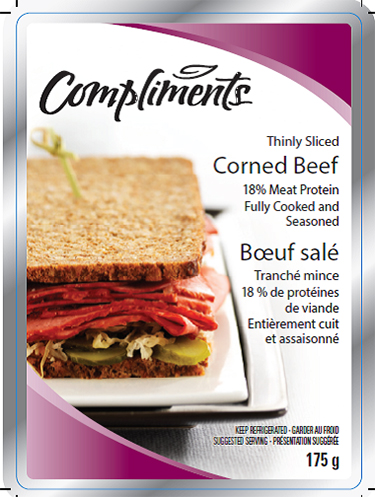
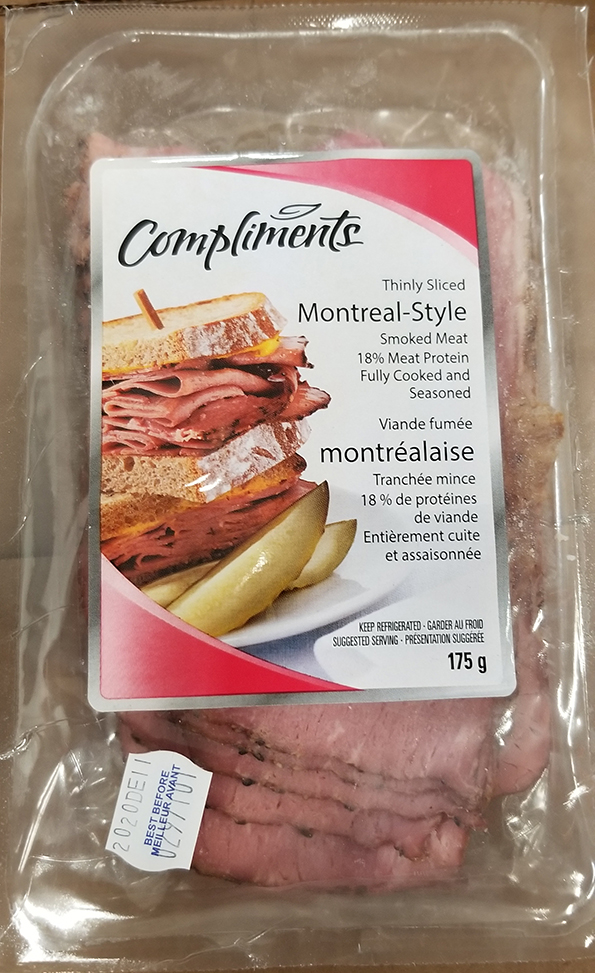
Compliments Montreal-Style Smoked Meat 175 g 0 68820 13357 5 BEST BEFORE 2020/DE/11
EST 48
Compliments Smoked Beef Pastrami 175 g 0 68820 13360 5 BEST BEFORE 2020/DE/11
EST 48
Compliments Corned Beef 175 g 0 68820 13356 8 BEST BEFORE 2020/DE/11
EST 48
Levitts Corned Beef 150 g 8 82756 72084 1 BEST BEFORE 2020/DE/23
EST 48
Levitts Montreal Style Smoked Meat 150 g 8 82756 71084 2 BEST BEFORE 2020/DE/23
EST 48
Levitts New York Style Pastrami 150 g 8 82756 73084 0 BEST BEFORE 2020/DE/23
EST 48
The Deli-Shop Sliced Pastrami 175 g 0 59749 95373 3 BEST BEFORE 2020/DE/11
EST 48
The Deli-Shop Sliced Pastrami 2 x 175 g 0 68820 13360 5 BEST BEFORE 2020/DE/11
EST 48

What you should do

If you think you became sick from consuming a recalled product, call your doctor.

Check to see if you have the recalled product in your home. Recalled products should be thrown out or returned to the store where they were purchased.

Food contaminated with Listeria monocytogenes may not look or smell spoiled but can still make you sick. Symptoms can include vomiting, nausea, persistent fever, muscle aches, severe headache and neck stiffness. Pregnant women, the elderly and people with weakened immune systems are particularly at risk. Although infected pregnant women may experience only mild, flu-like symptoms, the infection can lead to premature delivery, infection of the newborn or even stillbirth. In severe cases of illness, people may die.

Background

This recall was triggered by CFIA test results. The CFIA is conducting a food safety investigation, which may lead to the recall of other products. If other high-risk products are recalled, the CFIA will notify the public through updated Food Recall Warnings.

The CFIA is verifying that industry is removing the recalled products from the marketplace.

Illnesses

There has been one reported illness that may be associated with the consumption of these products.

Product photos

Printer ready version of photos

  • Compliments smoked meat 175 g - front panel with sticker
  •  

  • Compliments smoked meat 175 g - with inkjet code consumer complaint package front
  •  

  • Compliments pastrami 175 g - front
  •  

  • Compliments corned beef, 175 g - front
  •  

  • Levitts Montreal style smoked meat 150 g - front
  •  

  • Levitts new york style pastrami 150 g - front
  •  

  • Levitts corned beef 150 g - front

Public enquiries and media

Company information
Levitts Foods (Canada) Inc.: Simon Larochelle, 514-367-1654
Public enquiries
Toll-free: 1-800-442-2342 (Canada and U.S.)
Telephone: 1-613-773-2342 (local or international)
Email: cfia.enquiries-demandederenseignements.acia@canada.ca
Media relations
Telephone: 613-773-6600
Email: cfia.media.acia@canada.ca

Research – Consumer knowledge and behaviors regarding food safety risks associated with wheat flour

Journal of Food Protection

Consumers do not consider flour, a low-moisture food product, a high-risk for microbial contamination. In the past ten years, however, flour has been identified as a source of pathogenic bacteria, including Salmonella and E. coli . Online surveys were conducted to study consumers’ flour-handling practices and their knowledge about food safety risks related to flour. The survey also evaluated message impact on three food safety messages in communicating information and convincing consumers to adopt safe flour handling practices. Flour-using consumers (n = 1,045) from the United States reported they used flour to make cakes, cookies, and bread. Most consumers stored flour in sealed containers. Less than 1% kept a record of product identification numbers, like lot numbers, and less than 11% kept brand and use-by-date information. Many consumers (85%) were unaware of flour recalls, or outbreaks, and few (17%) believed they would be affected by flour recalls or outbreaks. If the recall affected the flour they bought, nearly half of the consumers (47%) would buy the same product from a different brand for a few months before they returned to the recalled brand. Among consumers who use flour to bake, 66% said they ate raw cookie dough or batter. Raw dough “eaters” were more difficult to convince to avoid eating and playing raw flour than “non-eaters.” Food safety messages were less impactful on those raw dough “eaters” than “non-eaters.” Compared with the food safety message with only recommendations, those messages with recommendations and an explanation as to the benefits of the practice were more effective in convincing consumers to change their practices. These findings provide insight into effective consumer education about safe flour-handling practices and could assist in the accurate development of risk assessment models related to flour handling.

Research – Competitive Exclusion Prevents Colonization and Compartmentalization Reduces Transmission of ESBL-Producing Escherichia coli in Broilers

Entero

Image CDC

Extended spectrum beta-lactamase (ESBL)-producing bacteria are resistant to extended-spectrum cephalosporins and are common in broilers. Interventions are needed to reduce the prevalence of ESBL-producing bacteria in the broiler production pyramid. This study investigated two different interventions. The effect of a prolonged supply of competitive exclusion (CE) product and compartmentalization on colonization and transmission, after challenge with a low dose of ESBL-producing Escherichia coli, in broilers kept under semi-field conditions, were examined. One-day-old broilers (Ross 308) (n = 400) were housed in four experimental rooms, subdivided in one seeder (S/C1)-pen and eight contact (C2)-pens. In two rooms, CE product was supplied from day 0 to 7. At day 5, seeder-broilers were inoculated with E. coli strain carrying blaCTX–M–1 on plasmid IncI1 (CTX-M-1-E. coli). Presence of CTX-M-1-E. coli was determined using cloacal swabs (day 5–21 daily) and cecal samples (day 21). Time until colonization and cecal excretion (log10 CFU/g) were analyzed using survival analysis and linear regression. Transmission coefficients within and between pens were estimated using maximum likelihood. The microbiota composition was assessed by 16S ribosomal RNA gene amplicon sequencing in cecal content of broilers on days 5 and 21. None of the CE broilers was CTX-M-1-E. coli positive. In contrast, in the untreated rooms 187/200 of the broilers were CTX-M-1-E. coli positive at day 21. Broilers in C2-pens were colonized later than seeder-broilers (Time to event Ratio 3.53, 95% CI 3.14 to 3.93). The transmission coefficient between pens was lower than within pens (3.28 × 10⁻⁴ day–2, 95% CI 2.41 × 10⁻⁴ to 4.32 × 10⁻⁴ vs. 6.12 × 10⁻² day–2, 95% CI 4.78 × 10⁻² to 7.64 × 10⁻²). The alpha diversity of the cecal microbiota content was higher in CE broilers than in control broilers at days 5 and 21. The supply of a CE product from day 0 to 7 prevented colonization of CTX-M-1-E. coli after challenge at day 5, likely as a result of CE induced effects on the microbiota composition. Furthermore, compartmentalization reduced transmission rate between broilers. Therefore, a combination of compartmentalization and supply of a CE product may be a useful intervention to reduce transmission and prevent colonization of ESBL/pAmpC-producing bacteria in the broiler production pyramid.

Research – Growth and Survival of Foodborne Pathogens during Soaking and Drying of Almond (Prunus dulcis) Kernels

Journal of Food Protection

ABSTRACT

The practice of soaking almonds prior to consumption is popular both commercially and at home. The food safety implications of soaking almonds was investigated through analysis of blogs and videos (n = 85 recipes) to identify both the reasons for soaking almonds and the common practices employed. Among the recipes analyzed, the most common reasons for soaking almonds (94.1%) were perceived benefits such as improved digestion and nutrient uptake. Most recipes (34.1%) suggested soaking at “room temperature” for times that ranged from 4 to 24 h or, more commonly, “overnight” (51.8%). Postsoaking drying instructions were provided in 40 recipes (47.1%). Among those providing a drying temperature (31.8%), 85% specified 66°C and lower. To evaluate the growth of foodborne pathogens during almond soaking, separate cocktails of Escherichia coli O157:H7, Listeria monocytogenes, and Salmonella enterica were inoculated onto raw almonds or into the soak water (almonds-to-water ratios of 1:1 and 1:3 [w/v]). Populations were monitored during soaking at 15, 18, and 23°C for up to 24 h, and during postsoak drying at 66°C for 14 h (for Salmonella only). At 15°C and a 1:1 almond:water ratio, no significant population increase (P > 0.05) was observed between 0 and 24 h for any of the pathogens. At 18°C, increases of 0.63, 1.70, and 0.88 log CFU per sample were observed over 24 h for populations of E. coli O157:H7, L. monocytogenes, and Salmonella, respectively. Populations of E. coli O157:H7, L. monocytogenes, and Salmonella increased by 3.48, 3.22, and 3.94 log CFU per sample, respectively, after 24 h at 23°C. When soaked almonds were dried for 14 h at 66°C, moisture and water activity decreased from 40 to ∼6% and 0.99 to 0.60, respectively, but no significant reduction in Salmonella populations was observed. Recommendations for using shorter times (<8 h) and cooler temperatures (≤15°C) should reduce the potential for foodborne pathogens, if present, to grow during soaking of almonds.

HIGHLIGHTS
  • Online recipes described soaking conditions that would support growth of pathogens.
  • Foodborne pathogens were able to multiply in almonds soaked at 18 and 23°C.
  • Pathogen populations significantly increased after 8 h of soaking at 23°C.
  • Foodborne pathogens did not multiply in almonds soaked at 15°C for 24 h.
  • Drying soaked almonds at 66°C for 14 h did not reduce populations of Salmonella.

Research – Occurrence of Listeria monocytogenes in Counter-Sliced Turkey Meat Samples from Independent Delis in New York City

Journal of Food Protection

Research suggests that small and independent delis are less likely to follow proper sanitation procedures, including slicer inspection, which could lead to a higher likelihood of these delis being a reservoir for Listeria monocytogenes growth and cross-contamination.    This study was undertaken to determine the incidence of L. monocytogenes in counter-sliced turkey deli meat obtained from independent delis in an urban city. Turkey deli meat, counter-sliced on site, was collected from 118 independent delis in New York City. The samples were analyzed for L. monocytogenes using USDA MLG methodology for isolation and confirmation.   The selection criteria for delis included using the city’s restaurant inspection and grading system. Two samples, from separate delis, were confirmed positive for L. monocytogenes (1.69%). Analysis of the genomic sequences of one of the samples revealed a close match to a cluster of 6 clinical isolates, which were part of an ongoing multi-state listeriosis outbreak spanning 4 different states.   The sequence of the second isolate matched a clinical isolate in a neighboring state. Both isolates were obtained from delis that did not have the top inspection grade. Although a snapshot of one urban area, this study is the first report on the current incidence of L. monocytogenes on counter-sliced deli meat from independent deli establishments. This study suggests that these delis can potentially serve as sources of L. monocytogenes contamination or contribute to downstream foodborne listeriosis. Information provided by city inspection and grading systems, in addition to the letter grade, may serve as a tool to identify delis with potential L. monocytogenes contamination issues and serve as a basis for product and environmental sampling by public health authorities.

Research – Use of a Novel Sanitizer To Inactivate Salmonella Typhimurium and Spoilage Microorganisms during Flume Washing of Diced Tomatoes

Journal of Food Protection

ABSTRACT

As demand for fresh-cut produce increases, minimizing the risk of salmonellosis becomes critical for the produce industry. Sanitizers are routinely used during commercial flume washing of fresh-cut produce to minimize cross-contamination from the wash water. This study assessed the efficacy of a novel sanitizer blend consisting of peracetic acid (PAA; OxypHresh 15) with a sulfuric acid–surfactant (SS) antimicrobial (PAA-SS; ProduceShield Plus) against Salmonella during simulated commercial washing of diced tomatoes. Triplicate 9.1-kg batches of Roma tomatoes were dip inoculated in a two-strain avirulent Salmonella cocktail (Salmonella Typhimurium LT2 and MHM112) to achieve 5 to 6 log CFU per tomato and air dried for 2 h. After mechanical dicing, the tomatoes were washed in a pilot-scale processing line for 60 s with or without an added organic load in 90 ppm of PAA-SS (pH 1.8), SS at pH 1.8, 90 ppm of PAA, 5 or 10 ppm of free chlorine or sanitizer-free water as the control. Overall, PAA-SS (1.75 ± 0.75 log CFU/g) was significantly (P ≤ 0.05) more effective than water (0.69 ± 0.42 log CFU/g), chlorine (0.35 ± 0.36 log CFU/g), or SS (0.36 ± 0.19 log CFU/g) in reducing Salmonella. After washing for 20 s, PAA-SS was the only sanitizer to show a significant (P ≤ 0.05) reduction (1.93 ±0.59 log CFU/g) in Salmonella. All wash water samples were negative for Salmonella, except for 5 and 10 ppm of chlorine and the water control. Using PAA-SS with an organic load, yeast and mold populations were below the limit of detection (1.40 log CFU/g) and significantly (P ≤ 0.05) lower on diced tomatoes after 14 days of refrigerated storage compared with the other treatments (8.37 ± 0.08 log CFU/g), with SS at pH 1.8 (3.91 ± 0.93 log CFU/g) most effective against yeast and mold in the absence of an organic load. On the basis of these findings, the safety and shelf life of commercially washed diced tomatoes can be improved with PAA-SS.

HIGHLIGHTS
  • PAA-SS yielded lower Salmonella populations in diced tomatoes than did chlorine (P ≤ 0.05).
  • Salmonella was not detected in the wash water using PAA-SS.
  • PAA-SS decreased Salmonella 1.93 log after 20 s of washing.
  • PAA-SS yielded lower (P ≤ 0.05) yeast and mold populations after 14 days of storage.

Research – Reduction of Norovirus in Foods by Nonthermal Treatments: A Review

Journal of Food Protection

ABSTRACT

Human noroviruses are enteric pathogens that cause a substantial proportion of acute gastroenteritis cases worldwide regardless of background variables such as age, ethnicity, and gender. Although person-to-person contact is the general route of transmission, foodborne infections are also common. Thorough cooking eliminates noroviruses, but several food products such as berries, leafy vegetables, and mollusks undergo only limited heat treatment, if any, before consumption. Novel applications of nonthermal processing technologies are currently being vigorously researched because they can be used to inactivate pathogens and extend product shelf life with limited effects on nutrient content and perceived quality. These technologies, adopted from several industrial fields, include some methods already approved for food processing that have been applied in the food industry for years. However, a majority of the research has been conducted with bacteria and simple matrixes or surfaces. This review focuses on elimination of norovirus in food matrixes by use of nonthermal technologies in four categories: high hydrostatic pressure, light, irradiation, and cold atmospheric plasma. We discuss the properties of noroviruses, principles and inactivation mechanisms of select technologies, and main findings of relevant studies. We also provide an overview of the current status of the research and propose future directions for related work.

HIGHLIGHTS
  • High pressure processing is the most promising nonthermal treatment for noroviruses.
  • High pressure processing, ionizing radiation, and UVC light can reduce noroviruses in foods.
  • Treatments used to eliminate viruses can impair food product quality.
  • Optimal virus elimination strategies should be validated independently for each food product.

Portugal – Legionnaires’ disease update: Additional cases/death recorded

Outbreak News Today

CDC legionella

In a follow-up on the Legionnaires’ disease outbreak in northern Portugal region of Greater Porto, officials report from October 29 through November 29, 88 registered cases, including 10 deaths.

The outbreak, which has affected the cities of Matosinhos, Vila do Conde and Póvoa de Varzim, has decreased after the cooling towers of an industry in Matosinhos were disconnected where the bacteria was detected.

“Since the operation of the aforementioned cooling towers was suspended, there has been a marked decrease in the number of cases of Legionnaires’ disease in the aforementioned geographical area,” ARS / Norte said in a statement this Sunday.

RASFF Alert – E.coli – Japanese Clams

European Food Alerts

RASFF

high count of Escherichia coli (1700 MPN/100g) in japanese clams from Portugal in Spain