Category Archives: Microbiological Risk Assessment

Research – High Hydrostatic Pressure Treatment Ensures the Microbiological Safety of Human Milk Including Bacillus cereus and Preservation of Bioactive Proteins Including Lipase and Immuno-Proteins: A Narrative Review

MDPI

Breast milk is the nutritional reference for the child and especially for the preterm infant. Breast milk is better than donated breast milk (DHM), but if breast milk is not available, DHM is distributed by the Human Milk Bank (HMB). Raw Human Milk is better than HMB milk, but it may contain dangerous germs, so it is usually milk pasteurized by a Holder treatment (62.5 °C 30 min). However, Holder does not destroy all germs, and in particular, in 7% to 14%, the spores of Bacillus cereus are found, and it also destroys the microbiota, lipase BSSL and immune proteins. Another technique, High-Temperature Short Time (HTST 72 °C, 5–15 s), has been tried, which is imperfect, does not destroy Bacillus cereus, but degrades the lipase and partially the immune proteins. Therefore, techniques that do not treat by temperature have been proposed. For more than 25 years, high hydrostatic pressure has been tried with pressures from 100 to 800 MPa. Pressures above 400 MPa can alter the immune proteins without destroying the Bacillus cereus. We propose a High Hydrostatic Pressure (HHP) with four pressure cycles ranging from 50–150 MPa to promote Bacillus cereus germination and a 350 MPa Pressure that destroys 106 Bacillus cereus and retains 80–100% of lipase, lysozyme, lactoferrin and 64% of IgAs. Other HHP techniques are being tested. We propose a literature review of these techniques. View Full-Text
Research – Economic evaluation of whole genome sequencing for pathogen identification and surveillance – results of case studies in Europe and the Americas 2016 to 2019 separator

Eurosurveillance

Whole genome sequencing (WGS) is transforming the work of microbiological reference laboratories across the globe. Complete genomic sequences from an isolate or sample have the potential to improve infectious disease surveillance programmes and strengthen epidemiological investigations. Examples include the potential to identify outbreaks earlier through the added value of genome-based cluster detection, the tracking of strains with specific markers relevant for health (for instance antigenicity, virulence, transmissibility, resistance markers) and the monitoring of effectiveness of control measures (for instance vaccination, elimination programmes) [1]. Development of pathogen genomics and the tools, infrastructure and necessary analytics for WGS can be used across sectors (public health, veterinary health or food safety) and pathogen types (viruses, bacteria or parasites), providing potential for further integration of surveillance activities and thus for economies of scale [1,2].

However, in practice, a model currently favoured involves the introduction of WGS into individual pathogen-focused programmes, where the costs of implementing WGS in routine diagnostics and surveillance remain high in comparison to the mainly phenotypic testing currently in use [2]. To better understand the cost differential between conventional methods and WGS in the context of pathogen identification and surveillance, and to identify the main factors affecting the costs and benefits of WGS-based surveillance systems, we conducted an economic evaluation in eight reference laboratories in seven countries (Argentina, Canada, Germany, Italy, the Netherlands, the United States (US) and two institutes from the United Kingdom (UK)). In a second step, we wanted to understand whether the benefits derived from the additional information obtained through the sequencing of pathogens is likely to balance out the additional cost of WGS. For this purpose, we estimated for the example of salmonellosis the number of cases of illness that would need to be prevented each year through the use of WGS in order to ‘break even’ on costs, i.e. in order to make the use of WGS cost-neutral.

Research – MYCOBIOTA ISOLATION AND AFLATOXIN B1 CONTAMINATION IN FRESH AND STORED SESAME SEEDS FROM RAINFED AND IRRIGATED ZONES OF PUNJAB, PAKISTAN

Study was carried out to evaluate the incidence of mycobiota and contamination of AFB 1  in sesame seeds from rainfed and irrigated zones of the Punjab, Pakistan. For this purpose, 100 sesame seed samples were collected directly from the fields of major sesame-producing areas of the rainfed and irrigated zone. Samples were subjected to the Agar Plate Method for the isolation of mycobiota and thin-layer chromatography for AFB 1 contaminations. Then, seed samples were stored for 12 months. After 12 months, the seeds were again analyzed for mycobiota and AFB 1 contaminations for comparison. The result of the present study revealed that all samples were reported positive for fungal growth in fresh and stored conditions. Twenty-one fungal species belonging to ten different fungal genera were isolated. Aspergillus flavus was the leading contaminant found in fresh and stored sesame seeds from rainfed and irrigated zone followed by A. niger, Alternaria alternata and Fusarium oxysporum . Least reported fungi were Aspergillus ochraceus and Cladosporium oxysporum.  AFB 1 analysis revealed that 92% fresh and 99% stored samples were contaminated with AFB 1 . In the rainfed zone, 88% fresh and 100% stored samples were contaminated with AFB 1 with a mean concentration of 15.74ppb and 33.8ppb, respectively. Similarly, in the irrigated zone, 96% fresh and 98% stored samples were contaminated with AFB 1 with a mean concentration of 20.5ppb and 27.56ppb, respectively. 20% fresh and 100% stored samples from rainfed zone and 28% fresh and 60% stored samples from irrigated zone were tainted with AFB 1 levels above 20 ppb, not fit for human consumption as per maximum limit (20ppb) assigned by FDA and FAO. This is the first-ever report of mycobiota and AFB 1 contamination in sesame seeds from rainfed and irrigated zones of the Punjab, Pakistan. This baseline data will be considered as an initial step to tackle this significant problem.

Research – Application of peroxyacetic acid for decontamination of raw poultry products and comparison to other commonly used chemical antimicrobial interventions – A Review

Journal of Food Protection

Poultry remains one of the top food commodities responsible for foodborne illness in the U.S., despite poultry industry efforts since the inception of HACCP to reduce the burden of foodborne illness implicating poultry products. The appropriate use of antimicrobial compounds during processing of raw poultry can help minimize this risk. Currently, peroxyacetic acid (PAA) is the most popular antimicrobial in the poultry industry, displacing chlorine compounds and others. The aim of this review was to compare the effectiveness of PAA to that of other antimicrobials for the decontamination of raw poultry carcasses and parts. Twenty-six articles were found that compared PAA to over 20 different antimicrobials, applied as spray or immersion treatments for different exposure times and concentrations. The most common comparisons were to chlorine compounds (17 articles), to lactic acid (LA) compounds (5 articles) and to cetylpyridinium chloride (CPC, 6 articles). Studies measured effectiveness by reductions in native flora or inoculated bacteria, usually Salmonella or Campylobacter . PAA was found to be more effective than chlorine under most conditions studied. Effectiveness of PAA was higher or comparable to that of LA and CPC depending on product and treatment conditions. Overall, the results of primary literature studies support the popularity of PAA as an effective intervention against pathogenic bacteria during poultry processing.

Research – Lacticaseibacillus rhamnosus Impedes Growth of Listeria spp. in Cottage Cheese through Manganese Limitation

MDPI

Acidification and nutrient depletion by dairy starter cultures is often sufficient to prevent outgrowth of pathogens during post-processing of cultured dairy products. In the case of cottage cheese, however, the addition of cream dressing to the curd and subsequent cooling procedures can create environments that may be hospitable for the growth of Listeria monocytogenes. We report on a non-bacterio-cinogenic Lacticaseibacillus rhamnosus strain that severely limits the growth potential of L. monocytogenes in creamed cottage cheese. The main mechanism underlying Listeria spp. inhibition was found to be caused by depletion of manganese (Mn), thus through competitive exclusion of a trace element essential for the growth of many microorganisms. Growth of Streptococcus thermophilus and Lactococcus lactis that constitute the starter culture, on the other hand, were not influenced by reduced Mn levels. Addition of L. rhamnosus with Mn-based bioprotective properties during cottage cheese production therefore offers a solution to inhibit undesired bacteria in a bacteriocin-independent fashion. View Full-Text

USA- Salmonella Outbreaks Linked to Backyard Poultry

CDC

Fast Facts
  • Illnesses: 163
  • Hospitalizations: 34
  • Deaths: 0
  • States: 43
  • Recall: No
  • Investigation status: Active
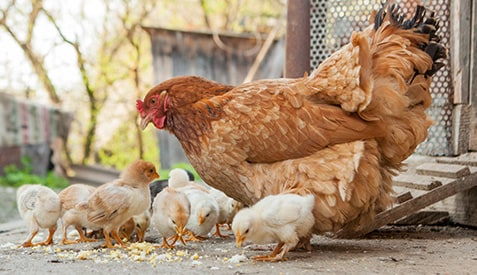
Backyard poultry with chickens eating
Backyard Poultry and Salmonella

Backyard poultry, like chicken and ducks, can carry Salmonella germs even if they look healthy and clean. These germs can easily spread to anything in the areas where they live and roam.

You can get sick from touching your backyard poultry or anything in their environment and then touching your mouth or food, and swallowing Salmonella germs.

Research – Legionella and Biofilms—Integrated Surveillance to Bridge Science and Real-Field Demands

MDPI

Legionella_Plate_01

Legionella is responsible for the life-threatening pneumonia commonly known as Legionnaires’ disease or legionellosis. Legionellosis is known to be preventable if proper measures are put into practice. Despite the efforts to improve preventive approaches, Legionella control remains one of the most challenging issues in the water treatment industry. Legionellosis incidence is on the rise and is expected to keep increasing as global challenges become a reality. This puts great emphasis on prevention, which must be grounded in strengthened Legionella management practices. Herein, an overview of field-based studies (the system as a test rig) is provided to unravel the common roots of research and the main contributions to Legionella’s understanding. The perpetuation of a water-focused monitoring approach and the importance of protozoa and biofilms will then be discussed as bottom-line questions for reliable Legionella real-field surveillance. Finally, an integrated monitoring model is proposed to study and control Legionella in water systems by combining discrete and continuous information about water and biofilm. Although the successful implementation of such a model requires a broader discussion across the scientific community and practitioners, this might be a starting point to build more consistent Legionella management strategies that can effectively mitigate legionellosis risks by reinforcing a pro-active Legionella prevention philosophy. View Full-Text

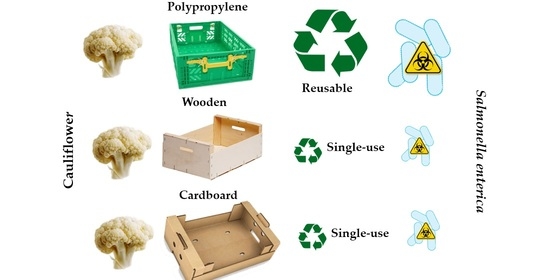
Research – Reusable Plastic Crates (RPCs) for Fresh Produce (Case Study on Cauliflowers): Sustainable Packaging but Potential Salmonella Survival and Risk of Cross-Contamination

MDPI

The handling of fresh fruits and vegetables in reusable plastic crates (RPCs) has the potential to increase the sustainability of packaging in the fresh produce supply chain. However, the utilization of multiple-use containers can have consequences related to the microbial safety of this type of food. The present study assessed the potential cross-contamination of fresh cauliflowers with Salmonella enterica via different contact materials (polypropylene from RPCs, corrugated cardboard, and medium-density fiberboard (MDF) from wooden boxes). Additionally, the survival of the pathogenic microorganism was studied in cauliflowers and the contact materials during storage. The life cycle assessment (LCA) approach was used to evaluate the environmental impact of produce handling containers made from the different food-contact materials tested. The results show a higher risk of cross-contamination via polypropylene compared with cardboard and MDF. Another outcome of the study is the potential of Salmonella for surviving both in cross-contaminated produce and in contact materials under supply chain conditions. Regarding environmental sustainability, RPCs have a lower environmental impact than single-use containers (cardboard and wooden boxes). To exploit the potential environmental benefits of RPCs while ensuring food safety, it is necessary to guarantee the hygiene of this type of container. View Full-Text

Information – 1,000,000,000,000 germs can live in one gram of poop

Click to access one-trillion-germs_508_8x11.pdf

Research – Kitchen-scale Treatments for Reduction of Listeria monocytogenes in Prepared Produce

Journal of Food Protection

Listeriosis, a foodborne illness caused by Listeria monocytogenes , has relatively low incidence, but a substantial mortality rate, particularly in immunocompromised populations. Because of the known risk of L. monocytogenes and other pathogens in produce, immunocompromised individuals are often placed on neutropenic diets that exclude fresh produce. Therefore, this study aimed to evaluate several kitchen-scale treatments as potential interventions to reduce L. monocytogenes in prepared produce. Cucumbers, apples, and celery were dip inoculated with a three-strain cocktail of L. monocytogenes and dried for 24 h. Inoculated products were subjected to the following treatments as applicable: commercial sanitizer soak (90 s, with agitation), tap water rinse (15 s), tap water soak (90 s, with agitation), surface blanching (25 s), tap water rinse (15 s) followed by peeling, and surface blanching (25 s) followed by peeling. Additionally, inoculum uptake in celery and the impact of two different types of peelers (mechanical crank and manual) were assessed. Treated samples were plated on differential media and incubated for 48 h at 37°C. L. monocytogenes populations were then enumerated and compared to the untreated control (log CFU/g). All treatments lacked efficacy for celery, with reductions significantly less ( P < 0.05) than in other products, likely due to inoculum internalization. The sanitizer soak, tap water rinse, and tap water soak did not differ in efficacy ( P > 0.05), which was low for cucumbers (< 1.5 log CFU/g), apples (< 1.3 log CFU/g), and celery (< 0.7 log CFU/g). The two types of apple peelers did not differ in efficacy ( P > 0.05). Surface blanching and surface blanching followed by peeling were the most effective treatments in both cucumbers and apples ( P < 0.05), with average reductions of 4.2 to 5.1 and 3.5 to 5.9 log CFU/g, respectively.