Category Archives: microbial contamination

RASFF Alerts – Listeria monocytogenes – Blanched maize Kernels – Swett Chilli Chicken Wraps – Chilled Cheese

European Food Alerts

RASFF

Listeria monocytogenes (present /25g) in frozen blanched sweet maize kernels from Hungary in Switzerland

RASFF

Listeria monocytogenes (in 2 out of 5 samples /25g) in chilled sweet chilli chicken wraps from the Netherlands in the Netherlands

RASFF

Listeria monocytogenes (<10 CFU/g) in chilled cheese from the Netherlands in France

RASFF Alert – Hepatitis A – Dried Tomato’s

European Food Alerts

RASFF

hepatitis A virus (presence /25g) in dried tomatoes from Turkey in Greece

RASFF Alerts – Salmonella – Anything to do with Chicken from Poland – Black Pepper – Paprika Powder – Chilled beef Merguez Sausages

European Food Alerts

RASFF

Salmonella enterica ser. Münster (presence /25g) in paprika powder from China in Spain

RASFF

Salmonella (presence /25g) in pepper from Brazil in Spain

RASFF

Salmonella enterica ser. Newport (presence /25g) in frozen chicken elements from Poland in Poland

RASFF

Salmonella enterica ser. Enteritidis (presence /25g) in chilled chicken elements from Poland in Poland

RASFF

Salmonella enterica ser. Mbandaka (presence /150g) in egg yolk powder from Poland in Sweden

RASFF

Salmonella enterica ser. Enteritidis (presence /25g) in frozen chicken legs from Poland in France

RASFF

Salmonella (present /25g) in black pepper from Brazil in the Netherlands

RASFF

Salmonella (present /10g) in chilled beef merguez sausages from Belgium in Belgium

RASFF

Salmonella enterica ser. Infantis (presence /25g) in frozen chicken breast fillets from Poland in Estonia

RASFF

Salmonella group C (presence /25g) in chilled chicken broiler thighs and breast steaks from Poland in Lithuania

RASFF Alerts – Animal Feed – Enterobacteriaceae – Dog Chews

European Food Alerts

RASFF

high count of Enterobacteriaceae (1300 CFU/g) in dog chews from China in Sweden

RASFF Alerts – Animal Feed – Salmonella – Dog Chews – Rapeseed Cake – Sunflower Husk Pelletes

European Food Alerts

RASFF

Salmonella enterica ser. Typhimurium (presence /25g) in dog chews from Germany in Austria

RASFF

Salmonella enterica ser. Agona (present /25g) in rapeseed cake from Belgium in Belgium

RASFF

Salmonella (present /25g) in sunflower husk pellets from Estonia in Germany

Canada – Harvest brand Polish Sausages may be unsafe due to undercooking

CFIA

Recall details

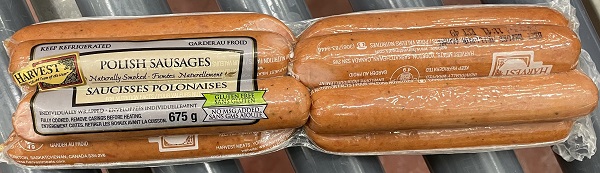
Ottawa, January 14, 2021 – Harvest Meats is recalling Harvest brand Polish Sausages from the marketplace due to undercooking. Consumers should not consume the recalled product described below.

Recalled product

Brand Product Size UPC Codes
Harvest Polish Sausages 675 g 0 57393 70017 8 BEST BEFORE 2021MR15

What you should do

Check to see if you have the recalled product in your home. Recalled products should be thrown out or returned to the store where they were purchased.

Undercooked food may contain bacterial pathogens which can make you sick.

Background

This recall was triggered by the company. The Canadian Food Inspection Agency (CFIA) is conducting a food safety investigation, which may lead to the recall of other products. If other high-risk products are recalled, the CFIA will notify the public through updated Food Recall Warnings.

The CFIA is verifying that industry is removing the recalled product from the marketplace.

Illnesses

There have been no reported illnesses associated with the consumption of this product.

Product photos

Printer ready version of photos

  • Harvest – Polish Sausages – 675 grams (front)
  • Harvest – Polish Sausages – 675 grams (back)

Public enquiries and media

Company information
Harvest Meats: 1-800-667-1496 ext. 358
Public enquiries
Toll-free: 1-800-442-2342 (Canada and U.S.)
Telephone: 1-613-773-2342 (local or international)
Email: cfia.enquiries-demandederenseignements.acia@canada.ca
Media relations
Telephone: 613-773-6600
Email: cfia.media.acia@canada.ca

Ireland – Recall of Tesco Finest Taleggio PDO Italian Cheese Due to the Presence of Listeria monocytogenes

FSAI

Summary
Category 1: For Action
Alert Notification: 2021.05
Product: Tesco Finest Taleggio PDO Italian Cheese; pack size: 200 g
Batch Code: Use-by date: 25.01.2021
Country Of Origin: Italy

Message:

Tesco Ireland is recalling Tesco Finest Taleggio PDO Italian Cheese with the use by date of 25th January 2021, due to the detection of Listeria monocytogenes. Point-of-sale recall notices will be displayed in all Tesco stores.

Nature Of Danger:

Symptoms of Listeria monocytogenes infection can include vomiting, nausea, persistent fever, muscle aches, severe headache and neck stiffness.  In rare cases, the infection can be more severe, causing serious complications. Some people are more vulnerable to Listeria monocytogenes infections, including pregnant women, babies, and people with weakened immune systems, including the elderly.  The incubation period (time between initial infection and first symptoms appearing) is on average 3 weeks but can range between 3 and 70 days.

Action Required:

Consumers:

Consumers are advised not to eat the implicated batch.

Taleggio

UK – Tesco recalls Tesco Finest Taleggio because of contamination with Listeria monocytogenes

FSA

Tesco is recalling Tesco Finest Taleggio 200g because it contains Listeria monocytogenes.

Product details

Tesco Finest Taleggio
Pack size 200g
Batch code all
Use by 25 January 2021

Risk statement

The presence of Listeria monocytogenes in the product listed above.

Symptoms caused by this organism can be similar to flu and include high temperature, muscle ache or pain, chills, feeling or being sick and diarrhoea.

Some people are more vulnerable to listeria infections, including those over 65 years of age, pregnant women and their unborn babies, babies less than one month old and people with weakened immune systems.

Action taken by the company

Tesco is recalling the above product. Product recall notices will be issued to explain to customers why the product is being recalled and tell them what to do if they have bought the product. Please see attached notice.

Our advice to consumers

If you have bought the above product do not eat it. Instead, return it to the store from where it was bought for a full refund.

About product recalls and withdrawals

If there is a problem with a food product that means it should not be sold, then it might be ‘withdrawn’ (taken off the shelves) or ‘recalled’ (when customers are asked to return the product). The FSA issues Product Withdrawal Information Notices and Product Recall Information Notices to let consumers and local authorities know about problems associated with food. In some cases, a ‘Food Alert for Action’ is issued. This provides local authorities with details of specific action to be taken on behalf of consumers.

Ref: FSA-PRIN-02-2021

Research – Possibility, duration, and molecular predictors of sanitizer tolerance in Listeria monocytogenes

Centre For Produce Safety

Summary

Due to concerns over bacterial tolerance to sanitizers, FDA and FSIS recommend rotating sanitizers in RTE food processing facilities to better control foodborne pathogens, in particular, Listeria monocytogenes (Lm). These recommendations are nonbinding; whether Lm develops tolerance to common sanitizers remains
inconclusive and debated. Even if Lm develops tolerance through sub-lethal exposure to sanitizers, how long and how strong the tolerance can last should be considered in determining whether sanitizer rotation is needed and how often it should be applied. Lack of consensus and quantitative data on possibility and duration of sanitizer tolerance creates confusions and dilemmas, especially when sanitizer rotation presents considerable challenges in training, compliance, and cost control to the industry. This proposal describes studies to help settle the debate and fill critical knowledge gaps regarding Lm tolerance to chlorine and quaternary ammonium compounds. We will measure residual sanitizer levels in produce processing facilities. We will perform laboratory assays to investigate tolerance development and persistence. We will explore machine-learning-aided tolerance prediction and identify evolutionary signals (or lack thereof) of tolerance development from whole genome sequencing data. Our results will provide the industry and regulators with scientific evidence for substantiating, better implementing, or justifiably shelving sanitizer rotational programs.

Technical Abstract

There is still no scientific consensus on whether Listeria monocytogenes (Lm) develops sanitizer tolerance. We hypothesize that development of two types of sanitizer tolerance may occur in Lm. First, short-term adaptation to sub-lethal levels of sanitizers induces acquired tolerance, which is transient and not hereditary. Second, long- term selection by sanitizers causes intrinsic tolerance, which is established in Lm populations by evolutionary changes to Lm genomes. To help settle the debate, we will test our hypothesis by distinguishing and investigating both types of tolerance in Lm using chlorine and a quaternary ammonium compound as example sanitizers.

In this study, we will survey residual sanitizer levels in a leafy green and a tomato processing facilities to evaluate if laboratory-derived sanitizer levels optimal for tolerance development are relevant to produce processors. We will assess the possibility of acquired tolerance by measuring the difference in minimum inhibition concentrations (MIC) before and after sanitizer adaptation. We will study how different sanitizer levels and exposure time affect the development of acquired tolerance, including how long the tolerance can last after exposure to sanitizers. We will explore the mechanisms behind the development of acquired sanitizer tolerance by characterizing temporal shifts in Lm transcriptome throughout the duration of the tolerance.

We will assess intrinsic tolerance in a collection of 200-300 strategically selected Lm strains using high-throughput growth kinetics assays. We will search for evolutionary evidence that suggests the development of intrinsic tolerance in recent history by analyzing whole genome sequencing (WGS) data of these strains. We
will build a machine-learning classifier to predict tolerance levels and identify key tolerance predictors from WGS.

This research will provide valuable prerequisite information for determining if sanitizer rotation is necessary for preventing the development of Lm tolerance to sanitizers. Scientific data from the project will also help optimize sanitation practices to mitigate tolerance development and determine frequency for sanitizer rotation if rotation is needed.


Research – The presence of microbial contamination and biofilms at a beer can filling production line

Journal of Food Protection

Contamination of beer arises in 50% of all events at the late stages of production, the filling area. Hereby, biofilms, being consortia of microorganisms embedded in a matrix composed of extracellular polymeric substances, play a critical role. To date, most studies have focused on the presence of (biofilm forming) microorganisms within this filling environment. Our aim was to characterize the microbial status as well as the presence of possible biofilms at a can filling line for beer by determining the presence of microorganisms and their associated matrix components (carbohydrates, proteins and extracellular DNA (eDNA)). Targeted qPCR confirmed the presence of microorganisms at ten sites during operation and three after cleaning (from 23 sites respectively). The evaluation of carbohydrates, eDNA and proteins showed that 16 sites were positive for at least one component during operation and four after cleaning. We identified one potential biofilm hotspot, namely the struts below the filler, harboring high loads of bacteria and yeast, eDNA, carbohydrates and proteins. The protein pattern was different than that of beer. This work deepens our understanding of biofilms and microorganisms found at the filling line of beer beverages at sites critical for production.