Category Archives: microbial contamination

Research – Heatwave-associated Vibrio infections in Germany, 2018 and 2019

Eurosurveillance

Food Illness

The genus , which belongs to the family  and the class , includes many species that are potential human pathogens [1].  is a highly diverse species that consists of more than 200 serogroups [2]. Strains within the serogroups O1 and O139 produce cholera toxin and are the causative agents of endemic and epidemic cholera, which represent an important cause of morbidity and mortality in countries with inadequate access to clean water and sanitation facilities [3].  strains not included in these serogroups as well as other  spp. are referred to as non-cholera  spp. and are ubiquitous aquatic bacteria with a worldwide distribution, especially in warm estuarine and marine ecosystems [2]. These halophilic bacteria prefer low to moderate salinity (less than 25 parts per thousand (ppt) NaCl) [4]. The abundance of  spp. in marine and estuarine waters closely corresponds with the sea surface temperatures (SSTs) since they proliferate in warm water [5]. Thus, regional variations in environmental conditions are paramount importance in understanding the ecology of  spp.

Human infections with non-cholera  spp. can manifest as wound infections, ear infections, gastroenteritis, and primary septicaemia and have been predominantly reported in tropical and subtropical regions [6]. In Europe, cases are rare, and infections associated with the Mediterranean Sea [79], the Atlantic Ocean [1012], or the Baltic Sea [13,14] have only been sporadically reported. However, a rapidly warming marine environment accompanied by an increase in extreme weather events such as heatwaves has resulted in unprecedented peak SSTs favouring the spread of  spp. worldwide. Recently, larger  spp. outbreaks have been reported in temperate regions such as Spain [15], Sweden, and Finland [16]. In Germany,  spp. other than toxigenic  strains were not classified as reportable pathogenic agents before March 2020; to date, only a few cases have been reported and few case series of autochthonous infections have been published [1720]. Over the last decades, resistance to various antibiotics, including to ampicillins, tetracyclines, and carbapenems, has emerged among  spp [21,22]. As a result of resistant isolates, the monitoring of antibiotic profiles of clinical and environmental  spp. has become of increasing importance. However, information on the number of human cases and the abundance of  spp. in coastal waters is scarce in most other European countries.

When we became aware of a high number of human infections with virulent  strains contracted in the Baltic Sea during the summer months of 2018 and 2019 (data not shown), we decided to conduct an observational retrospective multi-centre cohort study of domestically-acquired  infections. This study describes the epidemiology and the clinical impact of those infections and assesses antibiotic resistance patterns and phylogenetic relationships among clinical isolates. To determine the association between  infections and SST anomalies, we analysed the degree of warming in the south-western Baltic Sea, where the majority of the infections occurred.
Research – Use of Acetic Acid to Partially Replace Lactic Acid for Decontamination against Escherichia coli O157:H7 in Fresh Produce and Mechanism of Action

MDPI

Escherichia coli O157:H7 is frequently detected in ready-to-eat produce and causes serious food-borne diseases. The decontamination efficacy of lactic acid (LA) is clearly established. In this study, LA was mixed with acetic acid (AA) to reduce costs while achieving consistent or better inhibitory effects. Time-kill curves and inoculation experiments using fresh-cut spinach and arugula indicated that 0.8%LA+0.2%AA shows similar antibacterial effects to those of 1%LA. To determine whether 1%LA and 0.8%LA+0.2%AA exert antibacterial effects by similar mechanisms, proteomics analysis was used. The proteins related to macromolecule localization, cellular localization, and protein unfolding were uniquely altered after the treatment with 1%LA, and the proteins related to taxis, response to stress, catabolic process, and the regulation of molecular function were uniquely altered after the treatment with 0.8%LA+0.2%AA. Based on these findings, combined with the results of a network clustering analysis, we speculate that cell membrane damage is greater in response to LA than to 0.8%LA+0.2%AA. This prediction was supported by cell membrane permeability experiments (analyses of protein, nucleotide, ATP, and alkaline phosphatase leakage), which showed that LA causes greater membrane damage than 0.8%LA+0.2%AA. These results provide a theoretical basis for the application of an acid mixture to replace LA for produce decontamination. View Full-Text

Research – Application of Whole Genome Sequencing to Understand Diversity and Presence of Genes Associated with Sanitizer Tolerance in Listeria monocytogenes from Produce Handling Sources

MDPI

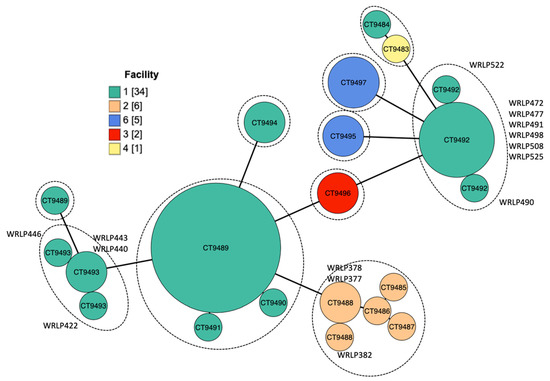
Recent listeriosis outbreaks linked to fresh produce suggest the need to better understand and mitigate L. monocytogenes contamination in packing and processing environments. Using whole genome sequencing (WGS) and phenotype screening assays for sanitizer tolerance, we characterized 48 L. monocytogenes isolates previously recovered from environmental samples in five produce handling facilities. Within the studied population there were 10 sequence types (STs) and 16 cgMLST types (CTs). Pairwise single nucleotide polymorphisms (SNPs) ranged from 0 to 3047 SNPs within a CT, revealing closely and distantly related isolates indicative of both sporadic and continuous contamination events within the facility. Within Facility 1, we identified a closely related cluster (0–2 SNPs) of isolates belonging to clonal complex 37 (CC37; CT9492), with isolates recovered during sampling events 1-year apart and in various locations inside and outside the facility. The accessory genome of these CC37 isolates varied from 94 to 210 genes. Notable genetic elements and mutations amongst the isolates included the bcrABC cassette (2/48), associated with QAC tolerance; mutations in the actA gene on the Listeria pathogenicity island (LIPI) 1 (20/48); presence of LIPI-3 (21/48) and LIPI-4 (23/48). This work highlights the potential use of WGS in tracing the pathogen within a facility and understanding properties of L. monocytogenes in produce settings. View Full-Text

RASFF Alert- High Microbial Count- Food Supplement

RASFF

High microbial count in food supplement from Italy in San Marino

RASFF Alerts – Animal Feed – Salmonella – Rapeseed Expeller

RASFF

Salmonella spp. in organic rapeseed expeller from Italy in Germany

RASFF

Salmonella Havana in rapeseed expeller from Germany in Denmark

EU – EU helps strengthen food safety controls in Bosnia and Herzegovina

Food Safety News

The European Union is providing more than 30 vehicles for use by authorities in Bosnia and Herzegovina for phytosanitary inspections as well as food controls and monitoring.

The 33 new off-road vehicles worth €467,000 ($540,000) will be used by authorities in the country to support alignment with EU standards. Bosnia and Herzegovina is not yet an EU member country.

Food and feed chain monitoring will be faster, the delay from taking a sample during border inspections until the final analysis will be shortened, and the time spent on issuing phytosanitary certificates will be reduced.

Research – O148 Shiga toxin-producing Escherichia coli outbreak: microbiological investigation as a useful complement to epidemiological investigation

Core

An outbreak of Shiga toxin-producingEscherichia coli(STEC) O148 infection occurred among weddingattendees in France in June 2002. A retrospective cohort study was performed and ten cases wereidentified, including two adults with haemolytic uraemic syndrome (HUS). The analytical studyrevealed that > 80%of affected individuals had eaten lightly roasted mutton and poultry paˆte ́, but onlythe consumption of paˆte ́tended to be associated with illness (relative risk 3.4; 95%CI 0.8–14.4). Left-overs (cooked mutton and raw offal) and processed foods (paˆte ́) from the same batches as served at theparty were sampled. Human, food and environmental samples were examined for the Shiga toxin (stx)gene and virulence traits by PCR.Stx-positive samples were cultured for STEC. HUS cases were testedfor serum antibodies against 26 major STEC serogroups. An STEC O26 strain (stx1,eae,ehxA) wasisolated from one case with diarrhoea, and an STEC O148 strain (stx2c) from one case of HUS. Serumantibodies against O26 were not detected in either of these patients; antibodies against O148 were nottested. Three STEC strains were isolated from the mutton and the offal (stx2c, O148), and two from thepaˆte ́(stx2c, O-X and O-Y). The isolates from the mutton were indistinguishable from the humanstx2cisolate, whereas the paˆte ́isolates differed. Although four different STEC strains were identified inpatients and foods, the results of molecular subtyping, in conjunction with analysis of food consumptionpatterns, strongly suggested that this outbreak was caused by mutton contaminated with STEC O148.

USA Research – National Outbreak Reporting System (NORS)

CDC

Use NORS Dashboard to search and access data from reports of foodborne and waterborne disease outbreaks and enteric (intestinal) disease outbreaks spread by contact with environmental sources, infected people or animals, and other means.

NORS

ECDC -Cryptosporidiosis – Annual Report 2018

Click to access CRYP_AER_2018_Report.pdf

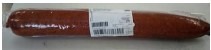
France- SMOKED GARLIC SAUCISSON NATURAL TUBE – Microbiology Safety

Gov france

Identifying information for the recalled product

  • Product category Food
  • Product sub-category Meats
  • Product brand name WITHOUT BRAND
  • Names of models or references SMOKED GARLIC SAUSAGE NATURAL TUBE VARIABLE WEIGHT APPROXIMATELY 1 KG
  • Product identification
    GTIN Lot Dated
    3181580008697 126501 Use-by date 06/11/2021
  • Packaging Sausage with smoked garlic natural casing vacuum-packed
  • Start date / End of marketing From 04/10/2021 to 05/10/2021
  • Storage temperature Product to be stored in the refrigerator
  • Health mark FR 22-389-003-CE
  • Further information SMOKED GARLIC SAUCISSON NATURAL TUBE
  • Geographical sales area Whole France
  • Distributors Butchers

Practical information regarding the recall

  • Reason for recall Health risk from cooking failure
  • Risks incurred by the consumer Manufacturing defect, sealing defect (e.g. micro leaks, defective heat sealing) or packaging anomalies
  • Additional description of the risk Cooking fault