Category Archives: foodborne outbreak

USA – Public Health Alert Concerning A Possible Listeria Contamination of Little Hatch’s Ready To Eat Foods

FDA

Audience

Consumers who have recently purchased Little Hatch’s:

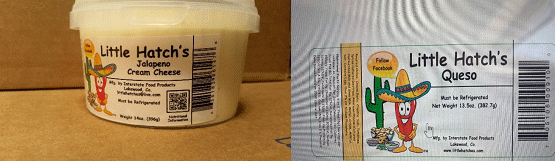
  • Jalapeno Cream Cheese Dip (13.5 oz or 14 oz)
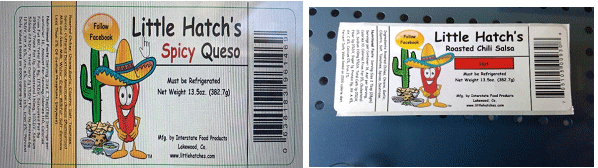
  • Queso (13.5 oz)
  • Spicy Queso (13.5 oz)
  • Roasted Chili Salsa Medium (13.5 oz)
  • Roasted Chili Salsa Hot (13.5 oz)

Product

  • Little Hatch’s ready to eat foods: Jalapeno Cream Cheese Dip, Queso, Spicy Queso, Roasted Chili Salsa Medium and Roasted Chili Salsa Hot, sold in 13.5 oz or 14 oz containers in the refrigerated section of grocery stores
  • Little Hatch’s products are manufactured by Interstate Food Products, LLC and distributed to:
    • Whole Foods Market Distribution Center, Denver, CO
    • Whole Foods Market Rocky Mountain Regional states – CO, KS, MO, NM, UT, TX, WY
    • Natural Grocers, Denver, CO
    • Lucky Market, Denver, CO
Little Hatch’s products

Purpose

The FDA advises consumers not to purchase or eat Little Hatch’s ready to eat Jalapeno Cream Cheese Dip, Queso, Spicy Queso, Roasted Chili Salsa Medium and Roasted Chili Salsa Hot sold in 13.5 oz or 14 oz containers due to a possible Listeria monocytogenes contamination. Listeria monocytogenes is a species of disease-causing bacteria, which causes an infection called listeriosis. A listeriosis infection can have serious adverse effects for women who are or may become pregnant, the elderly, and persons with weakened immune systems.

Summary of Problem and Scope

The FDA detected Listeria monocytogenes in retail samples of Jalapeno Cream Cheese Dip, Queso and Spicy Queso and subsequently initiated an inspection at the manufacturing facility. The FDA confirmed Listeria monocytogenes in 23 of 149 samples taken from processing, packaging, and storage areas at the facility, including various food-contact surfaces.

On May 20 2021, Interstate Food Products, initiated a voluntary recall of “Little Hatch’s” brand Jalapeno Cream Cheese, Queso, and Spicy Queso products with specific sell by dates that the FDA tested and found positive for Listeria monocytogenes. On June 15, 2021, Interstate Food Products indicated to the FDA that they may need to further expand the recall to include “Little Hatch’s” brand Roasted Chili Salsa Hot after conducting their own testing and confirming additional positive Listeria monocytogenes findings.

FDA Actions

The FDA is issuing this alert because the agency is concerned with the firm’s ongoing Listeria monocytogenes contamination. The FDA is continuing its efforts to remove Little Hatch’s product from the market.

Recommendations for Consumers

  • Contact your healthcare providers immediately if you are experiencing illness after consuming these products.
  • Contact your healthcare providers if you have recently consumed these products and are concerned about your health.
  • Consumers who have purchased these products should throw the food away and follow these steps:
    • Wash the inside walls and shelves of the refrigerator, cutting boards and countertops, and utensils that may have had contact with contaminated foods; then sanitize them with a solution of one tablespoon of chlorine bleach to one gallon of hot water; dry with a clean cloth or paper towel that has not been previously used.
    • Wipe up spills in the refrigerator immediately and clean the refrigerator regularly.
    • Wash hands with warm water and soap for at least 20 seconds before and after handling food and following any cleaning and sanitation process.
    • Pregnant women, the elderly and those with weakened immune systems should avoid certain foods, including raw fish, which carry a higher risk for Listeria monocytogenes.

Reporting Problems to the FDA

To report a complaint or adverse event (illness or injury), you can

Visit www.fda.gov/fcic for additional consumer and industry assistance.
USA – CDC and FDA report Salmonella Outbreak linked to Frozen Shrimp

Food Poison Journal

The Salmonella Shrimp Outbreak

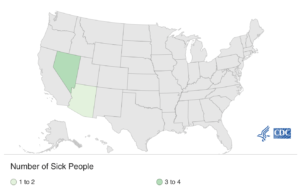
As of June 25, 2021, six people infected with the outbreak strain of Salmonella Weltevreden have been reported from two states – Arizona and Nevada (see map). Illnesses started on dates ranging from February 26, 2021, to April 25, 2021 (see timeline).

Sick people range in age from 30 to 80 years, with a median age of 56 years, and 66% are female. Of five people with information available, two have been hospitalized. No deaths have been reported.

The true number of sick people in an outbreak is likely much higher than the number reported, and the outbreak may not be limited to the states with known illnesses. This is because many people recover without medical care and are not tested for Salmonella. In addition, recent illnesses may not yet be reported as it usually takes 3 to 4 weeks to determine if a sick person is part of an outbreak.

Finland – At least a hundred children became ill with diarrhea, the cause was revealed Salmonella – “There are likely to be more cases,” says the doctor

YLE

Young children in particular have been suffering from diarrhea in Central Finland since last week. Diarrhea has been increasing in various parts of the province, and the pediatric ward of the Central Hospital of Central Finland has been filled with symptomatic children.

All the cases we know are united by the fact that the patients are children in care in kindergartens, but the children have been in care in different kindergartens, says Mia Kapanen , the leading environmental health inspector for environmental health in the Jyväskylä region.

– Food is brought to these kindergartens from somewhere else. We still don’t know if all kindergartens bring food from the same place, Mia Kapanen explains.

“But already on Thursday, it has been possible to rule out that the disease does not come from drinking or bathing water,” he continues.

– It strongly seems that the salomella bacterium has been in the food available on Friday, Kapanen states and justifies the matter with the salmonella bacterium’s germination period of a few days and the fact that children’s illnesses have been detected in the early part of the Midsummer week.

However, with 100% certainty, the origin of salmonella infection may not be clear. The bacterium may be present in food that came in different batches and the contaminated batch may not have ended up in a frozen safety sample.

Ukraine – Dozens sickened after consuming sushi

Outbreak News Today

The Kharkiv Regional Center for Disease Control and Prevention has reported 89 people, including 19 children, have been hospitalized for food poisoning.

Two patients, registered on June 22, are residents of Lugansk, who were on a business trip in the city of Kharkov and ate sushi in the Yakitoria restaurant.

It is noted that according to the results of bacteriological examination of patients, 42 people, incl. two employees of the institution, the culture of the genus Salmonella is highlighted. Pathogenic staphylococcus was found in six workers, pathogenic E. coli was isolated in one, and opportunistic pathogens were isolated in six more.

Research – A Systematic Review of Listeria Species and Listeria monocytogenes Prevalence, Persistence, and Diversity throughout the Fresh Produce Supply Chain

MDPI

Listeria monocytogenes is an increasing food safety concern throughout the produce supply chain as it has been linked to produce associated outbreaks and recalls. To our knowledge, this is the first systematic literature review to investigate Listeria species and L. monocytogenes prevalence, persistence, and diversity at each stage along the supply chain. This review identified 64 articles of 4863 candidate articles obtained from four Boolean search queries in six databases. Included studies examined naturally detected/isolated Listeria species and L. monocytogenes in fresh produce-related environments, and/or from past fresh produce associated outbreaks or from produce directly. Listeria species and L. monocytogenes were detected in each stage of the fresh produce supply chain. The greatest prevalence of Listeria species was observed in natural environments and outdoor production, with prevalence generally decreasing with each progression of the supply chain (e.g., packinghouse to distribution to retail). L. monocytogenes prevalence ranged from 61.1% to not detected (0.00%) across the entire supply chain for included studies. Listeria persistence and diversity were also investigated more in natural, production, and processing environments, compared to other supply chain environments (e.g., retail). Data gaps were identified for future produce safety research, for example, in the transportation and distribution center environment.

Research – Feedborne Salmonella enterica Serovar Jerusalem Outbreak in Different Organic Poultry Flocks in Switzerland and Italy Linked to Soya Expeller

MDPI

Poultry feed is a leading source of Salmonella infection in poultry. In Switzerland, heat-treated feed is used to reduce Salmonella incursions into flocks in conventional poultry production. By contrast, organic feed is only treated with organic acids. In 2019, the Swiss National Reference Center for Enteropathogenic Bacteria identified the rare serovar S. Jerusalem from samples of organic soya feed. Further, in July 2020, the European Union’s Rapid Alert System for Food and Feed published a notification of the detection of S. Jerusalem in soya expeller from Italy. During 2020, seven S. Jerusalem isolates from seven different poultry productions distributed over six cantons in Switzerland were reported, providing further evidence of a possible outbreak. Using whole-genome sequencing (WGS), S. Jerusalem isolates from feed and from animals in Switzerland were further characterized and compared to S. Jerusalem from organic poultry farm environments in Italy. WGS results showed that feed isolates and isolates from Swiss and Italian poultry flocks belonged to the sequence type (ST)1028, grouped in a very tight cluster, and were closely related. This outbreak highlights the risk of spreading Salmonella by feed and emphasizes the need for a heat-treatment process for feed, also in organic poultry production.

USA – 2021 E. Coli Outbreak Linked to Pasteurized Yogurt – Update

Washington State DOH

On May 12, 2021, The Washington State Department of Health (DOH) announced a multi-county outbreak of E. coli O157:H7 that began as a Public Health-Seattle & King County investigation involving several children with E. coli. The outbreak is linked to Pure Eire Dairy  yogurt also sold as PCC Community Market brand yogurt.

Update 6/23/21: One new case from Arizona has been identified who was infected with the outbreak strain of E. coli O157:H7. This brings the total number of outbreak-associated cases to 17. All three of the Arizona cases are considered secondary infections.

Update 6/17/21: One new child case has been identified who was infected with the outbreak strain of E. coli O157:H7 and was hospitalized for their illness. This brings the total number of outbreak-associated cases to 16.

The two Arizona cases infected by the outbreak strain of E. coli O157 did not consume PCC or Pure Eire brand yogurt.

  • The first Arizona case is considered a secondary infection. This person was infected after having close contact with a Washington state resident who regularly ate Pure Eire yogurt and developed diarrhea (but was not tested) shortly before traveling to Arizona.
  • The newest Arizona case added on 6/17/2021 is also considered a secondary infection.

 Public health message

  • If you have PCC Community Market brand yogurt or Pure Eire yogurt at home, do not eat it and throw it away.
  • E. coli infections can cause serious complications. Symptoms include diarrhea, stomach cramps and blood in the stool.
  • If you notice symptoms, especially bloody diarrhea, contact your health care provider right away.

Case information

DOH is reporting confirmed cases infected with bacteria that have been genetically linked. Local health jurisdictions may report higher numbers for their counties that include cases still under investigation and may provide additional detail on their cases.

Case information will be updated twice a week, as new information is available.

Last updated 6/23/21 at 7:07 p.m.

Summary

Statewide total

Cases

Confirmed cases – updated 6/23/21

17

Hospitalized – updated 6/17/21

10

Developed hemolytic uremic syndrome (HUS)

4

Died

0

USA – Timeline for Identifying and Reporting Illnesses in Foodborne Outbreaks

CDC

Ever wonder why the number of illnesses in a foodborne outbreak can increase for weeks, even after the contaminated food is off the market?

A series of events happen before public health officials can report that a case of illness is linked to an outbreak. Each event takes a certain amount of time. This time is known as the “reporting lag” or “lag window” of an outbreak. It is usually 3–4 weeks. For illnesses caused by some bacteria, such as Listeria, it may be longer. Public health officials work to speed up this process when possible.

The steps below outline what typically happens from the day someone eats a contaminated food to the day their illness is linked to a multistate foodborne outbreak investigated by CDC.*

Day 1: You eat a food containing harmful bacteria.
Day 3: You start to feel sick.
  • Symptoms of food poisoning (such as nausea and diarrhea) could start anywhere from a few hours to a few weeks later, depending on the bacteria you ingested. The following chart describes how long it typically takes for someone to have symptoms after being infected with some of the most common foodborne bacteria.
How long it typically takes for someone to have symptoms after being infected with some of the most common foodborne bacteria.
Bacteria Typical start of symptoms
Campylobacter 2–5 days
E. coli 3–4 days
Listeria 1–4 weeks
Salmonella 6 hours–6 days
Vibrio 1-2 days
Should I call the doctor?

Find out when some common food poisoning symptoms are severe enough to need medical attention. See the list

Day 5: You still feel sick with nausea or diarrhea, so you decide to see a healthcare provider.
  • To learn which germ is making you sick, the healthcare provider collects a sample of your stool (poop), urine (pee), or blood.
  • The provider sends your sample to a clinical laboratory for testing.
Day 6: The clinical laboratory tests your sample.
  • After receiving your sample, the laboratory takes 1–3 days to run tests, depending on their capacity.
Day 9: Clinical laboratory test results show what germ is causing your illness.
  • The clinical laboratory identifies the germ making you sick and reports the test results to your healthcare provider.
  • The clinical laboratory should also report test results to the state or local public health department, and they notify CDC.
Days 9–16: The clinical laboratory sends a sample of your bacteria to a public health laboratory.
  • The clinical laboratory ships the bacteria found in your sample to a public health laboratory for whole genome sequencing (WGS) analysis.
  • Shipping can take up to a week, depending on transportation arrangements in your state and the distance between the two laboratories.
Days 16–21: The public health laboratory performs WGS analysis and other tests on the bacteria.
  • The public health laboratory performs tests to determine the bacteria’s DNA fingerprint and other characteristics.
  • WGS testing and analysis of the results, including whether the bacteria is resistant to any antibiotics, can take 2–10 days depending on the bacteria.
What Is Whole Genome Sequencing?

CDC and public health laboratories use a technology called whole genome sequencing (WGS) to generate DNA fingerprints of bacteria causing illness. When bacteria have nearly identical DNA fingerprints, we consider them “genetically closely related.” Illnesses caused by bacteria that are genetically closely related are more likely to have a common source, such as a contaminated food. An outbreak is an event in which a group of people get similar illnesses from a common source. Disease detectives investigate outbreaks to find out what is making people sick.

Find out how CDC uses WGS to detect and solve foodborne outbreaks.

Day 22: The public health laboratory sends WGS results to CDC.
  • Within a day of analyzing the WGS results, state public health officials add the DNA fingerprint from the bacteria to PulseNet, a national laboratory network coordinated by CDC. PulseNet connects foodborne illnesses in order to identify outbreaks.
Day 23: CDC determines if your illness is related to other recent illnesses.
  • CDC scientists determine whether the bacteria causing your illness is closely related genetically to any other recent WGS results from other people in PulseNet.
  • If it is closely related to bacteria causing recent illnesses in other people, CDC may begin an outbreak investigation or add your illness to an ongoing investigation.

Total time: 34 weeks

*Most cases of illness, even those caused by common foodborne germs, are not linked to a foodborne outbreak. This can happen for many reasons. A major reason is that most illnesses are not part of an outbreak. Another reason is that germs that cause foodborne illness can also be spread in other ways, such as by water or directly from one person to another. Also, if an illness is diagnosed by a culture-independent diagnostic test, that case may not be linked to an outbreak because these tests do not provide the information needed to link it to an outbreak. In addition, many people do not seek medical care for foodborne illnesses, so their illnesses cannot be diagnosed or reported to public health officials.

UK – FSA working on reasons behind foodborne illness decline

Food Safety News

The Food Standards Agency’s chief scientific advisor has said potential trends in foodborne infections must be monitored after a decline during the COVID-19 pandemic.

Robin May said data from the past 12 months shows a substantial drop in foodborne disease rates for four major pathogens but this is likely because of fewer patients going to general practioners’ (GP) offices and reduced diagnostic testing during the coronavirus pandemic.

May said understanding the true level of foodborne disease in 2020 and early 2021 will require detailed analysis, work which the FSA has started.

“An accurate benchmark will be invaluable as we start to monitor post-COVID trends and establish, for instance, whether changes in domestic and commercial hygiene practices may ultimately lead to a lasting change in foodborne disease rates,” he said.

“In terms of foodborne disease reporting, the bottom line is we don’t know what the data really looked like for last year because so much of our data comes from things like GP reporting, which people were not doing.

Singapore – Tilapia linked to Streptococcus outbreak in Singapore

The Fish Site

Tilapia have been linked to an outbreak of Streptococcus, which affected 146 people in Singapore, prompting the FAO to issue a “risk profile report” to raise awareness of the threat.

In 2015, around 146 people became ill after eating a traditional raw freshwater fish dish in Singapore, with several people eventually having to have limbs amputated. It turns out that they had developed blood poisoning linked to a bacterium called Streptococcus agalactiae, also called Group B Streptococcus (SBS). The specific strain responsible for the outbreak was a unique sequence type 283 (ST283). A four-page factsheet, Invasive disease linked to raw freshwater fish, has just been made available, as has a more comprehensive Risk profile – Group B Streptococcus (GBS) – Streptococcus agalactiae sequence type (ST) 283 in freshwater fish.

Dr Tim Barkham, an associate professor at Tan Tock Seng Hospital in Singapore, first identified the human health risk. “Many microbiologists were surprised, as invasive GBS disease in people has not been known to be foodborne previously,” he said.