Category Archives: Food Technology

Research – Nanoparticles to Kill Listeria

The Packerlisteria-hp

A study by researchers at Rensselaer Polytechnic Institute used enzymes attached to food-safe silica nanoparticles to create a coating that kills listeria.

The method aims at an alternative to chemical or antibiotic decontamination of various foods during handling and packaging.

The findings were published in April in Scientific Reports.

The coating killed listeria within a few minutes of contact without affecting other bacteria.

The cell lytic enzymes can also be attached to starch nanoparticles used in food packaging, according to the researchers. On meat, for example, edible starch is often sprayed into packaging as a powder layer.

“Stable enzyme-based coatings or sprays could be used in food supply infrastructure — from picking equipment to packaging to preparation — to kill listeria before anyone has a chance to get sick from it,” Rensselaer Polytechnic chemical and biological engineering professor Ravi Kane said in a news release. “We can adapt this technology for all different kinds of harmful or deadly bacteria.”

USA – Recall – Queso Fresco Cheese – Salmonella

Food Poisoning Bulletin

Salmonella in unpasteurized Mexican-style cheese called queso fresco has sickened at least 13 people in Minnesota who all got it from the same private home, according to state health officials. The Minnesota Department of Health (MDH), the Minnesota Department of Agriculture (MDA) and health officials from the City of Minneapolis are investigating the outbreak and searching for the source of the raw milk used to make the cheese. The sale of raw milk is not legal in Minnesota unless it is purchased on the farm where it was produced.

Eleven people were diagnosed with confirmed cases of infection from the same strain of Salmonella Typhimurium. Eight of them were hospitalized.  Additional illnesses, among family members of those with confirmed cases, were also reported but not confirmed through testing. Two of those people were hospitalized. All of the those who were sickened have recovered

Research – China Shellfish – Virus – Fresh Cut Salad Quality – Seasonal Campylobacter – Salmonella Control

Wiley Online

Prevalence of Human Enteric Viruses and a Potential Indicator of Contamination in Shellfish in China.

Science Direct

Influence of working conditions and practices on fresh-cut lettuce salads quality

Cambridge Journals

Identifying the seasonal origins of human campylobacteriosis

University of Cambridge

Researchers plan to use data collected to develop vaccines to control Salmonella in animals and humans

Research – IFR – Contact Killing of Salmonella Typhimurium by Human Faecal Bacteria

Institute of Food Research

Dr Carmen Pin, and PhD student Gaspar Avendaño-Perez at the Institute of Food Research, which is strategically funded by the Biotechnology and Biological Sciences Research Council, have recently found a novel mode of interaction between Salmonella, a foodborne pathogen, and the gut bacteria that leads to the inactivation of Salmonella. This interaction relies on Salmonella and the gut bacteria being in close proximity, or through cell to cell contact. This new way of interaction between the “good” and the” bad” bacteria may contribute to prevent intestinal colonization and infection by foodborne pathogens.

Research – Antibiotic Resitant Bacteria in Meats in the USA – E.coli Use Flagella as Anchors

Food Poisoning Bulletin

An analysis by the Environmental Working Group has found that antibiotic-resistant bacteria are common on meat for sale in American supermarkets. A government study published on February 5, 2012 without fanfare found that 81% of ground turkey, 69% of pork chops, 55% of ground beef, and 39% of chicken carried antibiotic-resistant bacteria.

The study, published by the National Antimicrobial Resistance Monitoring System (NARMS), which is a joint project by the FDA, CDC and USDA, found that the meat samples collected in 2011 harbored “significant amounts” of superbug versions of Salmonella and Campylobacter. Those two bacteria cause 3.6 million cases of foodborne illness every year in the United States.

In addition, 53% of raw chicken samples carried an antibiotic-resistant strain of E. coli, the bacteria found in feces. And the antibiotic resistance is growing fast. Of all Salmonella bacteria found on raw chicken in 2011, 74% were antibiotic resistant, compared to less than 50% in 2002.

Food Poisoning Bulletin

Flagella aren’t just for swimming. For E.coli, these long tails that propel them through liquid, also function as anchors, establishing a hold on surfaces that allow the bacteria to settle in and colonize, according to a new study from Harvard researchers.

“We demonstrate that flagella are able to reach into crevices, access additional surface area, and produce a dense, fibrous network,’” the researchers say in the abstract for the  study which was published in Proceedings of the National Academy of Sciences (PNAS) on March 18. The findings could lead to improved design of surfaces used in health care and food manufacturing settings.

Research- Contamination on Sprouts – Food Packaging

Food Poisoning BulletinEurofins

A study published int he April issue of the Journal of Food Science looked at seed disinfection treatments of sprouts. In the last few years, there have been several major foodborne illness outbreaks linked to raw sprouts, including an E. coli outbreak linked to clover sprouts served at Jimmy John’s restaurants that sickened 29 people in 11 states. And there were seven recalls of sprouts for pathogenic bacterial contamination.

Sprouts are problematic for several reasons. First, the bacteria can be encapsulated inside the seed, making it impervious to physical disinfection such as the application of calcium hypochlorite. And the seeds are sprouted in warm, moist conditions, which are ideal for bacterial growth.

The FDA released guidelines in 1999 designed to limit this problem, including growing seeds using good agricultural practices, conditioning and storing seed under sanitary conditions, following GMPs at sprouting facilities, applying a disinfection treatment just before sprouting, and in-process testing of spent sprout irrigation water for pathogens before the product enters commerce. While sproutbreaks declined after these guidelines were released, the treatments are variable and food poisoning cases continue.

The study examined chemical disinfection with 20000 ppm calcium hypochlorite, and found that it does reduce microbial load on seeds. But there is a high variability in efficacy. Increasing treatment time did not improve the microbial load, but reduced germination rate of seeds. Other chemicals have not been adequately tested.

Food Poisoning Bulletin

Researchers at Rensselaer Polytechnic Institute (RPI) have found a way to kill Listeria and other pathogens without chemicals or antibiotics. Building on a method they developed to coat medical equipment with an agent that can kill antibiotic-resistant Staphylococcus aureus (MRSA), the researchers added lytic enzymes to nanoparticles of food-safe silica and to starch nanoparticles commonly used in food packaging.

“In this study, we have identified a new strategy for selectively killing specific types of bacteria. Stable enzyme-based coatings or sprays could be used in food supply infrastructure—from picking equipment to packaging to preparation—to kill Listeria before anyone has a chance to get sick from it,” said Ravi Kane, RPI’s  P.K. Lashmet Professor of Chemical and Biological Engineering, in a statement. “What’s most exciting is that we can adapt this technology for all different kinds of harmful or deadly bacteria.”

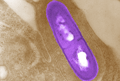
EFSA – VTEC E.coli Strains

EFSAefsa

EFSA’s scientific experts say that it is currently not possible to identify which VTEC bacteria strains have the potential to cause human diseases. In order to help risk managers to identify human health risks, EFSA has proposed a scheme to categorise VTEC strains according to their potential to cause disease. This work has been carried out in response to a request of the Austrian Federal Ministry of Health.

VTEC (verocytotoxin-producing Escherichia coli) is a group of pathogenic E. coli bacteria that can cause bloody diarrhoea and haemolytic uremic syndrome in humans, a serious condition that can lead to kidney failure and be fatal [1].

EFSA’s Panel on Biological Hazards (BIOHAZ) has evaluated data from the EU on different VTEC strains with respect to their reported frequency, severity of human disease caused by the strains, and association with outbreaks. The Panel concluded that it is currently not possible to fully predict the potential of a VTEC strain found in food to cause human disease.

However the Panel has provided guidance to assist public health authorities in assessing risks related to VTEC strains. They proposed a scheme that considers the detection of specific genes in VTEC strains from humans, food and animals. EFSA will regularly review this scheme to improve future risk assessments.

Due to under-reporting of human cases and the unavailability of complete information, EFSA’s scientific experts also recommended that all Member States collect comprehensive data on VTEC strains when these are detected. Accurate reporting will help in predicting the factors responsible for the severity of human infections and outbreaks.

To carry out this evaluation, the Panel used data from the European Surveillance System (TESSy data) provided by the European Centre for Disease Prevention and Control and from the EU Summary Report on Trends and Sources of Zoonoses, Zoonotic Agents and Food-borne Outbreaks in 2011published today as well as data from relevant scientific literature.

Research – Biofilms and Salmonella

Science DailySalmonella

Virginia Tech scientists have provided new evidence that biofilms — bacteria that adhere to surfaces and build protective coatings — are at work in the survival of the human pathogen Salmonella.

Researchers affiliated with the Fralin Life Science Institute discovered that in addition to protecting Salmonella from heat-processing and sanitizers such as bleach, biofilms preserve the bacteria in extremely dry conditions, and again when the bacteria are subjected to normal digestive processes. The study is now online in the International Journal of Food Microbiology and will appear in the April issue.


Research – Antimicrobial resistance and co-selection phenomenon in Listeria spp

Food Microbiology /Science Direct

Antimicrobial resistance (AMR), co-selection phenomenon, and the relationship between reduced susceptibility (RSC) to ciprofloxacin (CIP) and resistance to other antimicrobials in Listeria spp. (n = 103) recovered from food processing environments (FPE) and food were investigated. Resistance of Listeria monocytogenes and other listeriae, respectively, to cefoxitin (FOX; 98% vs. 88%), CIP (7% vs. 4%), clindamycin (CLI; 33% vs. 59%) and tetracycline (6% vs. 8%) was observed, as was RSC to CIP (67% vs. 57%) and CLI (65% vs. 41%). L. monocytogenes also possessed RSC to linezolid (LZD; 6%), rifampicin (2%) and streptomycin (6%), with other listeriae displaying RSC to chloramphenicol (4%). L. monocytogenes serotype 1/2a (90%) isolates were more frequently resistant or possessed RSC to CIP compared to serotype 4b (55%) (p = 0.015). When eight strains were experimentally adapted to high concentrations of CIP, co-selection occurred as MICs to benzalkonium chloride (BAC) increased (n = 5), gentamicin MICs remained the same (n = 6) or increased 2-fold (n = 2), and led to RSC to LZD (n = 1) and resistance to CLI (n = 8). Overall, levels of resistance/RSC to CIP in food chain isolates, particularly 1/2a, are concerning. Further, reduced sensitivity to disparate antimicrobials following CIP exposure highlights the need for increased knowledge of co-selection phenomenon linked with antimicrobial agents.

Research – Natural Antimicrobials on Poultry – Whey Protein Isolate Edible Films with Essential Oils

Wiley Online imagesCAYZ5I84

Abstract

Background

Whey protein isolate edible films with oregano or clove essential oils (EOs) incorporated as natural antimicrobials have been developed aimed to enhance the microbial quality of poultry. The effectiveness of the films was determined both against the whole and selected microbiota developed during different periods of cold storage on the surface of skinless chicken breast. Tests were conducted by using both turbidimetric and agar disk diffusion methods.

Results

The antimicrobial edible films developed showed high effectiveness against the main spoilers developed on the surface of skinless chicken breasts cold-stored along 8 days. The films based on oregano EO showed higher effectiveness than those based on clove EO. Still, clove EO could be part of an effective antimicrobial edible film. Enterobacteriaceae was the most susceptible to the effect of the films when the lower concentrations of EO were incorporated. The largest inhibition surfaces obtained were provoked by films with the highest concentration of oregano EO incorporated against Lactic Acid Bacteria.

Conclusion

The antimicrobial edible films developed in this study inhibited the growth of the microbial populations that developed through the chicken breast storage and caused its spoilage. The results of this research have direct application in the food industry to enhance the control of the development of spoilers such as Pseudomona spp. or lactic acid bacteria.