Category Archives: food safety training

Research – IFST Fact Sheet – Safe Heating of Food

IFST

This Food Science Fact Sheet is one of a series compiled by Institute of Food Science and Technology, providing clear, concise and scientifically reliable information on key food science topics for consumers.

Safe Heating of Food – Saving energy and staying safe

RASFF Alerts – Norovirus – Oysters

RASFF

Detection of norovirus in oysters from France in Austria, Belgium, Denmark, Germany and Hong Kong

RASFF

Norovirus in oysters from France in Italy

Fifteen Tips to Avoid Food Poisoning

Food Poisoning Bulletin

Whenever there is a good poisoning outbreak, odds are that the outbreak notice will include some information about how consumers can protect themselves against contaminated food. While it is illegal for companies to sell food contaminated with enough pathogens to make someone ill, it happens all the time. These 15 tips to avoid food poisoning may help.

Information in the Link Above

RASFF Alert – Mould/Mold – Baby Food

RASFF

Mould in baby food from Spain in Poland

Pakistan- LOOSE MILK SALE TO BE BANNED IN PUNJAB – Aflatoxin

Ary News

LAHORE: Punjab Food Authority (PFA) has decided to ban sale of loose milk in Lahore and then implement the decision gradually across the province, sources told ARY News on Tuesday.

According to sources, the PFA has decided to impose a ban on the sale of loose milk citing a number of reasons including presence of aflatoxin (a cancer-causing chemical) and lack of  pasteurization (heating to a specified temperature and time to kill pathogens that may be found in the raw milk) recommended for sale of milk.

Hong Kong – Food Safety Tips for “Poon Choi”

CFS

Seasonal Food Safety Tips

Leaflet

RASFF Alert – Histamine – Frozen Tuna

RASFF

Histamine in frozen tuna (Katsuwonus pelamis) from Portugal in Spain

USA – Food Code 2022

FDA

Food Code 2022

The Food Code is a model for safeguarding public health and ensuring food is unadulterated and honestly presented when offered to the consumer. It represents FDA’s best advice for a uniform system of provisions that address the safety and protection of food offered at retail and in food service.

This model is offered for adoption by local, state, and federal governmental jurisdictions for administration by the various departments, agencies, bureaus, divisions, and other units within each jurisdiction that have been delegated compliance responsibilities for food service, retail food stores, or food vending operations. Alternatives that offer an equivalent level of public health protection to ensure that food at retail and foodservice is safe are recognized in this model.

The 2022 Food Code (10th edition) reflects the agency’s continued commitment to maintaining cooperative programs with state, local, tribal, and territorial governments.

The 2022 edition reflects the input of regulatory officials, industry, academia, and consumers that participated in the 2020 biennial meeting of the Conference for Food Protection (CFP) (held in 2021).

Members of FDA’s National Retail Food Team are available to assist regulatory officials, educators, and the industry in their efforts to adopt, implement, and understand the provisions of the FDA Food Code and the Retail Program Standards. Inquiries may be sent to retailfoodprotectionteam@fda.hhs.gov or directly to a Retail Food Specialist located in one of FDA’s three Retail Food Protection Branches across the country.

Food Code 2022 (PDF: 4.68MB)

Summary of Changes in the 2022 FDA Food Code

France – Chopped steak – Salmonella

Gov france

Identification information of the recalled product

  • Product category Food
  • Product subcategory Meats
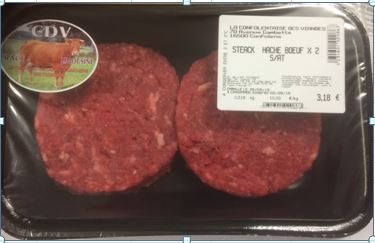
  • Product brand name CDV Confolentaise of Meats
  • Model names or references Chopped Steak S/AT x2 10%MG Chopped Steak S/AT x16 10%MG Chopped Steak S/Vide x5 10%MG
  • Identification of products
    Batch Date
    H221219 Use-by date 28/12/2022
  • Packaging x2 /X16/X5
  • Marketing start/end date From 22/12/2022 to 28/12/2022
  • Storage temperature Product to be stored in the refrigerator
  • Geographic area of ​​sale Whole France
  • DistributorsLeclerc Rocadis Flavors of Antoine Limoges NosEpiceries NetN Small basket of brillac Dominique Isabelle Pressac

Practical information regarding the recall

  • Reason for recall Presence of Salmonella
  • Risks incurred by the consumer Salmonella spp (causative agent of salmonellosis)

Spain – New regulations on food safety applied to retail trade

ACSA

Published in the BOE Royal Decree 1021/2022, of December 13, which regulates certain hygiene requirements for the production and marketing of food products in retail establishments.

This royal decree establishes measures for the correct application throughout the State of the EU regulations on food safety, with the aim that its implementation is homogeneous throughout the territory and also makes use of flexibility provisions to favor the sustainability of the food system.

The new text compiles in a single regulation the requirements for meat and derivatives, for fishery products, raw milk, foods made with eggs, prepared meals, thus repealing the specific regulations for these food groups and that were prior to the hygiene pack.

In addition, it incorporates in its articles the regulation of the preparation of meals in private homes, the requirements in the tasting areas, vending machines, the access of pets to these establishments and establishes measures against food waste and the use of reusable containers. .

The bill regulates, among others, hygiene requirements such as temperature and establishes guidelines for freezing, thawing and refreezing operations and specific requirements for prepared meals.

In the case of large pieces of fruit, such as watermelon, melon, pineapple, cut into halves or quarters, it will be allowed to keep them for a while at room temperature.

Table 1. Temperature requirements of food products

Food refrigeration temperature

1. Meat of domesticated ungulates and of wild or farmed large game, except rats.

Equal to or less than 7 °C.
2. Carcasses of domestic ungulates, farmed and wild game, poultry and lagomorphs. Equal to or less than 3 °C.
3. Meat of poultry, lagomorphs, small wild game and rats. Equal to or less than 4 °C.
4. Meat preparations. Equal to or less than 4 °C.
5. Minced meat. Equal to or less than 2 °C.
6. Live bivalve molluscs and fishery products that are kept alive. Temperature that does not negatively affect its safety and viability.
7. Fresh fishery products, unprocessed thawed fishery products, cooked and refrigerated crustaceans and molluscs. Temperature close to that of melting ice (0-4 °C).
8. Raw milk. 1-4°C
9. Filled pastry products (unless stable at room temperature). Equal to or less than 4 °C.
10. Cut or peeled fruits, cut or peeled vegetables and unpasteurized juices ready for consumption and made in the retail trade. Equal to or less than 4 °C.
11. Frozen or deep-frozen foods. Equal to or less than –18 °C.