
Category Archives: Food Poisoning

Viet Nam – Bacterium Staphylococcus causes 42 percent of food poisoning

SGGP News

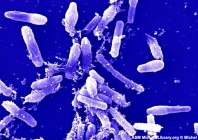
Staph


According to the Department of Food Safety in Ho Chi Minh City’s statistics, the bacterium Staphylococcus aureus (Staph) has caused 14 food poisoning cases accounting for 42 percent from 2010 to November, 2018.

The statistics showed that there has been 54 cases of food poisoning cases in the time.
Of these cases, 33 cases of food poisoning are caused by the organisms making up 61 percent, 14 cases are caused by toxic substances, two cases by chemicals accounting for 4 percent and two cases unverified equal to 4 percent.
People and animals have Staph on their skin and in their nose. Staph food poisoning is characterized by a sudden start of nausea, vomiting, and stomach cramps. Most people also have diarrhea. Symptoms usually develop within 30 minutes to 8 hours after eating or drinking an item containing Staph toxin,
To prevent food poisoning by the bacterium Staphylococcus aureus, the Department of Food Safety warned people with rhinitis or spots touch food materials.
Moreover, people should eat well-done food and drink boiled water; peel fruits before having and wash hand before and after toilets.
Research – Genetic Diversity of Salmonella and Listeria Isolates from Food Facilities

Journal of Food Protection

Food production–related facilities (farms, packing houses, etc.) are monitored for foodborne pathogens, and data from these facilities can provide a rich source of information about the population structure and genetic diversity of Salmonella and Listeria. This information is of both academic interest for understanding the evolutionary forces acting on these organisms and of practical interest to those responsible for controlling pathogens in facilities and to those analyzing data from facilities in the context of public health decision making. We have collected information about all positive isolates from facility inspections performed by the U.S. Food and Drug Administration for which whole genome sequencing data are available. The within- and between-facilities observed genetic diversity of isolates was computed and related to the common origin of isolates (as the common collected facility). This relationship provides quantification for assessing the relationship between isolates based on their genetic similarity quantified by single-nucleotide polymorphisms (SNPs). Our results show that if the genetic distance (D) between two isolates is low, then more likely than not they are from the same facility or have some overlap in their supply chain. For example, if the genetic distance is no more than 20 SNPs, the probability (P) that two isolates come from the same facility = 0.66 for Salmonella and 0.70 for Listeria. However, if two isolates come from different facilities, their genetic distance is likely large (for Salmonella, P(D > 20 SNPs) = 0.99982; for Listeria, P(D > 20 SNPs) = 0.99949); even if two isolates come from the same facility, their genetic distance is also very likely large (for Salmonella, P(D > 20 SNPs) = 0.794; for Listeria, P(D > 20 SNPs) = 0.692). These results provide insight into what SNP thresholds might be appropriate when determining whether two isolates are from the same facility and thus would be of interest to those investigating foodborne outbreaks and conducting traceback investigations.

Research – Analysis of Bacillus cereus cell viability, sublethal injury, and death induced by mild thermal treatment

Wiley Online Library bacillus

Abstract

As the most cost‐effective tool to ensure microbial safety, thermal processing induces a large portion of sublethal injury presenting a potential hazard to food safety. Thermal treatment at 63 °C for 1 min injured 2.22 log cfu/ml totally, half of which were sublethally injured using plate counting method. After 2 min, the inactivation log of Bacillus cereus reached 1.55 while the sublethally injured log even reached 2.16. As for the sublethally injured rate of the B. cereus, it was over 65% after 0.5 min and kept ever‐increase with time. In the end, the injured rate arrived at 99.30% after 2 min processing time. Partial esterase enzyme inactivation was found after 0.5 min heat treatment with flow cytometry combining carboxyfluorescein diacetate/propidium iodide (PI) double‐staining, but B. cereus was not dyed by PI at 63 °C. Comparing with the initial protein concentration of 0.57 ± 0.02 μg/ml, the leakage of the protein was not so notable though the general trend was increasing with duration of heat. Scanning and transmission electron microscopy analysis revealed that a portion of cells morphology and structure had changed after thermal process.

Practical applications

Bacillus cereus is an endospore forming pathogenic, causing foodborne illnesses and outbreaks all over the world. This research indicated that thermal treatment at 63 °C was a sublethal stress for B. cereus that a portion of cells were sublethally injured which could resume growth in suitable condition and might exist potential safety hazard if used for food pasteurization.

Research – Survival of Escherichia coli O157:H7 and Salmonella on Bruised and Unbruised Tomatoes from Three Ripeness Stages at Two Temperatures

Journal of Food Protection


Tomatoes are one of the major fresh produce commodities consumed in the United States. Harvesting tomato fruit at a later stage of development can enhance consumer acceptance but can also increase damage due to bruising. Bruising can affect the quality of whole tomatoes by causing an unacceptable appearance and accelerating decay. Bruising may also facilitate bacterial attachment to the fruit surface and support growth of pathogens. This study evaluated the survival and/or proliferation of Escherichia coli O157:H7 and Salmonella on the surface of artificially bruised and unbruised tomatoes at three ripeness stages (breaker, pink, and red) and two storage temperatures (10 and 20°C). A total of 1,440 tomatoes, 720 for each organism, were analyzed. Both E. coli O157:H7 and Salmonella counts declined significantly (P < 0.05) on the bruised and unbruised tomatoes over the 7-day storage period, by approximately 2.5 and 2.0 log, respectively. E. coli O157:H7 was not detected on pink tomatoes on day 7, whereas Salmonella persisted on the tomato surfaces throughout the 7-day study at all ripeness stages. Bruising had no significant effect (P > 0.05) on the survival of E. coli O157:H7 (CFU per tomato) compared with the unbruised tomatoes, in most cases. Tomatoes from the red ripeness stage showed a significant effect (P < 0.05) of bruising on Salmonella survival at both 10 and 20°C. Similar to the colony count results, the frequency (presence or absence) of inoculated tomatoes with detectable levels of inoculated bacteria decreased significantly (P < 0.05) over time. At the lower temperature, E. coli O157:H7 was recovered from significantly higher (P < 0.05) numbers of breaker and pink tomatoes, whereas there was no effect of temperature on the overall survival of E. coli O157:H7 on red tomatoes. Results from this study are essential for understanding the effects of bruising on produce safety and for producers and packers to develop mitigation strategies to control pathogenic and spoilage organisms.

RASFF Alerts – STEC E.coli -Chilled Boneless Beef – Farmstead Cheese

RASFF-Logo

RASFF-shigatoxin-producing Escherichia coli (in 1 out of 5 samples /25g) in chilled boneless beef from Argentina in Germany

RASFF-shigatoxin-producing Escherichia coli (presence /25g) in farmstead cheese from France in Germany

RASFF Alerts – Aflatoxin – Raw Red Rice – Hazlenut Kernels – Groundnut Kernels – Dried Figs

RASFF-Logo

RASFF-aflatoxins (B1 = 6.1 µg/kg – ppb) in raw red rice from India, via Germany in Siwtzerland

RASFF-aflatoxins (B1 = 20; Tot. = 21 µg/kg – ppb) in hazelnut kernels from Azerbaijan in Germany

RASFF-aflatoxins (B1 = 5 µg/kg – ppb) in groundnut kernels from Argentina in the Netherlands

RASFF-aflatoxins (B1 = 5.3 µg/kg – ppb) in groundnut kernels from China in the UK

RASFF-aflatoxins (B1 = 8.7; Tot. = 15 µg/kg – ppb) in groundnut kernels from Argentina in the Netherlands

RASFF-aflatoxins (B1 = 42.21; Tot. = 62.66 µg/kg – ppb) in dried figs from Turkey in Germany

RASFF Alert- Ochratoxin A – Raisins – Sultanas

RASFF-Logo

RASFF-ochratoxin A (>15 µg/kg – ppb) in raisins (sultanas) from Turkey in Spain

Canada – Food Recall Warning – Achva and S&F brand tahini products recalled due to Salmonella

CFIA kswfoodworld Salmonella

Recall details

Ottawa, November 28, 2018 – Industry is recalling Achva and S&F brand tahini products from the marketplace due to possible Salmonella contamination. Consumers should not consume the recalled products described below.

The following products have been sold in Alberta, British Columbia, Manitoba, New Brunswick, Nova Scotia, Ontario and Quebec and maybe have been distributed in other provinces.

Recalled products

Brand Name Common Name Size Code(s) on Product UPC
Achva Whole Sesame Tahini 500 g LOT 18-099 7 290000 572796
Achva Organic Tahini 500 g LOT 18-099 7 290000 572086
Achva Tahini 500 g LOT 18-106 8 14968 02002 0
Achva Whole Tahini 500 g LOT 18-106 8 14968 02003 7
Achva Seasoned Tahini 500 g LOT 18-128 7 290000 572123
Achva Tahini – Crushed Sesame Seeds 500 g LOT 18-130 7 290000 572109
Achva Tahini 18 kg LOT 18-106 7 290000 572116
S&F Pure Tahini 18 kg Lot. 18-099 7 290000 572116

Vietnam – Food safety still a problem in school canteens

Vietnamnet

VietNamNet Bridge – Several food poisoning cases reported at public canteens, including a number in schools, across the country in recent months have raised concerns among parents and the public about food safety.

In the latest incident, hundreds of students at Xuan Non Kindergarten in Dong Anh District suffered food poisoning after attending a party at their school on November 14.

Days later, nearly 200 students were taken to local medical facilities for emergency treatment after experiencing stomach aches, headaches, vomiting and high fevers.

One of 13 food samples tested positive for Salmonella type 2 – a bacteria that causes intestinal infection, fever, abdominal pain and diarrhoea.

In October, more than 300 students from Dinh Tien Hoang Primary School in Ninh Binh Province also suffered food poisoning.

Health authorities confirmed that bacteria was to blame for the mass poisoning that affected hundreds of children at the schools after they ate chicken floss.

The samples taken from the food and victims’ vomit tested positive for microbes and bacteria, according to Dr Cao Van Trung, deputy director of the Food Poisoning Supervision Office at the Food Safety Department.

Results of the investigation showed the samples contained Staphylococcus aureus, also known as golden staph, or a type of bacteria frequently found in the nose, along the respiratory tract, and on the skin in humans. It is a common cause of skin infections including abscesses, respiratory infections, and food poisoning.

Nigeria -Three Kebbi schoolgirls die after eating food allegedly prepared by parent

Punch NG

Three schoolgirls at Government Girls Comprehensive Secondary School, Mega, Kebbi State, have reportedly died of suspected food poisoning.

The children reportedly died after eating a meal called Rama, allegedly prepared by a parent of one of the victims.

The school’s principal, Hajiya Lami Abubakar, disclosed that the food was not a school meal, but it was prepared from home by a parent of one of the girls.