Category Archives: Food Micro Blog

USA – Outbreak Investigation of Listeria monocytogenes: Dole Packaged Salad (December 2021)

FDA

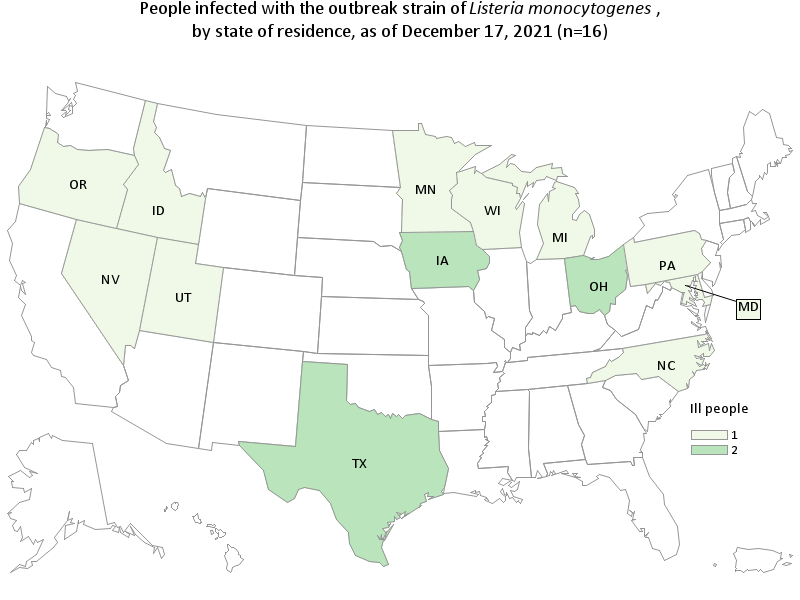
The FDA, along with CDC and state and local partners, is investigating a multistate outbreak of Listeria monocytogenes infections potentially linked to Dole packaged leafy greens. According to the CDC, as of December 22, 2021, 16 people infected with the outbreak strain of Listeria monocytogenes have been reported from 13 states. Illnesses started on dates ranging from August 16, 2014 to October 17, 2021 (one case occurred in 2014 and the remaining cases occurred between 2018 and 2021).

CDC investigated this outbreak in 2019 and 2020 but was unable to gather enough data to identify the source in the past. CDC reopened the investigation in November 2021 when four new illnesses were reported since the end of August.

In October 2021, as a part of routine retail sampling, the Georgia Department of Agriculture collected a product sample of prepackaged salad mix from a grocery store for testing. The sample tested positive for Listeria monocytogenes. In response to the sample results, Dole initiated a recall of packaged garden salads in October 2021. These products are now past their “Best if Used By” dates. The positive sample was later sent for whole genome sequencing (WGS) analysis; and in December 2021, WGS analysis was completed. The results show that the Listeria monocytogenes in the product sample was a match to the outbreak strain. FDA is conducting an inspection at the facility that produced the product that tested positive for Listeria monocytogenes.

The Michigan Department of Agriculture and Rural Development also recently initiated retail sampling of Dole products in their state as part of this investigation. One product containing lettuce from the Dole facility in Yuma, AZ, tested positive for Listeria monocytogenes. WGS analysis showed that the Listeria monocytogenes in the product sample is also a match to the outbreak strain.

In response to the sample analyses and the ongoing outbreak investigation, Dole has agreed to voluntarily suspend operations at both the Bessemer City, NC, facility and Yuma, AZ, facility and has voluntarily recalled all products and brands from those facilities. Those products have production lot codes beginning with either the letter “N” or “Y” in the upper right-hand corner of the package and Best if Used By dates from November 30, 2021 to January 8, 2022.

This recall does not include whole head packaged lettuce. A full list of recalled products is available on FDA’s website.

This investigation is ongoing, and additional information will be provided as it becomes available.

Recommendation

Consumers, restaurants, and retailers, should not eat, sell, or serve recalled Dole packaged salads. A full list of recalled products is available on FDA’s website.

FDA recommends that anyone who received recalled products use extra vigilance in cleaning and sanitizing any surfaces and containers that may have come in contact with these products to reduce the risk of cross-contamination. Listeria can survive at refrigeration temperatures and can easily spread to other foods and surfaces.

Recall Information

In response to the sample analyses and the ongoing outbreak investigation, Dole has agreed to voluntarily suspend operations at both the Bessemer City, NC, facility and Yuma, AZ, facility and has voluntarily recalled all products and brands from those facilities. Those products have production lot codes beginning with either the letter “N” or “Y” in the upper right-hand corner of the package and Best if Used By dates from November 30, 2021 to January 8, 2022.

This recall does not include whole head packaged lettuce.

The following images are of example labels from recalled products highlighting where to find product codes. View a full list of recalled products. 
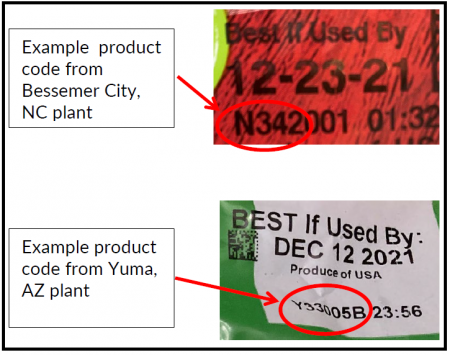
Outbreak Investigation of Listeria monocytogenes from Dole Packaged Salad - Sample Product Codes (December 22, 2021)

Map of U.S. Distribution of Recalled Packaged Salad
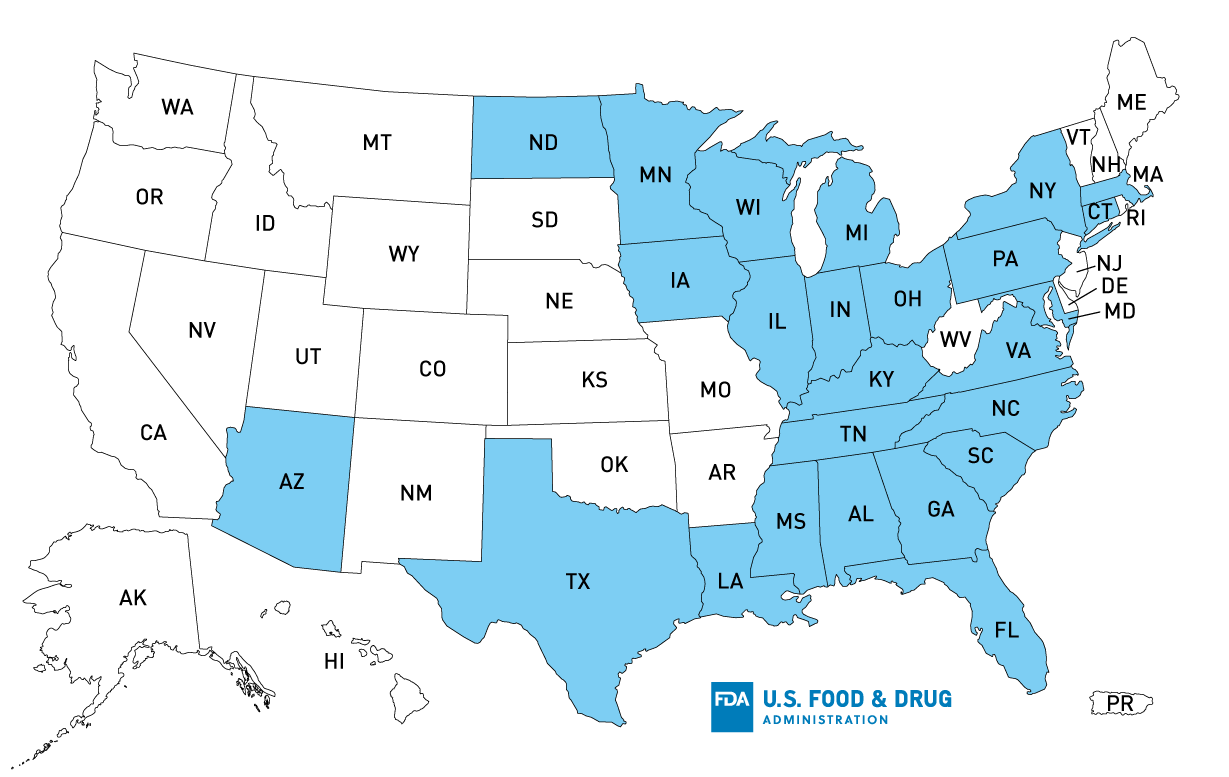
Outbreak Investigation of Listeria monocytogenes from Dole Packaged Salad - Map of U.S. Distribution of Recalled Packaged Salas (December 22, 2021)

Case Count Map Provided by CDC

Outbreak Investigation of Listeria monocytogenes from Dole Packaged Salad - CDC Case Count Map (December 22, 2021)

Case Counts

Total Illnesses: 16
Hospitalizations: 12
Deaths: 2
Last Illness Onset: October 17, 2021
States with Cases: IA, ID, MD, MI, MN, NC, NV, OH, OR, PA, TX, UT, WI
Product Distribution*: AL, AZ, CT, FL, GA, IA, IL, IN, KY, LA, MA, MD, MI, MN, MS, NC, ND, NY, OH, PA, SC, TN, TX, VA, WI

*Distribution has been confirmed for states listed, but product could have been distributed further, reaching additional states

USA – Giant Eagle voluntarily recalls salad products for possible Listeria monocytogenes contamination

Cleveland 19

CLEVELAND, Ohio (WOIO) – If you bought a salad item from Giant Eagle or Market District in Ohio, Indiana, Pennsylvania, Maryland, or West Virginia between Dec. 12-20, check your refrigerator.

Giant Eagle recalled numerous salad items on Dec. 21 related to a nationwide Fresh Express recall due to a possible Listeria contamination.

The recall covers a variety of packaged salad items under the Fresh Express, Giant Eagle, and Market District brands in addition to select items sold in the company’s prepared foods departments.

Giant Eagle’s recall is associated with the nationwide recall by Fresh Express, which is a leading manufacturer of ready-to-eat greens, salads, spinach, and vegetables.

France – Carré de neufchâtel AOP – Cheese – Listeria monocytogenes

Gov france

Identifying information for the recalled product

  • Product category Food
  • Product sub-category Milk and dairy products
  • Product brand name Etienne Thillard
  • Names of models or references Carré neufchâtel PDO origin France Carré neufchâtel x2 origin Normandy
  • Product identification
    GTIN Lot Dated
    02045540 325 Use-by date 12/30/2021
    02040680 325 Use-by date 12/30/2021
    02040680 325 Use-by date 03/01/2022
  • Packaging Sold individually in the traditional department. Sold wrapped in pairs in plastic film in the self-service department.
  • Start date / End of marketing From 12/01/2021 to 12/16/2021
  • Storage temperature Product to be stored in the refrigerator
  • Health markFR76459005CE
  • Further information Farmhouse cheese made from whole raw milk
  • Geographical sales area Neuchâtel-en-Bray (76270)
  • Distributors Center E.Leclerc Neuchâtel-en-Bray

Practical information regarding the recall

  • Reason for recall Presence of Listeria monocytogenes
  • Risks incurred by the consumer Listeria monocytogenes (causative agent of listeriosis)

Canada – Certain Fresh Express brand salad products recalled due to Listeria monocytogenes – updated 22/12/2021

CFIA

Summary

Product
Salad products
Issue
Food » Microbial Contamination » Listeria
What to do

Do not consume the recalled products

Issue

The food recall warning issued on December 21, 2021 has been has been amended to correctly identify the package size for one of the affected products. The correction for this product is marked by an asterisk (*).

Fresh Express - Chopped Kit Sunflower Crisp

Fresh Express Incorporated is recalling certain Fresh Express brand salad products from the marketplace due to possible Listeria monocytogenes contamination.

The recalled products have been sold in Manitoba and Ontario and may have been distributed in other provinces and territories.

Product codes are located on the front of the packages below the Use-By Date

France – Parsley Head Pâté – Listeria monocytogenes

Gov france

Identifying information for the recalled product

  • Product category Food
  • Product sub-category Others
  • Product brand name Ollivier country charcuterie
  • Names of models or references Ploumillau head pie
  • Product identification
    GTIN Dated
    0209787000000 Use-by date 12/15/2021
  • Start date / End of marketing From 12/01/2021 to 12/11/2021
  • Storage temperature Product to be stored in the refrigerator
  • Further information PRODUCT SOLD ON THE TRADITIONAL CHARCUTERIE STAND
  • Geographical sales area LECLERC PAIMPOL
  • Distributors SAS PAIMPOLDIS

Practical information regarding the recall

  • Reason for recall PRESENCE OF LISTERIA
  • Risks incurred by the consumer Listeria monocytogenes (causative agent of listeriosis)

Ireland – Recall of a Batch of The Little Milk Co. Organic Irish Cheddar due to Elevated Levels of Histamine

FSAI

Little Milk Co 1

Little Milk Co 2

Summary
Category 2: For Information
Alert Notification: 2021.110
Product: The Little Milk Co. Organic Irish Cheddar; pack size: 135g; approval number: 1987 EC
Batch Code: K98; best before date: 18.05.22
Country Of Origin: Ireland

Message:

The Little Milk Co. is recalling the above batch of its Organic Irish Cheddar due to elevated levels of histamine. In some people, elevated levels of histamine can cause symptoms which are similar to those of an allergic reaction. Point-of-sale recall notices will be displayed in stores supplied with the implicated batch.

USA – FDA Warning Letters – The Famous Lartigue Seafood

FDA

The United States Food and Drug Administration (FDA) inspected your seafood processing facility located at 100 Plantation Pointe, Fairhope, AL 36532 on October 19, 20 and 25, 2021. Our inspection found you have serious violations of the Seafood Hazard Regulations, Part 123 (21 CFR Part 123(g), failure of a seafood processor to have and implement a HACCP plan that complies with this section or otherwise operate in accordance with requirements of Part 123, renders the fish or fishery products adulterated within the meaning of section 402(a)(4) of the Federal Food, Drug, and Cosmetic Act (the Act), 21 U.S.C. § 342 (a)(4). Accordingly, your seafood products are adulterated because they have been prepared, packed, or held under insanitary conditions whereby they may have been rendered injurious to health. You may find the Act, the seafood HACCP regulation and the 4th Edition of the Fish and Fishery Products Hazards and Controls Guidance (the Hazards Guide) through links on FDA’s home page at www.fda.gov.External Link Disclaimer

FDA’s inspection resulted in the issuance of a FORM FDA 483, Inspectional Observations, listing deviations found during our inspection. We received your response, via email on October 25, 2021. After reviewing the inspectional findings and your response to the observations listed in the FORM FDA483, we are issuing this letter to advise you of FDA’s concerns and provide detailed information describing the findings at your facility.

Your significant violations were as follows:

1. You must conduct or have conducted for you a hazard analysis for each kind of fish and fishery product that you produce to determine whether there are food safety hazards that are reasonably likely to occur, and you must have and implement a written HACCP plan to control any food safety hazards that are reasonably likely to occur, to comply with 21 CFR 123.6(a), and (b). However, you do not have a HACCP Plan for fresh sushi-grade salmon to control the parasite and environmental hazards.

In your response sent on October 25, 2021 you state a HACCP plan will be devised once you complete a seafood HACCP certification course. However, you did not provide documentation of enrollment into a seafood HACCP course. Additionally, no timeline was provided for completion of your HACCP plan.

2. You must maintain sanitation control records that, at a minimum, document monitoring and corrections set out in 21 CFR 123.11(b), to comply with 21 CFR 123.11(c). Specifically, you do not have sanitation control records that document the monitoring of the following key areas of sanitation:

a. Condition and cleanliness of food contact surfaces, such as tables and utensils.
b. Prevention of cross-contamination from insanitary objects.
c. Maintenance of hand washing, hand sanitizing, and toilet facilities.
d. Protection of food, food packaging material, and food contact surfaces from adulteration.
e. Proper labeling, storage and use of toxic compounds.
f. Control of employee health conditions.

In your response sent on October 25, 2021 you state that you monitor sanitation controls utilizing daily and monthly logs. However, no supporting documentation was provided.

3. To comply with 21 CFR 123.10, you must have an individual who has successfully completed training in the application of HACCP principles to fish and fishery product processing that is at least equivalent to that received under a standardized curriculum recognized as adequate by the U.S. Food and Drug Administration or who may otherwise be qualified through job experience to perform the following functions: (1) the development of the HACCP plan, as required by 21 CFR 123.6(b); (2) the reassessment and modification of the HACCP plan in accordance with the corrective action procedures specified in 21 CFR 123.7(c)(5); (3) the reassessment and modification of the HACCP plan in accordance with the verification activities specified in 21 CFR 123.8(a)(1);(4) the reassessment and modification of the hazard analysis in accordance with the verification activities specified in 21 CFR 123.8(c); and (5) perform the record review required by 21 CFR 123.8(a)(3).

In your response sent on October 25, 2021 you state that you will be attending an online seafood HACCP certification course; however, no documentation of enrollment into the course was provided.

You should respond in writing within fifteen (15) working days from your receipt of this letter. Your response should outline the specific actions you are taking to correct these violations. Your response should include documentation reflecting the corrections you made, such as a copy of your HACCP plan. You should also provide five (5) consecutive days of completed monitoring records to demonstrate implementation of your HACCP plan.

USA – Nationwide Onion Outbreak will likely be over 1,000 by Christmas -Salmonella

Food Poison Journal

As of November 12, 2021, 892 people infected with the outbreak strain of Salmonella Oranienburg have been reported from 38 states and Puerto Rico. Illnesses started on dates ranging from May 31, 2021, to October 25, 2021.

Sick people range in age from less than 1 year to 101 years, with a median age of 37, and 58% are female. Of 571 people with information available, 183 (32%) have been hospitalized.

According to other publicly available data, we expect to see the number of sickened in this outbreak to crest 1,000.

USA – Haifa Smoked Fish Inc Recalls Turbot Cold Smoked 8 oz Package Lot # 246 Because of Possible Health Risk – Listeria monocytogenes

FDA

Image - TURBOT COLD SMOKED, HAIFA SMOKED FISH & CAVIAR

Summary

Company Announcement Date:
FDA Publish Date:
Product Type:
Food & Beverages
Reason for Announcement:
Potential for Listeria monocytogenes
Company Name:
HAIFA SMOKED FISH
Brand Name:
HAIFA SMOKED FISH
Product Description:
TURBOT COLD SMOKED

Company Announcement

HAIFA SMOKED FISH of Jamaica, NY is recalling approximately 230 LB OF TURBOT COLD SMOKED 8 OZ PACKAGES LOT # 246, because it has the potential to be contaminated with Listeria monocytogenes, an organism which can cause serious and sometimes fatal infections in young children, frail or elderly people, and others with weakened immune systems. Although healthy individuals may suffer only short-term symptoms such as high fever, severe headache, stiffness, nausea, abdominal pain and diarrhea, Listeria infection can cause miscarriages and stillbirths among pregnant women.

TURBOT COLD SMOKED 8 OZ Lot # 246 was distributed to retail stores in New York and New Jersey Areas.

The product is packaged in clear plastic with a gold board that contains sliced Turbot fish with a blue label that reads “Haifa Smoked Fish & Caviar Turbot Cold Smoked” Net wt. 8 oz/227g. Ingredients: Turbot, Salt and Natural wood smoke. On the back of the board, it will display a sticker that reads “LOT # 246.”

No illnesses have been reported up to date.

The recall was the result of a routine sampling program by New York State Department of Agriculture which revealed that the finished product Turbot Cold Smoked 8 oz Package Lot # 246 contained Listeria monocytogenes. Haifa Smoked Fish ceased distribution of the TURBOT COLD SMOKED 8 OZ Lot # 246 and Haifa Smoked Fish to continue their investigation as to what caused the problem.

Consumers who have purchased Turbot Cold Smoked 8 oz Package LOT # 246 are urged to return it to the place of purchase for a full refund.

Consumers with question may contact the company at 718 523-8899,

Our hours of operation are Monday thru Friday 9am to 5pm Eastern Standard Time.

Dmitriy Yakubbayev


Company Contact Information

Consumers:
HAIFA SMOKED FISH
 718-523-8899

Research – What you need to know during a Listeria Outbreak –

Food Poison Journal

There is a video to watch in the link above.

Ingested by mouth, Listeria is among the most virulent foodborne pathogens, with up to 20% of clinical infections resulting in death. These bacteria primarily cause severe illness and death in persons with immature or compromised immune systems.

Except for the transmission of mother to fetus, human-to-human transmission of Listeria is not known to occur. Infection is caused almost exclusively by the ingestion of the bacteria, most often through the consumption of contaminated food.

Adults can get listeriosis by eating food contaminated with Listeria, but babies can be born with listeriosis if their mothers eat contaminated food during pregnancy. The mode of transmission of Listeria to the fetus is either transplacental via the maternal blood stream or ascending from a colonized genital tract. Infections during pregnancy can cause premature delivery, miscarriage, stillbirth, or serious health problems for the newborn.

Listeria is a common presence in nature, found widely in such places as water, soil, infected animals, human and animal feces, raw and treated sewage, leafy vegetables, effluent from poultry and meat processing facilities, decaying corn and soybeans, improperly fermented silage, and raw (unpasteurized) milk.

Foods commonly identified as sources of Listeria infection include improperly pasteurized fluid milk, cheeses (particularly soft-ripened varieties, such as traditional Mexican cheeses, Camembert and ricotta), ice cream, raw vegetables, fermented raw-meat sausages, raw and cooked poultry, and cooked, ready-to-eat (RTE) sliced meats—often referred to as “deli meats,) smoked finfish, smoked shellfish and packaged fruits and vegetables.