Category Archives: Food Illness

USA- FDA – Core Investigation Table

FDA

What’s New

  • For the outbreak of Salmonella Enteritidis (ref #1250) linked to recalled eggs sourced from Milo’s Poultry Farms, LLC, an outbreak advisory was issued. Refer to the advisory for additional information. FDA has initiated traceback.
  • For the outbreak of E. coli O157:H7 (ref #1249) linked to a not yet identified product, the case count has increased from 26 to 27.
  • For the outbreak of Listeria monocytogenes (ref #1247) linked to a not yet identified product, the case count has increased from 3 to 4.
  • For the outbreak of Cyclospora cayetanensis illnesses (ref #1245) linked to a not yet identified product, the case count has increased from 50 to 54.
  • For the outbreak of Cyclospora cayetanensis illnesses (ref #1237) linked to a not yet identified product, FDA has initiated inspections.
  • For the outbreak of Salmonella Typhimurium (ref #1234) linked to a not yet identified product, the case count has increased from 89 to 90. 

France – Pesto linked to five botulism cases in France

Food Safety News

Several people are suspected to have developed botulism after eating pesto in France.

The Centre-Val-de-Loire Regional Health Agency received reports of five probable cases of botulism following a family meal.

Sick people ate wild garlic pesto from the “O Ptits Oignons” brand. The five cases are currently hospitalized in an intensive care unit.

USA -Shigella Outbreak hits Elk’s Lodge in Humboldt

Food Poison Journal

Humboldt County Department of Health & Human Services Public and Environmental Health officials are advising community residents who attended a dinner at the Elks Lodge in Eureka on Wednesday, Aug. 28, that they may have been exposed to Shigella. Attendees experiencing gastrointestinal (GI) issues should contact their primary care provider, as well as take steps not to spread the highly contagious infection.

Instances of Shigella infection are on the rise in the county after at least six individuals have tested positive for the illness since August.

The first cluster of three cases was identified in late-August. The individuals all appear to have been infected sometime in mid-August and a connection between the individuals could not be confirmed. Based on this information, Public Health sent out a Provider Alert to monitor for potential cases in case there was ongoing spread in the community.

Humboldt County Health Officer Dr. Candy Stockton said within the last 24 hours, staff was notified about three new confirmed cases and five suspected cases associated with the Aug. 28 event.

USA – FDA – Outbreak Investigation of Salmonella: Eggs (Sept 2024)

fda

Do not eat, sell, or serve recalled chicken eggs from Milo’s Poultry Farms and Tony’s Fresh Market. FDA’s investigation is ongoing.

Product

All types (conventional cage-free, organic, and non-GMO chicken eggs) and sizes (M, L, XL, Jumbo) of recalled chicken eggs supplied by Milo’s Poultry Farms, LLC in Bonduel, WI.

This recall covers all expiration dates for the following eggs:

  • All carton sizes and all egg types labeled with “Milo’s Poultry Farms”.
  • All carton sizes of “Tony’s Fresh Market” branded eggs.

Symptoms of Salmonella Infection:

Illness usually occurs within 12 to 72 hours after eating food that is contaminated with Salmonella, and the symptoms usually lasts four to seven days. Symptoms include diarrhea, fever, and abdominal cramps. Children younger than five, the elderly, and people with weakened immune systems are more likely to have severe infections.

Stores Affected

Recalled eggs were distributed to food service locations and retailers located in Wisconsin, Illinois, and Michigan. The firm has directly notified foodservice customers who received recalled product.

FDA will update this advisory as more information becomes available.

Status

Ongoing

Recommendation

  • Consumers, restaurants, and retailers should not eat, sell, or serve recalled chicken eggs produced by Milo’s Poultry Farms, LLC and distributed to restaurants and retailers in IL, WI, and MI.
  • Consumers, restaurants, and retailers who purchased or received recalled chicken eggs, including wholesale eggs, should carefully clean and sanitize any surfaces or containers that they touched.
  • Check your refrigerators for any recalled chicken eggs and throw them away. If you stored the eggs without the original packaging and can’t tell if it is part of the recall, throw them away.
  • Wash hands, utensils, and surfaces with hot, soapy water before and after handling raw eggs and raw egg-containing foods. Follow FDA’s safe handling and cleaning advice and use extra care in cleaning and sanitizing any surfaces and containers that may have come in contact with this product to reduce the risk of cross-contamination.
  • Contact your healthcare provider if you think you may have developed symptoms of a Salmonella infection, after eating eggs.

CDC – Keep Food Safe After a Disaster or Emergency

CDC

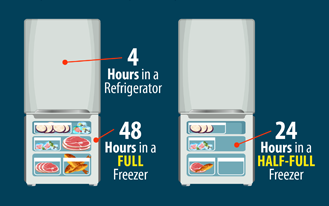
image of refrigerator and freezer with text saying "4 hours in a refrigerator" and text by freezer saying "48 hours in a full freezer and 24 hours in a half-full freezer."

Foods may be unsafe to eat after a disaster or emergency. To prevent foodborne illness, prepare for emergencies and take key steps during and after power outages, floods, and other emergencies.

Research – New Zealand Food Safety on track to meet Campylobacteriosis-reduction target

MPI

New Zealand Food Safety is approaching its target to reduce rates of campylobacteriosis, the country’s most common foodborne illness, a new report published today has found.

Annual report concerning Foodborne Diseases in New Zealand 2023 [PDF, 5 MB]

The report, prepared for New Zealand Food Safety by the Institute for Environmental and Scientific Research (ESR), found that the rate of New Zealand-acquired foodborne illness caused by the bacteria Campylobacter has fallen from 88 to 77 cases per 100,000 population over the past 4 years.

“New Zealand Food Safety has made reducing campylobacteriosis rates a key priority, and we’ve made great strides in recent years,” says New Zealand Food Safety deputy director-general Vincent Arbuckle.

“Rates of infection more than halved between 2006 and 2020. In 2020 we set a target to reduce the rate by a further 20%, taking it to 70 cases per 100,000 by the end of 2024.

“These latest results show this goal is in sight, which is a testament to the combined and sustained work of government and industry over time.

“The Campylobacter Action Plan, put in place to help tackle the issue, mainly focuses on steps to reduce the levels of Campylobacter through the poultry food chain. We have worked with government, industry and NGOs right across the poultry food chain through the Campylobacter governance group with representatives from Ministry of Health, Poultry Industry Association of New Zealand, Foodstuffs North Island, Foodstuffs South Island, Woolworths NZ, and Consumer NZ.”

Campylobacter Action Plan

The poultry industry has continued to improve processing practices over time, resulting in a sustained reduction in the proportion of birds that have detectable levels of Campylobacter at the end of primary processing.

While changes in the food supply chain have achieved good results, consumer awareness remains an important part of the effort, Mr Arbuckle says.

“We know that about half of all foodborne illness is caused at home. These illnesses can be prevented with good food preparation techniques as well as proper cooking and storage.

“To support prevention of Campylobacter at home we run public education campaigns which focus on giving people information they can use to keep themselves safe.

“While it is rewarding to see campylobacteriosis rates falling, there is more work to do. The symptoms of campylobacteriosis can be unpleasant for healthy adults and the consequences for the very young and people over 65 can be serious.”

The report also provides data on other foodborne illnesses in New Zealand, including listeriosis, which remains steady with 37 cases notified this year, Mr Arbuckle said.

Listeria is common in the environment and while case of illness are low, listeriosis can have tragic consequences, including death. Of the notified cases, 26 people were in the 60-plus age group, and 7 people died with listeriosis this year.

“There are a range of practical measures people can take at home to reduce their risk from Listeria. More information is available on our website.

Listeria infection: symptoms and advice

New Zealand Food Safety ran a Listeria education campaign in June targeting pregnant people and those aged over 60.

By the numbers:

  • 76.8 campylobacteriosis cases per 100,000 population, with 4,010 cases domestically acquired
  • 989 hospitalised with campylobacteriosis, with 325 in the over-70 age group – the highest number of hospitalisations across all age groups
  • 37 cases of listeriosiswith 7 deaths. 26 of these cases occurred in people aged over 60.

Media release: Simple steps to avoid life-threatening listeriosis

Campylobacter infection: symptoms and advice

For further information and general enquiries, call MPI on 0800 00 83 33 or email info@mpi.govt.nz

For media enquiries, contact the media team on 029 894 0328.

USA – New STEC E. coli outbreak under investigation

FSA

The FDA is investigating a new outbreak of E. coli O157:H7 infections that has sickened 25 people.

The Food and Drug Administration has not reported where the patients live or how old they are. The agency has begun traceback efforts, but is not yet reporting what food or foods are being traced.

E. coli is particularly dangerous and often results in the hospitalization of patients. Some patients develop a type of kidney failure and others develop brain injuries. Death is more likely in patients infected with E. coli O157:H7 than other types of E. coli.

Hong Kong – CHP investigates two food poisoning clusters

Gov HK

The Centre for Health Protection (CHP) of the Department of Health is today (August 30) investigating two epidemiologically linked food poisoning clusters affecting nine persons, and reminded the public to maintain personal, food and environmental hygiene to prevent foodborne diseases.

The first cluster involved two males and four females, aged between 36 and 46, who developed abdominal pain, diarrhoea, nausea, vomiting, and fever about 10 to 15 hours after having dinner at a restaurant in Mong Kok on August 28.

The other cluster involved one male and two females, aged between 28 and 30, who developed similar symptoms about nine to 31 hours after having dinner at the same restaurant on the same day.

Among the nine affected persons, five of them sought medical advice. Two of them required hospitalisation. The stool specimen of one affected person was positive for Vibrio parahaemolyticus upon laboratory testing. All patients are in stable condition.

Initial investigations by the CHP revealed that the affected persons had consumed common food and the food concerned was clam in preserved fish sauce. The incident might have been caused by Vibrio parahaemolyticus.

Personnel from the Centre for Food Safety (CFS) of the Food and Environmental Hygiene Department conducted an inspection at the restaurant, took food sample for examination, and instructed the premises concerned to suspend the sale of relevant food as well as carry out cleaning and disinfection of the premises. The CFS has also provided health education related to food safety and environmental hygiene to the staff of the premises. The investigations of the CHP and the CFS are ongoing.

USA – CDC – Update – Listeria Outbreak Linked to Meats Sliced at Delis

CDC

Investigation start date: July 19, 2024
Investigation status: Open
Recall issued: Yes

Latest update: More illnesses and deaths have been reported in this outbreak. Listeria is a hardy germ that can remain on surfaces, like meat slicers, and foods, even at refrigerated temperatures. It can also take up to 10 weeks for some people to have symptoms of listeriosis. Do not eat recalled deli meats. Some of the products have sell by dates into October 2024.

Fast Facts

  • Cases: 57 (14 new)
  • Hospitalizations: 57 (14 new)
  • Deaths: 9 (6 new)
  • States: 18 (5 new)

India – Mathura: Over 120 hospitalised after food poisoning on Janmashtami, 2 vendors booked

Indian Express

More than 120 people, including women and children, were hospitalised due to food poisoning after consuming items made from buckwheat flour, officials said on Tuesday.

A team from the District Food and Drug Administration raided and sealed the shops of two vendors supplying the contaminated buckwheat flour (kuttu atta), they said, adding a case has been registered against them.

The incident was reported from several villages in the Farah police station area of Mathura district last night. All victims are stable, the officials said