Category Archives: Food Illness

USA – SALMONELLA TYPHIMURIUM OUTBREAK ASSOCIATED WITH RESTAURANT ‘A’ ELKO, NEVADA

Food Poison Journal

Between Friday, March 8, 2019 and Monday, March 11, 2019 OPHIE received 12 Salmonella positive laboratory reports from Hospital A in Elko. Case interviews were conducted to obtain symptomology, onset dates, potential exposures, incubation period and other information. EHS was notified of the increasing frequency of Salmonella reports. By 3:00 PM on March 11, 2019 five (5) interviews had been completed revealing that all five (5) cases had dined at Restaurant A in Elko and reported consuming “sunny side up” eggs. EHS inspectors were notified of the findings and subsequently inspected Restaurant A on the same day.

Malaysia – 21 still warded after food poisoning at Malay Dignity Congress

Malay Mail

SHAH ALAM, Oct 7 — Twenty One of the 197 university students who suffered food poisoning at the Malay Dignity Congress here yesterday are still being treated at hospitals.

Selangor Health director Datuk Dr. Khalid Ibrahim said 20 students were treated at Tuanku Ampuan Rahimah Hospital, Klang while another was in Serdang Hospital.

“The rest of the students were allowed to return home and they were in stable condition.

“Before this, the students were treated at the Emergency Department of Tuanku Rahimah Hospital in Klang, Shah Alam Hospital, Serdang Hospital and KPJ Selangor Specialist Hospital,” he said in a statement today.

He said initial investigations found the first case of food poisoning broke out at 10 am yesterday and the last case was reported at 3pm yesterday believed to be due to eating contaminated nasi lemak.

Canada -Updated Food Recall Warning – Various raw beef and raw veal products recalled due to E. coli O157:H7

CFIA

Recall details

Ottawa, October 7, 2019 – The food recall warning issued on October 6, 2019 has been updated to include additional product information. This additional information was identified during the Canadian Food Inspection Agency’s (CFIA) food safety investigation.

Industry is recalling various raw beef and raw veal products from the marketplace due to possible E. coli O157:H7 contamination. Consumers should not consume and distributors, retailers and food service establishments such as hotels, restaurants, cafeterias, hospitals and nursing homes should not sell or use the recalled products described in the link above.

Background

This recall was triggered by the CFIA’s inspection activities. The CFIA is conducting a food safety investigation, which may lead to the recall of other products. If other high-risk products are recalled, the CFIA will notify the public through updated Food Recall Warnings.

The CFIA is verifying that industry is removing the recalled products from the marketplace.

Illnesses

There have been no reported illnesses associated with the consumption of these products.

Canada – E.coli outbreak reported in Newfoundland and Labrador

Outbreak News Today ecoli

Health officials in Newfoundland and Labrador are reporting an E. coli outbreak in the province. The Department of Health and Community Services advises that there have been 22 confirmed cases of E.coli in the province this week, and Public Health officials within the department, as well as the regional health authorities are working with Service NL to investigate.

USA – E. coli Outbreak at Acapulco Mexican Restaurant in Andover, MN

Food Poisoning Bulletin

CDC E.coli

Image CDC

An E. coli outbreak at the Acapulco Mexican Restaurant in Andover, Minnesota has been confirmed by Doug Schultz, Information and Communications Officer for the Minnesota Department of Health. He said, “We are investigating a cluster of STEC cases that ate at the Andover location.” That restaurant is located at 13753 Ibis St NW in Andover.

USA – Four Sick with Scombroid After Eating Mical Seafood Tuna Products

Food Poisoning Bulletin

Four people are sick since 10/01/2019 with scombroid poisoning after eating Mical Seafood tuna. The company is voluntarily recalling frozen, wild-caught yellowfin tuna poke cubes, tuna loins, tuna ground meat, and 6 ounce tuna steaks because they may have elevated histamine levels. This is the third time in about the last month that yellowfin tuna products have been associated with scombroid poisoning.

USA – Mical Seafood Inc Recalls Tuna Products for Possible Scombroid Poisoning

FDA

Company Announcement

Mical Seafood, Inc. of Cooper City, FL, voluntarily initiated a recall of frozen, wild-caught yellowfin tuna poke cubes, tuna loins, tuna ground meat and 6oz tuna steaks because of potentially elevated levels of histamine. Elevated levels of histamines can produce an allergic reaction called scombroid fish poisoning that may result in symptoms that can generally appear within minutes to several hours after eating the affected fish.

The most common symptoms of histamine or scombroid fish poisoning are tingling or burning sensation in the mouth, facial swelling, rash, hives and itchy skin, nausea, vomiting or diarrhea; these symptoms usually resolve within several hours without medical intervention. However, each individual may experience symptoms differently. If symptoms are severe an individual should seek immediate medical attention for treatment.

These tuna products were sold to customers in Maryland, Pennsylvania, New York, New Jersey, Florida, Texas, Alabama, North Carolina, California Michigan, Rhode Island, U.S. Virgin Islands, Sint Maarten and Grand Cayman.

The tuna products have production dates between 04/02/2019 to 05/14/2019.

Product Name

Brand

Size

Lot Number

Production Date

Tuna Poke 2cm AAA IVP Mical Seafood 10lb 23910 04/09/2019
Tuna Poke 2cm AAA IVP Mical Seafood 10lb 24046 04/20/2019
Tuna Poke 2cm AAA IVP Mical Seafood 10lb 25324 04/27/2019
Tuna Loins 5-8lb AAA IVP Mical Seafood 30lb 20799 04/02/2019
Tuna Loins 5-8lb AAA IVP Mical Seafood 30lb 24037 04/09/2019
Tuna Loins 5-8lb AAA IVP Mical Seafood 30lb 24279 04/24/2019
Tuna Loins 5-8lb AAA IVP Mical Seafood 30lb 23020 05/10/2019
Tuna Ground Meat AAA IVP Mical Seafood 10lb 25694 05/14/2019
Tuna Steaks 6z AA IVP Mical Seafood 10lb 23906 04/20/2019

Four reported illnesses have been confirmed as of 10/01/2019. While Mical Seafood feels these were isolated incidents, it has initiated this voluntary recall to take every precautionary measure when it comes to customers’ health and safety.

Customers who received products from Lot # 23910, 24046, 25324, 20799, 24037, 24279, 23020. 25694, and 23906 with Production Dates of: 04/02/2019, 4/09/2019, 04/20/2019, 04/24/2019, 04/27/2019, 05/10/2019 and 05/14/2019 should not consume them. Inventory should be quarantined until returned to the supplier or to Mical Seafood, Inc. for a full refund.

Customers with questions or concerns may contact the company’s Recall Team: (Jennifer Gonzalez or Margarita Alzugaray) by calling (954) 935-0133, Monday through Friday, 8 a.m. to 5 p.m., Eastern Time.

Canada – Canada’s Deadly Salmonella Outbreak Has Now Affected At Least 110 People – One Dead

Narcity

The Public Health Agency of Canada revealed on Tuesday afternoon that their Salmonella outbreak investigation has now uncovered an additional 14 cases of the disease in Canada, taking the total number of confirmed cases to 110. According to a statement from the Health Agency, Salmonella has been found across multiple provinces and territories, and the cases are part of an ‘ongoing’ outbreak in the country.

Daily Hive

One person has died after year-long Salmonella outbreak in Canada

Europe – Epidemiological update: Multi-country outbreak of Salmonella Enteritidis infections linked to Polish eggs

ECDC

Since the joint ECDC-EFSA rapid outbreak assessment ’Multi-country outbreak of Salmonella Enteritidis infections linked to Polish eggs’ published on 12 December 2017, 15 EU/EEA countries (Belgium, Czech Republic, Denmark, France, Hungary, Iceland, Ireland, Italy, Luxembourg, Netherlands, Norway, Poland, Slovenia, Sweden and United Kingdom) have reported 336 confirmed, 94 probable and 3 new historical-confirmed cases associated with this ongoing multi-country outbreak of Salmonella Enteritidis in the EU/EEA. In the same period, seven historical probable cases were reclassified as excluded.

Overall, 1 412 cases have been found associated with this outbreak: 532 confirmed and 166 probable cases since 1 February 2017 and 343 historical-confirmed and 367 historical-probable cases between 2012 and 31 January 2017. In addition, no dates have been reported for four outbreak-confirmed cases, so they are unclassifiable as current or historical cases (Table 1).

Table 1. Distribution of cases by case classification and country, EU/EEA, February 2012 to November 2018 (n=1 420; 4 cases missing date of onset or sampling or receipt at reference laboratory), as of 12 November 2018

Reporting country Confirmed cases Probable cases Historical-confirmed cases Probable-confirmed cases Total number of cases
Belgium 0 46 14 127 187
Croatia 0 0 4 0 4
Czech Republic 0 6 0 3 9
Denmark 16 0 6 2 24
Finland 0 0 0 1 1
France 21 0 8 0 29
Greece 0 0 0 2 2
Hungary 0 29 0 5 34
Ireland 12 0 4 4 20
Ireland 1 0 0 0 1
Italy 0 12 1 19 32
Luxembourg 4 0 5 0 9
Netherlands 8 25 90 164 287
Norway 22 18 11 32 83
Poland 25 0 0 0 25
Slovenia 0 7 3 0 10
Sweden 11 20 12 2 45
United Kingdom 412 3 185 6 606
Total 532 166 343 367 1408
              698                 710


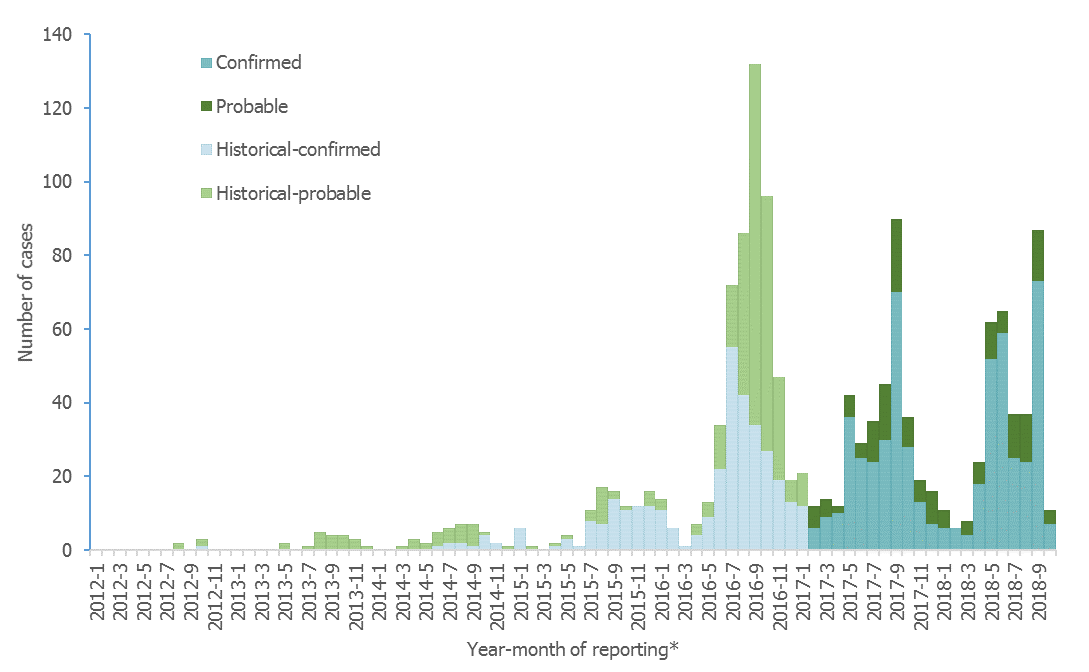
Most outbreak cases were reported during the summer months (Figure 1). Due to reporting delays, additional cases are expected to be reported with onset in recent months.

A total of 112 confirmed or historical-confirmed cases were reported with travel history in an EU country during the incubation period and therefore were likely infected there. Countries where infections likely took place were Poland (25 cases identified from 2016 to 2018), Bulgaria (22 cases from 2015 to 2018), Cyprus (14 cases in 2016 and 2018), Portugal (11 cases from 2015 to 2017) and Hungary (10 cases from 2016 to 2018). Additional travel-associated cases were also reported (<10 cases per country) with travel history to Austria, Belgium, Greece, Italy, the Netherlands, Romania, Slovenia and Spain.

Figure 1. Distribution of cases by month of onset* and case classification (n=1 412; 4 cases missing any date of report), EU/EEA, January 2012 to October 2018, as of 12 November 2018

Salmonella Enteritidis - Distribution of cases by month of onset* and case classification (n=1 412; 4 cases missing any date of report), EU/EEA, January 2012 to October 2018, as of 12 November 2018
 *: month of sampling or month of receipt by the reference laboratory if month of onset is not available.

The 2016 and 2017 European outbreak investigations identified eggs originating from Poland as the vehicle of infection in this outbreak (ECDC/EFSA rapid outbreak assessments published in March and December 2017). Outbreak-confirmed cases belong to four different WGS clusters.

Assessment

As reported in the previous ECDC/EFSA rapid outbreak assessment, in 2016 and 2017, evidence from epidemiological, microbiological, environmental and tracing investigations identified eggs originating from Poland as the vehicle of infections in this multi-strain outbreak. Control measures were implemented following these investigations. However, new outbreak cases were notified in 2017 and in 2018 with similar magnitude and temporal patterns. Based on the analysis of the travel-associated cases, it is likely that more countries where molecular typing is not performed routinely for human S. Enteritidis isolates are affected by the outbreak, including Bulgaria, Cyprus and Portugal.

Actions

ECDC monitors the occurrence of human cases associated with this threat and offers sequencing services for countries reporting probable cases of human S. Enteritidis isolates with MLVA profile 2-9-7-3-2 or 2-9-6-3-2 or
2-9-10-3-2 or 2-10-6-3-2 or 2-10-8-3-2 or 2-11-8-3-2. EU/EEA countries should consider interviewing new outbreak-confirmed cases.

USA – Norovirus most common foodborne pathogen in 2017

Barf Blog

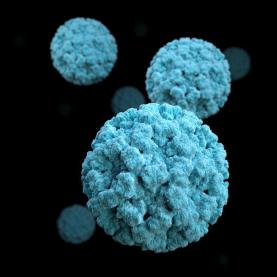
Food Borne Illness - Norovirus -CDC Photo

Image CDC

The Centers for Disease Control and Prevention (CDC) late last week released a summary of foodborne illnesses in 2017 based on an annual analysis of data from the Foodborne Disease Outbreak Surveillance System, and Norovirus was the most common pathogen reported, responsible for 46% of illnesses. Salmonella and Shiga toxin–producing Escherichia coli were also linked to a substantial number of outbreaks.  

In 2017, the CDC tracked 841 foodborne outbreaks, which included 14,481 illnesses, 827 hospitalizations, 20 deaths, and 14 food product recalls. A single etiologic agent was confirmed in 395 outbreaks (47%), which are defined as two or more related cases.