Category Archives: Food Hygiene

Ireland – Recall of Holland and Barrett Brazil Nut Products Due to the Possible Presence of Salmonella

FSAI

Category 1: For Action
Alert Notification: 2020.53
Product: See tables below
Batch Code: See tables below
Country Of Origin: United Kingdom

Message:

Holland & Barrett is recalling some batches of nut products due to possible Salmonella contamination of the ingredient, brazil nuts. Point-of-sale recall notices will be displayed in stores supplied with the implicated batches.

Nature Of Danger:

People infected with Salmonella typically develop symptoms between 12 and 36 hours after infection, but this can range between 6 and 72 hours.  The most common symptom is diarrhoea, which can sometimes be bloody.  Other symptoms may include fever, headache and abdominal cramps.  The illness usually lasts 4 to 7 days. Diarrhoea can occasionally be severe enough to require hospital admission. The elderly, infants, and those with impaired immune systems are more likely to have a severe illness.

Action Required:

Inspectors:

A distribution list will be emailed to PEHOs in due course. Please notify FSAI (foodincidents@fsai.ie)

Manufacturers, wholesalers, distributors, caterers & retailers:

Retailers are requested to remove the implicated batches from sale.

Consumers:

Consumers are advised not to eat the implicated batches.

hb products
hb nut labels
hb nut labels 2

Switzerland – Cheese firm in Switzerland investigated over Listeria link

Cheese firm in Switzerland investigated over Listeria link

USA – U.S. among countries sent Brazil nuts contaminated with Salmonella

U.S. among countries sent Brazil nuts contaminated with Salmonella

UK – Nearly 100 sick in UK outbreak linked to nuts; some sent to U.S.

Nearly 100 sick in UK outbreak linked to nuts; some sent to U.S.

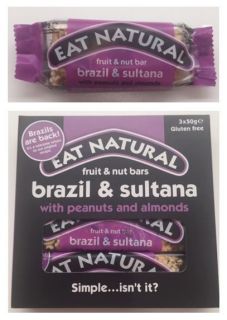
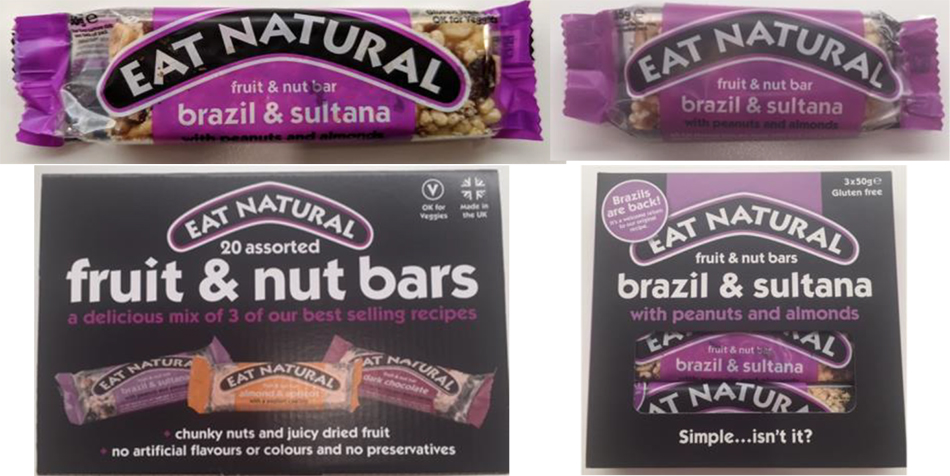
Luxembourg – FRUIT & NUT BARS – BRAZIL & SULTANA (WITH PEANUTS AND ALMONDS) – PACKAGING: INDIVIDUAL OR MULTIPACK (3X) OF THE EAT NATURAL BRAND AND NATURAL BAR FRUIT & NUT OF THE HEMA BRAND – POSSIBLE PRESENCE OF SALMONELLA

SAP

Last name FRUIT & NUT BARS – BRAZIL & SULTANA (with peanuts and almonds) – packaging: individual or multipack (3x)
Mark NATURAL EAT
Unit 50 g
Bar code Individual: 50 g – EAN 50676262

Multipack: 3 X 50 g – EAN 5013803666149

Date of Minimum Durability (DDM) August 2020 to June 2021

NEW

Last name NATURAL BAR Fruit & nut
Mark HEMA
Unit 45 g
Article number 10.41.0001
Date of Minimum Durability (DDM) all

Danger  : Possible presence of Salmonella

Salmonella can cause symptoms such as nausea, vomiting, abdominal cramps, diarrhea, fever and headache within 6 to 72 hours after consumption. These symptoms may be aggravated in young children, immunocompromised individuals and the elderly. People who have consumed these products and who present these symptoms are advised to consult a doctor, notifying him of this consumption.

The sale of the products is confirmed in various points of sale in Luxembourg.

Source of information: Mandatory notification and RASFF (Rapid Alert System for Food and Feed)

Communicated by: Government Commission for Quality, Fraud and Food Safety .

Iceland – Salmonella in an energy bar

Mast

Matvælastofnun warns against consuming Eat Natural energy bars from the British company Hand2mouth, which Costco imports and sells in its store due to the risk of salmonella. Costco in Iceland has contacted its customers who have purchased the product and recalled it, in consultation with the Health Inspectorate of the Hafnarfjörður and Kópavogur areas.

The recall only applies to the following cycles:

  • Product: Brazil & sultana with peanuts and almonds 
  • Brand: Eat Natural 
  • Size and bar code: 
    35g pcs. 96003787 
    4x 35g package 5013803666712 
    50g pcs. 50676262 
    3x 50g package 5013803666149
    12x 50g box 50138803621247
    20x 50g various types 5013803666385
  • Best for: AUGUST 2020, SEP 2020, OCT 2020, NOV 2020, DEC 2020, JAN 2021, FEB 2021, MAR 2021, APR 2021, MAY 2021, JUNE 2021, JUL 2021
  • Distribution: Costco and Heimkaup store

Energy bar - salmonella

Customers can get their product refunded according to the instructions in Costco’s press release below. 

Related material

Updated 27.08.20 at 13:18

France – Les Viviers de St Colomban brand live breeding cockles – E.coli

Oulah

Presence of Escherichia coli

PROPOSED SOLUTION

People who hold the product in question are asked not to consume them – and more particularly young children, pregnant women, immunocompromised people and the elderly – and to return them to the point of sale where they were purchased.

People who have consumed it and who present symptoms such as diarrhea, abdominal pain or vomiting should consult their doctor as soon as possible, mentioning this consumption and the possible link with the bacterium Escherichia coli.

In the absence of symptoms within 10 days after consuming the affected products, there is no need to worry and consult a doctor.

The E. coli bacterium is naturally present in the digestive microflora of humans and warm-blooded animals. Some strains of E. coli are pathogenic, and can be responsible in humans for various disorders ranging from mild diarrhea to more serious forms such as hemorrhagic diarrhea or severe kidney damage such as HUS, mainly in young children.

FURTHER INFORMATION

▸ Sale
In the traditional fish department from 08/18/20 to 08/22/20.

▸ Consumer service contact
For any further information, you can contact the company “Les Viviers de St Colomban” at 02.97.52.26.66.

▸ Source
https://www.carrefour.fr/

https://www.oulah.fr/rappel-produit-coques-delevage-vivantes-de-marque-les-viviers-de-st-colomban/

Canada – Picoudi brand microgreens recalled due to Salmonella

CFIA

Recall details

Ottawa, August 28, 2020 – Les Jardins Picoudi is recalling Picoudi brand microgreens from the marketplace due to possible Salmonella contamination. Consumers should not consume the recalled products described below.

The ministère de l’Agriculture, des Pêcheries et de l’Alimentation du Québec (MAPAQ) transmitted an alert to the news media concerning the affected products (in French only).

Product

Brand Product Size UPC Codes
Picoudi Organic Broccoli Microgreens 35 g 8 13526 00001 6 3 233
Picoudi Organic Broccoli Microgreens 75 g 8 13526 00011 5 3 233
Picoudi Organic Arugula Microgreens 35 g 8 13526 00006 1 3 233
Picoudi Organic Arugula Microgreens 75 g 8 13526 00016 0 3 233
Picoudi Organic Coriander Microgreens 35 g 8 13526 00005 4 3 233
Picoudi Organic Coriander Microgreens 75 g 8 13526 00015 3 3 233

What you should do

If you think you became sick from consuming a recalled product, call your doctor.

Check to see if you have the recalled products in your home. Recalled products should be thrown out or returned to the store where they were purchased.

Food contaminated with Salmonella may not look or smell spoiled but can still make you sick. Young children, pregnant women, the elderly and people with weakened immune systems may contract serious and sometimes deadly infections. Healthy people may experience short-term symptoms such as fever, headache, vomiting, nausea, abdominal cramps and diarrhea. Long-term complications may include severe arthritis.

Background

This recall was triggered by MAPAQ. A food safety investigation is being conducted. If other high-risk products are recalled, the Canadian Food Inspection Agency (CFIA) will notify the public through updated Food Recall Warnings.

The CFIA is verifying that industry is removing the recalled products from the marketplace.

Illnesses

There have been no reported illnesses associated with the consumption of these products.

Public enquiries and media

Public enquiries
Toll-free: 1-800-442-2342 (Canada and U.S.)
Telephone: 1-613-773-2342 (local or international)
Email: cfia.enquiries-demandederenseignements.acia@canada.ca
Media relations
Telephone: 613-773-6600
Email: cfia.media.acia@canada.ca

Research – Effectiveness of edible coatings to inhibit browning and inactivate foodborne pathogens on fresh‐cut apples

Wiley Online

Multiple formulations of edible coating solutions were developed and evaluated for their ability to maintain the quality and minimize populations of foodborne bacteria on fresh‐cut apples. Fresh‐cut apples were artificially inoculated with Salmonella spp., Escherichia coli O157:H7, and Listeria monocytogenes , and dip‐treated with coating solutions. Changes in populations of pathogens and molds and yeasts (M&Y) were evaluated after solution treatments and during storage at 4°C for 35 days. Changes in color, texture firmness, and weight loss during storage were also determined. Among the formulations, the solution containing 1% of three organic acids (acetic, lactic, and levulinic acids), 2% N‐acetyl‐l‐cysteine or L‐cysteine with 0.5% chitosan demonstrated the best effectiveness for the simultaneous reduction of pathogenic and spoilage microorganisms, control of browning, and maintenance of the quality of fresh‐cut apples. The treated apple slices had nondetectable pathogens and M&Y (<1 log CFU) and the least quality changes for 35‐day storage. The developed solutions can be used at processing plants, retail stores, or homes to protect fresh‐cut apples or other fresh‐cut fruits and vegetables from microbiological and quality deterioration.


Research – Escape artists: How vibrio bacteria break out of cells

Science Daily

Food Illness

Image CDC

As soon as the foodborne pathogen Vibrio parahaemolyticus infects a human intestinal cell, the bacteria are already planning their escape. After all, once it is in and multiplies, the bacterium must find a way out to infect new cells.

Now, UT Southwestern scientists have discovered the surprising route that V. parahaemolyticus takes during this exit — or egress — from cells. The bacteria, they report in the journal eLife, gradually modify cholesterol found in a cell’s plasma membrane, eventually weakening the membrane enough so that it can break through.

“The more we understand how bacteria are manipulating host cells at a molecular level, the more we understand how they cause disease,” says study leader Kim Orth, Ph.D., professor of molecular biology and biochemistry at UTSW and a Howard Hughes Medical Institute investigator. “Bacteria have many different mechanisms to escape, but this stood out because it’s an especially novel one.”