Category Archives: E.coli O157:H7

Research – Evaluation of Bactericidal Effects of Phenyllactic Acid on Escherichia coli O157:H7 and Salmonella Typhimurium on Beef Meat

Journal of Food Protection

ABSTRACT

Bactericidal effects of various concentrations of phenyllactic acid on Shiga toxin–producing Escherichia coli (STEC), including E. coli O157:H7, O26:H11, O103:H2, and O121:H19, and on Salmonella Typhimurium DT104 in pure culture and microplates assays were studied. Beef cuts were surface sprayed with phenyllactic acid or lactic acid for inactivation of E. coli O157:H7 and Salmonella Typhimurium. The 1.5% phenyllactic acid inactivated all inoculated E. coli O157:H7, O26:H11, O103:H2, and O121:H19 and Salmonella Typhimurium DT104 (>6-log reduction) within 1 min of contact at 21°C, whereas 1.5% lactic acid did not result in microbial reduction. Microplate assays (for STEC and Salmonella Typhimurium DT104 at 10 to 100 CFU per well) indicated that concentrations of 0.25% phenyllactic acid or 0.25% lactic acid inhibited the growth of STEC and Salmonella Typhimurium DT104 incubated at 37°C for 24 h. Treatment of beef with 1.5% lactic acid or 1.5% phenyllactic acid reduced E. coli O157:H7 by 0.22 and 0.38 log CFU/cm2, respectively, within 5 min and reduced Salmonella Typhimurium DT104 by 0.12 and 0.86 log CFU/cm2, respectively. When meat treated with 1.5% phenyllactic acid was frozen at −20°C, inactivation of E. coli O157 and Salmonella Typhimurium DT104 was enhanced by 1.06 and 1.46 log CFU/cm2, respectively. Thus, treatment of beef with 1.5% phenyllactic acid significantly reduced the population of E. coli O157:H7 and Salmonella.

HIGHLIGHTS
  • Phenyllactic acid at 1.5% killed STEC and Salmonella (>6-log reduction) within 1 min.

  • The MIC of lactic and phenyllactic acids was 0.25%.

  • The bactericidal effect of phenyllactic acid on beef was enhanced by freezing.

USA -Investigation of E. coli O157:H7 Outbreak Linked to Romaine from Salinas, California, November 2019

FDA

November 26, 2019

Recommendation

FDA, CDC, and state health authorities are investigating an outbreak of illnesses caused by E. coli O157:H7 in the United States. Epidemiologic, laboratory, and traceback evidence indicates that romaine lettuce from the Salinas, California growing region is a likely source of this outbreak. The CDC is reporting an increase in the case count to 67 and that the most recent illness onset date is November 14, 2019.

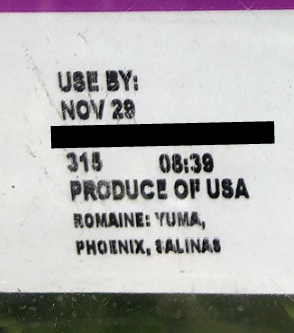
Romaine from Salinas, California Label Enjoy By December 2, 2019


Romaine from Salinas, California Label Use By November 29, 2019

Consumers: Consumers should not eat romaine lettuce harvested from Salinas, California. Additionally, consumers should not eat products identified in the recall announced by the USDA on November 21, 2019.

Romaine lettuce may be voluntarily labeled with a harvest region. If this voluntary label indicates that the romaine lettuce was grown in “Salinas” (whether alone or with the name of another location) do not eat it. Throw it away or return it to the place of purchase.  If romaine lettuce does not have information about harvest region or does not indicate that it has been grown indoors (i.e., hydroponically- and greenhouse-grown), throw it away or return it to the place of purchase. Consumers ordering salad containing romaine at a restaurant or at a salad bar should ask the staff whether the romaine came from Salinas.  If it did, or they do not know, do not eat it.

At this time, romaine lettuce that was harvested outside of the Salinas region has not been implicated in this outbreak investigation. Hydroponically- and greenhouse-grown romaine, which is voluntarily labeled as “indoor grown,” from any region does not appear to be related to the current outbreak. There is no recommendation for consumers to avoid using romaine harvested from these other sources.

Restaurants and Retailers: Restaurants and retailers should not serve or sell romaine harvested from Salinas, California.  If you do not know the source of your romaine lettuce, and if you cannot obtain that information from your supplier, you should not serve, nor sell it.

Suppliers and Distributors: Suppliers, distributors and others in the supply chain should not ship or sell romaine harvested in Salinas, California. If the source of the romaine lettuce is unknown, you should not ship, nor sell the product.

For Restaurants, Retailers, Suppliers and Distributors: Currently, the FDA does not have enough traceback information to identify the specific source of the contamination that would allow us to request a targeted recall from specific growers. At this stage in the investigation, the most efficient way to ensure that contaminated romaine is off the market would be for industry to voluntarily withdraw product grown in Salinas, and to withhold distribution of Salinas romaine for the remainder of the growing season in Salinas. FDA has made this request of industry.

At this time, romaine lettuce that was harvested outside of the Salinas region has not been implicated in this outbreak investigation. Hydroponically- and greenhouse-grown romaine, which is voluntarily labeled as “indoor grown,” from any region does not appear to be related to the current outbreak. There is no recommendation for consumers or retailers to avoid using romaine harvested from these other sources.

Background

According to the CDC, as of November 25, 2019, 67 people infected with the outbreak strain of E. coli O157:H7 have been reported from 19 states. The case patients report that illnesses started on dates ranging from September 24, 2019 to November 14, 2019.

The Maryland Department of Health identified E. coli O157:H7 in an unopened package of Ready Pac Bistro® Chicken Caesar Salad collected from an ill person’s home in Maryland. Analysis of this salad, through Whole Genome Sequencing (WGS), has linked strain E. coli O157:H7 to three Maryland cases and the multi-state outbreak.

The FDA and state partners are conducting a traceback investigation to trace romaine exposures to the source. Preliminary information indicates that ill people in Maryland were exposed to romaine lettuce harvested in Salinas, California.

FDA has deployed investigators to the farms in question to try to determine the source and extent of the contamination. More information will be forthcoming as the investigation proceeds.

Additionally, state partners are conducting laboratory analyses of romaine lettuce samples from case patients potentially linked to the outbreak.

The Salinas region as defined by the United Fresh Produce Association and the Produce Marketing Association Romaine Taskforce ReportExternal Link Disclaimer includes: Santa Cruz, Santa Clara, San Benito, and Monterey counties in California.

Genetic analysis of the E. coli O157:H7 strains from patients in this current outbreak are similar to strains of E. coli O157:H7 associated with a previous outbreak from the Fall of 2017 and the Fall of 2018 that affected consumers in both Canada and the U.S. The 2017 outbreak of E. coli O157:H7 was associated with leafy greens in the U.S. and romaine in Canada. The 2018 outbreak of E. coli O157:H7 was associated with romaine in both countries.

Canada – Canada reports US Romaine Lettuce may have sickened at least one Citizen – E.coli O157

Food Poison Journal Eurofins Food Testing UK

Although an outbreak is not occurring in Canada, the Public Health Agency of Canada (PHAC) has identified one Canadian illness with a similar genetic fingerprint to illnesses reported in the U.S. investigation.

The Canadian Food Inspection Agency (CFIA) has confirmed that romaine lettuce from the affected areas reported in the U.S. investigation is imported to Canada at this time of year. The CFIA has taken measures to protect consumers and is implementing new actions at the border to ensure that any affected romaine lettuce products are no longer being imported into Canada.

As a result of the U.S. outbreak investigation and its link to product on the Canadian market, the Public Health Agency of Canada is advising Canadians to follow the U.S. CDC’s public health advice, which advises consumers to not eat, and retailers and food service establishments to not sell or serve, any romaine lettuce harvested from the Salinas, California growing region in the U.S. Romaine lettuce harvested in Canada is not affected by this advice.

Hong Kong -Not to consume romaine lettuce produced in Salinas, California, US – E.coli O157

CFS

Issue Date 23.11.2019
Source of Information US authorities
Food Product Romaine lettuce produced in the US
Product Name and Description Product name: baby spring mix
Brand: organicgirl
Place of origin: Salinas, California, US
Net weight: 5 ounces /142 grams
Reason For Issuing Alert
  • The CFS, through its Food Incident Surveillance System, noted a notice from the US Food and Drug Administration about the investigation of an outbreak of E. coli infections that was likely linked to the consumption of romaine lettuce produced in Salinas, California, which was suspected to be contaminated with E. coli O157:H7.
  • For the sake of prudence, the CFS has immediately suspended the import into and sale within Hong Kong of romaine lettuce produced in the area concerned.
Action Taken by the Centre for Food Safety
  • CFS has informed the US authorities concerned of the import suspension and alerted the trade to the incident.
  • The Centre will continue to follow up on the incident and take appropriate action.
Advice to the Trade
  • Stop using or selling the affected batches of the products immediately if they possess them.
Advice to Consumers
  • Not to consume the affected batches of the products if they have purchased any.
Further Information The CFS press release

Members of the public may call the hotline of the importer at 2299 1133 during office hours for enquiries about the recall.

Canada -Bonduelle brand salad products may be unsafe due to E. coli O157:H7

CFIA

Ottawa, November 22, 2019 – The Canadian Food Inspection Agency (CFIA) is warning the public not to consume the products described below due to E. coli O157:H7.

The following products have been sold in Ontario, Quebec and New Brunswick and may have been distributed in other provinces or territories.

Products

Brand Product Size UPC Codes
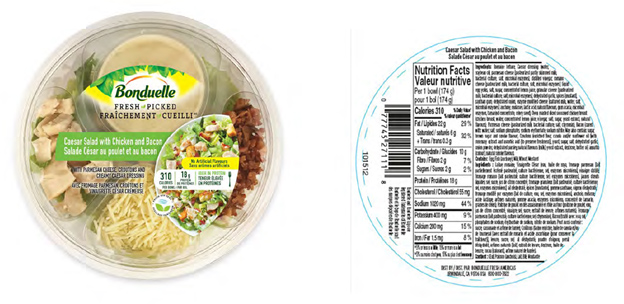
Bonduelle Caesar Salad with Chicken and Bacon 174 g 0 77745 27111 8 Use by:
10/29/2019
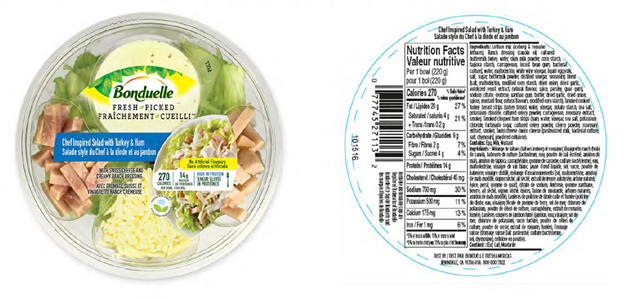
Bonduelle Chef Inspired Salad with Turkey & Ham 220 g 0 77745 27113 2 Use by:
10/31/2019
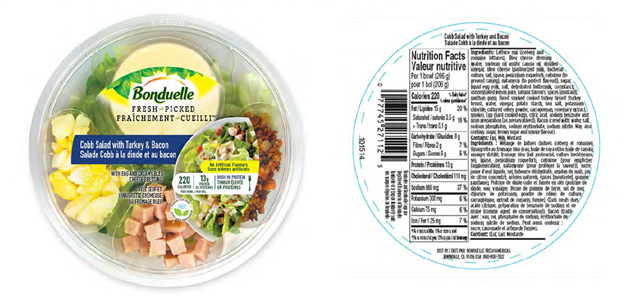
Bonduelle Cobb Salad with Turkey & Bacon 206 g 0 77745 27112 5 Use by:
10/31/2019
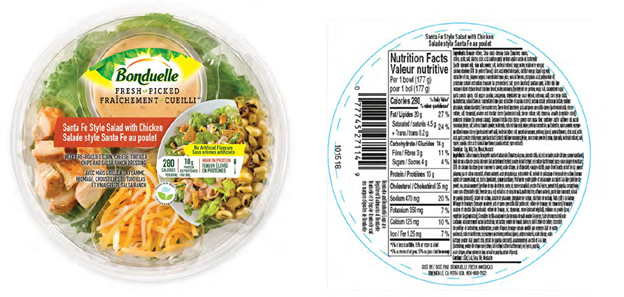
Bonduelle Santa Fe Style Salad with Chicken 177 g 0 77745 27114 9 Use by:
10/31/2019

Background

This warning was triggered by a recall in another country. The CFIA is conducting a food safety investigation, which may lead to the recall of these or other products. If products are recalled, the CFIA will notify the public through a Food Recall Warning.

Illnesses

There have been no reported illnesses associated with the consumption of these products in Canada. However, the Public Health Agency of Canada has issued guidance to Canadians with regard to all types of romaine lettuce from Salinas, California, please refer to the Public Health Notice for additional information.

Product photos

Printer ready version of photos

  • Bonduelle Caesar Salad with Chicken and Bacon
  • Bonduelle Chef Inspired Salad with Turkey & Ham
  • Bonduelle Cobb Salad with Turkey & Bacon
  • Bonduelle Santa Fe Style Salad with Chicken

Research -Influence of surface properties of produce and food contact surfaces on the efficacy of chlorine dioxide gas for the inactivation of foodborne pathogens

Science Direct

The objective of this study was to evaluate the influence of surface properties of produce and food contact surfaces on the antimicrobial effect of chlorine dioxide (ClO2) gas against Escherichia coli O157:H7, Salmonella Typhimurium, and Listeria monocytogenes. The hydrophobicity of the selected surfaces was evaluated by water contact angle measurements. White light scanning interferometry (WLSI) was used to acquire surface roughness values of each surface. Produce and food contact surfaces inoculated with foodborne pathogens were treated with 20 ppmv ClO2 gas for 5, 10, and 15 min. As treatment time increased, different levels of inactivation of the three pathogens were observed among the samples. Contact angles of produce and food contact surfaces were highly and negatively correlated with the log reduction of all three pathogens. There were generally weaker correlations between the roughness values of sample surfaces and microbial reduction compared to those between hydrophobicity and microbial reduction. The results of this study showed that surface hydrophobicity is a more important factor relative to bacterial inactivation by ClO2 gas from the surface than is surface roughness. Also, the existence of crevices with features of similar size to the pathogen cell was more important than the Ra and Rq values in the inactivation of pathogens.

USA -Missa Bay, LLC Recalls Salad Products Due to Possible E. coli O157:H7 Contamination

FSIS USDA

WASHINGTON, Nov. 21, 2019 – Missa Bay, LLC, a Swedesboro, N.J. establishment, is recalling approximately 75,233  pounds of salad products that contain meat or poultry because the lettuce ingredient may be contaminated with E. coli O157:H7, the U.S. Department of Agriculture’s Food Safety and Inspection Service (FSIS) announced today.

The salad products items were produced from October 14, 2019 through October 16, 2019. The products subject to the recall can be found on the following spreadsheet. [View Labels (PDF only)]

The products subject to recall bear establishment number “EST. 18502B” inside the USDA mark of inspection. These items were shipped to distribution locations in Alabama, Connecticut, Florida, Georgia, Illinois, Indiana, Louisiana, Maine, Maryland, Massachusetts, Michigan, Minnesota, Mississippi, Missouri, New Jersey, New York, North Carolina, Ohio, Pennsylvania, South Carolina, Virginia and Wisconsin.

As part of a foodborne illness outbreak investigation, the Maryland Department of Health collected an unopened package of Ready Pac Bistro Chicken Raised Without Antibiotics Caesar Salad with FSIS EST number 18502B on the label. The state collected and tested individual ingredients in the salad and the lettuce tested positive for E. coli O157:H7. All products from the same lot of lettuce are included in the recall.

USA -Outbreak Investigation of lllnesses caused by E. coli O157:H7 November 2019

FDA

November 20, 2019

Recommendation

Consumers are advised not to eat Ready Pac Bistro® Chicken Caesar Salad, lot #255406963, UPC  0 77745 27249 8, “Best By” date Oct. 31, 2019, purchased from Sam’s Club stores in Maryland. State testing of unopened salad purchased by an ill person identified the presence of E. coli O157 in the romaine lettuce.  It should be noted that the “Best By” date was almost 3 weeks ago, so this product is not likely in stores. Consumers should not eat this specific product, regardless of where it was purchased.

Background

Chicken Caesar Salads

FDA, CDC and state health authorities are investigating an outbreak of illnesses caused by E. coli O157:H7  in the U.S.

According to the CDC, as of November 18, 2019, 17 people infected with the outbreak strain of E. coli O157:H7 have been reported from eight states. The case patients report that illnesses started on dates ranging from September 24, 2019 to November 8, 2019.

Two cases reported from Maryland have been linked to this outbreak by Whole Genome Sequencing (WGS), through analysis of clinical samples taken from those patients. The Maryland Department of Health identified E. coli O157 in an unopened package of Ready Pac Bistro® Chicken Caesar Salad collected from a ill person’s home in Maryland which was purchased from a Sam’s Club in that state. Preliminary information indicates that romaine lettuce used in the product that tested positive was harvested in mid-October and is no longer within current expiration dates. To date, the food sample has not yet been definitively linked to the Maryland cases or other E. coli O157 illnesses in the multi-state outbreak. WGS analysis is currently underway for this sample to determine if it is closely related genetically to the E. coli found in people in this outbreak.

As analysis is underway, FDA is tracing back the supply of the romaine lettuce in the Caesar salad. FDA has identified possible farms in Salinas, California. FDA is deploying investigators to the farms in question to determine the source and extent of the contamination. More information will be forthcoming as the investigation proceeds.

Although the ill people interviewed in Maryland reported eating Ready Pac Bistro® Chicken Caesar Salad, at this time, ill people in other states have not reported eating this particular salad. Therefore, exposure to this product alone does not fully explain other cases in the outbreak.

State and local public health officials are interviewing ill people to determine what they ate and other exposures of interest in the week before their illness started.

USA- Romaine in the cross-hairs – FDA to test lettuce for pathogens

Food Poison Journal

The FDA is conducting a small, focused assignment to collect samples of raw agricultural commodity (RAC) romaine lettuce to test for Salmonella spp. and pathogenic Escherichia coli (also known as Shiga Toxin-producing E. coli or STEC), microbial hazards repeatedly linked to foodborne illnesses associated with romaine lettuce consumption. The assignment begins this month (November 2019) and is expected to last one year.

USA – MD E. coli O157:H7 Outbreak Linked to Ready Pac Chicken Caesar Salad

Food Poisoning Bulletin

A MD E. coli O157:H7 outbreak may be linked to Ready Pac Bistro® Bowl Chicken Caesar Salad that was purchased from several Sam’s Club locations in that state, according to the Maryland Health Department. Seven people are sick. One person has been hospitalized and no deaths have been reported.

The health department is recommending the consumers not eat Ready Pac Bistro® Bowl Chicken Caesar Salad. The lot number on the product is 255406963, and the best by date is October 31, 2019.