Monthly Archives: March 2020

Research – Biofilm-inhibition activities of fractions of Senna Siamea (LAM) Irwin & Barneby leaf against Escherichia coli

Academic Journals ecoli

Escherichia coli has carved its niche in the urinary tract with the formation of a formidable matrix called biofilm. This biofilm is not only recalcitrant to the body’s immune system but also resistant to antibacterial agents. Senna siamea (Lam) Irwin and Barneby is a medicinal plant with established antibacterial effect against planktonic cells of many bacteria. An attempt was made herein to evaluate the effect of its leaf extract and fractions on biofilm of E. coli isolates. Crude extracts of leaf, stem bark and root of this plant were prepared using ethanol as the solvent for the cold extraction. Phytochemical screening was carried out on the three extracts. Two E. coli strains from different antenatal patients attending General Hospital, Kafanchan, Kaduna were donated to us by a researcher from Ahmadu Bello University, Zaria and the reference strain, E. coli, WDCM 00013 (from Germany) were tested for biofilm production using the Congo red method. Antimicrobial susceptibility testing of the crude extracts against the isolates was carried out using the agar diffusion method. The Minimum Inhibitory Concentration (MIC) and the Minimum Bactericidal Concentration (MBC) were determined for the leaf extract of the plant using micro broth dilution and agar diffusion methods respectively. In order to establish the antibiofilm activities of the leaf extract of the plant, sub-inhibitory concentrations (sub-MIC) were used against the test isolates in the remaining assays in the work. Column chromatography backed by thin layer chromatography (TLC) was used to fractionate leaf extract (having the best antibacterial activity) of the plant, using different ratios of a combination of hexane, ethyl acetate and n-butanol as fractionating solvents. MIC and MBC of the leaf extract were and 50 mg/ml respectively. High values of percentage biofilm inhibition were observed against all the bacterial isolates from the antibiofilm assay. Combination of solvents in the increasing order of polarity enhanced the antibiofilm activity of the various fractions of the leaf extract of Senna siamea. In conclusion, further fractionation of Senna siamea leaf extract increases its antibiofilm activities.
Research – As warming waters make shellfish toxic, a way of life becomes deadly for Native Alaskans.

Grist org

This summer, independent shellfish testing sites all over the state reported spikes in toxin levels, possibly related to the historic high temperatures in the water surrounding Alaska. And those warming waters are creating the ideal conditions for the algae that produce the toxin to propagate year-round, some researchers say.

USA – Possible Campylobacter Outbreak at Rediviva in Aberdeen, WA

Food Poisoning Bulletin Campylobacter_jejuni_01

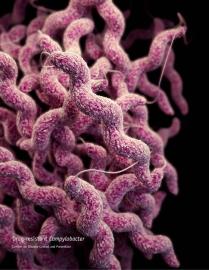
News reports are saying that a Campylobacter outbreak may have occurred at Rediviva restaurant at 118 Wishkah Street in Aberdeen, Washington. The Grays Harbor County Environmental Health Division learned about a person who tested positive for Campylobacter jejuni on February 25, 2020. That person told investigators he or she ate at Rediviva on Valentine’s Day.

Canada – Updated Food Recall Warning – Various tuna products recalled due to histamine

Canada Gov

Recall details

Ottawa, February 28, 2020 – The food recall warning issued on February 25, 2020 has been updated to include additional distribution and product information. This additional information was identified during the Canadian Food Inspection Agency’s (CFIA) food safety investigation.

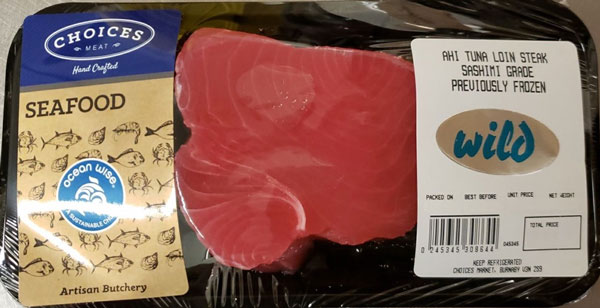
Industry is recalling various tuna products from the marketplace due to elevated levels of histamine. Consumers should not consume the recalled products described below.

Recalled products

Brand Product Size UPC Codes Additional Information
Choices Markets Ahi Tuna Loin Steak Sashimi Grade – Previously Frozen Variable Starts with 0 245345 All units sold from October 9, 2019 up to and including October 23, 2019 Sold at Choices Market, 8683 10th Ave., Burnaby, BC
Choices Markets Ahi Tuna Loin Steak Sashimi Grade – Previously Frozen Variable Starts with 0 245345 All units sold from October 10, 2019 up to and including October 12, 2019 Sold at Choices Market, 3493 Cambie St., Vancouver, BC
Choices Markets Ahi Tuna Loin Steak Sashimi Grade – Previously Frozen Variable Starts with 0 245345 All units sold from October 26, 2019 up to and including November 9, 2019 Sold at Choices Market, 1888 West 57th Ave., Vancouver, BC
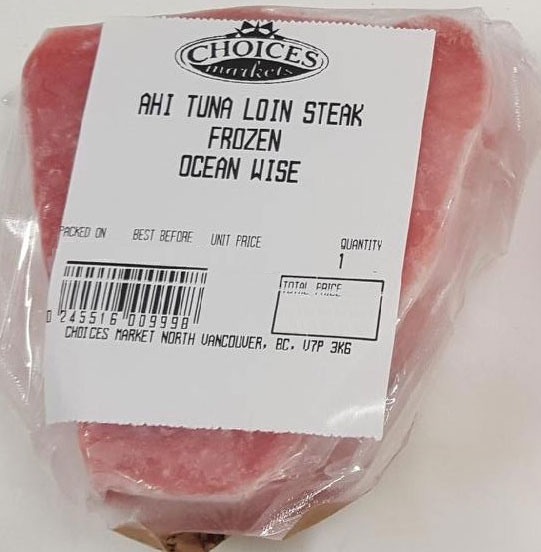
Choices Markets Ahi Tuna Loin Steak Frozen – Ocean Wise Variable Starts with 0 245516 All units sold from October 9, 2019 up to and including October 23, 2019 Sold at Choices Market, 8683 – 10th Ave., Burnaby, BC
Choices Markets Ahi Tuna Loin Steak Frozen – Ocean Wise Variable Starts with 0 245516 All units sold from October 10, 2019 up to and including October 12, 2019 Sold at Choices Market, 3493 Cambie St., Vancouver, BC
Choices Markets Ahi Tuna Loin Steak Frozen – Ocean Wise Variable Starts with 0 245516 All units sold from October 26, 2019 up to and including November 9, 2019 Sold at Choices Market, 1888 West 57th Ave., Vancouver, BC
IGA Ahi Tuna – Previously Frozen Variable Starts with 200840 All units sold from November 6, 2019 up to and including December 6, 2019 Sold at IGA, 1940 Kane Rd., Kelowna, BC
IGA Ahi Tuna – Previously Frozen Variable Starts with 200840 All units sold from September 28, 2019 up to and including December 17, 2019 Sold at IGA, 2286 West Broadway, Vancouver, BC
IGA Ahi Tuna – Previously Frozen Variable Starts with 200840 All units sold from November 26, 2019 up to and including January 13, 2020 Sold at IGA, 12887 Madeira Park Road, Madeira Park, BC
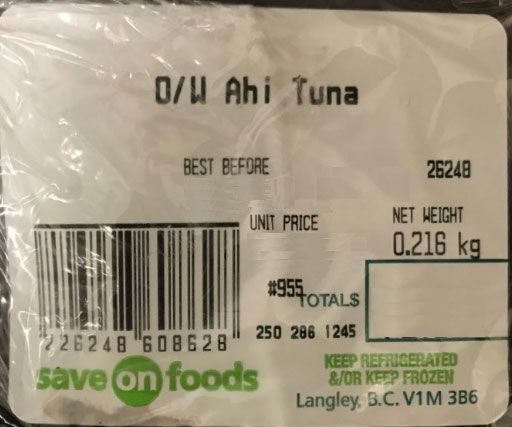
Save on Foods O/W Ahi Tuna Variable Starts with 226248 All units sold from September 18, 2019 up to and including February 28, 2020 Sold at Save on Foods locations in AB, BC, MB, SK, and YT

What you should do

If you think you became sick from consuming a recalled product, call your doctor.

Check to see if you have the recalled products in your home. Recalled products should be thrown out or returned to the store where they were purchased.

Food contaminated with high levels of histamine may not look or smell spoiled but can still make you sick. Histamines are not destroyed by cooking. High levels of histamine in fish can cause an allergic-type reaction known as scombroid poisoning. Symptoms can include burning throat, diarrhea, dizziness, facial swelling, headache, vomiting and peppery taste in mouth.

Background

This recall was triggered by consumer complaints. The CFIA is conducting a food safety investigation, which may lead to the recall of other products. If other high-risk products are recalled, the CFIA will notify the public through updated Food Recall Warnings.

The CFIA is verifying that industry is removing the recalled products from the marketplace.

Illnesses

There have been no reported reactions associated with the consumption of these products. However, there were reported reactions associated with the products included in the Food Recall Warning on February 25, 2020.

Product photos

Printer ready version of photos

  • Choices Markets - Ahi Tuna Loin Steak Sashimi Grade – Previously Frozen
  • Choices Markets - Ahi Tuna Loin Steak Frozen – Ocean Wise
  • IGA - Ahi Tuna – Previously Frozen
  • Save on Foods - O/W Ahi Tuna

Canada – Certain Les Huîtres Cadoret – La Perle Noire brand #4 oysters recalled due to norovirus

Canada Gov

Recall details

Ottawa, March 1, 2020 – La Mer is recalling certain Les Huîtres Cadoret – La Perle Noire brand #4 oysters from the marketplace due to possible norovirus. Consumers should not consume the recalled product described below.

Recalled products

Brand Product Size UPC Codes
Les Huîtres Cadoret – La Perle Noire Huitres speciales #4 Cadoret Perles Noires 24 CT – France 24 count 0 209656 067997 Emballe le
13.FE.20
Les Huîtres Cadoret – La Perle Noire Huitres speciales #4 Cadoret Perles Noires 12 CT – France 12 count 0 209656 034996 Emballe le
13.FE.20

What you should do

If you think you became sick from consuming a recalled product, call your doctor.

Check to see if you have the recalled products in your home. Recalled products should be thrown out or returned to the store where they were purchased.

People with norovirus illness usually develop symptoms of gastroenteritis within 24 to 48 hours, but symptoms can start as early as 12 hours after exposure. The illness often begins suddenly. Even after having the illness, you can still become re-infected by norovirus. The main symptoms of norovirus illness are diarrhea, vomiting (children usually experience more vomiting than adults), nausea and stomach cramps. Other symptoms may include low-grade fever, headache, chills, muscle aches and fatigue (a general sense of tiredness). Most people feel better within one or two days, with symptoms resolving on their own, and experience no long-term health effects. As with any illness causing diarrhea or vomiting, people who are ill should drink plenty of liquids to replace lost body fluids and prevent dehydration. In severe cases, patients may need to be hospitalized and given fluids intravenously.

Background

This recall was triggered by a consumer complaint. The Canadian Food Inspection Agency (CFIA) is conducting a food safety investigation, which may lead to the recall of other products. If other high-risk products are recalled, the CFIA will notify the public through updated Food Recall Warnings.

The CFIA is verifying that industry is removing the recalled products from the marketplace.

Illnesses

There have been reported illnesses associated with the consumption of these products.

Product photos

Printer ready version of photos

  • Les Huîtres Cadoret – La Perle Noire - Huitres speciales #4 Cadoret Perles Noires 24 CT – France
  • Les Huîtres Cadoret – La Perle Noire - Huitres speciales #4 Cadoret Perles Noires 12 CT – France

Research -Restaurants and takeaways cop blame for 60% of food poisoning cases

Food Service Equipment Journal

According to the FSA, there are an estimated 380,000 cases of norovirus linked to food occur in the UK per year.

A breakdown of the roles of the main transmission pathways in food suggest eating out accounts for an estimated 37% of all foodborne norovirus cases and takeaways at 26%.

Open-headed lettuce on retail sale at 30%, raspberries on retail sale at 4%, and oysters on retail sale at 3% make up the remainder.

The revised foodborne norovirus estimate, combined with better analysis of how many illnesses of unknown cause are also likely to be caused by food, suggest around 2.4 million estimated UK cases of foodborne illness occur each year.

Professor Guy Poppy, chief scientific adviser to the Food Standards Agency, said: “This work gives us a much better idea of the role of food in the spread of all infectious intestinal disease in the UK. However, this does not mean more people are getting unwell, only that we estimate food is responsible for more existing cases than previously thought.


Research – Campylobacter chicken liver outbreak adds to evidence of risk

Food Safety News

campy2

Image CDC

Researchers have called for increased awareness to reduce the risk of Campylobacter outbreaks linked to incorrectly cooked chicken liver dishes.

Communication from food safety and public health authorities may be required. Any strategy should ensure the risk profile of poultry liver-containing dishes is raised and availability of evidence-based preventative strategies for food preparation promoted, according to the study published in the journal Epidemiology and Infection.

There were 19 people who got campylobacteriosis linked to an outbreak in England 2016; seven confirmed and 12 probable cases. Chicken liver pâté was most strongly associated with illness. Three cases reported an incubation period of less than 24 hours, consistent with other outbreaks of campylobacteriosis associated with poultry liver.

Diversorium Ltd., the company which owned and operated the Downe Arms, a hotel in Wykeham near Scarborough, was fined £8,000 ($10,300) in November 2017 for two food hygiene related offences related to the outbreak.

Research – Expect More Foodborne HAV Outbreaks

IDSE 8153_thumb

The foodborne spread of hepatitis A virus (HAV) poses a risk for outbreaks, even among developed countries where general rates of HAV are low, according to a new study.

As the global trade of food products continues to grow, the potential for such outbreaks requires new approaches and tools for early disease detection and control (Foodborne Pathog Dis [Epub Dec 12, 2019]. http://doi.org/10.1089/fpd.2019.2648).

The researchers conducted a search of published literature in order to identify HAV foodborne outbreaks that occurred from Jan. 1, 2012, to Dec. 31, 2018. Specifically, the team looked at outbreaks in developed countries, according to International Monetary Fund definitions. The United States, Japan, Germany, France, Italy, the United Kingdom and Canada were included, as were the 15 members of the European Economic Area, and four newly industrialized Asian economies.


Research -Foodborne Illness Pathogens And Fecal Contaminants Found On New Disposable Gloves

Yahoo Finance

New results of microbial testing of the surfaces of unused disposable gloves, in association with Eagle Protect PBC, have found bacterial genera and species specific to foodborne illnesses (FBI), food spoilage and skin infections. Strains of these microorganisms of concern were present on new and unused disposable gloves currently being used in the US food industry, and in some cases as medical exam gloves. Twenty-five (25) different brands of gloves were analyzed, providing specific profiles in respect to their manufacturing standards, or lack thereof. Food, dermal and respiratory pathogens as well as spoilage species were linked to the use of polluted water sources; sewage (fecal pollution); and human and animal gut bacteria introduced into glove production environments.