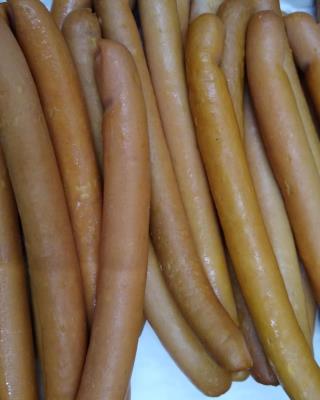
Czech Republic – Sausages with blue cheese – Food Spoilage

Potravinynapranyri

Illustration photo no. 1

Place of inspection:
Chrudim ( SNP 1060, 537 01 Chrudim )
Company ID: 44012373
Food group: Meat and meat products / Heat-treated non-perishable products

Sausages with blue cheese
Category: Dangerous food
Unsatisfactory parameter:

appearance
scent

The product was slimy and smelled unpleasant. Food is not considered safe if it shows signs of spoilage.

The food had an expiration date.

Expiration date: 06/08/2021
Packaging: original packaging PE sealed bag
Quantity of product in package: 1,238 kg
Date of sampling: 10. 6. 2021
Reference number: 21-000209-CAFIA-CZ
The sample was found by an official inspection of the State Agricultural and Food Inspection Authority.

Ireland – E. coli O26 outbreak sickens young children in Ireland

Food Safety News

Health officials in Ireland are investigating an E. coli O26 outbreak at a childcare facility.

Officials with the Department of Public Health Mid-West of the Health Service Executive (HSE) said the agency is managing the outbreak of Shiga toxin-producing E. coli (STEC) and highlighted the importance of effective hand hygiene and well water treatment.

The agency added that there are fewer than five patients at the childcare facility in Limerick and the incident is under control.

STEC, also known as Verotoxigenic E. coli (VTEC), can cause serious illness in children under 5 and the elderly. The serious outcomes of illness shows the importance of hand hygiene before and after preparing food and after contact with farm animals and their environment, said officials.

Singapore – Recall of raw oysters linked to Vibrio parahaemolyticusoutbreak in USA

Click to access sfa-media-release—recall-of-raw-oysters-linked-to-vibrio-parahaemolyticus-outbreak-in-usa.pdf

Italy – Natural mineral water 100 cl PLOSE (TMC 21.07.2023) – Microbial Risk

Salute

Brand : Acqua Plose

Name : Natural mineral water 100 cl PLOSE (TMC 21.07.2023)

Reason for reporting : Recall due to microbiological risk

Publication date : 28 July 2021

Click to access C_17_PubblicazioneRichiami_1302_azione_itemAzione0_files_itemFiles0_fileAzione.pdf

Italy – Natural mineral water 50 cl PLOSE (TMC 21.07.2023) – Microbiological Risk

Salute

Brand : Acqua Plose

Name : Natural mineral water 50 cl PLOSE (TMC 21.07.2023)

Reason for reporting : Recall due to microbiological risk

Publication date : 28 July 2021

Click to access C_17_PubblicazioneRichiami_1301_azione_itemAzione0_files_itemFiles0_fileAzione.pdf

Italy – Natural mineral water 100 cl PLOSE (TMC 14.07.2023) – Microbiological Risk

Salute

Brand : Acqua Plose

Name : Natural mineral water 100 cl PLOSE (TMC 14.07.2023)

Reason for reporting : Recall due to microbiological risk

Publication date : 28 July 2021

Click to access C_17_PubblicazioneRichiami_1299_azione_itemAzione0_files_itemFiles0_fileAzione.pdf

Research – ECDC rapid risk assessment: multi-country outbreak of Salmonella infections thought to be linked to imported melons

HPS

Article: 55/3004

The European Centre for Disease Prevention and Control (ECDC) has reported that, between 15 March and 6 July 2021, 348 confirmed cases of Salmonella braenderup (S. braenderup) sequence type 22 (ST22) were recorded in 12 EU or EEA countries, and the UK. Of these cases, 68 were hospitalised, with no deaths recorded.

Based on epidemiological, microbiological and traceability investigations, the vehicles of infection are presumed to be melons imported from outside the EU, EEA and UK. A batch of galia melons from a Honduran producer are reported to be a probable source of infection, however the first cases were detected in March 2021, before this batch had been harvested. This indicates that contaminated food vehicles had been circulating in these countries earlier, seemingly confirmed by the April 2021 detection, in Austria, of the outbreak strain in melons.

Further investigations are required to identify the point of contamination along the production chain. The Honduran producer finished harvesting melons in April 2021, and their produce is no longer on the market, with no additional exports from Honduras foreseen until the new season starts in December 2021. Given delays in reporting and the possibility of secondary cases, further infections may still be reported, but with decreasing frequency.

Source: ECDC, 20 July 2021

Italy – Natural mineral water 75cl PLOSE (TMC 20.07.2023) – Microbiological Risk

Salute

Brand : Acqua Plose

Name : Natural mineral water 75cl PLOSE (TMC 20.07.2023)

Reason for reporting : Recall due to microbiological risk

Publication date : 28 July 2021

Click to access C_17_PubblicazioneRichiami_1300_azione_itemAzione0_files_itemFiles0_fileAzione.pdf

Italy – Natural mineral water 100 cl PLOSE (TMC 13.07.2023) – Microbial Risk

Salute

Brand : Acqua Plose

Name : Natural mineral water 100 cl PLOSE (TMC 13.07.2023)

Reason for reporting : Recall due to microbiological risk

Publication date : 28 July 2021

Click to access C_17_PubblicazioneRichiami_1298_azione_itemAzione0_files_itemFiles0_fileAzione.pdf

Research – ECDC rapid risk assessment: increase in OXA-233 producing E.coli in the EU, EEA and UK since 2013

HPS

Article: 55/3005

The European Centre for Disease Prevention and Control (ECDC) has published an update to an existing risk assessment, first produced in response to evidence of healthcare associated transmission of OXA-244 producing Escherichia coli (E. coli) in the EU and EEA. A doubling of cases in the main cluster, and three new countries detecting cases, confirm the high risk for further spread of OXA-244 producing E. coli.

An urgent enquiry was made to ECDC’s Epidemic Intelligence Information System (EPIS), regarding a healthcare-associated outbreak involving 12 cases of OXA-244 producing E. coli in Norway. Subsequently, national public health reference laboratories in EU and EEA countries were invited to submit to ECDC whole genome sequencing (WGS) data, collected since the previous rapid risk assessment was published on 18 February 2020.

The analysis included WGS data submitted to ECDC from 13 countries, completed with data from the public domain. Among 458 isolates of E. coli ST38, 370 carried the blaOXA-244 gene encoding for the OXA-244 carbapenemase. Several clusters were identified, including one large cluster with 225 closely-related OXA-244-producing E. coli ST38 isolates. Of these, 210 isolates were detected in 11 EU and EEA countries and the UK, and 15 isolates were from other countries.

The source and route of transmission for OXA-244-producing E. coli in the EU, EEA and UK is currently unclear, and there is a need for further investigation to determine this so that control measures can be put in place. The wide geographical dispersion of cases within countries, without cases being linked in place and time, indicates transmission in the community as the main mode of spread.

Source: ECDC, 20 July 2021