Category Archives: Uncategorized

USA – 4 Listeria Illnesses Linked to Long Phung Food Products prompt Recall

Food Poison Journal kswfoodworld Listeria monocytogenes

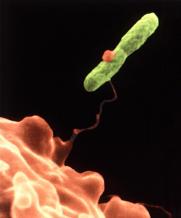
165368 C. Corporation, doing business as Long Phung Food Products, a Houston, Texas establishment, is recalling an undetermined amount of ready-to-eat pork products that may be adulterated with Listeria monocytogenes, the U.S. Department of Agriculture’s Food Safety and Inspection Service (FSIS) announced today.

The ready-to-eat pork patty rolls were produced on various dates from May 21, 2018 through Nov. 16, 2018.

On October 22, 2018, FSIS was notified of a cluster of listeriosis illnesses that were closely related. Working in conjunction with the Centers for Disease Control and Prevention and state public health partners, FSIS determined that there is a link between the Listeria monocytogenes illnesses and ready-to-eat pork products produced by Long Phung Foods.

USA – CDC Alert: Do Not Eat Romaine Lettuce, Throw It Out

CDC

Illustration with a triangle and exclamation mark and text reading Food Safety Alert

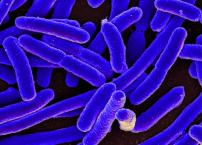
CDC, public health and regulatory officials in several states, Canada, and the U.S. Food and Drug Administration (FDA) are investigating a multistate outbreak of Shiga toxin-producing Escherichia coli O157:H7 (E. coli O157:H7) infections linked to romaine lettuce.

CDC is advising that U.S. consumers not eat any romaine lettuce, and retailers and restaurants not serve or sell any, until we learn more about the outbreak. This investigation is ongoing and the advice will be updated as more information is available.

  • Consumers who have any type of romaine lettuce in their home should not eat it and should throw it away, even if some of it was eaten and no one has gotten sick.
    • This advice includes all types or uses of romaine lettuce, such as whole heads of romaine, hearts of romaine, and bags and boxes of precut lettuce and salad mixes that contain romaine, including baby romaine, spring mix, and Caesar salad.
    • If you do not know if the lettuce is romaine or whether a salad mix contains romaine, do not eat it and throw it away.
    • Wash and sanitize drawers or shelves in refrigerators where romaine was stored. Follow these five steps(https://www.cdc.gov/foodsafety/communication/clean-refrigerator-steps.html) to clean your refrigerator.
  • Restaurants and retailers should not serve or sell any romaine lettuce, including salads and salad mixes containing romaine.
  • Take action(https://www.cdc.gov/vitalsigns/foodsafety-2015/index.html) if you have symptoms of an E. coli infection(https://www.cdc.gov/ecoli/ecoli-symptoms.html):
    • Talk to your healthcare provider.
    • Write down what you ate in the week before you started to get sick.
    • Report your illness to the health department.
    • Assist public health investigators by answering questions about your illness.

Advice to Clinicians

  • Antibiotics are not recommended(https://www.cdc.gov/ecoli/clinicians.html) for patients with E. coli O157 infections. Antibiotics are also not recommended for patients in whom E.coli O157 infection is suspected, until diagnostic testing rules out this infection.
  • Some studies have shown that administering antibiotics to patients with E. coli O157 infections might increase their risk of developing hemolytic uremic syndrome (a type of kidney failure), and the benefit of antibiotic treatment has not been clearly demonstrated.


India – 40 girls from the BC Ladies Hostel in Suryapet in Telangana were hospitalised after presenting with symptoms of food poisoning.

The News Minute

The girls had all eaten dal and rice for dinner at their hostel mess and within hours, all of them developed severe stomach pain and vomiting, and had to be taken to the Suryapet Government Hospital.Doctors at the hospital immediately began treatment for food poisoning, after which all 40 of them recovered and were discharged, according to officials from the Suryapet District Medical and Health Officer (DMHO) Dr Niranjan’s office.

“The girls were admitted on Sunday immediately after they began presenting with vomiting and stomach pain. They were all treated and discharged,” said an official from the DMHO’s office. “We have arranged for a team of health experts to follow up on the issue with the hostel and are taking efforts to ensure that something like this doesn’t happen again,” the official added.

UK- Scotland – Levels of antimicrobial resistant E. coli in UK retail meat remain low

HPS

CDC E.coli


The Food Standards Agency (FSA) have published the Year Three results of an EU survey commissioned to assess the frequency of certain types of antimicrobial resistant (AMR) E. coli in raw UK retail pork and beef.

Year Three of the survey was carried out between January and December 2017 during which 314 beef and 310 pork samples were purchased from retail premises in England, Scotland, Wales and Northern Ireland and tested for specific types of AMR E. coli.

The survey generates baseline data on certain types of AMR E. coli found in retail meat in the UK, which informs assessment of the risks found, and steps needed be taken, in order to reduce exposure to AMR.

Overall, the results showed that less than 1% of the samples were positive for ESBL or AmpC E. coli, which are specific types of AMR. These results are similar to what was found in Year One of the survey. However, one beef sample was found to be contaminated with an E. coli containing the mcr-1 gene, which confers resistance to the antibiotic colistin.

[Source: FSA, 13 November 2018. https://www.food.gov.uk/news-alerts/news/levels-of-amr-e-coli-in-uk-retail-…]

UK – Scotland – Norovirus season starts

HPS

Latest figures show that NHS boards have reported an increase in norovirus and health professionals across NHSScotland are working to reduce the likelihood of outbreaks arising.

Norovirus, sometimes referred to as the ‘winter vomiting bug’, is a highly infectious stomach bug which causes sickness and diarrhoea and can rapidly spread in health and social care settings, as well as in the wider community. Most people make a full recovery within a couple of days, however some people (usually the very young or elderly) may become dehydrated and require hospital treatment.

The best way to stop norovirus spreading is to stay at home for at least 48 hours after symptoms have stopped to avoid spreading it further. Hands should be washed frequently with soap and water as alcohol based hand rubs are not effective for norovirus.

Further information on norovirus can be found at: https://www.nhsinform.scot/illnesses-and-conditions/infections-and-poisonin….

HPS produce guidance for use in all care settings before and during outbreaks of norovirus, and this year have produced new guidance and supporting tools specifically for care homes. Guidance and materials can be found at: https://www.hps.scot.nhs.uk/giz/norovirus.aspx.

The norovirus public facing campaign materials are now available with posters and leaflets being issued to boards. These materials and social media messages can be viewed at: https://www.nhsinform.scot/norovirus.

Poland – Epidemiological update: Salmonella in eggs from Poland

ECDC

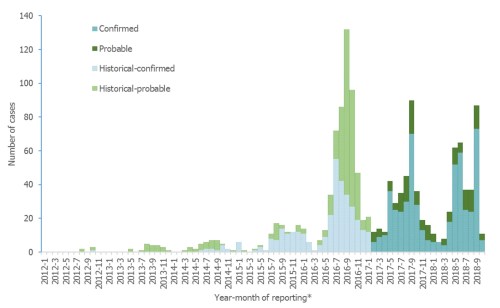
Since the joint ECDC-EFSA rapid outbreak assessment ’Multi-country outbreak of Salmonella Enteritidis infections linked to Polish eggs’ published on 12 December 2017, 15 EU/EEA countries (Belgium, Czech Republic, Denmark, France, Hungary, Iceland, Ireland, Italy, Luxembourg, Netherlands, Norway, Poland, Slovenia, Sweden and United Kingdom) have reported 336 confirmed, 94 probable and 3 new historical-confirmed cases associated with this ongoing multi-country outbreak of Salmonella Enteritidis in the EU/EEA. In the same period, seven historical probable cases were reclassified as excluded.

Overall, 1 412 cases have been found associated with this outbreak: 532 confirmed and 166 probable cases since 1 February 2017 and 343 historical-confirmed and 367 historical-probable cases between 2012 and 31 January 2017. In addition, no dates have been reported for four outbreak-confirmed cases, so they are unclassifiable as current or historical cases (Table 1).

Table 1. Distribution of cases by case classification and country, EU/EEA, February 2012 to November 2018 (n=1 420; 4 cases missing date of onset or sampling or receipt at reference laboratory), as of 12 November 2018

Reporting country Confirmed cases Probable cases Historical-confirmed cases Probable-confirmed cases Total number of cases
Belgium 0 46 14 127 187
Croatia 0 0 4 0 4
Czech Republic 0 6 0 3 9
Denmark 16 0 6 2 24
Finland 0 0 0 1 1
France 21 0 8 0 29
Greece 0 0 0 2 2
Hungary 0 29 0 5 34
Ireland 12 0 4 4 20
Ireland 1 0 0 0 1
Italy 0 12 1 19 32
Luxembourg 4 0 5 0 9
Netherlands 8 25 90 164 287
Norway 22 18 11 32 83
Poland 25 0 0 0 25
Slovenia 0 7 3 0 10
Sweden 11 20 12 2 45
United Kingdom 412 3 185 6 606
Total 532 166 343 367 1408
              698                 710


Most outbreak cases were reported during the summer months (Figure 1). Due to reporting delays, additional cases are expected to be reported with onset in recent months.

A total of 112 confirmed or historical-confirmed cases were reported with travel history in an EU country during the incubation period and therefore were likely infected there. Countries where infections likely took place were Poland (25 cases identified from 2016 to 2018), Bulgaria (22 cases from 2015 to 2018), Cyprus (14 cases in 2016 and 2018), Portugal (11 cases from 2015 to 2017) and Hungary (10 cases from 2016 to 2018). Additional travel-associated cases were also reported (<10 cases per country) with travel history to Austria, Belgium, Greece, Italy, the Netherlands, Romania, Slovenia and Spain.

Figure 1. Distribution of cases by month of onset* and case classification (n=1 412; 4 cases missing any date of report), EU/EEA, January 2012 to October 2018, as of 12 November 2018

aaaaa

The 2016 and 2017 European outbreak investigations identified eggs originating from Poland as the vehicle of infection in this outbreak (ECDC/EFSA rapid outbreak assessments published in March and December 2017). Outbreak-confirmed cases belong to four different WGS clusters.

Assessment

As reported in the previous ECDC/EFSA rapid outbreak assessment, in 2016 and 2017, evidence from epidemiological, microbiological, environmental and tracing investigations identified eggs originating from Poland as the vehicle of infections in this multi-strain outbreak. Control measures were implemented following these investigations. However, new outbreak cases were notified in 2017 and in 2018 with similar magnitude and temporal patterns. Based on the analysis of the travel-associated cases, it is likely that more countries where molecular typing is not performed routinely for human S. Enteritidis isolates are affected by the outbreak, including Bulgaria, Cyprus and Portugal.

Actions

ECDC monitors the occurrence of human cases associated with this threat and offers sequencing services for countries reporting probable cases of human S. Enteritidis isolates with MLVA profile 2-9-7-3-2 or 2-9-6-3-2 or
2-9-10-3-2 or 2-10-6-3-2 or 2-10-8-3-2 or 2-11-8-3-2. EU/EEA countries should consider interviewing new outbreak-confirmed cases.

USA – Green Cedar Ackawi Cheese Recalled for Possible Listeria

Food Poisoning Bulleting

Green Cedar Ackawi Cheese is being recalled for possible Listeria monocytogenes contamination. This cheese was distributed at retail locations in East Dearborn and Dearborn Heights, Michigan. No reports of illness connected to this issue have been received to date.

The Green Cedar Ackawi cheese is sold in a small clear plastic shrink wrapped package with a “sell by” date of March 26, 2019 or later. The “sell by” date is printed on a white sticker that is placed on the back of the product. The issue was discovered on November 9, 2018 during a routine inspection by the Michigan Department of Agriculture & Rural Development, Food & Dairy Division (MDARD) and the FDA.

If you bought this cheese, do not eat it, even if you plan to cook with it. Wrap the cheese in several layers of plastic wrap or foil so other people and animals can’t access it, and put it into a secure garbage can. You can take the cheese back to the store where you purchased it for a refund.

Pakistan – Karachi food poisoning: Sindh government takes charge after deceased’s family complains of inaction

Samaa TV

Sindh government swung into action after the parents of children who died after alleged food poisoning in Karachi complained that the government has done nothing for them.

On November 11, four-year-old Ahmad and one-and-an-half-year-old Muhammad died after eating ‘unhygienic food’ at Arizona grill – a restaurant in Karachi’s DHA.

UK – Nailsea pub slapped with zero rating after 60 people got food poisoning turned around to get five stars

Bristol Post

A pub where dozens of diners suffered food poisoning after eating there on Mothering Sunday has been issued with a five star food hygiene rating.

More than 60 people fell ill, suffering from sickness and diarrhoea in March this year after eating at the Old Farmhouse in Nailsea.

The kitchens at the pub, off Trendlewood Way, were temporarily closed while officials from Public Health England and North Somerset Council launched an investigation into the cause. It was given a zero food hygiene rating after an inspection.

The source of the food poisoning was traced to an organism called Clostridium perfringens.

USA – Illinois: Another Legionnaires’ disease cluster reported

Outbreak News Today


legionellacIn a follow-up to the recent Legionnaires’ disease clusters in Illinois, state and county health officials are investigating a cluster of three cases at McHenry Villa, an independent senior living community.

Public health officials confirmed the third case this week. McHenry Villa is notifying residents, the residents’ identified contact, and staff.  All three cases had outside exposures, and two of the cases had potential exposures at Centegra Hospital-McHenry.  Public health officials will continue to investigate any other potential sources.