Category Archives: Uncategorized

Research – Discerning microbial and quality attributes of differently slaughtered and dead poultry meat

Wiley Online

Abstract

Globally, various methods of slaughtering have been practiced for the production of chicken meat. Among these methods, Halal slaughtering is implemented to produce Halal chicken. This method involves cutting the throat to bring the animal toward quick death without anguishing. Additionally, Halal slaughtering also favours rapid blood flow and more bleeding. Slaughtering methods are concorded with composition, quality, and microbial safety of meat, mediated by varied blood retention. Accordingly, the present work was aimed to explicate the effect of various slaughtering methods on quality and safety of broiler meat. Results revealed that significant compositional changes were observed in meat obtained from different slaughtering methods. Additionally, Halal‐slaughtered meat showed less nitrogenous losses (TVBN = 9.81 mgN/100 g), high water holding capacity (72.02%), better shear‐force value (21.37 g), and normal color (L* = 48.59, a* = 0.85, b* = 11.56) as compared to other slaughtering methods and dead meat. Additionally, Halal‐slaughtered meat contained less number of total plate count (4.28 log10CFU/g), Enterobacteriaceae count (3.12 log10CFU/g), Salmonella (2.74 log10CFU/g), and E. coli (2.78 log10CFU/g) counts in comparison with the other slaughtering methods and dead meat samples. Findings of the study indicate that slaughtering methods significantly influence the quality and microbial status of broiler meat.

Practical applications

In recent years, the international market for meat obtained from animals/birds slaughtered by using various religious methods has become important for supplying the desired meat globally. Although several studies have been conducted in this domain but most of the published data mainly emphasise the work related to the use of conventional slaughtering methods with limited comparison to religious slaughtering methods. However, some projects have also addressed the issues related to the impact of slaughtering methods on meat quality. Discussion related to religious slaughtering has been in progress around the world. Accordingly, the present study was conducted in this regard for providing some more information and facilitating the existing and upcoming discussions on the merits and demerits of several slaughtering methods with special reference to meat quality and safety.

Research – Listeria monocytogenes risk associated with chicken at slaughter and biocontrol with three new bacteriophages

Wiley Online

Abstract

The aim of this study was to isolate Listeria monocytogenes from chicken neck skins and lytic bacteriophages from poultry slaughterhouse wastewaters, and following the characterization of the isolates, biocontrol of L. monocytogenes was investigated on chicken drumsticks with the isolated phages. L. monocytogenes prevalence was detected 12.3% in the chicken samples and the dominant serotype was determined as 1/2a (92.5%). Expression levels of major virulence genes were revealed by real‐time RT‐PCR. Ten different DNA profiles were detected by ERIC‐PCR fingerprinting. According to the MIC results, LM‐P75 was defined as MDR by showing resistance to antibiotics in six different groups. Besides, five lytic listeriophages were isolated from wastewaters and treated with Cla1 and Sac1. Taking EoP, TEM, in vitro, and in vivo analyses results into consideration, three bacteriophages were used for the biocontrol assay. The application of the bacteriophages on drumsticks achieved a reduction up to 3.3 log CFU/ml in L. monocytogenes count in 3 hr of incubation at 4°C.

Practical applications

Our results showed that in spite of the developments in hygiene practices during slaughtering, chicken meat is still a potential source for L. monocytogenes. On the other hand, the phage cocktail that used in this study can be an effective tool to reduce L. monocytogenes in chicken carcasses at final wash or at cooling step in poultry slaughtering process, as well as in decontamination of chicken meat parts.

USA – Environmental Sampling of Hatchery Detects Salmonella During 2018 Outbreaks

Contagion Live


The United States has seen 70 Salmonella outbreaks linked to contact with live poultry between 2000-2017, resulting in 4794 cases, according to reports from the US Centers for Disease Control and Prevention (CDC). The most recent surveillance reports indicate that live poultry-related outbreaks are on the rise with 9 outbreaks reported in 2016 and 10 reported in 2017.

Despite the frequency of live poultry-related outbreaks, environmental sampling is not routinely conducted during outbreak investigations. As a result, the source of the outbreak is rarely identified.

However, on June 12, 2018, the Michigan Department of Health and Human Services (MHHS) requested assistance from the CDC to investigate Salmonellarisk factors at a mail-order hatchery. The findings of the investigation were published in the CDC’s Morbidity and Mortality Weekly Report.

USA – Lunch Box Sandwiches Recalled for Possible Listeria

Food Poisoning Bulletin

Grand Strand Sandwich Company is recalling Lunch Box Italian Subs, Lunch Box Ham & Swiss Croissants and Lunch Box Ham & Cheese Frozen Wedges for possible Listeria monocytogenes contamination. No illnesses have been associated with these recalled items to date.

On January 3, 2019 the firm was notified by the FDA that swabs public health officials collected from the company’s meat slicing areas on December 11, 2018 tested positive for Listeria monocytogenes bacteria.

The recalled items are Italian Subs sold in 7 ounce packages, with UPC number 0 67068 12222 8 and Julian date 35218; Ham & Swiss Croissants in 5 ounce packages with UPC number 0 67068 21217 2 and Julian Date 34618; and Ham & Cheese, sold in 4,.5 ounce packages with UPC number 0 67068 12110 8 and Julian Date 34618. They were sold between December 17, 2018 and January 4, 2019. The products are packaged in clear plastic and sold mostly in convenience stores and vending machines in North Carolina and South Carolina.

If you bought these sandwiches, don’t eat them. Throw them away in a secure garbage can, or return them to the place of purchase.

Northern Ireland – Dog food urgently recalled because it contains traces of Salmonella

Belfast Live

Just Natural is recalling packets of its chicken and tripe dog food because they contain salmonella.

A statement was posted on the Trading Standards website, it reads: “After APHA sample laboratory secondary testing we have now been notified that the previously recalled product noted below has been confirmed positive for salmonella”.

The brand has contacted affected stockists and is urging customers to return unused packets to the shop they have bought it from for a possible refund.

Canada -Raw milk believed to be source of E. coli contamination in cheese: BCCDC

Cowichan Valley Citizen

The BC Centre for Disease Control (BCCDC) believes raw milk was the likely source of an E. coli contamination in Little Qualicum Cheeseworks’ Qualicum Spice cheese.

On Nov. 13, five people in B.C. became sick after consuming products from Little Qualicum Cheeseworks, prompting a warning from the BCCDC.

For several months, the BC Centre of Disease Control and Vancouver Island Health Authority worked with Little Qualicum Cheeseworks, going through the cheese-making process with the company, checking procedures, ingredient and equipment, said Sion Shyng, food safety specialist with the BCCDC.

New Zealand – Shellfish biotoxin alert – between Granville Point and Cape Karikari

MPI

Map highlighting in red the areas affected.

The Ministry for Primary Industries (MPI) today issued a public health warning advising the public not to collect or consume shellfish harvested from the Northland area between Granville Point and Cape Karikari (Whakapouaka). This warning includes Houhora and Rangaunu Harbours.

Routine tests on shellfish samples taken from this region have shown levels of Paralytic Shellfish Poisoning (PSP) toxins above the safe limit of 0.8 mg/kg set by MPI. Anyone eating shellfish from this area is potentially at risk of illness.

Mussels, oysters, tuatua, pipi, toheroa, cockles, scallops, catseyes, kina (sea urchin) and all other bivalve shellfish should not be eaten.

Note: cooking shellfish does not remove the toxin.

Pāua, crab and crayfish may still be eaten if the gut has been completely removed prior to cooking, as toxins accumulate in the gut. If the gut is not removed its contents could contaminate the meat during the cooking process.

New Zealand -Shellfish biotoxin alert – Northland East Coast

MPI

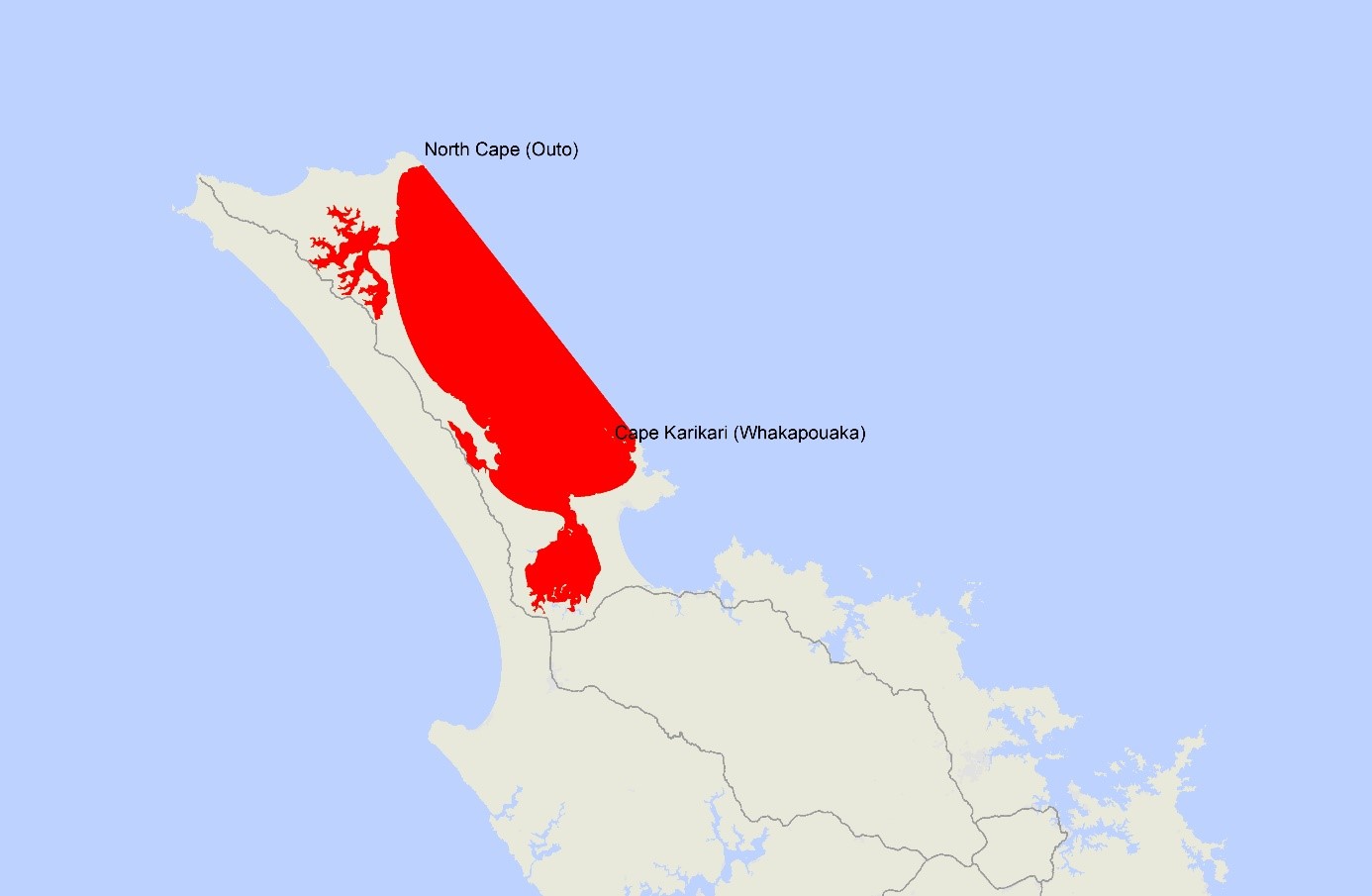
Map highlighting in red the areas affected.

The Ministry for Primary Industries today extended the public health warning against collecting shellfish in the Northland east coast region. The affected area now extends from North Cape (Outo) south to Cape Karikari (Whakapouaka). The warning includes Parengarenga, Houhoura and Rangaunu Harbours.

This warning has been extended due to a reported illness from someone consuming shellfish collected from Rarawa Beach.

MPI is undertaking sampling and testing of shellfish from this region. Test results have shown levels of Paralytic Shellfish Poisoning (PSP) toxins above the safe limit of 0.8 mg/kg set by MPI.

Anyone eating shellfish from this area is potentially at risk of illness.

Mussels, oysters, tuatua, pipi, toheroa, cockles, scallops, catseyes, kina (sea urchin) and all other bivalve shellfish should not be eaten.

Note: cooking shellfish does not remove the toxin.

Pāua, crab and crayfish may still be eaten if the gut has been completely removed prior to cooking, as toxins accumulate in the gut. If the gut is not removed its contents could contaminate the meat during the cooking process.


USA – Kroger Shrimp Recalled For Potential Health Hazard

Food Poisoning Bulletin

Kroger is recalling cooked shrimp that was actually sold raw or undercooked because they could be a potential health hazard. That means the shrimp could be contaminated with spoilage bacteria or with bacteria that could make you sick. The Kroger shrimp was sold in stores in parts of Michigan, central and northwest Ohio, and northwestern Virginia. This recall also includes Fry’s, King Soopers, and Smith’s grocery stores that are part of the Kroger chain.

Consumers may contact:

Aqua Star Consumer Hotline at 1-800-232-6280

We are sorry for this inconvenience. Your safety is important to us.


UK – UK family still waiting for answers one year after E. coli poisoning

Barf Blog

The Yorkshire Post reports parents of two boys who be­came se­ri­ously ill af­ter con­tract­ing E.coli 0157 sus­pected to be from beef burg­ers are still wait­ing for an­swers from su­per­mar­ket gi­ant Sains­bury’s more than a year later.

Al­fie and Oliver Maude, then seven and three, from Rich­mond, North York­shire, came down with up­set stom­achs two days af­ter eat­ing the Taste the Dif­fer­ence Aberdeen An­gus burg­ers in Oc­to­ber 2017. Al­fie was ad­mit­ted to Dar­ling­ton hos­pi­tal two days later with ex­cru­ci­at­ing stom­ach pain and se­vere de­hy­dra­tion.