Category Archives: Uncategorized

Research – Characterization of Virulence and Persistence Abilities of Listeria monocytogenes Strains Isolated from Food Processing Premises

Journal of Food Protection

ABSTRACT

We report the characterization of 15 Listeria monocytogenes strains isolated from various food processing plants by multivirulence locus sequence typing to determine virulence types (VTs) and epidemic clones. Molecular mechanisms involved in adaptation to food processing environments and related to virulence were also studied. Phenotypic behaviors associated with various antimicrobials, biofilm formations, and invasiveness were assessed. There were 11 VTs among the 15 L. monocytogenes strains. Strains belonging to six VTs were stress survival islet 1 (SSI-1) and one strain of VT94 was SSI-2. Tn6188 was found in VT6 and VT94 strains, and bcrABC cassette genes were identified in VT21, VT60, and VT63 strains. Only one strain, in VT20, showed llxS, whereas a full-size inlA was detected in strains belonging to VT8, VT20, VT21, and VT63. VT10, VT20, VT21, VT60, and VT63 strains were the most tolerant to studied disinfectants. A VT6 strain showed the strongest biofilm formation ability in polyvinyl chloride, and strains belonging to VT10, VT11, VT20, and VT94 had moderate abilities. Antimicrobial sensitivity tests showed that all the L. monocytogenes strains were multidrug resistant. F tests revealed that only strains of VT10, VT60, and VT94 were significantly noninvasive (P < 0.05) in Caco-2 cells. Our findings illustrate how L. monocytogenes isolates exploit diverse mechanisms to adapt to adverse conditions. Consequently, detailed characterization of L. monocytogenes isolates is required for comprehensive elimination of this pathogenic bacterium in food processing environments.

HIGHLIGHTS
  • Virulence types of epidemic clones are multidrug resistant and tolerant to disinfectants.

  • Presence of SSI-1, SSI-2, Tn6188, and ability to form biofilm support persistent strains.

  • Strains unable to invade Caco-2 cells have higher tolerance to disinfectants exposure.
Research – Recalls of Foods due to Microbial Contamination Classified by the Canadian Food Inspection Agency, 2000 to 2017

Journal of Food Protection

ABSTRACT

Recall of microbial-contaminated food products is an important intervention in preventing the transmission of foodborne illness. Here, we summarize the number and nature of foods recalled as a result of microbial contamination, classified by the Canadian Food Inspection Agency, for the period 1 January 2000 through 31 December 2017. A total of 10,432 food products were recalled from 2,094 recall events in Canada because of microbial contamination during this period. The meat, meat products and poultry category, followed by fishery and seafood products and nuts and edible seeds, contained the food products most commonly associated with microbial contamination. Most microbial-contaminated food products reported were recalled because of the presence bacterial pathogens. Salmonella contamination was responsible for the largest number of recall events, whereas Listeria monocytogenes contamination accounted for the greatest number of food products recalled because of microbial contamination. L. monocytogenes contamination was also most commonly associated with major food recall events, although records may be inflated because of an invested effort to prevent future L. monocytogenes outbreaks following a 2008 deli meat recall. The findings and data we present in this study will support future surveillance and analysis of microbial-contaminated food recalls in Canada.

HIGHLIGHTS
  • Top microbial-contaminated food products were meat, seafood, and nuts and edible seeds.

  • Salmonella contamination was responsible for the largest number of recall events.

  • L. monocytogenes accounted for the largest number of recalled food products.

Information -Food Safety and Eating Out

CDC

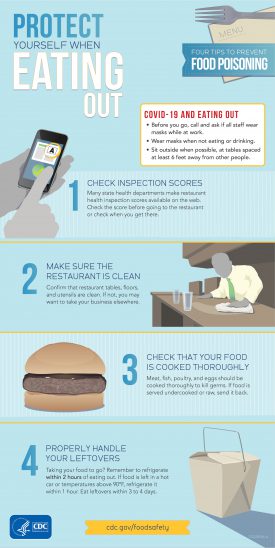
Food Safety Tips for Eating at Restaurants

  • Check inspection scores. Check a restaurant’s score at your health department’s website, ask the health department for a copy of the report, or look for it when you get to the restaurant.
  • Look for certificates that show kitchen managers have completed food safety training. Proper food safety training can help improve practices that reduce the chance of spreading foodborne germs and illnesses.
  • Look for safe food-handling practices. Sick food workers pdf icon[272 KB] can spread their illness to customers. Most kitchens are out of the customer’s sight, but if you can see food being prepared, check to make sure workers are using gloves or utensils to handle foods that will not be cooked further, such as deli meats and salad greens.
  • Order food that’s properly cooked. Certain foods, including meat, poultry, and fish, need to be cooked to a temperature high enough to kill harmful germs that may be present. If you’re served undercooked meat, poultry, seafood, or eggs, send them back to be cooked until they are safe to eat.
  • Avoid food served lukewarm. Cold food should be served cold, and hot food should be served hot. If you’re selecting food from a buffet or salad bar, make sure that the hot food is steaming, and the cold food is chilled. Germs that cause food poisoning grow quickly when food is in the danger zone, between 40˚F and 140˚F.
  • Ask your server if they use pasteurized eggs in foods such as Caesar salad dressing, custards, or hollandaise sauce. Raw or undercooked eggs can make you sick unless they’re pasteurized to kill germs.
  • Take care of your leftovers quickly. Refrigerate within 2 hours of eating out. If it is above 90ºF outside, refrigerate leftovers within 1 hour. Eat leftovers within three to four days. Throw them out after that time.

Protect Yourself When Eating Out

Research – Sanitization of Chicken Frames by a Combination of Hydrogen Peroxide and UV Light To Reduce Contamination of Derived Edible Products

Journal of Food Protection

ABSTRACT

Chicken carcass frames are used to obtain mechanically separated chicken (MSC) for use in other further processed food products. Previous foodborne disease outbreaks involving Salmonella-contaminated MSC have demonstrated the potential for the human pathogen to be transmitted to consumers via MSC. The current study evaluated the efficacy of multiple treatments applied to the surfaces of chicken carcass frames to reduce microbial loads on noninoculated frames and frames inoculated with a cocktail of Salmonella enterica serovar Enteritidis and Salmonella enterica serovar Typhimurium. Inoculated or noninoculated frames were left untreated (control) or were subjected to treatment using a prototype sanitization apparatus. Treatments consisted of (i) a sterile water rinse, (ii) a water rinse followed by 5 s of UV-C light application, or (iii) an advanced oxidation process (AOP) combining 5 or 7% (v/v) hydrogen peroxide (H2O2) with UV-C light. Treatment with 7% H2O2 and UV-C light reduced numbers of aerobic bacteria by up to 1.5 log CFU per frame (P < 0.05); reductions in aerobic bacteria subjected to other treatments did not statistically differ from one another (initial mean load on nontreated frames: 3.6 ± 0.1 log CFU per frame). Salmonella numbers (mean load on inoculated, nontreated control was 5.6 ± 0.2 log CFU per frame) were maximally reduced by AOP application in comparison with other treatments. No difference in Salmonella reductions obtained by 5% H2O2 (1.1 log CFU per frame) was detected compared with that obtained following 7% H2O2 use (1.0 log CFU per frame). The AOP treatment for sanitization of chicken carcass frames reduces microbial contamination on chicken carcass frames that are subsequently used for manufacture of MSC.

HIGHLIGHTS
  • Chicken carcass frames were sanitized using an advanced oxidation process.

  • Salmonella was reduced by 1.1 log CFU per frame with H2O2 and UV-C light.

  • Aerobic bacteria were reduced by up to 1.5 log CFU per frame with 7% H2O2 plus UV-C light.

  • Advanced oxidation processing produced greater reductions than water or UV-C light alone.

Research -Characterization of bacterial pathogens associated with milk microbiota in Egypt

Academic Journals

Abstract

Milk is a substantial source of nutrients needed by all humans across lifespan development. Given its nutritional composition, milk is considered a vehicle for various microbes including beneficial and pathogenic bacteria. In this study, 270 milk samples comprising raw cow and buffalo milk and pasteurized milk with different shelf-life durations were tested along with pasteurized organic milk for the presence of Staphylococcus aureus and Escherichia coli. Collectively, 21 E. coli and 14 S. aureus isolates were cultivated and identified from total milk samples. All E. coli and S. aureus isolates exhibited resistance to erythromycin and penicillin, respectively. Serogroups O26, O128, and O111 were the most frequently identified amongst E. coli isolates, whereas staphylococcal enterotoxins (SEs) were inconsistently produced across S. aureus isolates. The molecular profile showed clustering of 6 isolates of E. coli by harboring stx1, stx2, eaeA genes, and 5 isolates of S. aureus by mecA gene. Findings revealed the bacteriological quality of popularly consumed milk in Egypt, including raw and pasteurized milk with preference to pasteurized organic milk and 7-day shelf life (7DSL) pasteurized milk. However, raw milk and 3MSL pasteurized milk were the major sources of E. coli and S. aureus, posing a serious public health issue.

Information – 10 Dangerous Food Safety Mistakes

CDC

We all want to keep our families safe and healthy. But sometimes a simple mistake in the way we handle and prepare food can lead to serious sickness. With some germs like Salmonella, just a small amount in undercooked food is enough to cause food poisoning. And just a tiny taste of food with botulism toxin can cause paralysis and even death.

You can protect your family by avoiding these common food safety mistakes.

Washing Chicken Spreads Germs

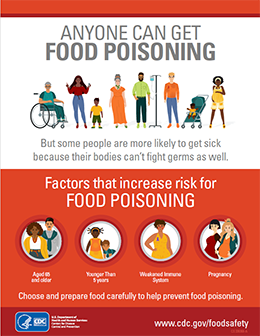
Thumbnail image of downloadable PDF about Food Poisoning.

cdcookie

Research -Occurrence, Seasonal Distribution, and Molecular Characterization of Vibrio vulnificus, Vibrio cholerae, and Vibrio parahaemolyticus in Shellfish (Mytilus galloprovincialis and Ruditapes decussatus) Collected in Sardinia (Italy)

Journal of Food Protection

ABSTRACT

In this study, we investigated the occurrence, seasonal distribution, and molecular characterization of pathogenic vibrios in Mediterranean mussels (Mytilus galloprovincialis) and grooved carpet shells (Ruditapes decussatus) from two harvesting areas of Sardinia (Italy). Samples collected before and after depuration were submitted for qualitative and quantitative determination of Vibrio spp. Vibrio spp. isolates were presumptively identified by means of biochemical methods. Identification and virulence profile of Vibrio cholerae, Vibrio parahaemolyticus, and Vibrio vulnificus were performed by molecular methods. The prevalence of Vibrio spp. in M. galloprovincialis and R. decussatus was, respectively, 96 and 77%. The averaged enumeration (mean ± standard deviation) of Vibrio spp. in samples of M. galloprovincialis and R. decussatus collected at the harvesting time was 2.04 ± 0.45 and 2.51 ± 0.65 log CFU/g, respectively. The average contamination levels in samples collected after purification were 2.28 ± 0.58 log CFU/g (M. galloprovincialis) and 2.12 ± 0.67 log CFU/g (R. decussatus). Four potentially pathogenic V. parahaemolyticus isolates (tdh+ or trh+) were recovered from grooved carpet shells samples. No isolate was tdh+/trh+. The presence of potentially pathogenic vibrios in Sardinian waters strengthens the need for rational purification practices under controlled conditions to guarantee the protection of consumers.

HIGHLIGHTS
  • Occurrence and pathogenicity characteristics of Vibrio pathogens were investigated.

  • Prevalence of Vibrio spp. in M. galloprovincialis was 96% and in R. decussatus was 77%.

  • Environmental conditions influence the occurrence of Vibrio spp.

  • Four V. parahaemolyticus isolates carried tdh or trh genes.

  • Rational purification practices are needed to guarantee the protection of consumers.

USA – Egg Rolls Recalled Because They Were Produced Under Insanitary Conditions

Food Poisoning Bulletin

T&R Enterprise USA Inc. of St. Louis, Missouri, is recalling about 118,000 pounds of meat and poultry egg rolls because they were produced and packed under insanitary conditions. No illnesses have been reported to date in connection with this recall. The recall notice did not go into more discussion about the potential problems with these products.

These meat and poultry egg rolls were produced on dates ranging from August 1, 2019 to September 25, 2019. They include:

  • 2 ounce cases containing 80 pieces of “SILVER LABEL PORK & VEGETABLE PROTEIN EGG ROLL.”
  • 2 ounce cases containing 120 pieces of “Dai Kin PORK & TEXTURED VEGETABLE PROTEIN EGG ROLL.”
  • 2 ounce cases containing 120 pieces of “TITA’S PORK & TEXTURED VEGETABLE PROTEIN EGG ROLL.”
  • 2 ounce cases containing 120 pieces of “TITA’S CHICKEN & TEXTURE VEGETABLE PROTEIN EGG ROLL.”

These products all have the establishment number “EST. 33792” or “P33792” inside the USDA mark of inspection. They were shipped to institutions in Georgia and Missouri.

Research – Potential Ad Hoc Markers of Persistence and Virulence in Canadian Listeria monocytogenes Food and Clinical Isolates

Food Protection Journal

ABSTRACT

The Listeria monocytogenes gene inlA, encoding a surface virulence protein, was examined for the presence of premature stop codon (PMSC) mutations in 82 isolates obtained by the Canadian Food Inspection Agency (CFIA) from foods and food contact surfaces. These mutations were coanalyzed for the presence of stress survival islet 1 (SSI-1) and for the abilities of the isolates to invade Caco-2 intestinal epithelial cells and form biofilms on polystyrene. PMSC mutations were present in one-third of the isolates (predominantly those of serogroup 1/2a), and their presence was correlated with a noninvasive phenotype. The presence of SSI-1 and the ability to form biofilms were also linked to the 1/2a serogroup. Serogroup 4b isolates lacked inlA PMSC mutations and were invasive, but neither formed biofilms nor carried SSI-1. To expand upon these experimental findings, an in silico analysis was performed on L. monocytogenes genomes from Canadian databases of 278 food isolates and 607 clinical isolates. The prevalence of inlA PMSC mutations in genomes of food isolates was significantly higher (P < 0.0001) than that in clinical isolates. Also, a three-codon deletion in inlA associated with a hyperinvasive phenotype was more prevalent in genomes from clinical isolates (primarily of clonal complex 6, serogroup 4b) than in those from food isolates (P < 0.001). In contrast, SSI-1 was significantly overrepresented (P < 0.001) in genomes from food isolates. We propose the hypothesis that SSI-1 and inlA play a role in the evolution of Canadian L. monocytogenes strains into either a virulent (represented by serogroup 4b clinical isolates) or an environmentally persistent (represented by serogroup 1/2a food isolates) phenotype. The combined presence of SSI-1 and inlA PMSC mutations have potential for use as genetic markers for risk assessment when L. monocytogenes is recovered from foods, indicating low potential for pathogenesis.

HIGHLIGHTS
  • Numerous Canadian food isolates of L. monocytogenes have attenuated virulence.

  • Food but not clinical Canadian L. monocytogenes strains often have inlA mutations.

  • Listeria strains carry potential markers of virulent or persistent phenotypes.

  • SSI-1 and inlA may be phenotypic markers for Canadian L. monocytogenes strains.

  • SSI-1 and inlA may indicate the health risk associated with L. monocytogenes food isolates.

USA -Another Case of Hepatitis A via a food service worker

Food Poison Journal

A case of Hepatitis A has been confirmed in a food worker at Popeyes Louisiana Kitchen on earl Core Road, according to the Monongalia County Health Department.

“While the risk of contracting Hepatitis A from a food worker is low, people who have not been vaccinated against Hepatitis A who have consumed food from the restaurant within the past two weeks should consider getting a Hepatitis A vaccine to prevent infection,” said Dr. Lee B. Smith, MCHD executive director and county health officer