Category Archives: Microbiology

Australia – Your poultry doesn’t need a bath!

Food Safety ASN

Campylobacter kswfoodworld

The Food Safety Information Council and the Australian Chicken Meat Federation today released a consumer survey that found 49% of Australian cooks were still taking a food poisoning risk by washing raw whole chicken before cooking.

Cathy Moir, Council Chair, said washing any raw poultry is very risky as it can spread bacteria to your hands, surfaces and other foods that may not be cooked. Washing is also unnecessary as cooking poultry to 75°C in the centre of a fillet or the thickest part of the thigh will kill any bacteria.

‘We are pleased that rates of washing raw whole chicken has reduced from 60% to 49% since we last asked this question in 2011. Cooks who wash raw chicken pieces with skin on has also reduced from 52% to 43% and washing skinless pieces from 41% to 40%.

‘The survey found that chicken is a popular dish with 78% of respondents cooking whole chicken, 83% cooking chicken pieces with skin on and 88% cooking skinless pieces. But the message is that washing any raw poultry, whether it is chicken, duck, goose or the Christmas turkey, is both unsafe and unnecessary.

“As we gather this Summer with multi-generations of family and friends, here are some of our key Christmas and Summer entertaining food safety tips:

  1. Wash hands: Another recent survey has found the number of times people wash their hands each day dropped 15% since last year. Don’t forget to wash your hands with soap and water before preparing and cooking food, and after handling shell eggs, seafood, raw meat and poultry, burgers and sausages. Watch how to wash your hands correctly using the Glitterbug here
  2. Clean utensils: Ensure your tools, utensils and chopping-boards are cleaned and dried thoroughly before you start preparing your food and ensure you clean them with hot soapy water after use. Use separate chopping-boards such as red for raw meat/poultry and  green for vegetables.
  3. Don’t strain your fridge: Plan ahead and don’t buy more food than you need. It’s vital that you don’t overstock your fridge and freezer, as this won’t allow the cool air to circulate freely and perishable food cannot be adequately frozen or chilled. Less food will also help to reduce food waste.
  4. Make space: Prevent overstocking by making room in your fridge for perishable foods by removing alcohol and soft drinks and put them on ice in a container or laundry sink. This also stops guests opening the fridge so often and helps to maintain the temperature at 5°C or below. Use a fridge thermometer to check the fridge temperature.
  5. Bird or bits? Think about getting a turkey breast that is simpler to cook, rather than a whole turkey. If you do need a whole turkey ask your supermarket if they sell them fresh rather than frozen. Otherwise it must be covered and defrosted in your fridge which can take several days and also increase the risk of potentially contaminating ready to eat foods stored in the fridge.
  6. Cook poultry correctly: Cook the any poultry until a meat thermometer shows it has reached 75° C in the thickest part of the thigh and cook any stuffing separately as it will slow the cooking and the inside of the bird might not be fully cooked. Probe thermometers are readily available, easy to use and help you make sure that food has reached the right temperature.
  7. Don’t go raw. Cooked egg dishes are simple and nutritious but try to avoid raw or minimally cooked egg dishes, such as raw egg mayonnaise or aioli, eggnog or fancy desserts like tiramisu, which can be a particular risk for food poisoning. A safer alternative, if you want to serve raw egg dishes, is to use pasteurised egg products.
  8. Christmas ham won’t last forever– check the storage instructions and best before or use by date before removing the ham from its plastic wrap, cover it with clean cloth soaked in water and vinegar so it doesn’t dry out, and store it in the fridge at or below 5°C. Keep the cloth moist to stop the ham drying out too much. It is important to remember that the use by date on the original packaging won’t apply after the packaging has been removed, so check the fine print and see if the ham has a suggested shelf life after opening. Reduced salt hams are now becoming popular but will not last as long as conventional hams so think how much you are going to use in the next week or so and freeze the rest for later.
  9. Phased roll-out: Don’t leave perishable chilled foods out for more than two hours. These foods include cold meats, soft cheeses like Camembert and Brie, cold poultry, cooked seafood like prawns and smoked salmon, pâtés, sushi and salads. Put out small amounts and replace them (do not top them up) from the fridge.
  10. Get it cold, quick. Refrigerate leftovers as soon as possible. If perishable foods and leftovers have been left out of the fridge for less than two hours they should be okay to refrigerate or freeze to eat later, so long as they haven’t been sitting out on a hot day. Never eat perishable food that has been unrefrigerated for more than four hours as it may not be safe and should be thrown away. Food should not be refrigerated if it has been outside in the heat for more than an hour and discarded after it has sat outside for 2 hours.
  11. Get it right hot. Always reheat leftovers to 75°C the centre of the item or the thickest part to kill any food poisoning bugs. Use a probe thermometer or the auto reheat function of your microwave (following any prompts) to help you make sure that the leftovers have been reheated safely.

‘We would like to thank our partner Tonic Media Network who will be showing our handwashing and food safety community service announcements in GP, Pharmacy and hospital waiting rooms around Australia this Summer. Also, thanks to our member First for Training, the Australian Chicken Meat Federation and Accord for their charitable donations to fund our Summer campaign.\,” Ms Mir concluded.

Media contact: Lydia Buchtmann, Food Safety Information Council, 0407 626 688 or info@foodsafety.asn.au

Survey details:

The chicken washing survey was conducted nationally by Omnipoll amongst 1219 people aged 18+ over the period 7-12 October 2021. Respondents were drawn from the online consumer panel managed by Lightspeed Research, OmniPoll’s online partner and to help reflect the overall population distribution. Results were post-weighted to Australian Bureau of Statistics (2016 Census) data on education, age, sex and area.

Research – Norovirus Vaccines: Current Clinical Development and Challenges

MDPI

Noroviruses are the major viral pathogens causing epidemic and endemic acute gastroenteritis with significant morbidity and mortality. While vaccines against norovirus diseases have been shown to be of high significance, the development of a broadly effective norovirus vaccine remains difficult, owing to the wide genetic and antigenic diversity of noroviruses with multiple co-circulated variants of various genotypes. In addition, the absence of a robust cell culture system, an efficient animal model, and reliable immune markers of norovirus protection for vaccine evaluation further hinders the developmental process. Among the vaccine candidates that are currently under clinical studies, recombinant VP1-based virus-like particles (VLPs) that mimic major antigenic features of noroviruses are the common ones, with proven safety, immunogenicity, and protective efficacy, supporting a high success likelihood of a useful norovirus vaccine. This short article reviews the recent progress in norovirus vaccine development, focusing on those from recent clinical studies, as well as summarizes the barriers that are being encountered in this developmental process and discusses issues of future perspective. View Full-Text

Iceland – Christmas without foodborne infections

MAST

There is a lot of pressure on Icelanders’ kitchens during Christmas preparations in December and during the holidays. Hygiene, cooling and proper heating of food are extremely important in order to prevent guests and household members from contracting foodborne illnesses with associated inconveniences.

Disease-causing bacteria can enter the kitchen with meat and soil that comes with vegetables and from there into other foods on the kitchen table or in the refrigerator. They can also be received in food from the person handling the food and from the equipment and utensils used in the kitchen.

Noroviruses can spread rapidly at Christmas and it is important for people with symptoms of foodborne illness to refrain from cooking. Regular hand washing reduces the risk of infection between persons or from contaminated food.

Keep in mind that:

  • Raw meat and its juices should not come into contact with ready-to-eat foods
  • Wash fruits and vegetables to prevent bacteria from entering ready-to-eat foods
  • Wash hands before cooking and after contact with raw meat and unwashed vegetables
  • Clean cutting boards and utensils immediately after use
  • Let’s organize the fridge well and keep it clean to prevent cross-contamination
  • We regularly change tablecloths, tea towels and hand towels

Bacteria multiply very rapidly under ideal conditions. At 37 ° C, one bacterium can multiply to 1000 in 3 hours and to 1 million in 6 hours. It is therefore important to store and handle food at a temperature that will prevent the rapid growth of bacteria by limiting the time that sensitive foods, such as smoked and buried fish and cold cuts, are on the table at room temperature. The greatest risk of bacterial growth is when the temperature of the food is between 5 and 60 ° C. Adequate heat treatment kills bacteria and storage at refrigerated temperatures (0-4 ° C) limits their proliferation. If food is to be kept hot, keep it at 60 ° C and when cooling heated food, make sure that it reaches 4 ° C in 3 hours. 

Citizens are encouraged to practice hygiene, proper handling and cooling of food in the kitchen so that foodborne illnesses can be prevented from spoiling the Christmas spirit.

Related material

Denmark – Danish campaign targets knowledge about cooling of hot food

Food Safety News

Most businesses correctly cool down hot food but some violations were found during inspections in Denmark.

The Danish Veterinary and Food Administration (Fødevarestyrelsen) investigated whether shops, restaurants and caterers were in control of the refrigeration and cooling process and its management.

Overall, 91 percent of the sites subject to unannounced visits knew how to cool down hot food. However, issues were found at the other 9 percent, including cooling of heat-treated food happening too slowly and procedures not being followed.

“Every year we see outbreaks of disease, which are caused by slow cooling of heat-treated foods. When this happens, it is most often because the company has produced large portions that have not cooled down quickly enough. Therefore, it is important that the amount of hot food matches the capacity of the cold storage,” said Ulrich Pinstrup, from the Danish Veterinary and Food Administration.

USA – Shigella Outbreak increases in San Diego

Food Poison Journal

Shigella - kswfoodworld

Image CDC

The County of San Diego has announced the ongoing outbreak of shigella now stands at 46 confirmed and five probable cases, with slowing cases up one from a week ago and a total of three since the 41 confirmed and seven probable cases reported in the Dec. 3 update.

The continuing investigation shows onset of illness dates between Aug. 16 and Nov. 21, 2021, with the new cases occurring between Nov.15 and Nov. 21, 2021, with symptom onset for the latest case being Nov. 27, 2021. The 51 cases in this outbreak represent 13% of the 402 total cases reported to date in San Diego County.

The County Public Health shigella website includes an epidemiological curve showing declining case numbers in recent weeks.

Research – Food Handling Concerns and Practices at-Home during the COVID-19 Pandemic by Food Security Status

Journal of Food Protection

There is limited examination about COVID-19-related food handling concerns and practices that cause chemical or microbial contamination and illness, particularly among those with food insecurity. We investigated consumer food handling concerns and practices during the COVID-19 pandemic, and whether they differed by food insecurity status. An online survey was distributed among Chicago, Illinois residents between July 15-August 21, 2020 (N=437). Independent t-tests and Fisher’s Exact tests were used to identify differences in food handling concerns and practices between those with and without food insecurity (alpha=0.05). Survey items included questions about food handling practices that were considered safe or neutral (i.e., washing hands and produce with water, sanitizing food packaging) and unsafe (i.e., using cleaning agents to wash foods, leaving perishable foods outside) using 5-point Likert-style scales or categorical responses (i.e., yes, no). Participant responses fell between “slightly” and “somewhat” concerned about contracting COVID-19 from food and food packaging (mean ± SE: 2.7±0.1). While participants reported washing their hands before eating and preparing foods at least “most of the time” (mean ± SE: 4.4 ± 0.0 and 4.5 ± 0.0, respectively), only one-third engaged in unsafe practices. The majority of participants (68%) indicated that they altered food handling practices due to the COVID-19 pandemic and received information about food safety from social media (61%).  When investigating differences in concerns and practices by food insecurity status, food insecure participants were more concerned about COVID-19 foodborne transmission for all food items (ps<0.0001) and more frequently performed unsafe based food handling practices than those with food security (ps<0.0001). Results from this study suggest more investigation is needed to understand barriers to safe food handling knowledge and practices, particularly among those with food insecurity.

Research – The Application of Bacillus subtilis for Adhesion Inhibition of Pseudomonas and Preservation of Fresh Fish

MDPI

Inhibiting the growth of spoilage bacteria, such as Pseudomonas spp., is key to reducing spoilage in fish. The mucus adhesion test in vitro showed that the adhesion ability of Bacillus subtilis was positively correlated with its inhibition ability to Pseudomonas spp. In vivo experiments of tilapia showed that dietary supplementation with B. subtilis could reduce the adhesion and colonization of Pseudomonas spp. in fish intestines and flesh, as well as reduce total volatile basic nitrogen (TVB-N) production. High throughput and metabolomic analysis showed treatment with B. subtilis, especially C6, reduced the growth of Pseudomonas spp., Aeromonas spp., Fusobacterium spp., and Enterobacterium spp., as well as aromatic spoilage compounds associated with these bacteria, such as indole, 2,4-bis(1,1-dimethylethyl)-phenol, 3-methyl-1-butanol, phenol, and 1-octen-3-ol. Our work showed that B. subtilis could improve the flavor of fish by changing the intestinal flora of fish, and it shows great promise as a microecological preservative. View Full-Text

Research – Recent Advances in the Mechanisms and Regulation of QS in Dairy Spoilage by Pseudomonas spp.

MDPI

Food spoilage is a serious issue dramatically impacting the worldwide need to counteract food insecurity. Despite the very expensive application of low temperatures, the proper conservation of fresh dairy products is continuously threatened at different stages of production and commercialization by psychrotrophic populations mainly belonging to the Pseudomonas genus. These bacteria cause discolouration, loss of structure, and off-flavours, with fatal implications on the quality and shelf-life of products. While the effects of pseudomonad decay have been widely reported, the mechanisms responsible for the activation and regulation of spoilage pathways are still poorly explored. Recently, molecule signals and regulators involved in quorum sensing (QS), such as homoserine lactones, the luxR/luxI system, hdtS, and psoR, have been detected in spoiled products and bacterial spoiler species; this evidence suggests the role of bacterial cross talk in dairy spoilage and paves the way towards the search for novel preservation strategies based on QS inhibition. The aim of this review was to investigate the advancements achieved by the application of omic approaches in deciphering the molecular mechanisms controlled by QS systems in pseudomonads, by focusing on the regulators and metabolic pathways responsible for spoilage of fresh dairy products. In addition, due the ability of pseudomonads to quickly spread in the environment as biofilm communities, which may also include pathogenic and multidrug-resistant (MDR) species, the risk derived from the gaps in clearly defined and regulated sanitization actions is underlined. View Full-Text

Research – Role of blue light in bactericidal effect against meat-borne pathogens and freshness maintaining of beef 

Journal of Food Protection

Beef is rich in various nutrients while easily spoils due to contamination by pathogens, thus it is of great significance to develop a bactericidal method to inactivate meat-borne pathogens and meanwhile maintain the freshness of beef. For the first time, the present study investigated the bactericidal effect of blue light (BL) at 415 nm against four meat-borne pathogens (methicillin-resistant Staphylococcus aureus , Escherichia coli , Salmonella Typhimurium and Listeria monocytogenes ) in vitro and inoculated on the surface of fresh beef, respectively. When the non-illuminated beef was used as control, the population of the four pathogens did not change significantly ( P > 0.05), while BL-illuminated beef showed dose-dependent inactivation effect in both in vitro and in vivo studies. The experiments on beef cuts showed that 109.44 J/cm 2 of BL inactivated 90% of inoculated cells for the tested strains ( P < 0.05), and the impact of BL inactivation could be sustained in 7 days of cold storage. Notably, changes of lipid oxidation rate, water holding capacity and cooking loss value between the control and beef illuminated by 109.44 J/cm 2 at the same time were scarcely detected during the storage. BL had a minor but insignificant influence on surface color and free amino acid content. Moreover, the pH of illuminated beef increased slower ( P < 0.05) than that of non-illuminated beef. The present work demonstrated that BL could be a novel bactericidal and freshness-maintaining method for fresh beef.

USA – CDC – Food Safety Page

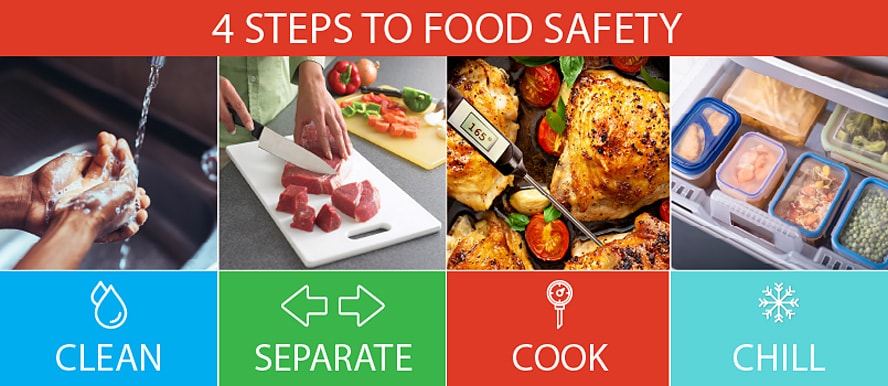
4 Steps to Food Safety - Clean, Separate, Cook and Chill

CDC