Category Archives: Lactobacillus

Research – Anti-Biofilm Effects of Z102-E of Lactiplantibacillus plantarum against Listeria monocytogenes and the Mechanism Revealed by Transcriptomic Analysis

MDPI

Abstract

Lactic acid bacteria (LAB) are the most common probiotics, and they present excellent inhibitory effects on pathogenic bacteria. This study aimed to explore the anti-biofilm potential of the purified active substance of Lactiplantibacillus plantarum, named Z102-E. The effects of Z102-E on Listeria monocytogenes were investigated in detail, and a transcriptomic analysis was conducted to reveal the anti-biofilm mechanism. The results indicated that the sub-MIC of Z102-E (3.2, 1.6, and 0.8 mg/mL) decreased the bacterial growth and effectively reduced the self-aggregation, surface hydrophobicity, sugar utilization, motility, biofilm formation, AI-2 signal molecule, contents of extracellular polysaccharides, and extracellular protein of L. monocytogenes. Moreover, the inverted fluorescence microscopy observation confirmed the anti-biofilm effect of Z102-E. The transcriptomic analysis indicated that 117 genes were up-regulated and 214 were down-regulated. Z102-E regulated the expressions of genes related to L. monocytogenes quorum sensing, biofilm formation, etc. These findings suggested that Z102-E has great application potential as a natural bacteriostatic agent.

Research – Microbial community structure of plant-based meat alternatives.

Nature

A reduction in animal-based diets has driven market demand for alternative meat products, currently raising a new generation of plant-based meat alternatives (PBMAs). It remains unclear whether these substitutes are a short-lived trend or become established in the long term. Over the last few years, the trend of increasing sales and diversifying product range has continued, but publication activities in this field are currently limited mainly to market research and food technology topics. As their popularity increases, questions emerge about the safety and nutritional risks of these novel products. Even though all the examined products must be heated before consumption, consumers lack experience with this type of product and thus further research into product safety, is desirable. To consider these issues, we examined 32 PBMAs from Austrian supermarkets. Based on 16S rRNA gene amplicon sequencing, the majority of the products were dominated by lactic acid bacteria (either Leuconostoc or Latilactobacillus), and generally had low alpha diversity. Pseudomonadota (like Pseudomonas and Shewanella) dominated the other part of the products. In addition to LABs, a high diversity of different Bacillus, but also some Enterobacteriaceae and potentially pathogenic species were isolated with the culturing approach. We assume that especially the dominance of heterofermentative LABs has high relevance for the product stability and quality with the potential to increase shelf life of the products. The number of isolated Enterobacteriaceae and potential pathogens were low, but they still demonstrated that these products are suitable for their presence.

Research – Biocontrol of L. monocytogenes with Selected Autochthonous Lactic Acid Bacteria in Raw Milk Soft-Ripened Cheese under Different Water Activity Conditions

MDPI

Abstract

The effect of selected autochthonous Lactic Acid Bacteria (LAB) against Listeria monocytogenes was evaluated in two elaborations of soft-ripened cheese performed under high and low relative humidity (RH) elaborations, to achieve aw ranging from 0.97 to 0.94 in ripened cheeses. Two selected autochthonous strains of Lacticaseibacillus casei 31 and 116 were used. In each elaboration, 8 batches were physicochemically and microbiologically evaluated throughout the ripening process. The aw and pH decreased during ripening to final values ranging from 0.944 to 0.972 aw and 5.0 to 5.3 pH, respectively. LAB was the only microbial group that increased throughout the ripening in high and low RH elaborations. In batches that were uninoculated with LAB strains, L. monocytogenes was either maintained at the initial inoculation level or showed a slight reduction by the end of the ripening process. However, in LAB-inoculated batches in the two elaborations, steady decreases of L. monocytogenes were observed throughout maturation. L. casei 31 alone or in combination with strain 116 provoked reductions of 2 to 4 log CFU/g in L. monocytogenes over 60 days of ripening, which could be enough as a strategy for biocontrol to deal with the usual contamination by L. monocytogenes during cheese processing.

Research – Lactic acid bacteria and spoilage bacteria: Their interactions in Escherichia coli O157:H7 biofilms on food contact surfaces and implications for beef contamination

Wiley Online

Abstract

This research explores the interaction between Shiga toxin-producing Escherichia coli (STEC) O157:H7 and bacteria species commonly found in beef processing environments, specifically CarnobacteriumLactobacillusComamonasRaoultella, and Pseudomonas. The study investigated how various environmental conditions impact the formation of biofilms and the ability of O157:H7 to transfer from multispecies biofilm onto beef surfaces. For this purpose, a mixture of lactic acid bacteria (LAB), spoilage bacteria (106 CFU/mL), and E. coli O157 (103 CFU/mL) were combined as follows: LAB (T1)Carnobacterium piscicola + Lactobacillus bulgaricus + O157:H7, an spoilage bacteria (T2)Comamonas koreensis + Raoultella terrigena + O157:H7, an spoilage bacteria (T3)Pseudomonas aeruginosa + C. koreensis strain + O157:H7 and only O157:H7 as control (T4). Multispecies biofilms were developed on thermoplastic polyurethane (TPU) and stainless steel (SS) coupons at 10 and 25°C for 6 days, washed and stored for 6, 30, and 60 days at wet (60%–90% RH) and dry (20%–50%, RH) conditions. To evaluate O157:H7 transfer, beef cubes (3 × 3 × 1 cm) were placed on the coupons, followed by a 50-g weight (7.35 kPa). The experiment was repeated three times in triplicate for each strain combination. Results demonstrate that biofilms formed at 10°C were generally weaker (less biomass) than those at 25°C. Regardless of temperature, more viable O157:H7 cells were transferred to beef from moist biofilms on TPU surfaces. At 25°C, T3 biofilm exhibited the lowest O157:H7 transfer to beef by 1.44 log10 CFU/cm2 (p < 0.01). At 10°C, none of the multispecies biofilm (T1–T3) affected the number of O157:H7 transfers to beef (p > 0.05). Notably, O157:H7 was not detected on food contact surfaces with 30 and 60-day-old dry biofilms (T1–T4). Through enrichment, E. coli O157:H7 was recovered from multispecies biofilms T1, T2, and T3. Findings from this study imply that multispecies biofilms contribute to the persistence of O157:H7 under dry conditions, regardless of temperature. These results underscore the intricate influence of multiple environmental factors—including surface type, biofilm age, humidity, temperature, and the presence of other bacterial species—on the risk of beef contamination facilitated by biofilms.

RASFF Alert- Lactobacilli – Curry Ketchup

RASFF

Lactobacilli in curry ketchup from the Netherlands in Aruba, Canada, Portugal and Spain

Research – Inactivation of Foodborne Pathogens by Lactobacillus Strains during Meat Fermentation: Kinetics and Mathematical Modelling

MDPI

Abstract

This study examined the effect of beef fermentation with Lactiplantibacillus paraplantarum (L) PTCC 1965, Lactiplantibacillus (Lplantarum subsp. plantarum PTCC 1745, and Lactiplantibacillus (Lpentosus PTCC 1872 bacteria on the growth of pathogenic bacteria, including Salmonella (S) Typhi PTCC 1609 and Staphylococcus (Saureus PTCC 1826. The growth of lactic acid bacteria (LAB) and the effect of fermentation on pathogenic bacteria were studied using Weibull: biphasic linear and competitive models. The results showed that the rate of pH reduction was lower in the early stages and increased as the microbial population grew. The α parameter was lower for L. plantarum subsp. plantarum compared to L. paraplantarum and L. pentosus. The comparison of the α parameter for bacterial growth and pH data showed that the time interval required to initiate the rapid growth phase of the bacteria was much shorter than that for the rapid pH reduction phase. The pH value had a 50% greater effect on the inactivation of S. Typhi when compared to the samples containing L. plantarum subsp. plantarum and L. pentosus. The same parameter was reported to be 72% for the inactivation of St. aureus. In general, during the fermentation process, LAB strains caused a decrease in pH, and as a result, reduced the growth of pathogens, which improves consumer health and increases the food safety of fermented meat.

Netherlands – Lactic acid bacteria in ketchup

Foedevarestyrelsen

Image of the product: Beauvais Tomato Ketchup

Orkla Food Denmark is recalling Beauvais Tomato Ketchup, 1000g, as there is a risk of lactic acid bacteria in the product. The lactic acid bacteria can affect the consistency and taste of the ketchup, making it unsuitable as food.

If you have the product, you should discard it or return it to the store where it was purchased.

Which food is recalled

Beauvais Tomato Ketchup

Net content: 1000g
Best-before dates: 29.06.2025, 02.07.2025 and 01.07.2025
Lot numbers: 154603, 156306 and 154602

Where is the product sold

The product is sold in grocery stores throughout the country

Why is the product being recalled?

Due to a manufacturing error, there is a risk of lactic acid bacteria in the product.

The lactic acid bacteria make the product unsuitable as food, as the bacteria can affect the consistency and give the tomato ketchup a sour taste.

What should you do as a consumer?

The Danish Veterinary and Food Administration advises consumers to return the product to the store where it was purchased or to discard it.

Who recalls the product

Orkla Food Danmark A/S

Deltapark 45

2665 Vallensbæk

Research – Researchers explore probiotics to control Campylobacter

Feedstuffs

On-farm control measures are required to mitigate the risk of the bacteria being transmitted to humans working with poultry and people who visit poultry farms. Abdelaziz’s lab is studying the impact of inoculating eggs (in-ovo) with probiotics on gut health and immune system development of broilers before they hatch.

Probiotics are live bacteria, fungi, or yeasts that help poultry maintain healthy digestive systems. They are increasingly being included in poultry diets as alternatives to antibiotics. Abdelaziz and his team believe in-ovo technology can be used to deliver probiotics to chicken embryos and help boost chicks’ immune systems before they hatch.

During their investigation, Abdelaziz and his team have found certain probiotics (lactobacilli) applied in-ovo to chick embryos increased immune-related genes in the chicks’ guts which could promote healthy immune systems of chick embryos. Future studies will investigate whether Lactobacillus-induced immune responses protect against harmful microorganisms after chicks hatch.

Research – Special Issue: Beneficial Properties and Safety of Lactic Acid Bacteria

MDPI

The application of LAB in various sectors, including in the biotechnical and food industry, in human and veterinary practice, and in health-promoting practices and cosmetics, has been the subject of intensive research across the globe, with a range of traditional and innovative methods currently being explored. The rediscovery of old practices, the establishment of new processes based on the production and application of different metabolites produced by LAB, and the formation of novel perspectives on the fermentation processes initiated by LAB, have become areas of significant interest in recent years. Various antimicrobial peptides, including bacteriocins, have been proposed as alternatives to antibiotics or have been suggested for use as their synergistic “partners”. The application field of probiotics is being widened to encompass new innovative areas that are targeted towards personalized practice, with the aim of improving human health. An increasingly extensive understanding of bioactive peptides has heralded their application in practices that are alternative or complementary to Western medicine. Approaches to bio-preservation require fewer chemical preservatives and are, currently, thoroughly explored in food research. The enrichment and fortification of food products with biologically active metabolites, including vitamins, antimicrobials, and immunomodulators, are only some of the research areas that ought to be explored as options for the application of various LAB in the food industry.
The concepts associated with the beneficial properties and safety of LAB have been, and always need to be, jointly explored. Even if several LAB strains have been applied historically as safe and beneficial cultures, various other representatives of LAB have been documented as human and animal pathogens, as phytopathogens, and as also including strains associated with spoilage and deterioration [1]. LAB represent a universe of varied microorganisms, with all of them characterized as Gram-positive, catalase negative, as possessing a common metabolism and as initiating the formation of a similar end product (lactic acid) as a result of carbohydrate fermentation [2]. As a diverse group of microorganisms, they are adapted to various ecosystems and environmental conditions, and can grow at different temperatures and use a variety of carbon sources [1,2]. They are associated with virtually all living forms, from simple eukaryotic organisms and plant material, to the skin and GIT of vertebrates, insects, mollusks, crustaceans, etc. They may be described as either beneficial or as pathogens, but they always possess a clear ecological role in numerous life cycles [2]. Of particular note are species such as Enterococcus spp., some of which are unmistakably opportunistic pathogens and, when associated with vancomycin resistance, pose a serious health threat to humans and to animals [3]; these pathogens are typically associated with nosocomial infections [3]. Simultaneously, however, LAB also comprise species that play a beneficial role in the production of various plants, dairy and meat fermented food products [4], or even as probiotics [5]. It has been suggested that enterococci are producers of bacteriocins, some of which can be applied in the control of food-borne and hospital-associated (human and veterinary) pathogens [6]. However, before proposing a strain, even one belonging to a species with a history of safe application, its safety properties must be appropriately evaluated; this is a necessary and essential step that must be completed prior to its application in food fermentation, as a probiotic for human and animals, in human and veterinary medicine, or in agricultural practices. The novel tools utilized in the evaluation of the safety of microbial cultures, including DNA-associated experimental approaches, have become routine in the last two decades. Considering this, the validation of safety, both of new microbial and currently applied cultures, is now considered essential. In addition to “classical” PCR-based approaches, whole genome sequencing and the appropriate analysis of the generated data have become routine in the evaluation of the safety profile of microbial cultures [7,8,9].

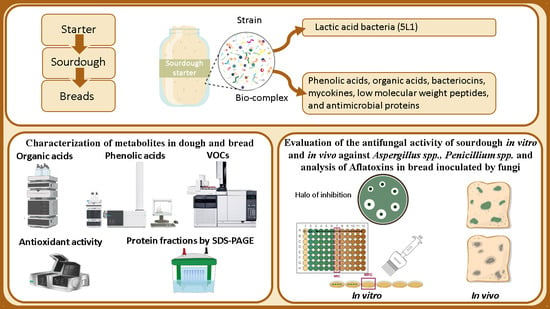
Research – Bread Biopreservation through the Addition of Lactic Acid Bacteria in Sourdough

MDPI

Abstract

Nowadays, the consumer seeks to replace synthetic preservatives with biopreservation methods, such as sourdough in bread. Lactic acid bacteria (LAB) are used as starter cultures in many food products. In this work, commercial yeast bread and sourdough breads were prepared as controls, as well as sourdough breads with L. plantarum 5L1 lyophilized. The impact of L. plantarum 5L1 on the properties of bread was studied. Antifungal compounds and the impact on the protein fraction by the different treatments in doughs and breads were also analyzed. In addition, the biopreservation capacity of the treatments in breads contaminated with fungi was studied and the mycotoxin content was analyzed. The results showed significant differences with respect to the controls in the properties of the bread and a higher total phenolic and lactic acid content in breads with higher amounts of L. plantarum 5L1. In addition, there was a higher content of alcohol and esters. Furthermore, adding this starter culture produced hydrolysis of the 50 kDa band proteins. Finally, the higher concentration of L. plantarum 5L1 delayed fungal growth and reduced the content of AFB1 and AFB2 compared to the control.