Category Archives: Histamine

France – YELLOWFIN TUNA LOIN FISHED IN THE INDIAN OCEAN – Histamine

Gov france

Identification information of the recalled product

  • Product category Food
  • Product subcategory Fishery and aquaculture products
  • Product brand name SUPPLIER BRAND
  • Model names or references SUPPLIER BRAND
  • Identification of products
    GTIN Batch Date
    3000005180735 5860221261 Use-by date 05/19/2022
  • Packaging Bulk
  • Marketing start/end date From 05/10/2022 to 05/12/2022
  • Storage temperature Product to be stored in the refrigerator
  • Health mark Nope
  • Geographic area of ​​sale Whole France
  • Distributors SCAPMAREE
  • List of points of salestore_list.pdf

Practical information regarding the recall

  • Reason for recall Non-compliant histamine level
  • Risks incurred by the consumer Other biological contaminants

Luxembourg – SARDINE FILLETS FROM LES NATURELS OCEALLIANCE – Histamine

SAP

Furic Solutions is recalling the following product:

name Sardine fillets
Brand OCEALLIANCE Naturals
Unity 200g
Sales period from 04/29/2022 to 05/03/2022
Use-by date (DLC) 05/03/2022; 04/05/2022
Batch 0622118; 0622119

Danger  : Presence of histamine

Sale in Luxembourg by: Auchan

A sale by other operators cannot be excluded.

Source of information: Auchan recall notification

Communicated by: Government Commission for Quality, Fraud and Food Safety .

RASFF Alerts – Histamine – Tonijnfilet A-Sashimi

RASFF

Histamine in Tonijnfilet A-Sashimi from Sri Lanka in Hong Kong – Belgium, Germany and Netherlands

France – Yellowfin Tuna Loin – Histamine

Gov france

Identification information of the recalled product

  • Product category Food
  • Product subcategory Fishery and aquaculture products
  • Product brand name unbranded (sold in the traditional department with service)
  • Model names or references albacore tuna loin sliced ​​on demand at the fishmonger’s stall
  • Identification of products
    Lot
    product sold between 01/03/22 and 06/03/22
  • Marketing start/end date From 03/01/2022 to 03/06/2022
  • Storage temperature Product to be stored in the refrigerator
  • Health mark/
  • Further information Albacore tuna loin sold on the fish counter between 03/01/2022 and 03/06/2022
  • Geographic area of ​​sale Cora Dorlisheim
  • Distributors cora store dorlisheim

Practical information regarding the recall

  • Reason for recall Presence of histamine
  • Risks incurred by the consumer Endogenous toxins: histamine (fish, cheese, alcoholic beverages, meats)

USA – Salmonella accounted for nearly 80 percent of pathogen violations in U.S. food imports from 2002 to 2019

USDA

<i>Salmonella</i> accounted for nearly 80 percent of pathogen violations in U.S. food imports from 2002 to 2019

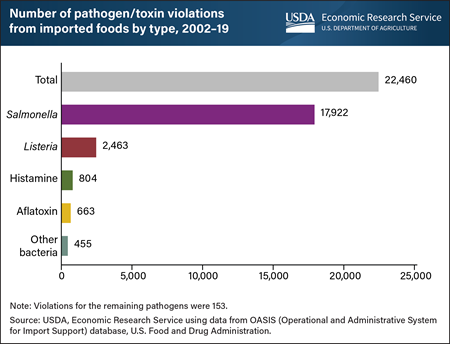
As the quantity of food imported into the United States continues to rise, it is increasingly important to minimize foodborne illness risks for U.S. consumers. Foods contaminated with pathogens or toxins can result in foodborne illnesses. A recent USDA, Economic Research Service (ERS) study examined the number of U.S. import refusals caused by pathogen/toxin contamination and which pathogens accounted for those safety violations. From 2002 to 2019, 22,460 pathogen/toxin violations were discovered among imported shipments. Salmonella was the most frequently identified agent among imported foods during the period with 80 percent, or 17,922 of total pathogen/toxin violations. Listeria recorded the second largest number of violations at 2,463, accounting for 11 percent of the total. It was followed by histamine with 804 violations (3.6 percent), aflatoxin with 663 violations (3 percent), and bacteria other than Salmonella or Listeria with 455 violations (2 percent). Those five most frequently detected pathogens and toxins accounted for 99.3 percent of the total pathogen/toxin violations from imported foods over the period. This chart was drawn from the ERS report Examining Pathogen-Based Import Refusals: Trends and Analysis From 2002 to 2019, published December 2021.

RASFF Alert – Histamine- Tuna

RASFF

Tuna contaminated with histamine from France in Spain and Ivory Coast

RASFF Alert – Histamine – Tuna Fillet

RASFF

Histamine in Tuna fillet center cut from the Maldives in the Netherlands and Belgium

France – Tuna steak sold at the traditional stand – Histamine

Gov france

Identification information of the recalled product

  • Product category Food
  • Product subcategory Fishery and aquaculture products
  • Product brand name Unbranded
  • Model names or references Sliced ​​tuna loin in store (Darne de thon) sold at the traditional stand of the CARREFOUR MARKET store in SANCERRE between 21/02/2022 and 22/02/2022
  • Identification of products
    Lot
    Lot sold between 02/21/22 and 02/22/22
  • Packaging by weight, presented sliced
  • Marketing start/end date From 21/02/2022 to 22/02/2022
  • Storage temperature Product to be stored in the refrigerator
  • Health mark EN 34.336.503 EC
  • Further information Sliced ​​tuna loin in store (Darne de thon) sold at the traditional stand of the CARREFOUR MARKET store in SANCERRE between 21/02/2022 and 22/02/2022
  • Geographic area of ​​sale SANCERRE MARKET STORE ONLY
  • Distributors SANCERRE MARKET STORE ONLY

Practical information regarding the recall

  • Reason for recallPresence of Histamine
  • Risks incurred by the consumerEndogenous toxins: histamine (fish, cheese, alcoholic beverages, meats)

Research – Two Case Reports of Scombroid in Singapore: A Literature Review

Cureus

Abstract

Scombroid is a foodborne illness that results from eating improperly handled fish. Due to a disruption in the cold chain, these fish have high histamine levels. As a result, scombroid presents with allergy-like symptoms but is not really an allergy per se. Cases have been reported in many countries.

Here, we report two cases of a 48 and 17-year-old father and son in Singapore who developed symptoms suggestive of scombroid after eating tuna imported from Vietnam delivered by an internationally known supply company. The diagnosis was confirmed by elevated histamine levels measured in the culprit fish product. We discuss the pathophysiology, signs, symptoms, and management of scombroid.

Introduction

Scombrotoxin fish poisoning (SFP) also known as scombroid poisoning, scombrotoxicosis, or histamine fish poisoning is a foodborne illness that results from the consumption of fish that has been improperly handled between the time it is caught and the time it is cooked [1]. The word “scombroid” is derived from Scombridae which is a family of dark-fleshed fish consisting of species such as mackerel and tuna. However, non-scombroid fishes such as mahi-mahi, salmon, and sardine have also been implicated in scombroid poisoning [2].

Scombroid poisoning is very common. A 2013 report from the United States estimated over 35,000 cases resulting in 162 hospital admissions between 2000 and 2009 [3]. Scombroid cases have also been reported from countries such as Australia [4], the Netherlands [5], Israel [6], Colombia [7], and many others.

Inappropriate storage, resulting in disruption of the cold chain, of the fish leads to bacterial enzymatic conversion of free histidine into histamine. This is due to the action of bacterial histamine decarboxylase (HDC), usually by mesophilic bacteria such as Clostridium perfringensMorganella morganii, etc. As a result, high levels of histamine are usually found in the culprit seafood item [8]. Whether histamine is the only constituent of “scombrotoxin” is unclear. Nevertheless, the symptomatology is essentially that of histamine toxicity. It is considered an atypical foodborne illness as the main symptoms are not gastrointestinal and also because it is not due to contamination of the product.

While mostly self-limiting and mild, there have been reports of life-threatening scombroid poisoning. A previously healthy young woman developed hypotension needing vasopressors with ST depressions [9] while another scombroid poisoning was complicated by acute pancreatitis [10]. Some cases were severe enough to need ICU admissions. A recent narrative discussed acute coronary syndromes (ACS) associated with scombroid. Of note, there is a potential of hemodynamic failure in the acute stage, even in apparently healthy people [11].

Closer to home, in September 2016, the Agri-Food and Veterinary Authority (AVA) of Singapore issued a recall order on a batch of canned tuna imported from Thailand under a common food brand. This was reported in various newspapers such as The Straits Times and The Independent. In one issue of the Singapore Food Agency’s Food Safety Bulletin in 2018, there was a segment on scombroid. Interestingly, however, a PubMed search was conducted and while we found a case of pufferfish poisoning reported in 2013 [12] and a report of stonefish poisoning in 2009 [13], we found no reports of scombroid poisoning in Singapore. We report two confirmed cases of scombroid poisoning who are from the same household who presented to our hospital after consuming tuna for dinner.

RASFF Alert – Histamine – Tuna

RASFF

Histamine in chilled tuna from The Netherlands in Belgium