Category Archives: Fumonsins

RASFF Alert – Mycotxin – Fumonsins – Corn Flour

RASFF-Logo

RASFF – fumonisins (18255 µg/kg – ppb) in corn flour from Peru in Spain

Belgium – Demeter corn flour of the Vajra brand – Fumonsins – Mycotoxins

AFSCA

Recall of Vajra
Product: Demeter corn flour of the Vajra brand
Problem: Exceeding the standard for fumonisins


VAJRA is withdrawing from sale and recalling from consumers the Demeter Corn Flour (500g and 5kg) of the Vajra brand. Analyzes have revealed a non-compliance with the fumonisin parameters (exceeding the standard) in a batch of this corn flour.
The products concerned were sold from May 2020 in certain organic food stores. Vajra brand Demeter corn flour


  • Weight: 500g
  • Lot: 0420/260520
  • Expiration dates (DDM): 05/01/2021
  • Packing: Paper bag

(update) Demeter Corn Flour of the Vajra brand Weight: 5 kg Lot: 120/220520 Expiration date (DDM): 05/01/2021 Packaging: Paper bag People who have bought the Corn Flour are asked Demeter corn from the lot concerned, not to consume this product and to bring it back to the place of purchase where it will be refunded to you.

RASFF Alert – Fumonsins – Organic Corn Flour

RASFF-Logo

RASFF – fumonisins (2067 µg/kg – ppb) in organic corn flour packaged in Belgium, with raw material from Italy in Belgium

Belgium – Demeter corn flour of the Vajra brand – Fumonisins

AFSCA

The VAJRA company is withdrawing from sale and recalling from consumers the Demeter Corn Flour of the Vajra brand. Analyzes have revealed a non-compliance with the fumonisin parameters (exceeding the standard) in a batch of this corn flour.

The products concerned were sold from May 2020 in certain organic food stores.

  • Product: Demeter Corn Flour from Vajra
  • Weight: 500g
  • Lot: 0420/260520
  • Expiration dates (DDM): 05/01/2021
  • Packing: Paper bag

People who have purchased the Demeter Corn Flour from the lot concerned are asked not to consume this product and to return it to the place of purchase where it will be refunded to you.
The product was sold through various health food stores.

For more information, please call VAJRA on 02 731 05 22.
We apologize for any inconvenience.

VAJRA sprl
330 Brusselsesteenweg, hall 5
3090 Overijse


Research – Mycotoxin Analysis: 90% of samples show presence of DON

All About Feed

Trouw Nutrition, a Nutreco company, recently release findings from the 2019 Global Mycotoxin Risk Analysis in a live webinar. The analysis includes more than 21,000 ingredient and finished feed samples collected from 38 countries across Europe, North America, South/Central America, Middle East/Africa and Asia.

90% of samples showed presence of DON

The analysis shows that of the global crop samples collected in 2019, more than 90% had a quantifiable presence (>100 ppb) of DON, with between 80 and 90% of samples showing FUMO, AFLAOTA and ZEA T-2 levels were lowest, at about 70%. (Figure 1). The 2019 mycotoxin risk analysis includes analysis for individual ingredients, complete feeds and silages including small grains (wheat and barley) which tested at as high as 88% for DON, to 59% for AFLA. Among byproducts, concentrations in DDGS were significantly higher than in maize, with levels approaching 5,000 ppb. Looking at protein meals, concentrations of mycotoxins were relatively low compared to cereal grains. However, soybean meal is used at about 25-30% of monogastric diets, and hence can contribute significantly to concentration of toxins in final feed. Sunflower meal showed the greatest concentration of FUMO while levels of DON, AFLA and ZEA were lower. Among silages, 100% of maize and grass silage samples showed mycotoxin contamination with concentrations that can cause toxicity in ruminant animals.

RASFF Alert – Mycotoxin – Fumonsins – Corn Flour

RASFF-Logo

RASFF – fumonisins (3048 µg/kg – ppb) in corn flour from Germany in Belgium

Research – World Mycotoxin Report: Impact 2020

All About Feed Mold Mould Mycotoxin kswfoodworld

The prevalence of FUM and DON mycotoxins remained high last year, according to the results of the World Mycotoxin Survey 2019, released by Biomin.

Last year more than 20,000 samples were tested in 86 countries. Overall the survey shows that the occurrence of Fumonisins and Deoxynivalenol remain high in every continent. Although the prevalence of mycotoxins is shifting, explains Annelies Mueller product manager, Biomin in a live webinar: “Due to climate change mycotoxins which were usually found in the southern part of the world are now moving to the north. Mycotoxins are moving with the shifting climate.” The mycotoxin report shows detailed results on the prevalence of mycotoxins for each continent.

Research – 2017 BIOMIN Mycotoxin Survey Results

Biomin

The latest edition of the annual survey, covering 18757 agricultural commodity samples from 72 countries with over 73000 analyses, highlights the main dangers from the most important mycotoxins in primary feedstuffs and their potential risk to livestock animal production.

The survey results provide an insight on the incidence of aflatoxins (Afla), zearalenone (ZEN), deoxynivalenol (DON), T-2 toxin (T-2), fumonisins (FUM) and ochratoxin A (OTA) in the primary components used for feed which include corn (maize), wheat, barley, rice, soybean meal, corn gluten meal, dried distillers grains (DDGS) and silage, among others.

Research – Summer 2018: The perfect storm of mycotoxins

All About Feed

Harvest samples from across Europe show high levels of mycotoxins, particularly deoxynivalenol (DON), fusaric acid and fumonisin.

Information – Regional Results of Global Mycotoxin Occurrence through June 2018

Biomin

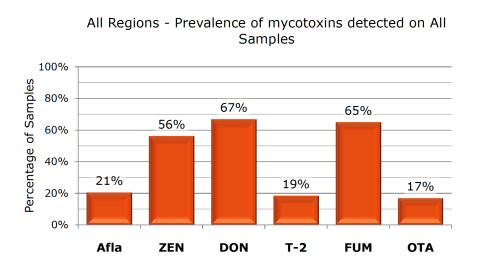
Since 2004, the BIOMIN Mycotoxin Survey Program constitutes the longest running, and most comprehensive survey of its kind. It details the incidence of the main mycotoxins occurring in agricultural commodities, which include aflatoxins (Afla), zearalenone (ZEN), deoxynivalenol (DON), T-2 toxin (T-2), fumonisins (FUM) and ochratoxin A (OTA).

The survey focuses on components that are used for feed such as corn, wheat, barley, rice, soybean meal, corn gluten meal, dried distillers grains (DDGS) and silage, among others.

From January to June 2018, the BIOMIN scientists have tested 8,310 samples, from different regions around the world.

Figure 1. Occurrence of mycotoxins worldwide through Q2 2018. Average of all samples collected by BIOMIN.

untitled.png