Category Archives: foodbourne outbreak

Types of Data Collected in Foodborne Outbreak Investigations

CDC

Three Types of Data

When a foodborne outbreak is detected, public health and regulatory officials work quickly to collect as much information as possible to find out what is making people sick.

Epidemiologic Data
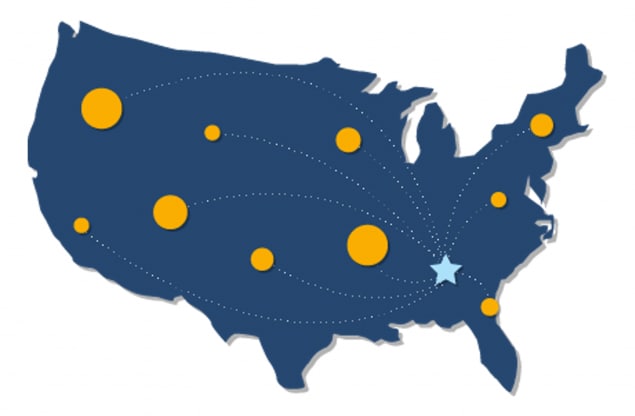
map of the continental U.S. with sites of outbreaks highlighted

Where and when did people get sick? Has the same germ caused outbreaks before? If it has, what made people sick in those outbreaks?
plate of food

What foods did people eat before they got sick?

restaurant and diners

What restaurants, grocery stores, or events did sick people go to?

Traceback Data

flow chart and checklists

Is there a common point in the distribution chain where the food could have gotten contaminated?

farm with barn and fields

Is there anything about the food production facilities, farms, or restaurants that made germs likely to spread?

Food and Environmental Testing Data

person wearing gloves and shield testing food

Is the germ causing the outbreak also found in a food item or in the food production environment?

woman looking at viruses under microscope

Do the germs found in the food or food production environment have the same DNA fingerprints as germs found in sick people?

Actions to Stop the Outbreak

Outbreak investigators take actions to protect the public when there is clear and convincing information showing that people got sick from the same contaminated food.
Live breaking news: outbreak

Health officials warn the public

recalled packaged lettuce

Companies recall contaminated products

"closed" sign

Restaurants or food production facilities close temporarily

Constantly Improving

investigators working at a table

Investigators don’t solve every outbreak. Sometimes outbreaks end before enough information is gathered to identify the contaminated food. Outbreak investigators are constantly developing new ways to investigate and solve outbreaks faster.
Research – Phenotypic and genotypic characterization of salmonella Enteritidis isolated from two consecutive Food-Poisoning outbreaks in Sichuan, China

Wiley Online

Abstract

Salmonella enterica serotype Enteritidis (SE) is a primary pathogen that causes foodborne diseases in humans. Although whole-genome sequencing (WGS) -based typing analyses have been increasingly used to investigate food-poisoning outbreaks, they are rarely applied to the epidemiology of multiple Salmonella outbreaks in Sichuan, China. This study therefore isolated SE from patients and food of two consecutive food-poisoning outbreaks during 2020 in Sichuan, China. We tracked outbreak origin using epidemiological investigation, serotyping, antimicrobial susceptibility testing (AST), pulsed-field gel electrophoresis (PFGE), and WGS. We also determined phylogenetic relationships using PFGE, whole and core genome multilocus sequence typing (wg/cgMLST), and whole-genome single nucleotide polymorphism (wgSNP) analyses. Epidemiological investigations identified a correlation between cake consumption and food poisoning. Thirteen strains isolated from patients and one strain isolated from the cake were confirmed as SE. Among the 14 strains, only six shared the same AST pattern (AMP-AMS-Sul-STR). Isolates from patients and cakes were indistinguishable in PFGE results. All four methods, namely PFGE, wgMLST, cgMLST, and wgSNP were appropriate for bacterial typing in SE-related outbreak investigation. However, wgSNP can assign 12 SE strains from the first outbreak to one cluster and assign two SE strains from the second outbreak to another cluster, while PFGE, wgMLST, cgMLST did not successfully distinguish the SE strains from different outbreaks. Thus, we conclude that SNP-based phylogenetic analysis might be a viable method for differentiating SE strains at the outbreak level.

Sweden – Salmonella sickens more than 50 in Sweden

Food Safety News

More than 50 people have fallen ill in a national outbreak of Salmonella in Sweden with the source yet to be identified.

A total of 54 confirmed cases of Salmonella Typhimurium have been reported from 20 different regions in the country from Sept. 17 to Oct. 5.

Patients are aged between 8 and 86 years old; 31 of them are women.

Cases have been connected by whole genome sequencing of patient samples. This means they are suspected of having been infected by a common source, according to the Public Health Agency of Sweden (Folkhälsomyndigheten).

Local infection control units, the Swedish Food Agency (Livsmedelsverket) and Folkhälsomyndigheten are investigating the outbreak to identify the source of infection, which is suspected to be a food with wide distribution in Sweden.

Patient interviews to compile information about what those sick have eaten before falling ill are ongoing. Answers will be used to form a hypotheses about the source and compared to what people in a control group that are not part of the outbreak have eaten.

The incident doesn’t appear to be connected to a Salmonella Typhimurium outbreak that is ongoing in Denmark. Officials believe the outbreak in Sweden is caused by a different source because the strains don’t cluster.

USA – Old Europe Cheese Listeria Outbreak holds at six sick in six States

Food Poison Journal

Epidemiologic and Traceback Data

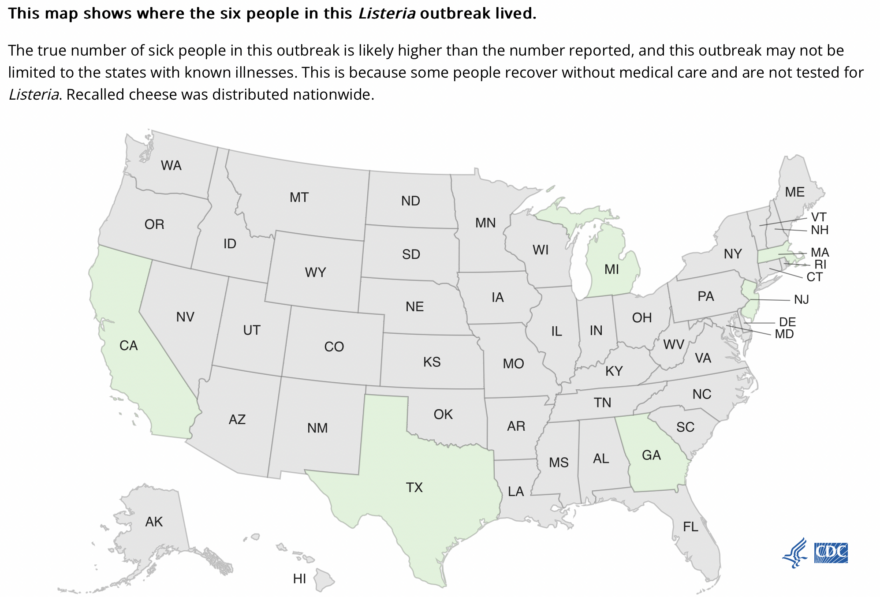
As of September 28, 2022, six people infected with the outbreak strain of Listeria have been reported from six states (see map). Sick people’s samples were collected from August 6, 2017, to August 5, 2022 (see timeline).

Sick people range in age from 56 to 83 years, with a median age of 78, and 67% are female. Five people have been hospitalized, and no deaths have been reported.

The true number of sick people in this outbreak is likely higher than the number reported, and the outbreak may not be limited to the states with known illnesses. This is because some people recover without medical care and are not tested for Listeria. In addition, recent illnesses may not yet be reported as it usually takes 3 to 4 weeks to determine if a sick person is part of an outbreak.

USA – Big Olaf’s Ice Cream Listeria Outbreaks stands at 25 sick with 24 hospitalized with 1 death

Food Poison Journal

Epidemiologic Data

Since the last update on July 13, 2022, two more illnesses have been reported. As of August 2, 2022, a total of 25 people infected with the outbreak strain of Listeria monocytogenes have been reported from 11 states (see map). Thirteen sick people are residents of Florida and ten reported traveling to Florida before getting sick. Illnesses started on dates ranging from January 24, 2021, to June 24, 2022 (see timeline).

Sick people range in age from less than one to 92 years, with a median age of 72, and 56% are male. Of 25 people with information available, 24 have been hospitalized. One death in a person who was not pregnant has been reported from Illinois. Five people got sick during their pregnancy, and one person’s illness resulted in a fetal loss.

The true number of sick people in an outbreak is likely higher than the number reported, and the outbreak may not be limited to the states with known illnesses. This is because some people recover without medical care and are not tested for Listeria. In addition, recent illnesses may not yet be reported as it usually takes 3 to 4 weeks to determine if a sick person is part of an outbreak.

USA – Michigan hit hardest in Falafel E. coli Outbreak

Food Poison Journal

As of October 7 2022, 20 people infected with the outbreak strain of E. coli O121 have been reported from 6 states (see map). Illnesses started on dates ranging from July 13, 2022, to September 13, 2022 (see timeline).


Sick people range in age from less than 1 to 71 years, with a median age of 31, and 79% are female. Of 14 people with information available, 5 have been hospitalized, including 1 who developed hemolytic uremic syndrome, a serious condition that can cause kidney failure. No deaths have been reported.

The true number of sick people in this outbreak is likely higher than the number reported, and the outbreak may not be limited to the states with known illnesses. This is because some people recover without medical care and are not tested for E. coli. In addition, recent illnesses may not yet be reported as it usually takes 3 to 4 weeks to determine if a sick person is part of an outbreak.

State and local public health officials are interviewing people about the foods they ate in the week before they got sick. Among 18 people interviewed, 15 reported shopping at ALDI stores. Among these 15 ALDI shoppers, 6 reported eating Earth Grown brand frozen falafel purchased from ALDI in the week before getting sick.

Netherlands – Dutch retailer issues recall after Ferrero chocolate error – Salmonella

Food Safety News

A Dutch retailer has issued a recall after mistakenly sending Ferrero chocolate potentially contaminated with Salmonella to market.

Jumbo is recalling Ferrero Kinder Schokobons 300 grams with an expiry date of Oct. 5, 2022 or earlier.

These products were recalled by Ferrero in April this year in relation to a multi-country monophasic Salmonella Typhimurium outbreak. However, Jumbo said some chocolate had recently been delivered to a limited number of stores.

The retailer added that as soon as the error became known, all stock was removed from stores as a precaution.

Jumbo asked customers not to consume the affected Ferrero Kinder Schokobons and to return them to one of its stores.

Official figures show the Netherlands had three cases related to the outbreak that affected more than 450 people from December 2021 to June 2022.

Denmark searches for source of Salmonella outbreak with 14 sick

Food Safety News

Danish officials are trying to find the source of a Salmonella outbreak that has sickened 14 people in a month.

Between Aug. 15 and Sept. 16, more than a dozen cases with the same type of Salmonella Typhimurium have been registered at the Statens Serum Institut.

Patients are seven men and seven women aged between 4 and 84 years old, with a median age of 61. Ten cases were reported in one week. Six sick people live in Midtjylland, five in Hovedstaden and three in Syddanmark.

The Statens Serum Institut (SSI), Danish Veterinary and Food Administration (Fødevarestyrelsen) and DTU Food Institute are investigating the outbreak.

Research – Netherlands records more than 800 outbreaks in 2021

Food Safety News

The number of foodborne outbreaks in the Netherlands passed 800 in 2021, according to the National Institute for Public Health and the Environment (RIVM).

A total of 838 outbreaks, affecting 3,517 people, were reported in 2021. This is an increase compared with 559 outbreaks in 2020 affecting 1,907 people and is also up from 735 outbreaks in 2018 and 756 in 2019.

Salmonella and Campylobacter were still responsible for most outbreaks and illnesses this past year. Norovirus was reported far less than in previous years for the second year in a row.

Figures come from the Netherlands Food and Consumer Product Safety Authority (NVWA) and Municipal Health Service (GGD).

Pathogen unknown for most outbreaks
Based on NVWA statistics, most outbreaks involved two to four and five to nine patients. Twenty or more sick people were registered in 13 outbreaks, with 71 and 79 patients in two norovirus incidents. More than 400 people were affected in one outbreak caused by an unknown pathogen. From GGD figures, in 28 outbreaks, four people died from listeriosis.

A pathogen was found in patients, food or environmental samples for only 28 of the 838 outbreaks. Experts said the percentage of outbreaks where a pathogen was identified continues to decrease but the reason for this is uncertain.

Malawi bans sale of food in primary, secondary schools as cholera death toll hits 117

China Org

LILONGWE, Oct. 9 (Xinhua) — Malawi has banned sale of food in primary and secondary schools ahead of the new school year, which starts Monday, as cholera outbreak continues with 117 cumulative deaths recorded as of Sunday.

Requesting parents to pack homemade food for students, the education ministry “is directing that selling of food in primary and secondary schools is banned with immediate effect until further notice,” said a statement signed by Secretary for Education Chikondano Mussa.

Universities and colleges are advised to ensure that food vendors and suppliers are oriented and adhere to the standard operating procedures issued by the ministry to all learning institutions.

Cholera has been spreading sporadically across the country since the first cases were recorded in the south-eastern border district of Machinga in March.

As of Sunday, 23 districts have reported cases with 17 districts coming on board in the past 14 days, bringing the caseload and death toll to 4,223 and 117 respectively. Enditem