Category Archives: foodbourne outbreak

Norway – Norway links Salmonella outbreak to raw milk cheese

Food Safety News

Six people in Norway have fallen ill in recent months with the source of infection thought to be contaminated raw milk cheese from France.

The foodborne outbreak was suspected to be caused by Salmonella Dublin in chilled cheese made with unpasteurized milk.

The Norwegian Institute of Public Health (Folkehelseinstituttet) investigated the outbreak with the Norwegian Food Safety Authority (Mattilsynet) and Norwegian Veterinary Institute.

USA – Factors Potentially Contributing to the Contamination of Peaches Implicated in the Summer 2020 Outbreak of Salmonella Enteritidis

Click to access Rep.pdf

USA/Canada- Factors Potentially Contributing to the Contamination of Red Onions Implicated in the Summer 2020 Outbreak of Salmonella Newport

FDA

Executive Summary

Between June and October 2020, federal and state agencies investigated a Salmonella Newport foodborne illness outbreak associated with consumption of red onions from the Southern San Joaquin Valley and Imperial Valley in California. The outbreak, which caused 1,127 reported domestic illnesses and 515 reported Canadian cases, is the largest Salmonella outbreak in over a decade. This outbreak is also remarkable because the food vehicle, whole red onions, is a raw agricultural commodity that had not been previously associated with a foodborne illness outbreak.

The U.S. Food and Drug Administration (FDA), alongside state and federal partners, investigated the outbreak to identify potential contributing factors that may have led to red onion contamination with Salmonella Newport. While the Salmonella Newport outbreak strain (specific whole genome sequence [WGS]) was not identified in any of the nearly 2,000 subsamples tested, a total of 11 subsamples (10 water and 1 sediment) collected near one of the growing fields identified in the traceback were positive for Salmonella Newport, representing a total of three different genotypical strains (unique WGS patterns). Although a conclusive root cause could not be identified, several potential contributing factors to the 2020 red onion outbreak were identified, including a leading hypothesis that contaminated irrigation water used in a growing field in Holtville, California may have led to contamination of the onions.

While our investigation did not occur during any harvesting activities, visual observations of the implicated red onion growing fields suggested several plausible opportunities for contamination including irrigation water, sheep grazing on adjacent land, as well as signs of animal intrusion, such as scat and large flocks of birds which may spread contamination. Similarly, the investigation did not occur while packing activities were ongoing. However, visual observations and records review of packing house practices confirmed numerous opportunities for spread of foodborne pathogens such as Salmonella, including signs of animal and pest intrusion as well as food contact surfaces which had not been inspected, maintained, cleaned, or sanitized as frequently as necessary to protect against the contamination of produce. Thomson International Inc. cooperated with FDA throughout the investigation and is continuing to engage with FDA on the agency’s findings and recommendations.

Notably, Salmonella isolates from two sediment subsamples and two water subsamples collected during this investigation were found to be genetically related by WGS to clinical isolates from 2016 and 2018 foodborne illness outbreaks (Salmonella Muenchen and Salmonella Montevideo, respectively) associated with consumption of sprouts. This may be indicative of human pathogen persistence and distribution in this growing region (a concentrated area of seed for sprouting production), which could pose a risk of contamination for any produce commodity. FDA issued an assignment to follow-up at the associated firms. Sprouts are not a food vehicle of interest in the 2020 Salmonella Newport foodborne illness outbreak.

We urge growers to conduct risk assessments that include evaluation of hazards that may be associated with adjacent and nearby land uses—especially relating to the presence of livestock and wildlife and the potential for runoff into growing fields or water sources—and implement risk mitigation strategies where appropriate. FDA recognizes the interconnection between people, animals, plants, and their shared environment when it comes to public health outcomes, and we encourage collaboration among various groups in the broader agricultural community (e.g., produce growers, those managing animal operations, state and federal government agencies, and academia) to address this issue.

This document provides an overview of the traceback investigation, subsequent on-site investigation, and factors that potentially contributed to the contamination of red onions with Salmonella Newport.

Download the Full Report (PDF 531KB)

New Zealand – New Zealand Food Safety places precautionary controls on North Island egg producer – Salmonella Outbreak

MDPI

New Zealand Food Safety has placed movement controls on a North Island egg producer as a precautionary measure after environmental testing indicated Salmonella Enteritidis on the farm.

New Zealand Food Safety has been carrying out tracing and testing of poultry operations after Salmonella Enteritidis was found at an Auckland hatchery that supplies chicks to other operators, earlier this year.

Symptoms of Salmonella illness include abdominal cramps, diarrhoea, fever, headache, nausea and vomiting. It can be serious in people with reduced immunity, frail elderly, children under 2 years, and pregnant women.

New Zealand Food Safety director of food regulation Dr Paul Dansted said to date no eggs had tested positive.  However, it was possible that some eggs could contain Salmonella Enteritidis so it was prudent to provide advice to consumers.

“No product is leaving the farm at present while we carry out more investigations.

“It’s important to note the positive results are not from eggs, but from samples from within the farm.”

“While the risk is low, we are taking this precautionary action as we are not yet in a position to assure consumers that Salmonella Enteritidis is not in some eggs.”

There are key actions consumers can take to protect against Salmonella Enteritidis.

They include:

  • Keep eggs in the fridge after purchase.
  • Cook eggs thoroughly – until the white is completely firm and the yolk begins to thicken.
  • Wash your hands after handling eggs.
  • Consume eggs within the recommended date on the carton.
  • Don’t serve raw eggs to children under 2 years of age, pregnant woman, the frail and elderly, and people with low or compromised immune systems.
  • Keep surfaces and kitchen utensils clean and dry before and after handling eggs.
  • Use clean eggs free from dirt, faecal matter and cracks.

Last month, NZ Food Safety stopped 2 farms from sending eggs to sale after tests found Salmonella Enteritidis on their properties.

Media release: Food safety actions to protect consumers

“We have been conducting tests with the poultry industry and action will be taken where necessary to identify and manage any suspect flocks.”

NZ Food Safety is working closely with the Ministry of Health, which has been monitoring Salmonella Enteritidis cases in humans.

“To date, while there is no proven association between human illness and poultry meat and eggs, we continue to investigate.”

Dr Dansted said NZ Food Safety would continue to work with the poultry industry to assist it to manage the risk of Salmonella Enteritidis in commercial flocks and reduce the risk to consumers.

“Many countries have Salmonella Enteritidis in poultry flocks and manage the risk with on-farm prevention measures. By taking this pre-emptive action with the farm and informing people to handle and prepare food safely at home, we reduce the risk.”

Salmonellosis, the illness caused by Salmonella Enteritidis bacteria, can spread in a variety of ways outside of food, including contact with infected animals, material, or surfaces, and between persons.

If you have health concerns after consuming eggs or chicken, seek medical advice from your doctor or Healthline.

Resources

Frequently asked questions [PDF, 134 KB]

Director-General privileged statement regarding Section 289 of the Food Act [PDF, 837 KB]

Learn more about Salmonellosis – Ministry of Health

Clean, Cook, Chill for home food safety advice

Salmonella symptoms and advice

New Zealand – Salmonella Outbreak

Food Safety News

Officials in New Zealand are investigating a Salmonella outbreak that has sickened 35 people so far this year.

Salmonella Enteritidis sequence type 11 (ST 11) was first detected in 2019 in an outbreak traced to a restaurant in the Auckland region. Since May 2019, the number of patients associated with this strain is 101 and from 2019 it has been found in four other outbreaks.

The majority of people sick from January to April this year live in the Auckland region, according to the Institute of Environmental Science and Research (ESR).

New Zealand Food Safety found Salmonella Enteritidis at an Auckland poultry farm and there has been a rise in infections caused by this strain of Salmonella despite attempts to prevent contaminated eggs reaching consumers.

Research – EU – More Salmonella infections in Europe: Hygiene rules help prepare poultry safely

Eurekalert

kswfoodworld salmonella

In recent months, more than three hundred cases of salmonellosis have occurred in various European countries and Canada, which are linked to each other. In the UK the cases could be partly traced back to frozen breaded poultry meat. The cause was contamination with the bacterium Salmonella Enteritidis, which causes gastrointestinal inflammation. Salmonella is not killed by deep freezing and can remain infectious at temperatures below zero degrees Celsius. The Robert Koch Institute (RKI) and the BfR are monitoring the situation together with the Federal Office of Consumer Protection and Food Safety (BVL). In Germany, the number of reported cases has currently risen to more than 20 in six federal states. In 2020, there were a total of about 10,000 reported cases of salmonellosis in Germany, most of which were caused by the consumption of contaminated food. In principle, foodborne infections can be avoided by paying particular attention to hygienic care when preparing raw poultry. Due to the measures taken to contain the COVID 19 pandemic, people are currently cooking more often at home and, in the course of this, convenience products such as frozen goods are also being used more frequently. Sometimes it is not obvious at first glance whether such products contain pre-cooked or raw meat. Sufficient heating should always be ensured during preparation, especially of products containing raw poultry meat. In addition, bacterial contamination of other dishes via the raw meat and breading is possible. “Especially for children and elderly people there is a higher risk of getting sick from salmonella,” says BfR President Prof. Dr. Dr. Andreas Hensel.

USA- Salmonella Outbreaks Linked to Backyard Poultry

CDC

Fast Facts
  • Illnesses: 163
  • Hospitalizations: 34
  • Deaths: 0
  • States: 43
  • Recall: No
  • Investigation status: Active
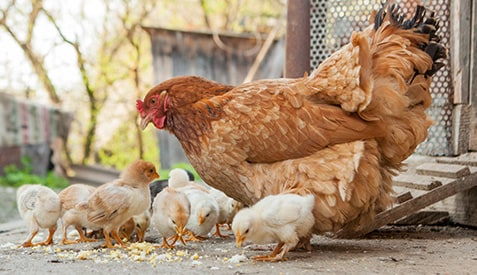
Backyard poultry with chickens eating
Backyard Poultry and Salmonella

Backyard poultry, like chicken and ducks, can carry Salmonella germs even if they look healthy and clean. These germs can easily spread to anything in the areas where they live and roam.

You can get sick from touching your backyard poultry or anything in their environment and then touching your mouth or food, and swallowing Salmonella germs.

USA – Core Investigation Updated

FDA

The table includes the conclusion of an  E. coli O145:H28 outbreak. The FDA reports that 16 people were sickened in the outbreak for which a cause has not been detected.

A new Salmonella outbreak has also been added with little other information.

USA – Breaded Chicken Products and Salmonella

Food Safety News

This week the CDC, public health and regulatory officials in several states, and the U.S. Department of Agriculture’s Food Safety and Inspection Service (USDA-FSIS) announced a multistate outbreak of Salmonella Enteritidis infections linked to raw frozen breaded stuffed chicken products. As of June 2, 2021, a total of 17 people infected with the outbreak strain of Salmonella Enteritidis have been reported from six states. Illnesses started on dates ranging from Feb. 21, 2021 to May 7, 2021.

Sounds a bit familiar?  Why does the USDA-FSIS ignore this risky product?

USA – Kirkwood’s Chicken Cordon Bleu appears linked to Salmonella Outbreak

Food Poison Journal

Arizona, Minnesota, Indiana, Indiana, Michigan and New York report Salmonella illnesses.

CDC, public health and regulatory officials in several states, and the U.S. Department of Agriculture’s Food Safety and Inspection Service (USDA-FSIS) are collecting different types of data to investigate a multistate outbreak of Salmonella Enteritidis infections linked to raw frozen breaded stuffed chicken products.

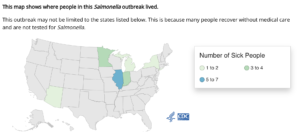
As of June 2, 2021, a total of 17 people infected with the outbreak strain of Salmonella Enteritidis have been reported from 6 states. Illnesses started on dates ranging from February 21, 2021 to May 7, 2021.

Sick people range in age from 3 to 83 years, with a median age of 52 years, and 60% are female. Of 13 people with information available, 8 (62%) have been hospitalized; no deaths have been reported.

People reported buying many different brands of raw frozen breaded stuffed chicken products from multiple stores. When asked about how the products were prepared at home, seven people reported undercooking, microwaving, or air frying the product.