Category Archives: foodborne outbreak

Canada – Canada’s Deadly Salmonella Outbreak Has Now Affected At Least 110 People – One Dead

Narcity

The Public Health Agency of Canada revealed on Tuesday afternoon that their Salmonella outbreak investigation has now uncovered an additional 14 cases of the disease in Canada, taking the total number of confirmed cases to 110. According to a statement from the Health Agency, Salmonella has been found across multiple provinces and territories, and the cases are part of an ‘ongoing’ outbreak in the country.

Daily Hive

One person has died after year-long Salmonella outbreak in Canada
Europe – Multi-country cluster of Listeria monocytogenes ST1247 in five EU countries

ECDC

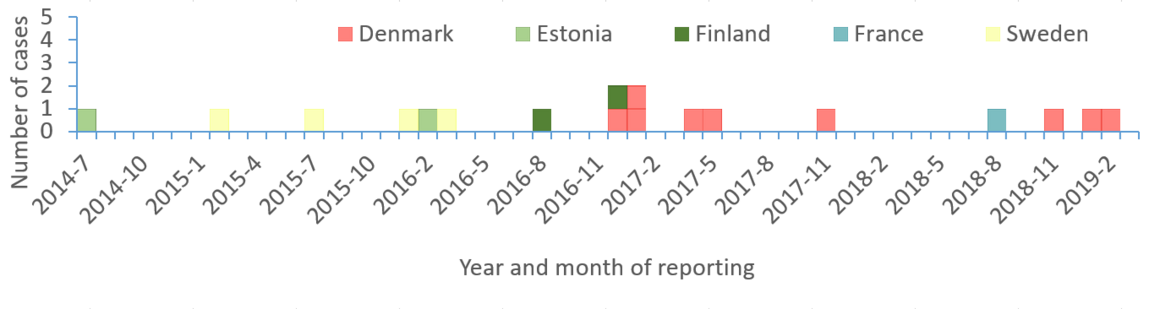
ECDC has identified a microbiological link between an outbreak of nine Listeria monocytogenes ST1247 cases in Denmark and nine additional cases reported between 2014 and 2018 in Estonia (2 cases) Finland (2), France (1) and Sweden (4).  In Denmark, the outbreak investigation is led by Statens Serum Institut (SSI), the Danish Veterinary and Food Administration and the DTU Food Institute.

Whole Genome Sequencing (WGS) analysis performed at the national level and by ECDC found all isolates from the 18 cases within two allelic differences from each other (core genome MLST using Moura scheme, 1540 of 1748 loci detected in all 18 isolates). The latest case was reported in Denmark in February 2019 (Figure 1).

Figure 1: Distribution of Listeria monocytogenes isolates by country and time of reporting 2014-2019 (n=18)

Figure 1: Distribution of Listeria monocytogenes isolates by country and time of reporting 2014-2019 (n=18)

A large-scale study led by ECDC on whole genome sequencing shows that most listeria outbreaks such as this one remain undetected. The study, published in 2018, suggests that more than half of the severe listeriosis cases in the European Union belong to clusters, many of which are not being picked up fast enough by the current surveillance system.

Listeria monocytogenes causes listeriosis, which primarily affects pregnant women, newborns, and adults with a weakened immune system. Listeriosis is a relatively rare but potentially severe food-borne disease that has been reported in increasing numbers in the EU/EEA countries since 2008. In 2016, 2 536 cases were reported, including 247 deaths.


USA – Norovirus most common foodborne pathogen in 2017

Barf Blog

Food Borne Illness - Norovirus -CDC Photo

Image CDC

The Centers for Disease Control and Prevention (CDC) late last week released a summary of foodborne illnesses in 2017 based on an annual analysis of data from the Foodborne Disease Outbreak Surveillance System, and Norovirus was the most common pathogen reported, responsible for 46% of illnesses. Salmonella and Shiga toxin–producing Escherichia coli were also linked to a substantial number of outbreaks.  

In 2017, the CDC tracked 841 foodborne outbreaks, which included 14,481 illnesses, 827 hospitalizations, 20 deaths, and 14 food product recalls. A single etiologic agent was confirmed in 395 outbreaks (47%), which are defined as two or more related cases.

Sweden – Cherry tomatoes may be lined to Salmonella outbreaks in Sweden

Barfblog cherry-tomato-pristine-variety

SVT reports people have been sick with diarrhea between August 29 and September 14 with Salmonella Typhimurium. Anders Enocksson, infection prevention consultant at Region Halland.

In all, 11 counties are affected. Most cases are in Halland together with Dalarna, Jönköping and Västra Götaland, which P4 Halland was the first to tell . The infected are in all age groups, but just over half are 60 years or older. There are slightly more women than men.

The source of infection is not yet known, but there is suspicion of tomatoes, and cherry tomatoes.

USA – Whole Genome Sequencing Solves Cake Mix Salmonella Outbreak

Food Poisoning Bulletin

For the first time, whole genome sequencing solved a Salmonella outbreak associated with cake mix, according to a study published in the Center For Disease Control and Prevention’s Weekly Morbidity and Mortality Report. This cake mix Salmonella outbreak was associated with Duncan Hines products.

Whole Genome Sequencing Solves Cake Mix Salmonella Outbreak

USA – Outbreak of Listeria Infections Linked to Deli-Sliced Meats and Cheeses Final Update

CDC

Final Outbreak Information
Illustration of a megaphone.
At A Glance

Photo of deli products.

  • As of September 26, 2019, this investigation is over.
  • 10 people infected with the outbreak strain of Listeria were reported from 4 states.
    • All 10 were hospitalized, and 1 death was reported from Michigan.
  • Epidemiologic and laboratory evidence indicated that various meats and cheeses sliced at deli counters might have been contaminated with Listeria monocytogenes and made people sick.
  • In interviews, ill people reported eating different types and brands of meats and cheeses purchased from and sliced at deli counters in different retail locations.
  • The outbreak strain was identified in samples taken from meat sliced at a deli and from deli counters in multiple stores.
  • The investigation did not identify a single, common supplier of deli products.
  • This outbreak is a reminder that deli products, such as sliced meats and cheeses, can have Listeria bacteria. People who are at higher risk for Listeria infection should avoid eating hot dogs, lunch meats, cold cuts, or other deli meats, unless they are heated to an internal temperature of 165°F or until steaming hot just before serving.

Research – Belgian Salmonella outbreak traced to tartare sauce

Food Safety News


A Salmonella outbreak that sickened almost 200 people at a Belgian school was likely caused by eggs used to make a tartare sauce, according to authorities.

The Agency for Care and Health (Zorg en Gezondheid) and Federal Agency for the Safety of the Food Chain (FASFC) investigation detected Salmonella in the freshly prepared tartare sauce. Findings from an online survey of students and teachers also reached the same conclusion on the source.

The Agency for Care and Health had previously received information about a number of students from the school complaining of gastrointestinal illness.

Since Sept. 14, no new cases of illness have been reported so the Spermalie Hotel and Tourism School in Bruges has been allowed to resume normal operation.

About 200 students and teachers from the school became ill from Sept. 6 onward. Laboratory analyses of stool samples revealed students and teachers had been affected by Salmonella.


Latvia – Sigulda Regional Council turns to State Police regarding Salmonella outbreak at local kindergartens

The Baltic Times

Salmonella kswfoodworld

Image CDC

RIGA – The Sigulda Regional Council turned to the State Police (VP) about the infection of four kindergarten children with salmonella, Sindija Brikmane, deputy head of the Public Relations Department of Sigulda Municipality, informed LETA.

Investigating the causes of the disease, the Center for Disease Prevention and Control (CDPC) has received information from a laboratory that four children from local kindergartens in Sigulda Region have been diagnosed with the salmonella bacterium.

The CDPC explains that the symptoms of Salmonella-related diseases are nausea, vomiting, seizures, diarrhea, fever, headaches.

A spokeswoman for the municipality said all four children had not been attending kindergarten for a week, but the CDPC said the infection could have occurred at different times, beginning on September 7. The children are currently undergoing medical treatment under the supervision of a family doctor.

RASFF Alert – Foodborne Outbreak – Listeria monocytogenes – Fried Pork Belly

RASFF-Logo

RASFF – foodborne outbreak suspected (Listeria monocytogenes) to be caused by fried pork belly from Spain in Spain

Sweden – Salmonella outbreak, dozens affected

Outbreak News Today

Swedish Public Health officials (Folkhalsomyndigheten) are reporting (computer translated) an outbreak of Salmonella Typhimurium since the beginning of the month.

To date, 36 cases from 10 counties have been linked with whole-genome sequencing. Most cases have been reported from Västra Götaland, Jönköping, Halland and Dalarna. Ill persons are found in all age groups, both among children and the elderly, and slightly more women (22) than men (14) have become sick.

The Swedish National Food Agency and the Public Health Authority together are investigating the outbreak to identify the source of the infection that is suspected to be a food that has been widely distributed in Sweden.