Category Archives: Foodborne Illness

Research – Record number of outbreak alerts on EU platform

Record number of outbreak alerts on EU platform

A European system used by countries to report outbreaks saw a record number of alerts in 2019.

The European Centre for Disease Prevention and Control (ECDC) hosts the Epidemic Intelligence Information System for food- and waterborne diseases (EPIS-FWD) platform. The network is a restricted web-based platform for experts to help with early detection and coordination of response to multi-country outbreaks through sharing information.

It consists of Urgent Inquiries and associated forums, which are the outbreak alert and investigation tools. The forums allow information to be shared about the outbreak investigation among a restricted number of experts. Nominated people outside the EPIS-FWD network, such as food safety and environmental experts or veterinarians from network countries or any expert or organization outside the network can also be invited to join.

USA/Canada – 1,139 Sickened by Cyclospora in the United States and Canada

1,139 Sickened by Cyclospora in the United States and Canada

727 tied to Fresh Express bagged salads – 412 sick from unknown product.

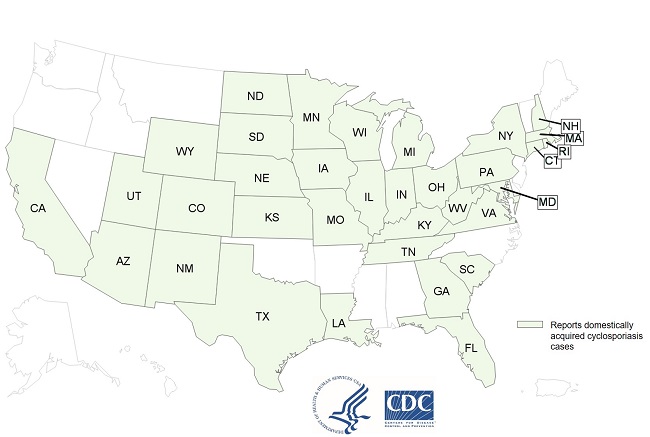
As of August 26, 2020, 1,102 laboratory-confirmed cases of cyclosporiasis in people who had no history of international travel during the 14-day period before illness onset have been reported to CDC by 35 jurisdictions, including 34 states and New York City, since May 1, 2020.

The median illness onset date is June 11, 2020 (range: May 1–August 15, 2020). At least 78 people have been hospitalized; no deaths have been reported.

In Canada, as of July 8, 2020, there are 37 confirmed cases of Cyclospora illness linked to this outbreak in three provinces: Ontario (26), Quebec (10) and Newfoundland and Labrador (1). Individuals became sick between mid-May and mid-June 2020. One individual has been hospitalized. No deaths have been reported. Individuals who became ill are between 21 and 70 years of age. The majority of cases (76%) are female.

RASFF Alert – Foodborne Outbreak – Histamine – Chilled Tuna

European Food Alerts

RASFF

foodborne outbreak suspected to be caused by and histamine (434 mg/kg – ppm) in chilled tuna (Thunnus albacares) from Sri Lanka, via France in Belgium

USA – 1,469 with Salmonella in the United States and Canada linked to Onions

1,469 with Salmonella in the United States  and Canada linked to Onions

Ukraine – Ukraine reports 16 salmonella outbreaks so far this year

Outbreak News today

Ukraine health officials reported recently that during the first eight months of 2020, the country has seen 16 salmonella outbreaks, including four in Zaporizhia oblast, two in Ivano-Frankivsk oblast and one each in Vinnytsia, Dnipropetrovsk, Zakarpattia, Kirovohrad, Odesa, Poltava, Rivne, Sumy, Cherkasy oblasts and Kyiv.

In total, 2402 salmonella cases have been reported, Officials say the incidence rate per 100,000 population is 5.7, which is 41% lower than in the same period last year.


USA – CDC update – Outbreak Investigation of Salmonella Enteritidis: Peaches (August 2020)

FDA

The FDA, along with CDC and state and local partners, is investigating an ongoing multistate outbreak of Salmonella Enteritidis infections potentially linked to peaches packed or supplied by Prima Wawona or Wawona Packing Company.

CDC reports that epidemiologic evidence indicates that peaches are the likely source of this outbreak. As of August 27, 2020, CDC is reporting a total of 78 cases across 12 states. FDA’s investigation to identify a source of contamination is ongoing.

Available recall information is included below and will be updated as more products are identified and recalled.

Recommendation

Advice for consumers, restaurants, and retailers: Consumers, restaurants, and retailers should not eat, sell, or serve recalled peaches packed or supplied by Prima Wawona.

Recalled bagged peaches packed or supplied by Prima Wawona from June 1, 2020 to August 19, 2020 should not be eaten and should be thrown away. Recalled loose/bulk peaches packed or supplied by Prima Wawona from June 1, 2020 to August 3, 2020 should not be eaten and should be thrown away.

Consumers who cannot identify the brand or remember the date of purchase, should throw the product away. Consumers who may have frozen peaches supplied by Prima Wawona should throw them away.

FDA recommends that anyone who received recalled peaches packed or supplied by Prima Wawona use extra vigilance in cleaning and sanitizing any surfaces and containers that may have come in contact with the produce to reduce the risk of cross-contamination. This includes cutting boards, slicers, countertops, refrigerators, and storage bins.

Consumers who have symptoms of Salmonella infection should contact their health care provider. Most people with salmonellosis develop diarrhea, fever, and abdominal cramps. More severe cases of salmonellosis may include a high fever, aches, headaches, lethargy, a rash, blood in the urine or stool, and in some cases may become fatal.

Suppliers and distributors: Suppliers, distributors, and others in the supply chain should not use, ship or sell recalled peaches packed or supplied by Prima Wawona.

Recalled bagged peaches packed or supplied by Prima Wawona from June 1, 2020 to August 19, 2020 should not be eaten and should be thrown away. Recalled loose/bulk peaches packed or supplied by Prima Wawona from June 1, 2020 to August 3, 2020 should not be eaten and should be thrown away.

Suppliers and distributors that re-packaged recalled peaches packed or supplied by Prima Wawona from should use extra vigilance in cleaning and sanitizing any surfaces and storage areas that may have come into contact with recalled peaches packed or supplied by bagged Prima Wawona. If there has been potential cross contamination or mixing of peaches from other sources with these recalled bagged products, then comingled products should be discarded.

Investigation Update

August 28, 2020

As of August 28, 2020, CanadaExternal Link DisclaimerSingaporeExternal Link Disclaimer, and New ZealandExternal Link Disclaimer have issued recalls of Prima Wawona peaches. Information received by FDA indicates that recalled Wawona peaches were shipped to foreign consignees in Australia, Canada, China, Costa Rica, Ecuador, El Salvador, Guatemala, Honduras, Mexico, Panama, the Philippines, Singapore, Taiwan, and the United Arab Emirates. FDA is sharing distribution information directly with foreign food safety authorities in these jurisdictions.

Additional information regarding the foreign distribution of recalled product is included in the table below.

FDA’s traceback investigation is working to identify the source of this ongoing outbreak, whether additional peaches are affected, and to determine if potentially contaminated product has been shipped to additional retailers.

Recall Information (Updated August 28, 2020)

Recalled Peaches

On August 22, 2020, Prima Wawona recalled bagged and bulk, or loose, peaches that they supplied to retailers nationwide.

The firm’s press states it is recalling “bulk/loose peaches distributed and sold from June 1 through August 3 and its bagged Wawona and Wawona Organic peaches distributed and sold from June 1 through August 19th because the products could possibly be contaminated with Salmonella.”

The bagged peaches were distributed and sold in supermarkets with the following product codes:

  • Wawona Peaches – 033383322001
  • Wawona Organic Peaches – 849315000400
  • Prima® Peaches – 766342325903
  • Organic Marketside Peaches – 849315000400
  • Kroger Peaches – 011110181749
  • Wegmans Peaches – 077890490488

For bagged peaches, the product codes may be found at the bottom of each package. All affected peaches may be found in stores nationwide.

Retailers that received recall product from Prima Wawona or Wawona Packing Company include, but are not limited to:

The bulk/loose peaches supplied by Prima Wawona are sold in grocery stores in a variety of formats, typically bins where consumers may select their own fruit and may have the following stickers with PLU numbers on them: 4037, 4038, 4044, 4401, 94037, 94038, 94044, 94401. Please note that not all peaches with these PLU codes are supplied by Prima Wawona. If you are unsure of the brand or variety of your loose peaches, you can contact your retailer or supplier, or throw them out.

Recalls have also been initiated by companies that sold peaches or products containing recalled peaches.

  • Russ Davis Wholesale
    • Recalling peach salsa and gift baskets made from recalled Prima Wawona peaches

Below is a list of consignees that the FDA had reason to believe received peaches from Prima Wawona that shipped or distributed to countries outside the United States. It is possible that this list may not include all such consignees who may have received the peaches. However, this list represents the best information currently available to the FDA:


Product Images

Outbreak Investigation of Salmonella Enteritidis in Bagged Peaches (August 2020) - Photos of Recalled Bagged Peaches

View larger images

Case Count Map Provided by CDC

Outbreak Investigation of Salmonella Enteritidis in Peaches (August 2020) - Case Count Map from CDC 8/27/2020

USA – Peaches linked to U.S. outbreak recalled in New Zealand, Singapore

Peaches linked to U.S. outbreak recalled in New Zealand, Singapore

USA – U.S. among countries sent Brazil nuts contaminated with Salmonella

U.S. among countries sent Brazil nuts contaminated with Salmonella

UK – Nearly 100 sick in UK outbreak linked to nuts; some sent to U.S.

Nearly 100 sick in UK outbreak linked to nuts; some sent to U.S.

Jordan – Rotten chicken supplier turns himself in and authorities step up monitoring efforts

Roya News

Seven people were arrested in relation to the second mass food poisoning incident in Ain al-Basha.

The owner of the restaurant and six of his employees were charged with four offences — causing harm, handling food in unsuitable conditions that made it harmful to human health, handling food that is not safe for human consumption and practicing a craft that causes harm.

The seven individuals will be detained for one week at Al-Balqa Reform and Rehabilitation Center.

Sixty seven people have been affected by the incident so far.

Jordan Food and Drug Administration (JFDA) strengthened its nationwide monitoring efforts, which will be conducted by control and inspection teams around the clock.

After numerous complaints reported symptoms of food poisoning among citizens, the JFDA, in cooperation with both the Ministry of Health and the Ministry of Interior, tightened control procedures for all food establishments by increasing the number of field visits and extending working hours to run 24 hours a day.

The aim is to inspect all main meat suppliers that provide restaurants with the pulled chicken for shawarma, and other associated food establishments.

An unpleasant odour was reported by the JFDA after obtaining 59 uncooked chicken samples.

Test results showed that the chicken is not safe for human consumption due to the presence of dense bacterial growth caused by poor storage conditions at meat warehouses and a failure to follow JFDA guidelines for high-risk materials, which require storage temperatures not to exceed five degrees Celsius.

Legal measures were taken and all violators were transferred to the public prosecutor to pursue further legal action.

The JFDA stressed the need to adhere to all instructions issued by the administration and not to ease legal consequences on violators.

The foundation also called on citizens to raise awareness about food distribution and not to hesitate to report any violations or submit complaints.

Free hotline complaints line: 117114

E-mail address: INFO@JFDA.JO

WhatsApp number: 0795632000

Facebook page: facebook.com/jfda.jo