Category Archives: Food Temperature Abuse

UK – Sixteen people food poisoned after eating ‘runny’ uncooked pate at Essex golf club

Essex Live

Sixteen guests were food poisoned and had “cramps and diarrhoea” after eating “runny” uncooked chicken liver pate at an Essex golf club.

The club’s then-operating company Crown Golf Operators Ltd, have now been fined £60,000, after the guests fell ill after eating at Stapleford Abbots Golf Club in Romford on June 17, 2017.

After playing golf that day around 24-25 guests sat down for a three-course meal, which included the pate as a starter and a carvery for mains from a set menu.

Within a day after this meal, 16 of the guests reported being ill. Some of them were ill for up to two weeks and some had to be hospitalised.

On January 29, Crown Golf Operators Ltd, were sentenced at Basildon Crown Court after pleading guilty to placing food on the market at the Romford club that was unsafe and unfit for human consumption.

The head chef at the club, Chris James, who was a co-defendent and had cooked the chicken liver pate, entered a not-guilty plea. At his trial last year, he was offered a formal caution, which he accepted.

Stapleford Abbots Golf Club is currently under new ownership after it was sold and taken over in February 2019.


RASFF Alert – Histamine – Frozen Tuna Belly

RASFF-Logo

RASFF – histamine (151.7 mg/kg – ppm) in frozen tuna belly with skin from Vietnam in Portugal

Research -Climate change could unlock new microbes and increase heat-related deaths

Science Daily

The Journal of Clinical Investigation (JCI) recently published “Viewpoint” articles by Johns Hopkins University School of Medicine professors who warn that global climate change is likely to unlock dangerous new microbes, as well as threaten humans’ ability to regulate body temperature.

Johns Hopkins Bloomberg Distinguished Professors Rexford Ahima, M.D., Ph.D., and Arturo Casadevall, M.D., Ph.D., M.S., along with William Dietz, M.D., Ph.D., director of the George Washington University’s Sumner M. Redstone Global Center for Prevention and Wellness, and Susan Pacheco, M.D., associate professor in the Department of Pediatrics at the University of Texas Health Science Center at Houston, authored journal articles relevant to their fields that detail how rising temperatures around the world pose dangerous threats to humanity.

Ahima, director of Johns Hopkins’ Division of Endocrinology, Diabetes and Metabolism, wrote in the journal that “global warming threatens human thermoregulation and survival.”


India – Boy dies after food poisoning

The Hindu

A minor boy died while his sister and grandmother are reported to have recovered after they consumed food at home which had turned bad. Ellavva of Hanuman Nagar in the district headquarters and her grandchildren were hospitalised after they ate some food prepared at home and took medicine from a local medical practitioner. Later, they were shifted to hospital. While Ravi died while being shifted to a hospital on Thursday evening, Ellavva and her granddaughter are being treated at the hospital and their health was reported to be stable.

Information – Food Safety Charts – Food Safety During Power Outage

Food Safety.gov

Refrigerated Food and Power Outages: When to Save It and When to Throw It Out

As the USDA notes in Keeping Food Safe During an Emergency, your refrigerator will keep food safe for up to 4 hours during a power outage. Keep the door closed as much as possible. Discard refrigerated perishable food such as meat, poultry, fish, eggs, and leftovers after 4 hours without power.

After a power outage never taste food to determine its safety. You will have to evaluate each item separately—use this chart  in the link above as a guide.

When in Doubt, Throw it Out!

Research – Predictive Model of Listeria monocytogenes Growth in Queso Fresco

Journal of Food Protection

ABSTRACT

Listeria monocytogenes is a hardy psychrotrophic pathogen that has been linked to several cheese-related outbreaks in the United States, including a recent outbreak in which a fresh cheese (queso fresco) was implicated. The purpose of this study was to develop primary, secondary, and tertiary predictive models for the growth of L. monocytogenes in queso fresco and to validate these models using nonisothermal time and temperature profiles. A mixture of five strains of L. monocytogenes was used to inoculate pasteurized whole milk to prepare queso fresco. Ten grams of each fresh cheese sample was vacuum packaged and stored at 4, 10, 15, 20, 25, and 30°C. From samples at each storage temperature, subsamples were removed at various times and diluted in 0.1% peptone water, and bacteria were enumerated on Listeria selective agar. Growth data from each temperature were fitted using the Baranyi model as the primary model and the Ratkowsky model as the secondary model. Models were then validated using nonisothermal conditions. The Baranyi model was fitted to the isothermal growth data with acceptable goodness of fit statistics (R2 = 0.928; root mean square error = 0.317). The Ratkowsky square root model was fitted to the specific growth rates at different temperatures (R2 = 0.975). The tertiary model developed from these models was validated using the growth data with two nonisothermal time and temperature profiles (4 to 20°C for 19 days and 15 to 30°C for 11 days). Data for these two profiles were compared with the model prediction using an acceptable prediction zone analysis; >70% of the growth observations were within the acceptable prediction zone (between −1.0 and 0.5 log CFU/g). The model developed in this study will be useful for estimating the growth of L. monocytogenes in queso fresco. These predictions will help in estimation of the risk of listeriosis from queso fresco under extended storage and temperature abuse conditions.

HIGHLIGHTS
  • Growth of L. monocytogenes was examined in queso fresco at constant temperatures.

  • A positive correlation was found between temperature and growth rate.

  • A tertiary model was developed to predict growth under nonisothermal conditions.

  • The acceptable prediction zone analysis suggests that the tertiary model was acceptable.

RASFF Alert – Histamine – Chilled Chestnut Fish

RASFF-Logo

RASFF – histamine in chilled chestnut fish (Brama brama) from Spain in Italy

RASFF Alert – Mould – Cream Yoghurt

RASFF-Logo

RASFF – bulging packaging of cream yogurt from Germany infested with moulds in Germany

USA – UNFI Voluntarily Recalls Arla Apetina Marinated Feta & Olives in Oil, Pitted Because of Possible Health Risk

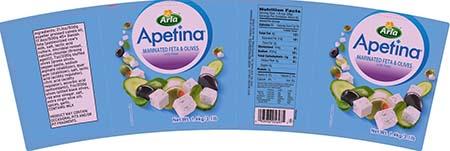
FDA “Label, Arla Apetina Marinated Feta & Olives in Oil, Pitted”

UNFI is voluntarily recalling cases of Arla Apetina Marinated Feta & Olives in Oil, Pitted distributed by UNFI. The product requires refrigeration to ensure food safety and we have learned that some product distributed to retail customers from 2 UNFI distribution centers may have been exposed to temperatures above refrigeration during storage and/or distribution by UNFI’S customers. Extended exposure to above-refrigerated temperatures may allow growth of bacteria such as Clostridium Botulinum to reach unsafe levels, which if consumed can cause life-threatening illness or death. Consumers are warned not to use the product even if it does not look or smell spoiled. No illnesses, including allergic reactions, involving this product have been reported to date in connection with this problem.

Botulism, a potentially fatal form of food poisoning, can cause the following symptoms: general weakness, dizziness, double-vision and trouble with speaking or swallowing. Difficulty in breathing, weakness of other muscles, abdominal distension and constipation may also be common symptoms. People experiencing these symptoms should seek immediate medical attention.

A total of 75 cases of this product were distributed to 69 retail customers serviced by UNFI distribution centers in Greenwood, IN. and Sarasota, Fla. between Jan. 1, 2019 and Aug. 30, 2019 to the following states IN, KY, IL, MI, FL, OH, MO. No other distribution centers or products in states that are not listed are impacted by this notice. Additionally, Arla Apetina Marinated Feta & Olives in Oil, not sold by UNFI Greenwood or Sarasota are not impacted by UNFI’s voluntary recall.

The product comes in a 3.1-pound plastic package marked with UPC code 9393605697.

Retailers who have purchased the Arla Apetina Marinated Feta & Olives in Oil, Pitted product from these two distribution centers should remove any remaining product from the supply chain and discard the product in a manner that would prevent its consumption or distribution and contact their UNFI account managers for a full refund. Consumers with questions may contact the company at 800-451-2525.


RASFF Alert – Mould – Blanched Groundnut Kernels

RASFF-Logo

RASFF – blanched groundnut kernels from Argentina infested with moulds in Hungary