Category Archives: Food Technology

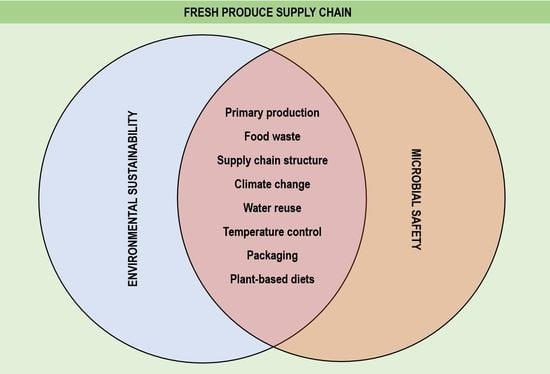
Research – Interactions between Microbial Food Safety and Environmental Sustainability in the Fresh Produce Supply Chain

MDPI

Improving the environmental sustainability of the food supply chain will help to achieve the United Nations Sustainable Development Goals (SDGs). This environmental sustainability is related to different SDGs, but mainly to SDG 2 (Zero Hunger), SDG 12 (Responsible Production and Consumption), SDG 13 (Climate Action), and SDG 15 (Life on Land). The strategies and measures used to improve this aspect of the food supply chain must remain in balance with other sustainability aspects (economic and social). In this framework, the interactions and possible conflicts between food supply chain safety and sustainability need to be assessed. Although priority must be given to safety aspects, food safety policies should be calibrated in order to avoid unnecessary deleterious effects on the environment. In the present review, a number of potential tensions and/or disagreements between the microbial safety and environmental sustainability of the fresh produce supply chain are identified and discussed. The addressed issues are spread throughout the food supply chain, from primary production to the end-of-life of the products, and also include the handling and processing industry, retailers, and consumers. Interactions of fresh produce microbial safety with topics such as food waste, supply chain structure, climate change, and use of resources have been covered. Finally, approaches and strategies that will prove useful to solve or mitigate the potential contradictions between fresh produce safety and sustainability are described and discussed. Upon analyzing the interplay between microbial safety and the environmental sustainability of the fresh produce supply chain, it becomes clear that decisions that are taken to ensure fresh produce safety must consider the possible effects on environmental, economic, and social sustainability aspects. To manage these interactions, a global approach considering the interconnections between human activities, animals, and the environment will be required. View Full-Text
Research – Bacteriophage Therapy to Reduce Colonization ofCampylobacter jejuniin Broiler Chickens before Slaughter

Click to access viruses-13-01428.pdf

Research – Reduction of Escherichia coli O157:H7, Listeria monocytogenes, or Salmonella on Whole Yellow Onions (Allium cepa) Exposed to Hot Water

Journal of Food Protection

In-home or food service antimicrobial treatment options for fresh produce are limited. Hot water treatments for whole (unpeeled) produce have been proposed but data to support this practice for onions are not available. Separate cocktails of rifampin-resistant Escherichia coli O157:H7, Listeria monocytogenes , or Salmonella were cultured on agar and suspended in sterile water. The outer papery skin at the equator or root or stem ends of the whole yellow onions was spot inoculated at 6 log CFU/onion. After drying for 30 min and, in some cases, storage at 4°C for 6 days, onions were immersed in water at ~100°C for 5 s or 85°C for 10 to 180 s. There was no significant difference ( P > 0.05) in the mean decline of Salmonella on onions that were exposed to hot water after drying the inoculum for 30 min or after storage at 4°C for 6 days. Exposure of whole onions at 100°C for 5 s reduced E. coli O157:H7 and L. monocytogenes populations by >5 log CFU/onion at all inoculum sites and Salmonella populations by >5 log CFU/onion at the stem end and equator but not consistently at the root end. Mean root-end reductions of ≥5 log CFU/onion of E. coli O157:H7, L. monocytogenes , or Salmonella were achieved consistently when the root end was fully immersed in 85°C hot water for 45 or 60 s, except in a small number of cases (4/57; 7%) when the root end oriented above the water line during treatment. When onions were held at 85°C for 180 s with the root end above the water line in an uncovered water bath, no significant declines in Salmonella populations were observed; significant mean declines of Salmonella were achieved (mean 5 log CFU/onion [range 3.49 to 6.25]) when the water bath was covered. Short exposure to hot water can significantly reduce pathogens on the surface of whole onions; reductions are more consistent when the root end is submerged, or when the water bath is covered.

USA – FSIS Industry Guideline for Minimizing the Risk of Shiga Toxin-Producing Escherichia coli (STEC) in Beef (including Veal) Slaughter Operations

FSIS USDA

GUIDELINE IDFSIS-GD-2021-0008
ISSUE DATEJuly 2021

Replaces: 2017 Version of the Guideline

This guideline helps establishments that slaughter beef (including veal) to implement effective sanitary dressing procedures designed to prevent carcass contamination; implement effective decontamination and antimicrobial interventions; properly assess microbial testing results; and use the results to assess the effectiveness of the overall HACCP system. This guideline relates to 9 CFR 310.18(a), 9 CFR 416.1 through 416.5, 9 CFR 417.2(a)(1), 9 CFR 417.2(c)(3), 9 CFR 417.4(a)(2), 9 CFR 417.5(a)(1), and 9 CFR 417.5(a)(2).

Research- Predictive microbial modeling of E. faecium NRRL B-2354 inactivation during baking of a multi-component low-moisture food

Journal of Food Protection

Validating baking ovens as a microbial kill step, using thermal inactivation models, is desirable; however, traditional isothermal models may not be appropriate for these dynamic processes, yet they are being used by the food industry. Previous research indicates that the impact of additional process conditions, such as process humidity, should be considered when validating thermal processes for the control of microbial hazards in low-moisture foods. In this study, the predictive performance of traditional and modified thermal inactivation kinetic models accounting for process humidity were assessed for predicting bacterial inactivation of Enterococcus faecium NRRL B-2354 in a multi-ingredient composite food during baking. Ingredients (milk powder, protein powder, peanut butter, and whole wheat flour), individually inoculated to ~6 logCFU/g and equilibrated to a water activity of 0.25, were mixed to form a dough. An isothermal inactivation study was conducted for the dough to obtain traditional D- and z- values (n=63). In a separate experiment, cookies were baked under four dynamic heating conditions: 135℃/high humidity, 135℃/low humidity, 150℃/high humidity, and 150℃/low humidity. Process humidity measurements, time-temperature profiles for the product core, surface, and bulk air, and microbial survivor ratios were collected for the four conditions at six residence times (n=144). The traditional isothermal model had a poor root mean square error (RMSE) of 856.51 log (CFU/g), significantly overpredicting bacterial inactivation during the process. The modified model accounting for the dynamic time-temperature profile and process humidity data yielded a better predictive performance with a RMSE of 0.55 log CFU/g. The results demonstrate the importance of accounting for additional process parameters in baking inactivation models, and that model performance can be improved by utilizing model parameters obtained directly from industrial-scale experimental data.

Research – Vapor Phase Hydroxyl- or Chlorine-radical Treatment for Inactivating Listeria monocytogenes on Mushrooms (Agaricus bisporus) Without Negatively Affecting Quality or Shelf-life

Journal of Food Protection

Processes based on generating vapor phase hydroxyl-radicals or chlorine-radicals were developed for inactivating Listeria monocytogenes on mushrooms without negatively affecting quality. Antimicrobial radicals were generated from the UV-C degradation of hydrogen peroxide or hypochlorite and ozone gas. Response Surface Modelling (RMS) was used to identify the interaction between the operating parameters for the hydroxyl-radical process; UV-C 254nm intensity, hydrogen peroxide concentration and ozone delivered. There was an inverse relationship between hydrogen peroxide concentration and UV-C intensity in terms of the log reduction of L. monocytogenes . The independent parameters for the chlorine-radical process were hypochlorite concentration, pH, and UV-C intensity. From predictive models, the optimal hydroxyl-radical treatment was found to be 5% v/v H 2 O 2 , 2.86 mW/cm 2 UV-C intensity (total UV-C dose 144 mJ/cm 2 ) and 16.5 mg ozone. The chlorine-radical optimal process parameters were 10 ppm hypochlorite (pH 3.0), ozone 11.0 mg and 4.60 mW/cm 2 UV-C intensity. When inoculated mushrooms were treated with the optimal hydroxyl-radical and chlorine-radical process the log CFU reduction of L. monocytogenes was found to be 2.42±0.42 and 2.61±0.30 log CFU respectively without any negative effects on mushroom quality (weight loss and Browning Index during 14 days storage at 4°C). The levels of L. monocytogenes inactivation were significantly greater compared to when the individual elements of the radical processes were applied and control using a 90 s dip in 1% v/v hydrogen peroxide. The study has demonstrated that both hydroxyl-radical and chlorine-radical vapor-phase treatments are both equally effective at inactivating L. monocytogenes on mushrooms and can be considered as a preventative control step.

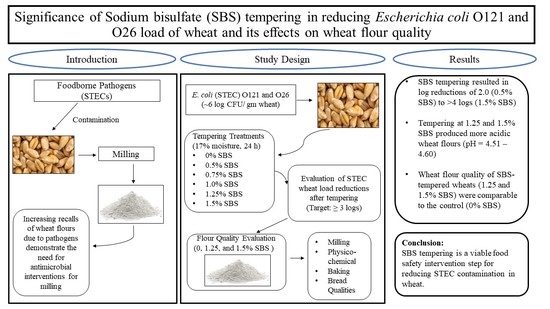
Research – Significance of Sodium Bisulfate (SBS) Tempering in Reducing the Escherichia coli O121 and O26 Load of Wheat and Its Effects on Wheat Flour Quality

MDPI

The occurrence of recalls involving pathogenic Escherichia coli-contaminated wheat flours show the need for incorporating antimicrobial interventions in wheat milling. The objectives of this study were to assess the efficacy of sodium bisulfate (SBS) tempering in reducing E. coli O121 (ATCC 2219) and O26 (ATCC 2196) wheat load and to evaluate the impact of effective (≥3.0 log reductions) SBS treatments on wheat flour quality. Wheat grains were inoculated with E. coli (~6 log CFU/g) and tempered (17% moisture, 24 h) using the following SBS concentrations (%wheat basis): 0, 0.5, 0.75, 1.0, 1.25, and 1.5% SBS. Reductions in E. coli O121 and O26 wheat load at different time intervals (0.5, 2, 6, 12, 18, and 24 h) during tempering were evaluated. The addition of SBS during tempering resulted in E. coli (O121 and O26) log reductions of 2.0 (0.5% SBS) to >4.0 logs (1.5% SBS) (p ≤ 0.05). SBS tempering (1.25 and 1.5% SBS) produced acidic wheat flours (pH = 4.51–4.60) but had comparable wheat flour properties in terms of composition, dough, and bread-making properties relative to the control (0% SBS). SBS tempering reduced the E. coli O121 and O26 load of wheat after tempering with minimal effects on wheat flour quality. View Full-Text

Research – Low-Temperature Virus vB_EcoM_VR26 Shows Potential in Biocontrol of STEC O26:H11

MDPI

Shiga toxin-producing Escherichia coli (STEC) O26:H11 is an emerging foodborne pathogen of growing concern. Since current strategies to control microbial contamination in foodstuffs do not guarantee the elimination of O26:H11, novel approaches are needed. Bacteriophages present an alternative to traditional biocontrol methods used in the food industry. Here, a previously isolated bacteriophage vB_EcoM_VR26 (VR26), adapted to grow at common refrigeration temperatures (4 and 8 °C), has been evaluated for its potential as a biocontrol agent against O26:H11. After 2 h of treatment in broth, VR26 reduced O26:H11 numbers (p < 0.01) by > 2 log10 at 22 °C, and ~3 log10 at 4 °C. No bacterial regrowth was observed after 24 h of treatment at both temperatures. When VR26 was introduced to O26:H11-inoculated lettuce, ~2.0 log10 CFU/piece reduction was observed at 4, 8, and 22 °C. No survivors were detected after 4 and 6 h at 8 and 4 °C, respectively. Although at 22 °C, bacterial regrowth was observed after 6 h of treatment, O26:H11 counts on non-treated samples were >2 log10 CFU/piece higher than on phage-treated ones (p < 0.02). This, and the ability of VR26 to survive over a pH range of 3–11, indicates that VR26 could be used to control STEC O26:H11 in the food industry. View Full-Text

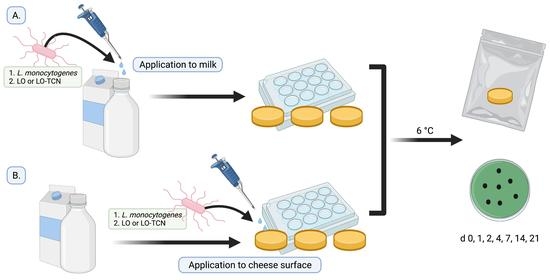
Research – Evaluation of Lactose Oxidase as an Enzyme-Based Antimicrobial for Control of L. monocytogenes in Fresh Cheese

MDPI

Listeria monocytogenes is a ubiquitous pathogen that can cause morbidity and mortality in the elderly, immune compromised, and the fetuses of pregnant women. The intrinsic properties of fresh cheese—high water activity (aW), low salt content, and near-neutral pH—make it susceptible to L. monocytogenes contamination and growth at various points in the production process. The aim of this study was to investigate the ability of lactose oxidase (LO), a naturally derived enzyme, to inhibit the growth of L. monocytogenes in fresh cheese during various points of the production process. Lab-scale queso fresco was produced and inoculated with L. monocytogenes at final concentrations of 1 log CFU/mL and 1 CFU/100 mL. LO and LO sodium thiocyanate (TCN) combinations were incorporated into the milk or topically applied to the finished cheese product in varying concentration levels. A positive control and negative control were included for all experiments. When L. monocytogenes was inoculated into the milk used for the cheese-making process, by day 28, the positive control grew to above 7 log CFU/g, while the 0.6 g/L treatment (LO and LO + TCN) fell below the limit of detection (LOD) of 1.3 log CFU/g. In the lower inoculum, the positive control grew to above 7 log CFU/g, and the treatment groups fell below the LOD by day 21 and continued through day 28 of storage. For surface application, outgrowth occurred with the treatments in the higher inoculum, but some inhibition was observed. In the lower inoculum, the higher LO and LO-TCN concentrations (0.6 g/L) reduced L. monocytogenes counts to below the LOD, while the control grew out to above 7 log CFU/g, which is a >5 log difference between the control and the treatment. These results suggest that LO could be leveraged as an effective control for L. monocytogenes in a fresh cheese. View Full-Text

France – Organic smoked Irish salmon – Listeria monocytogenes

Gov france

  • Product category Food
  • Product sub-category Fishery and aquaculture products
  • Product brand name Pierre Neau
  • Names of models or references2 slices 4 slices
  • Product identification
    Lot Dated
    111310026 Use-by date 06/12/2021
    111310026 Use-by date 06/15/2021
  • Packaging Vacuum plate
  • Start date / End of marketing From 05/18/2021 to 06/01/2021
  • Storage temperature Product to be stored in the refrigerator
  • Health mark FR 78.005.001 CE
  • Geographical sales area Departments: YVELINES (78)
  • Distributors La Marée Ets Neau (workshop shop)
  • List of points of sale Sales_points_list.pdf
  • Reason for recall Presence of listeria monocytogenes possible
  • Risks incurred by the consumer Listeria monocytogenes (causative agent of listeriosis)
  • Consumer behavior Return the product to the point of sale
  • Sanitary recommendation People who have consumed the “products” mentioned above and who have fever, isolated or accompanied by headaches, and muscle aches, are invited to consult their doctor, notifying him of this consumption. Serious forms with neurological complications and maternal or fetal damage in pregnant women can also sometimes occur. Pregnant women as well as immunocompromised people and the elderly should pay special attention to these symptoms. Listeriosis is a disease that can be serious and can take up to eight weeks to incubate.
  • Contact number0139110770
  • Compensation modalities Refund
  • End date of the recall procedure Sunday 20 June 2021