Category Archives: Food Technology

France – Gingerbread mix – Bacillus cereus

Gov france

Identification information of the recalled product

  • Product category Feed
  • Product subcategory Herbs and spices
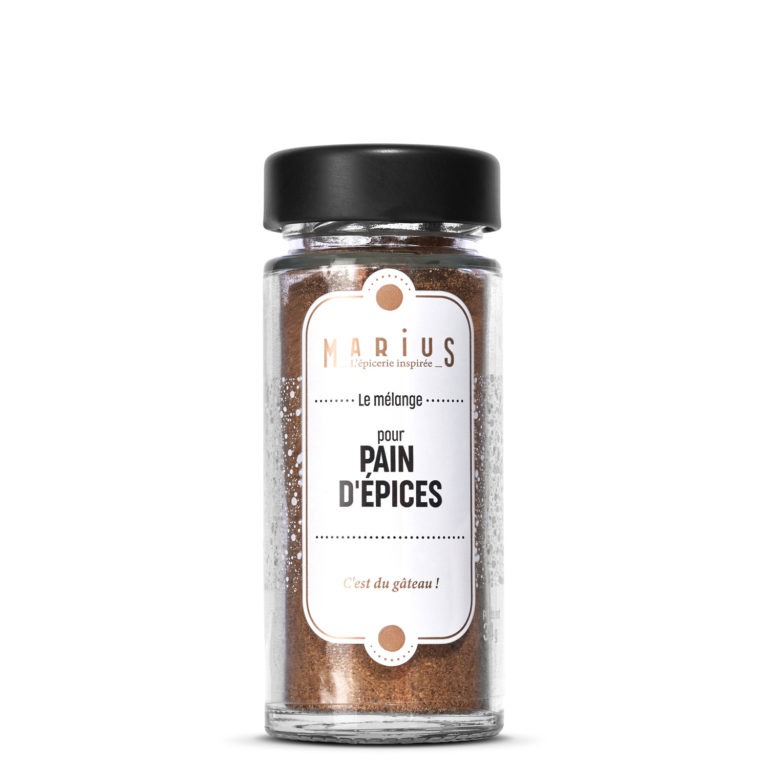
  • Product brand name marius
  • Model names or references Gingerbread Mix Bottle
  • Identification of products
    GTIN Batch Date
    3183811060542 000324516 Date of minimum durability 09/20/2025
  • Packaging 34g bottle
  • Marketing start/end date From 06/10/2022 to 08/12/2022
  • Storage temperature Product to be stored at room temperature
  • Further information Glass bottle with black cap
  • Geographic area of ​​sale Whole France
  • DistributorsRetail
  • List of points of saleTRACABILITE_6054__LOT_000324516_(ginger_moulu_lot_28042022_lot_fournisseur_N°1556).pdf

Practical information regarding the recall

  • Reason for recall Presence of Bacillus cereus in ginger raw material


Research – Microbiological and Sensorial Quality of Beef Meat (Longissimus dorsi) Marinated with Cinnamon Extract and Stored at Various Temperatures

MDPI

Abstract

Meat spoilage caused by temperature abuse is a major problem for producers, retailers, and consumers that can generate large economic losses to industries. Microbial growth of Pseudomonas spp. is the main source of spoilage during storage. Cinnamon has antimicrobial properties that may potentially be used to reduce the spoilage caused by Pseudomonas. The objectives of this study were to determine the inhibitory effect of cinnamon extract (CE) against Pseudomonas aeruginosa (ATCC 27853) and evaluate the treatment of CE on meat quality during different storage temperatures (5 °C, 10 °C, 15 °C, and 25 °C). The anti-Pseudomonas result showed that 100% (w/v) CE concentration produced a 13.50 mm zone of inhibition in a disc diffusion assay. The minimum inhibitor concentration (MIC) of CE was noted at 25% (v/v), whereas the minimum bactericidal concentration (MBC) value was observed at 50% (v/v) concentration of CE. The time-kill showed the growth of P. aeruginosa decreased from 7.64 to 5.39 log CFU/mL at MIC concentration. Total phenolic content and IC50 value of the cinnamon extract was expressed as 6.72 ± 0.87 mg GAE/g extract and 0.15 mg/mL, respectively. When the meat was marinated with 50% (v/v) CE and stored at various temperatures, the total viable count (TVC) and growth of Pseudomonas spp. were lowered as compared to the control sample. However, the reduction in microbial count in all samples was influenced by the storage temperature, where the lowered microbial count was noted in the sample treated with CE and stored at 5 and 10 °C for 48 h. The pH of meat treated with or without CE ranged from pH 5.74 to 6.48. The sensory attributes of colour, texture, and overall acceptability have a significant difference, except for odour, between marinated meat and control. The results indicate that the use of cinnamon extract as the marination agent for meat could reduce the growth of Pseudomonas spp. and therefore assist in extending the shelf life of meat at 5 and 10 °C storage temperatures.

Research – Treatment of Fresh Meat, Fish and Products Thereof with Cold Atmospheric Plasma to Inactivate Microbial Pathogens and Extend Shelf Life

MDPI

Abstract

Assuring the safety of muscle foods and seafood is based on prerequisites and specific measures targeted against defined hazards. This concept is augmented by ‘interventions’, which are chemical or physical treatments, not genuinely part of the production process, but rather implemented in the framework of a safety assurance system.
The present paper focuses on ‘Cold Atmospheric pressure Plasma’ (CAP) as an emerging non-thermal intervention for microbial decontamination. Over the past decade, a vast number of studies have explored the antimicrobial potential of different CAP systems against a plethora of different foodborne microorganisms.
This contribution aims at providing a comprehensive reference and appraisal of the latest literature in the area, with a specific focus on the use of CAP for the treatment of fresh meat, fish and associated products to inactivate microbial pathogens and extend shelf life. Aspects such as changes to organoleptic and nutritional value alongside other matrix effects are considered, so as to provide the reader with a clear insight into the advantages and disadvantages of CAP-based decontamination strategies.

Research – Mycotoxins and Essential Oils—From a Meat Industry Hazard to a Possible Solution: A Brief Review

MDPI

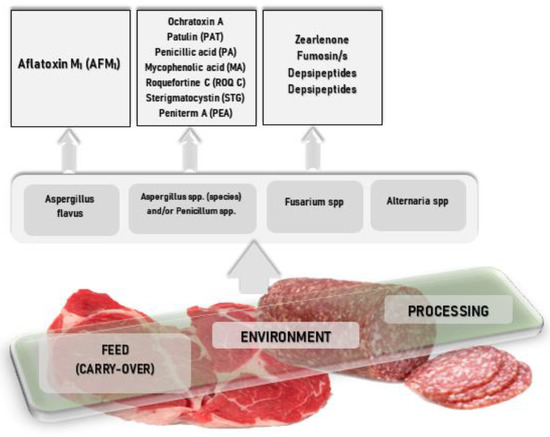
The preservation of food supplies has been humankind’s priority since ancient times, and it is arguably more relevant today than ever before. Food sustainability and safety have been heavily prioritized by consumers, producers, and government entities alike. In this regard, filamentous fungi have always been a health hazard due to their contamination of the food substrate with mycotoxins. Additionally, mycotoxins are proven resilient to technological processing. This study aims to identify the main mycotoxins that may occur in the meat and meat products “Farm to Fork” chain, along with their effect on the consumers’ health, and also to identify effective methods of prevention through the use of essential oils (EO). At the same time, the antifungal and antimycotoxigenic potential of essential oils was considered in order to provide an overview of the subject. Targeting the main ways of meat products’ contamination, the use of essential oils with proven in vitro or in situ efficacy against certain fungal species can be an effective alternative if all the associated challenges are addressed (e.g., application methods, suitability for certain products, toxicity). View Full-Text

Research – Combined Pulsed Electric Field with Antimicrobial Caps for Extending Shelf Life of Orange Juice

MDPI

The purpose of this study was to investigate the effectiveness of combined pulsed electric fields (PEF) and antimicrobial packaging treatment in maintaining the quality and stability of orange juice stored at 10 °C. Orange juice was treated by PEF and stored in glass jars with antimicrobial caps coated with 10 µL of carvacrol essential oil (AP). Microbial reductions and physiochemical properties of juice samples were determined after treatments and during storage at 10 °C. Orange juice samples subjected to the combined treatment (PEF+AP) had the lowest yeast and mold populations after 14 day-storage at 10 °C. There were no significant differences in pH, acidity, color, total soluble solid contents, total phenol compounds, and Vitamin C among all samples after treatments. Storage studies showed that PEF, AP, and PEF+AP treatments maintained the quality and stability of orange juice stored at 10 °C for 5 weeks but lost Vitamin C. This study provides valuable information to juice processors for consideration and design of nonthermal pasteurization with antimicrobial packaging of juice products. View Full-Text

Research – Microbial Control of Raw and Cold-Smoked Atlantic Salmon (Salmo salar) through a Microwave Plasma Treatment

MDPI

The control of the pathogenic load on foodstuffs is a key element in food safety. Particularly, seafood such as cold-smoked salmon is threatened by pathogens such as Salmonella sp. or Listeria monocytogenes. Despite strict existing hygiene procedures, the production industry constantly demands novel, reliable methods for microbial decontamination. Against that background, a microwave plasma-based decontamination technique via plasma-processed air (PPA) is presented. Thereby, the samples undergo two treatment steps, a pre-treatment step where PPA is produced when compressed air flows over a plasma torch, and a post-treatment step where the PPA acts on the samples. This publication embraces experiments that compare the total viable count (tvc) of bacteria found on PPA-treated raw (rs) and cold-smoked salmon (css) samples and their references. The tvc over the storage time is evaluated using a logistic growth model that reveals a PPA sensitivity for raw salmon (rs). A shelf-life prolongation of two days is determined. When cold-smoked salmon (css) is PPA-treated, the treatment reveals no further impact. When PPA-treated raw salmon (rs) is compared with PPA-untreated cold-smoked salmon (css), the PPA treatment appears as reliable as the cold-smoking process and retards the growth of cultivable bacteria in the same manner. The experiments are flanked by quality measurements such as color and texture measurements before and after the PPA treatment. Salmon samples, which undergo an overtreatment, solely show light changes such as a whitish surface flocculation. A relatively mild treatment as applied in the storage experiments has no further detected impact on the fish matrix.

Belgium – Cooked-Smoked Chicken +/- 1.3 kg from the Delhaize brand- Listeria monocytogenes

AFSCA

PRODUCT RECALL
 Printable version   |   Last updated on25.10.2022
25/10/2022
Delhaize recall
Product: Cooked-Smoked Chicken +/- 1.3 kg from the Delhaize brand.
Problem: Possible presence of Listeria monocytogenes.


Delhaize asks its customers not to consume and to bring the products below back to the store.

In collaboration with the FASFC, Delhaize has decided to withdraw these products from the market and to recall them from consumers due to the presence of Listeria monocytogenes.

Product info:

Name: Delhaize Smoked-Cooked Chicken +/- 1.3 kg
Brand: Delhaize
EAN code: 2223380000000
Batch number: 5412190116
Expiry date: 07/11/2022
Hope: 423380 Marketing
period: 18/10/2022 as of 22/10/2022

Delhaize performs hundreds of internal quality checks every day to guarantee the quality and food safety of its products at all times.

In the meantime, Delhaize has already taken all affected products off the shelves and tightened checks on the product and the supplier. Customers who have purchased this product are asked not to consume it. Customers have the option of returning the product in question to the point of sale where they purchased it. Reimbursement for each affected item is guaranteed.

Other products of the same assortment are not affected and can therefore be consumed in complete safety. Delhaize would like to apologize for the inconvenience caused.

Advice and information for consumers:

What if you have already purchased the product?
Do not consume the product and return it to your Delhaize store. The products will be refunded to you.

For further information , customers can contact our Customer Service on the free number 0800/95 713 .

Research – Antibiofilm Efficacy of Quercetin against Vibrio parahaemolyticus Biofilm on Food-Contact Surfaces in the Food Industry

MDPI

Vibrio parahaemolyticus, one of the most common foodborne pathogenic bacteria that forms biofilms, is a persistent source of concern for the food industry. The food production chain employs a variety of methods to control biofilms, although none are completely successful. This study aims to evaluate the effectiveness of quercetin as a food additive in reducing V. parahaemolyticus biofilm formation on stainless-steel coupons (SS) and hand gloves (HG) as well as testing its antimicrobial activities. With a minimum inhibitory concentration (MIC) of 220 µg/mL, the tested quercetin exhibited the lowest bactericidal action without visible growth. In contrast, during various experiments in this work, the inhibitory efficacy of quercetin at sub-MICs levels (1/2, 1/4, and 1/8 MIC) against V. parahaemolyticus was examined. Control group was not added with quercetin. With increasing quercetin concentration, swarming and swimming motility, biofilm formation, and expression levels of target genes linked to flagellar motility (flaAflgL), biofilm formation (vp0952vp0962), virulence (VopQvp0450), and quorum-sensing (aphAluxS) were all dramatically suppressed. Quercetin (0–110 μg/mL) was investigated on SS and HG surfaces, the inhibitory effect were 0.10–2.17 and 0.26–2.31 log CFU/cm2, respectively (p < 0.05). Field emission scanning electron microscopy (FE-SEM) corroborated the findings because quercetin prevented the development of biofilms by severing cell-to-cell contacts and inducing cell lysis, which resulted in the loss of normal cell shape. Additionally, there was a significant difference between the treated and control groups in terms of motility (swimming and swarming). According to our research, quercetin produced from plants should be employed as an antibiofilm agent in the food sector to prevent the growth of V. parahaemolyticus biofilms. These results indicate that throughout the entire food production chain, bacterial targets are of interest for biofilm reduction with alternative natural food agents in the seafood industry. View Full-Text

Research – Inhibitory Effect against Listeria monocytogenes of Carbon Nanoparticles Loaded with Copper as Precursors of Food Active Packaging

MDPI

Human listeriosis is a serious foodborne disease of which outbreaks are occurring increasingly frequently in Europe. Around the world, different legal requirements exist to guarantee food safety. Nanomaterials are increasingly used in the food industry as inhibitors of pathogens, and carbon nanomaterials are among the most promising. In the present study, novel carbon nanoparticles loaded with copper (CNP-Cu) were prepared, and their antimicrobial activity against Listeria monocytogenes was assessed. CNPs of two sizes were synthesized and characterized by dynamic light scattering (DLS), electrophoretic light scattering (ELS) and electron microscopy (EM). The minimum inhibitory concentration (MIC) of CNP-Cu was determined in accordance with the available standard. To get insights into its mechanism of action, the release of copper ions into a cell media was assessed by inductively coupled plasma optical emission (ICP-OE), and the ability of loaded CNPs to generate cytotoxic reactive oxygen species (ROS) was evaluated by EPR spectroscopy. Finally, the extent of release of copper in a food simulant was assessed. The results demonstrated the antimicrobial effectiveness of CNP-Cu, with growth inhibition up to 85% and a release of copper that was more pronounced in an acidic food simulant. Overall, the results indicate CNP-Cu as a promising agent for the design of active food packaging which is able to improve food shelf-life.

Research – Eco-Friendly Edible Packaging Systems Based on Live-Lactobacillus kefiri MM5 for the Control of Listeria monocytogenes in Fresh Vegetables

MDPI

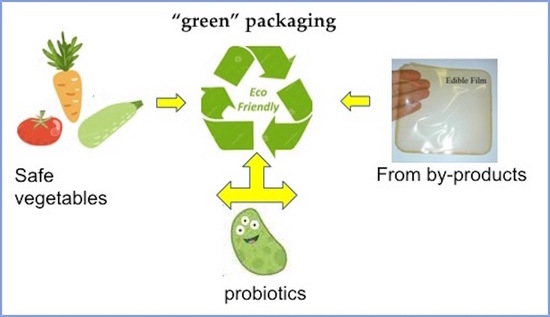
To meet consumer requirements for high quality food free of chemical additives, according to the principles of sustainability and respect for the environment, new “green” packaging solutions have been explored. The antibacterial activity of edible bioactive films and coatings, based on biomolecules from processing by-products and biomasses, added with the bacteriocin producer Lactobacillus kefiri MM5, has been determined in vegetables against L. monocytogenes NCTC 10888 (i) “in vitro” by a modified agar diffusion assay and (ii) “on food” during storage of artificially contaminated raw vegetable samples, after application of active films and coatings. Both polysaccharides-based and proteins-based films and coatings showed excellent antilisterial activity, especially at 10 and 20 days. Protein-based films displayed a strong activity against L. monocytogenes in carrots and zucchini samples (p < 0.0001). After 10 days, both polysaccharide-based and protein-based films demonstrated more enhanced activity than coatings towards the pathogen. These edible active packagings containing live probiotics can be used both to preserve the safety of fresh vegetables and to deliver a beneficial probiotic bacterial strain. The edible ingredients used for the formulation of both films and coatings are easily available, at low cost and environmental impact.