Category Archives: food safety training

USA – July Fourth is for Fireworks, not Foodborne Illness

USDA

America celebrates Independence Day

Pull out the grill and your red, white, and blue because the Fourth of July is here. This means gatherings, outdoor festivities, and good times with family and friends. As the meat sizzles on the grill, don’t let food safety fizzle out of your memory.

“Wherever you go this summer, don’t forget to bring your safe food handling practices along for the adventure,” said U.S. Department of Agriculture (USDA) Deputy Under Secretary for Food Safety Sandra Eskin. “As temperatures rise, the risk for foodborne illness does too. Always remember that whether you’re grilling for the Fourth of July, camping, or boating, you should wash your hands before and during food prep.”

Whether you’re eating at home or outdoors at a park this Fourth of July, sanitation is key to combat foodborne illness. Be sure to wash your hands and sanitize your cooking area before preparing food. Safe food handling practices also help to avoid cross-contamination. Summertime brings additional unique challenges to food safety because of the warmer temperatures. Be sure to keep hot foods hot and cold foods cold this Fourth of July, and don’t forget your food thermometer.

Clean and Sanitize

Always wash your hands with soap and warm water for at least 20 seconds before and after handling raw meat and poultry. A recent USDA study (PDF, 1.3 MB) showed that 56% of participants didn’t attempt to wash their hands during meal preparation. When preparing your Fourth of July meal, don’t skip this step. Remember, hand sanitizer is not as effective as handwashing, but it’s better than nothing. If you’re out camping and have no access to running water, use hand sanitizer as a backup.

Wash surfaces and utensils with soap and warm water before cooking and after contact with raw meat and poultry. After cleaning surfaces that raw meat and poultry have touched, apply a commercial or homemade sanitizing solution (1 tablespoon of liquid chlorine bleach per gallon of water). Use hand sanitizer that contains at least 60 percent alcohol.

Avoid Cross-Contamination

Cross-contamination is another risk to your summertime fun. Don’t let it spoil your plans or your food. Cross-contamination can happen even when grilling or getting food prepared to grill. In USDA’s recent observational study, 32% of participants contaminated plates and cutting boards and 12% contaminated spice containers while preparing food.

Be sure to wash hands thoroughly after handling raw meat. Any utensils that contacted raw meat must also be cleaned. Use separate plates for taking raw meat to the grill and then pulling cooked meat off the grill. USDA recommends using separate cutting boards; one for meat, and another for fruits and vegetables.

Keep Hot Foods Hot and Cold Foods Cold

Whether you’re transporting food to go hiking, camping, to a barbeque, or a picnic, the rule stays the same: keep hot foods hot and cold foods cold. Food is in the “Danger Zone” when it is in the temperature range of 40 F and 140 F. If in the “Danger Zone” for too long, bacteria can multiply to dangerous levels. Perishable foods (such as hamburgers, hotdogs, and chicken wings) should be discarded if left out longer than two hours, or one hour if outdoor or indoor temperatures in the area are above 90 F.

  • Keep cold foods at a temperature of 40 F or below by keeping food nestled in ice, in a cooler with a cold source, or refrigerated until ready to serve.
  • Keep hot foods at a temperature of 140 F or above by placing food on a grill, in a preheated oven, warming trays, chafing dishes or slow cookers.

The warmer the temperature, the sooner food needs to be refrigerated. Be sure to bring a cooler with ice to the next cookout to preserve any perishable foods.

Use a Food Thermometer

Many people use cues like grill marks, color, taste, and firmness to see if their food is fully cooked, but these tests come with great risk of getting food poisoning. Measuring the internal temperature of meat with a food thermometer is the safest way to see if your food is fully cooked. Be sure that the thermometer reaches the thickest part of the meat, through the side, for the most accurate temperature reading. USDA research showed that an alarmingly low number of participants in the control group, just 55%, relied on a food thermometer to determine if their food was safe to eat. This is a stark decline from the previous study where 77% used a food thermometer.

Whatever you’re cooking this summer, be sure to use a food thermometer. The following foods are safe to eat once they’ve reached these internal temperatures:

  • Cook beef, pork, lamb and veal steaks, chops and roasts to 145 F. For safety and quality, allow meat to rest for at least three minutes before carving or consuming.
  • Cook fish to 145 F.
  • Cook ground meats (beef, pork, lamb and veal) to 160 F.
  • Cook ground beef, pork, lamb and veal to 160 F.
  • Cook egg dishes to 160 F.
  • Cook poultry (whole or ground) to 165 F.

Norway – MENU recalls various cold cuts salads – Listeria monocytogenes

Matportalen

The producer has been diagnosed with Listeria monocytogenes in its production and therefore withdraws MENU Tzatziki, MENU Italian salad with ham, MENU crayfish tails in mayonnaise and MENU Whale salad. Listeria bacteria can pose a risk of serious illness in pregnant women and people with weakened immune systems.

The withdrawal applies to the following item:

  • Product name: MENU Tzatziki 200g
  • Name of company that recalls the goods: Matbørsen AS
  • Production business: Gorines AS
  • GTIN F-Pak: 7055330008496
  • Batch / lot no .: 220613
  • Last consumption date: 07.07.2022
  • Product name: MENU Italian salad with ham 200g
  • Name of company that recalls the goods: Matbørsen AS
  • Production business: Gorines AS
  • GTIN F-Pak: 7055330008045
  • Batch / lot no .: 220613
  • Last consumption date: 13.07.2022
  • Product name: MENU Crayfish tails in mayonnaise 200g
  • Name of company that recalls the goods: Matbørsen AS
  • Production business: Gorines AS
  • GTIN F-Pak: 7055330008885
  • Batch / lot no .: 220613
  • Last consumption date: 13.07.2022
  • Product name: MENU Whale salad 200g
  • Name of company that recalls the goods: Matbørsen AS
  • Production business: Gorines AS
  • GTIN F-Pak: 7055330007987
  • Batch / lot no .: 220613
  • Last consumption date: 19.07.2022

These products are sold in MENU stores across the country.

Consumers are asked to discard the product or return it to the store it was purchased for a refund.

Current products have been removed from the stores.

Press inquiries:

Birgit Nordvik , Quality Manager MatBørsen AS: 979 57 315.

Contact person:

Nina Horn Hynne , Head of Communications Menu: 934 44 213 .

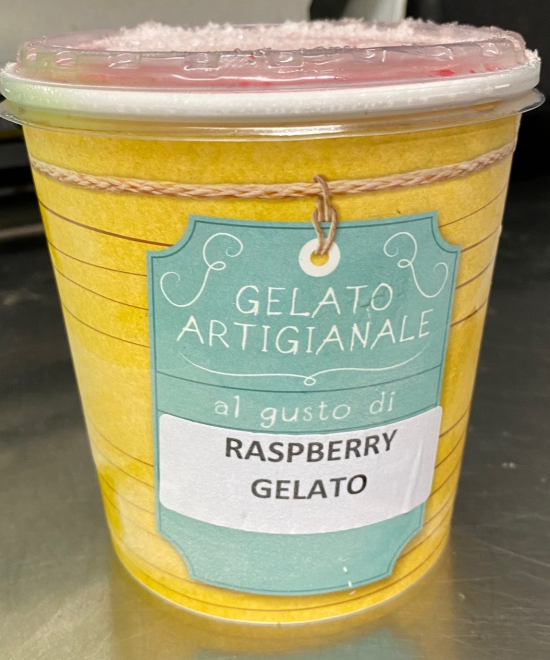
Canada – Gelato Artigianale al gusto di Raspberry Gelato recalled due to possible Norovirus contamination of raspberries used in product

CFIA

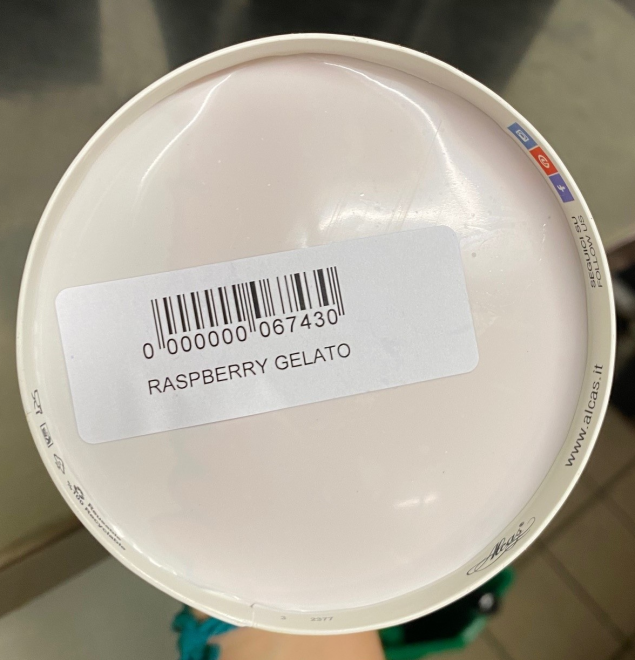
None – Gelato Artigianale al gusto di Raspberry Gelato - 1 L None – Gelato Artigianale al gusto di Raspberry Gelato - 1 L (label)

Summary

Product
Gelato Artigianale al gusto di Raspberry Gelato
Issue
Food – Microbial Contamination – Norovirus
What to do

Do not consume, use, sell, serve, or distribute recalled products

Affected products

The affected product is being recalled from the marketplace due to possible norovirus contamination of the raspberries used in this product.

The recalled product has been sold at Angelo’s Italian Market Inc. (London, ON).

What you should do

  • If you think you became sick from consuming a recalled product, contact your healthcare provider
  • Check to see if you have recalled products
  • Do not consume, serve, use, sell, or distribute recalled products
  • Recalled products should be thrown out or returned to the location where they were purchased

People with norovirus illness usually develop symptoms of gastroenteritis within 24 to 48 hours, but symptoms can start as early as 12 hours after exposure. The illness often begins suddenly. Even after having the illness, you can still become re-infected by norovirus. The main symptoms of norovirus illness are diarrhea, vomiting (children usually experience more vomiting than adults), nausea and stomach cramps. Other symptoms may include low-grade fever, headache, chills, muscle aches and fatigue (a general sense of tiredness). Most people feel better within one or two days, with symptoms resolving on their own, and experience no long-term health effects. As with any illness causing diarrhea or vomiting, people who are ill should drink plenty of liquids to replace lost body fluids and prevent dehydration. In severe cases, patients may need to be hospitalized and given fluids intravenously.

UK – Sainsbury’s recalls by Sainsbury’s Cooked and Peeled Frozen Large King Prawns because of possible presence of undercooked prawns

FSA

Sainbury’s is recalling by Sainsbury’s Cooked and Peeled Frozen Large King Prawns because of possible presence of undercooked prawns. The possible presence of undercooked prawns may make this product unsafe to eat.

Product details

by Sainsbury’s Cooked and Peeled Frozen Large King Prawns
Pack size 180g
Best before May 2023, June 2023, July 2023, August 2023, September 2023, and October 2023
by Sainsbury’s Cooked and Peeled Frozen Large King Prawns
Pack size 400g
Best before May 2023, June 2023, July 2023, August 2023, September 2023, and October 2023

Risk statement

The possible presence of undercooked prawns may make this product unsafe to eat.

Action taken by the company

Sainsbury’s is recalling the above products. Point of sale notices will be displayed in all retail stores that are selling these products. These notices explain to customers why the products are being recalled and tell them what to do if they have bought the product. Please see the attached notice.

Our advice to consumers

If you have bought any of the above products do not eat them. Instead, return them to the store from where they were bought for a full refund. If you have any questions or concerns, please visit Sainsbury’s website at Sainsburys.co.uk/help or contact their careline on 0800636262.

Research – Risk factors of Shiga toxin-producing Escherichia coli in livestock raised on diversified small-scale farms in California

Cambridge Org

Abstract

The increasing number of diversified small-scale farms (DSSF) that raise outdoor-based livestock in the US reflects growing consumer demand for sustainably-produced food. Diversified farms are small-scale and raise a combination of multiple livestock species and numerous produce varieties.

This 2015-2016 cross-sectional study aimed to describe the unique characteristics of DSSF in California, estimate the prevalence of STEC in livestock and evaluate the association between risk factors and the presence of STEC in livestock, using generalized linear mixed models. STEC prevalence was 13.62% (76/558). Significant variables in the mixed effect logistic regression model included daily maximum temperature (OR = 0.95; CI95%: 0.91-0.98), livestock sample source (cattle (OR = 4.61; CI95%: 1.64-12.96) and sheep (OR = 5.29; CI95%: 1.80-15.51)), multiple species sharing the same barn (OR = 6.23; CI95%: 1.84-21.15) and livestock having contact with wild areas (OR = 3.63; CI95%: 1.37-9.62).

Identification of STEC serogroups of public health concern (e.g., O157:H7, O26, O103) in this study indicated the need for mitigation strategies to ensure food safety by evaluating risk factors and management practices that contribute to the spread and prevalence of foodborne pathogens in a pre-harvest environment on DSSF.

USA -Fish and Fishery Products Hazards and Controls

FDA

This guidance represents the agency’s current thinking on the hazards associated with fish and fishery products and appropriate controls for those hazards. It does not create or confer any rights for or on any person and does not operate to bind FDA or the public. An alternative approach may be used if such approach satisfies the requirements of the applicable statute and regulations.

How to Report Seafood-Related Toxin and Scombrotoxin Fish Poisoning Illnesses

To help FDA effectively investigate, remove unsafe seafood products from the market, and develop new prevention strategies, the FDA relies on illness reporting from public health officials and healthcare providers.

U.S. Department of Health and Human Services
Food and Drug Administration
Center for Food Safety and Applied Nutrition
(240) 402-2300
SeafoodHACCP@fda.gov

This guidance is intended to assist processors of fish and fishery products in the development of their Hazard Analysis Critical Control Point (HACCP) plans. Processors of fish and fishery products will find information in this guidance that will help them identify hazards that are associated with their products, and help them formulate control strategies. The guidance will help consumers and the public generally to understand commercial seafood safety in terms of hazards and their controls. The guidance does not specifically address safe handling practices by consumers or by retail establishments, although many of the concepts contained in this guidance are applicable to both. This guidance is also intended to serve as a tool to be used by federal and state regulatory officials in the evaluation of HACCP plans for fish and fishery products.

Items Available


Introductory Video

Transcript of Video   |   Help with CaptionsExternal Link Disclaimer


Seafood HACCP Video Series

The FDA has developed a Seafood HACCP Video Series, designed to help the seafood industry and federal and state regulators better understand specific concepts described in FDA’s Fish and Fishery Products Hazards and Controls Guidance. The series consists of 6 videos covering the following topics: Time-Temperature Indicators, Time and Temperature Controls during Unrefrigerated Processing, Secondary Processor Receiving and Storage Controls, Heat Process Validation, Primary Processor Scombrotoxin Controls – Overview and Testing at Receiving, and Primary Processor Scombrotoxin Controls – Harvest Vessel Records.


Download the Guidance

June 2022

This guidance represents the agency’s current thinking on the hazards associated with fish and fishery products and appropriate controls for those hazards. It does not create or confer any rights for or on any person and does not operate to bind FDA or the public. An alternative approach may be used if such approach satisfies the requirements of the applicable statute and regulations.

Note: This document was corrected on August 3, 2011. The Agency corrected a typographical error appearing in the April 2011 version of this document. The Agency corrected “15%” to “1.5%” so that the sentence in “Chapter 11: Aquaculture Drugs” now reads “Sodium sulfite Used in a 1.5% solution for 5 to 8 minutes to treat eggs in order to improve their hatchability.”

Errata: Corrections and Omissions (PDF – 67KB)

USA – Outbreak Investigation of Hepatitis A Virus: Strawberries (May 2022)

FDA

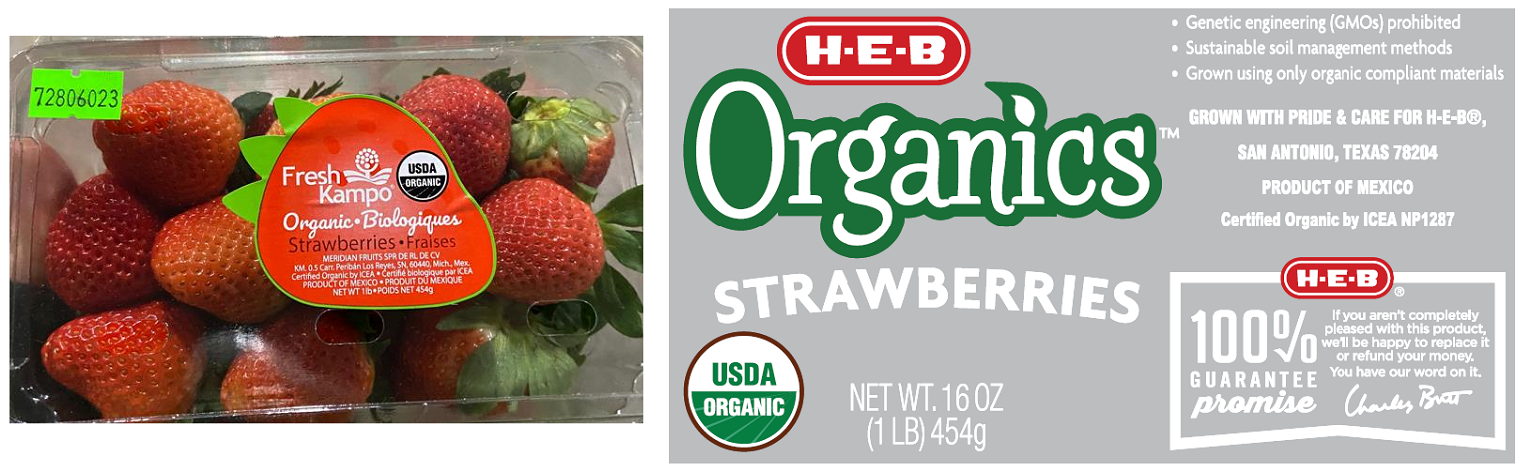
The FDA, along with CDC, and state and local partners, is investigating a multistate outbreak of hepatitis A infections in the United States linked to fresh organic strawberries. These potentially contaminated strawberries were imported from Baja California, a state in northern Mexico, and branded as FreshKampo and HEB by a common supplier; they were purchased between March 5, 2022, and April 15, 2022. The Public Health Agency of CanadaExternal Link Disclaimer and the Canadian Food Inspection AgencyExternal Link Disclaimer are also investigating an outbreak of hepatitis A. Imported FreshKampo brand fresh organic strawberries have been identified as the likely source of the outbreak in Canada.

Currently, these imported fresh organic strawberries are past shelf life and are not available for purchase in stores. People who purchased these fresh organic strawberries between March 5, 2022, and April 15, 2022, and then froze those strawberries for later consumption, should not eat them. If you are unsure of what brand you purchased, when you purchased your strawberries, or where you purchased them from prior to freezing them, the strawberries should be thrown away.

The downstream product removal conducted by Urban Remedy and reported on June 10, 2022, is now considered a market withdrawal. It has been determined that the product was not made using implicated strawberries.

This investigation is ongoing and this advisory will be updated as more information becomes available.

Recommendation

Consumers, restaurants, and retailers should not sell, serve, or eat any fresh organic strawberries branded as FreshKampo or HEB if purchased between March 5, 2022, and April 15, 2022. People who purchased the fresh strawberries and then froze those strawberries for later consumption should not eat them. They should be thrown away. Currently, the potentially contaminated product is past its shelf life. If you are unsure of what brand you purchased, when you purchased your strawberries, or where you purchased them from prior to freezing them, the strawberries should be thrown away.

If consumers purchased fresh organic strawberries branded as FreshKampo or HEB between March 5, 2022, and April 15, 2022, ate those berries in the last two weeks, and have not been vaccinated against hepatitis A, they should immediately consult with their healthcare professional to determine whether post exposure prophylaxis (PEP) is needed. PEP is recommended for unvaccinated people who have been exposed to hepatitis A virus in the last two weeks because vaccination can prevent a hepatitis A infection if given within 14 days of exposure. Those with evidence of previous hepatitis A vaccination or previous hepatitis A infection do not require PEP.

Contact your healthcare provider if you think you may have symptoms of a hepatitis A infection after eating these fresh organic strawberries, or if you believe that you have eaten these strawberries in the last two weeks.

Product Images

Outbreak Investigation of Hepatitis A Virus: Strawberries (May 2022) - Sample Product Images

Case Counts

Total U.S. Illnesses: 18 (including 1 probable case)
Hospitalizations: 13 (including 1 probable case)
Deaths: 0
Last illness onset: May 6, 2022
States with Cases: CA (16), MN (1), ND (1)
Product Distribution: Nationwide

USA – Outbreak Investigation of Salmonella: Peanut Butter (May 2022)

FDA

The FDA, along with CDC and state and local partners, are investigating a multistate outbreak of Salmonella Senftenberg infections linked to certain Jif brand peanut butter products produced at the J.M. Smucker Company facility in Lexington, Kentucky.

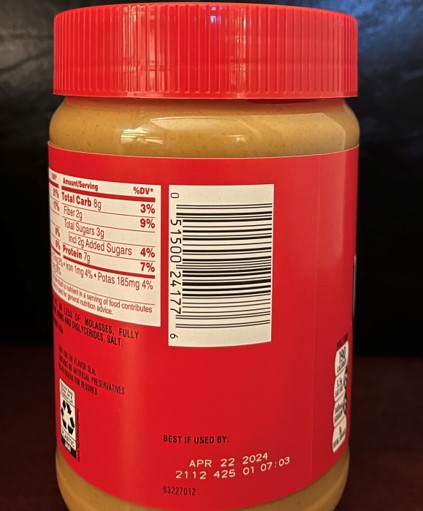
J.M. Smucker Company has voluntarily recalled certain Jif brand peanut butter products that have the lot codes described below. Photo examples are included below.

FDA has posted a list of additional recalls being conducted by companies that have used the recalled Jif peanut butter as an ingredient in the manufacturing of a new product (e.g., chocolate products) or in repackaging the product (e.g., snack cups). This list will be updated as the agency receives notification of new recalls.

In addition, USDA has issued a recall on ready-to-eat Super Asian Chicken Salads that were made with recalled Jif peanut butter and sold at an Amazon Go retail location in Washington state.

As of May 25, 2022, CDC reports that of the 10 people interviewed, 10 (100%) reported eating peanut butter prior to becoming ill. Nine people reported brand information, and all nine (100%) reported eating different varieties of Jif brand peanut butter.

FDA’s investigation is ongoing and more information will be provided as it becomes available.

Recommendation

Consumers, restaurants, and retailers should not eat, sell, or serve any recalled Jif brand peanut butter, including recalled products that contain the recalled Jif peanut butter. Consumers should also avoid feeding recalled peanut butter to pets or other animals, including wild birds.

For Consumers

Follow these steps:

  1. Check if you have Jif peanut butter in your home.
  2. Locate the lot code on the back of the jar, under the Best If Used By Date (the lot code may be next to the Best If Used By Date for cups or squeeze pouches).
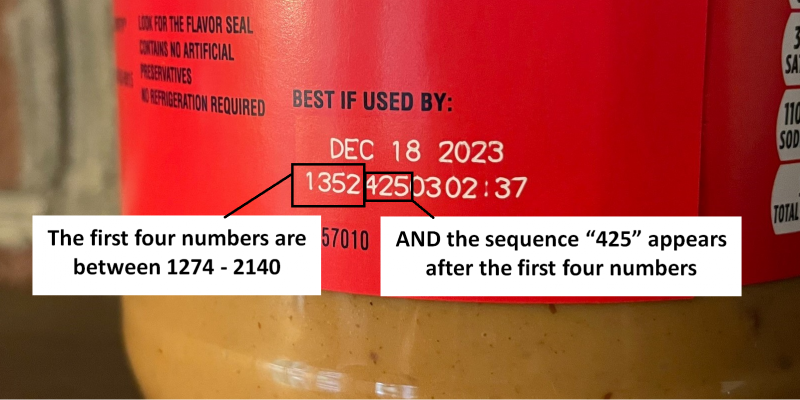
  3. In the lot code, if the first four digits are between 1274 and 2140, and if the next three numbers after that are ‘425’, this product has been recalled and you should not consume this product. An example is below.

If you are unsure what to do with your recalled product, you can call or email J.M. Smucker Company for more information:

The J.M. Smucker Co. Hotline: 800-828-9980
Website: jif.com/contact-usExternal Link Disclaimer

FDA recommends that if you have used the recalled Jif brand peanut butter that have lot code numbers 1274425 through 2140425 and the first seven digits end with 425, you should wash and sanitize surfaces and utensils that could have touched the peanut butter. If you or someone in your household ate this peanut butter and have symptoms of salmonellosis, please contact your healthcare provider.

For Retailers, Re-packers, and Manufacturers

In addition to the steps above, FDA recommends referring to the firm’s recall press for the UPC codes and other retailer information. Do not sell or serve recalled peanut butter or products containing recalled peanut butter.

Product Images

Outbreak Investigation of Salmonella in Peanut Butter (May 2022) - Sample Recalled Product Label
Outbreak Investigation of Salmonella in Peanut Butter (May 2022) - Sample Label

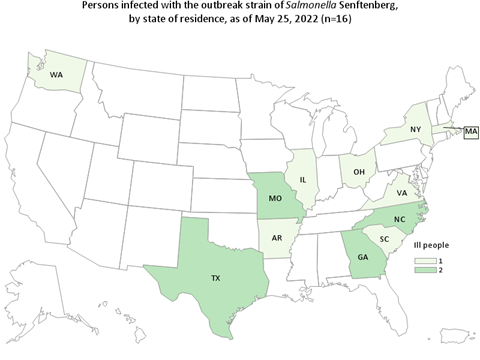
Case Count Map Provided by CDC

Outbreak Investigation of Salmonella in Peanut Butter (May 2022) - CDC Case Count Map as of May 25, 2022

Case Counts

Total Illnesses: 16
Hospitalizations: 2
Deaths: 0
Last Illness Onset: May 2, 2022
States with Cases: AR (1), GA (2), IL (1), MA (1), MO (2), OH (1), NC (2), NY (1), SC (1), TX (2), VA (1), WA (1)
Product Distribution: Nationwide and International (see below)

International Distribution for Recalled Products

The recall impacts markets outside of the U.S.

Customer information provided by J.M. Smucker on May 23, 2022 shows that it was distributed to the following countries and locations: Canada, Dominican Republic, Singapore, Malaysia, Taiwan, Korea, Thailand, Honduras, Spain, Japan.

For additional information, international officials and customers can visit the company’s recall page.

Cambodia – Food safety on radar as law takes effect

Phnom Penh Post

Thol Sreyleak, 35, is a resident of O’Bek Ka’am commune of Phnom Penh’s Sen Sok district. The last time she got food poisoning was in May and it was so severe she was admitted to hospital. The experience made her family of four start thinking about making their diet safer as this was the third time Sreyleak had suffered from food poisoning.

The food poisoning incidents took a lot of time away from her daily business, so Sreyleak and her family to decided to join a project to find organic and safe vegetables at the market.

“I was poisoned and had to be hospitalised. The first time was cauliflower poisoning, the second was soybean poisoning and the last was durian poisoning. In the case of durian poisoning, I had abdominal pain, diarrhoea and vomiting until I was hospitalised and I spent $140,” she said.

After her experiences with poisoning, she worried about her health. What makes it even more difficult for her is that her stomach and intestines are weak to begin with and she would feel the pain immediately if she ate bad vegetables or fruits.

“Every day I have to eat very carefully. I’m really worried because foods [recognised as safe] are expensive. I do not know if there is any food that I can eat that isn’t harmful to my health. If I want safe foods, I have to go to markets selling naturally-grown produce, but the cost is high compared to my daily income and it is not affordable,” she said.

Due to concerns about the impact that food safety was having on people’s health in the country, the government has enacted legislation like the law on food safety and the law on plant protection and phytosanitation.

On June 8, the Law on Food Safety was promulgated by King Norodom Sihamoni after sailing through the National Assembly on May 11 and the Senate on May 18.

Consisting of 11 chapters and 43 articles, the law applies to food quality and safety management that covers all stages of the food production chain and food businesses in Cambodia.

The law sets out the framework and mechanisms for managing and ensuring the safety, quality, hygiene and legitimacy of food at all stages of the food production chain in order to provide health protection and food safety to consumers, ensuring an honest and healthy food trade.

Pen Sovicheat, undersecretary of state and spokesman for the Ministry of Commerce, said that market and street vendors were one of the ministry’s targets for promoting good hygiene and better quality to attract tourists.

The ministry considers promoting the sale of foods in the markets and on the streets that is hygienic, safe and of high-quality as the main priority.

Belgium – Cordon Bleu with peas and carrots – Salmonella

AFSCA

Recall of Natuurvlees Dobbelaere
Products: Cordon Bleu & Dish of the day “Cordon Bleu with peas and carrots” from the Dobio brand.
Problem: Possible presence of Salmonella.

In agreement with the FASFC, Natuurvlees Dobbelaere is withdrawing the “Cordon Bleu” products (lot 2223760006) and the dish of the day “Cordon Bleu with peas and carrots” (lot 2224100020) from the Dobi o brand from sale and recalling them from consumers due to the possible presence of Salmonella.

Natuurvlees Dobbelaere asks its customers not to consume these products and to return them to the point of sale where they were purchased.

Description of products
– Product names: Cordon Bleu + Dish of the day cordon bleu with peas and carrots
– Brand: Dobio
– Batches and expiry dates (DLC):
         o Cordon Bleu: 2223700006 and DLC 20/06/2022
         o Dish of the day cordon bleu: 2224100020 and DLC 06/24/2022
– Sales period: from 06/13/2022 to 06/24/2022
– Type of packaging: transparent plastic jar
– Weight:
         o Cordon Bleu: 0.4 kg
         o Dish of the day cordon bleu: 0.6 kg

The products were sold via:
– Supermarkt Herne – Lindestraat 53 1540 Herne
– Supermarkt Moerkerke – Vissersstraat 82, 8340 Damme
– Roma Naaz – Grotesteenweg 662, 2600 Berchem
– De kruideniershoek – Grote steenweg 60, 3350 Linter

For further information , contact:
Mr. Koen Gevaert or Mrs. Alexandra Ackaert – kwaliteit@natuurvleesdobbelaere.beor 050 500 542.